Frequent itemset generation using Vertical data format
Consider the following dataset of 5 transactions of supermarket.
TID Items
1. Bread, Milk
2. Beer, Bread, Diaper, Eggs
3. Beer, Coke, Diaper, Milk
4. Beer, Bread, Diaper, Milk
5. Bread, Coke, Diaper, Milk
Illustrate Frequent itemset generation using Vertical data format (Minimum
Support = 2)
Homework Answers
Request Answer!
We need at least 10 more requests to produce the answer.
0 / 10 have requested this problem solution
The more requests, the faster the answer.
3112 1617 Q4 Q4 (4 marks) (a) What is machine learning? (b) Discuss the difference between classification and clustering. Give one example algorithm (6 marks) for classification and clustering r...
 3112 1617 Q4
Q4 (4 marks) (a) What is machine learning? (b) Discuss the difference between classification and clustering. Give one example algorithm (6 marks) for classification and clustering respectively For Q4(c)-Q4(f, consider the figure below which shows the examples (instances) with different Yellow Red Purple Orange Height Blue Red Violet Green Width (c) Is k-Nearest Neighbors (KNN) a classification method or clustering method? mark) (d) What is the outcome of KNN for the query point based on I-nearest neighbor?...
3112 1617 Q4
Q4 (4 marks) (a) What is machine learning? (b) Discuss the difference between classification and clustering. Give one example algorithm (6 marks) for classification and clustering respectively For Q4(c)-Q4(f, consider the figure below which shows the examples (instances) with different Yellow Red Purple Orange Height Blue Red Violet Green Width (c) Is k-Nearest Neighbors (KNN) a classification method or clustering method? mark) (d) What is the outcome of KNN for the query point based on I-nearest neighbor?...
Using the FP growth algorithm generate frequent patterns within the following dataset (use min_sup = 3)....
Using the FP growth algorithm generate frequent patterns within the following dataset (use min_sup = 3). TID Itemsets 1 Sausage, Milk, Bread, Yogurt, Beer 2 Milk, Beer, Juice 3 Milk, Bread, Juice 4 Soda, Sausage, Yogurt, Bread 5 Sausage, Milk, Bread, Fruit, Beer 6 Vegetable, Yogurt, Butter, Fruit, Milk 7 Sausage, Vegetable, Butter, Juice 8 Milk, Yogurt, Bread
Based on the market basket transactions data given below, calculate the support and confidence values of...
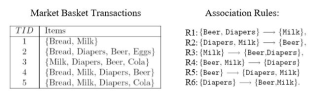 Based on the market basket transactions data given below,
calculate the support and confidence values of the association
rules R1 through R6. Discuss your observations of the calculation
results.
Market Basket Transactions Association Rules: TID 0910 Items {Bread, Milk} {Bread, Diapers, Beer, Eggs {Milk, Diapers, Beer, Cola {Bread, Milk, Diapers, Beer} Bread, Milk, Diapers, Cola} R1: {Beer, Diapers — {Milk}, R2:{Diapers, Milk} — {Beer}, R3: {Milk) {Beer Diapers}, R4: {Beer, Milk} — {Diapers) R5: {Beer) — Diapers, Milk R6:{Diapers) —...
Based on the market basket transactions data given below,
calculate the support and confidence values of the association
rules R1 through R6. Discuss your observations of the calculation
results.
Market Basket Transactions Association Rules: TID 0910 Items {Bread, Milk} {Bread, Diapers, Beer, Eggs {Milk, Diapers, Beer, Cola {Bread, Milk, Diapers, Beer} Bread, Milk, Diapers, Cola} R1: {Beer, Diapers — {Milk}, R2:{Diapers, Milk} — {Beer}, R3: {Milk) {Beer Diapers}, R4: {Beer, Milk} — {Diapers) R5: {Beer) — Diapers, Milk R6:{Diapers) —...
By applying the Apriori algorithm to the dataset in the table below: 10 Beer, Nuts, Diapers...
By applying the Apriori algorithm to the dataset in the table below: 10 Beer, Nuts, Diapers 20 Beer, Coffee, Diapers 30 Beer, Diapers, Eggs, Milk 40 Nuts, Eggs, Milk 50 Beer, Coffee, Milk 60 Diapers, Eggs, Milk 70 Beer, Coffee, Diapers 80 Beer, Nuts, Coffee, Diapers, Eggs, Milk where the minimum support for frequent patterns set at 3, the set of three items frequent itemsets, L3 is: Group of answer choices 1. L3 = {{Beer, Diapers, Milk}} 2. L3 =...
Use the set of the frequent item sequences to generate sequential rules (No need to generate...
Use the set of the frequent item sequences to generate sequential rules (No need to generate the frequent item sequences!). For each rule, calculate the support and the confidence. Here is an example: consider the rule the frequent itemset <{ Eggs },{Tomatoes},{Vinegar}>. From this itemset we can create a sequential rule <{ Eggs },{Tomatoes}> -> <{Vinegar}> which says that if a customer bought Eggs and Tomatoes already, they are likely to buy Vinegar at a later time. Remember, the order...
Consider the dataset in the table below: 10 Beer, Nuts, Milk 20 Beer, Coffee, Diapers 30...
Consider the dataset in the table below: 10 Beer, Nuts, Milk 20 Beer, Coffee, Diapers 30 Beer, Diapers, Eggs, Milk 40 Nuts, Eggs, Milk 50 Beer, Coffee, Milk 60 Diapers, Eggs, Milk 70 Beer, Coffee, Diapers, Eggs 80 Beer, Nuts, Coffee, Diapers, Eggs, Milk and the itemsets with minimum support of 3: {Beer, Diapers, Eggs}. Considering a minimum confidence threshold of 75%, which of the following association rules qualify as strong? Group of answer choices (Select all that apply) 1....
Apply the Apriori algorithm to the following data set: Trans Id Item Purchased 101 milk, bread,...
Apply the Apriori algorithm to the following data set: Trans Id Item Purchased 101 milk, bread, eggs 102 milk, juice 103 juice, butter 104 milk, bread, eggs 105 coffee, eggs 106 coffee 107 coffee, juice 108 milk, bread, cookies, eggs 109 cookies, butter 110 milk, bread The set of items is {milk, bread, cookies, eggs, butter, coffee, juice}. Use 2 for the minimum support value.
1. Apply the Apriori Algorithm Tasks: Apply the Apriori Algorithm to the following data set: Trans...
 1. Apply the Apriori Algorithm Tasks: Apply the Apriori Algorithm to the following data set: Trans ID Items Purchased 101 milk, bread, eggs 102 milk, juice 103 juice, butter 104 milk, bread, eggs 105 coffee, eggs 106 coffee 107 coffee, juice 108 milk, bread, cookies, eggs 109 cookies, butter 110 milk, bread The set of items is {milk, bread, cookies, eggs, butter, coffee, juice). Use 2 for the minimum support value. You must show all candidate and large itemsets during the process: C., L, C2, L2 etc. until the algorithm terminates.
This question is for frequent pattern mining algorithm Apriori and closed pattern mining algorithm like CLOSET....
This question is for frequent pattern mining algorithm Apriori and closed pattern mining algorithm like CLOSET. Implement Apriori algorithm to mine frequent pattern from a transaction dataset Implement an algorithm to mine closed frequent pattern from the same dataset. You can either write a code to extract closed patterns from the result that you got in Part 1 or code CLOSET. Input Format The input dataset is a transaction dataset. The first line of the input corresponds to the minimum...
(1)A database has five transactions (T100 to T500) as shown in the table below. Let min sup-3 and...
 (1)A database has five transactions (T100 to T500) as shown in the table below. Let min sup-3 and mi-conf-8090. TID T100 M, O, N, K, E, Y T200 D, O, N, K, E, Y ) T300{M, A, K, E) T400 M, U, C, K, Y) T500 | {C, О. О. К. 1 ,E) items bought Find all the frequent itemset晜using Apriori algorithm. You must show the contents of Ck and Lk tables in each step (please refer to your lecture...
 3112 1617 Q4
Q4 (4 marks) (a) What is machine learning? (b) Discuss the difference between classification and clustering. Give one example algorithm (6 marks) for classification and clustering respectively For Q4(c)-Q4(f, consider the figure below which shows the examples (instances) with different Yellow Red Purple Orange Height Blue Red Violet Green Width (c) Is k-Nearest Neighbors (KNN) a classification method or clustering method? mark) (d) What is the outcome of KNN for the query point based on I-nearest neighbor?...
3112 1617 Q4
Q4 (4 marks) (a) What is machine learning? (b) Discuss the difference between classification and clustering. Give one example algorithm (6 marks) for classification and clustering respectively For Q4(c)-Q4(f, consider the figure below which shows the examples (instances) with different Yellow Red Purple Orange Height Blue Red Violet Green Width (c) Is k-Nearest Neighbors (KNN) a classification method or clustering method? mark) (d) What is the outcome of KNN for the query point based on I-nearest neighbor?...
 Based on the market basket transactions data given below,
calculate the support and confidence values of the association
rules R1 through R6. Discuss your observations of the calculation
results.
Market Basket Transactions Association Rules: TID 0910 Items {Bread, Milk} {Bread, Diapers, Beer, Eggs {Milk, Diapers, Beer, Cola {Bread, Milk, Diapers, Beer} Bread, Milk, Diapers, Cola} R1: {Beer, Diapers — {Milk}, R2:{Diapers, Milk} — {Beer}, R3: {Milk) {Beer Diapers}, R4: {Beer, Milk} — {Diapers) R5: {Beer) — Diapers, Milk R6:{Diapers) —...
Based on the market basket transactions data given below,
calculate the support and confidence values of the association
rules R1 through R6. Discuss your observations of the calculation
results.
Market Basket Transactions Association Rules: TID 0910 Items {Bread, Milk} {Bread, Diapers, Beer, Eggs {Milk, Diapers, Beer, Cola {Bread, Milk, Diapers, Beer} Bread, Milk, Diapers, Cola} R1: {Beer, Diapers — {Milk}, R2:{Diapers, Milk} — {Beer}, R3: {Milk) {Beer Diapers}, R4: {Beer, Milk} — {Diapers) R5: {Beer) — Diapers, Milk R6:{Diapers) —...
 1. Apply the Apriori Algorithm Tasks: Apply the Apriori Algorithm to the following data set: Trans ID Items Purchased 101 milk, bread, eggs 102 milk, juice 103 juice, butter 104 milk, bread, eggs 105 coffee, eggs 106 coffee 107 coffee, juice 108 milk, bread, cookies, eggs 109 cookies, butter 110 milk, bread The set of items is {milk, bread, cookies, eggs, butter, coffee, juice). Use 2 for the minimum support value. You must show all candidate and large itemsets during the process: C., L, C2, L2 etc. until the algorithm terminates.
 (1)A database has five transactions (T100 to T500) as shown in the table below. Let min sup-3 and mi-conf-8090. TID T100 M, O, N, K, E, Y T200 D, O, N, K, E, Y ) T300{M, A, K, E) T400 M, U, C, K, Y) T500 | {C, О. О. К. 1 ,E) items bought Find all the frequent itemset晜using Apriori algorithm. You must show the contents of Ck and Lk tables in each step (please refer to your lecture...
Most questions answered within 3 hours.
-
Where is the error in this code sequence?
String s1 = "Hello";
String s2 = "ello";...
asked 10 months ago -
Financial data for Joel de Paris, Inc., for last year
follow:
Joel de Paris, Inc.
Balance...
asked 10 months ago -
Consider this reaction:
Al2(SO4)3 (aq)+ BaCl3
(aq) Al2Cl6 (aq)- +
3BaSO4(s) . What is the...
asked 10 months ago -
Suppose that Savneet is considering increasing her
recent random sample from 20 car rentals to 40...
asked 10 months ago -
Trucks arrive at an unloading terminal at an average rate of 120
per hour.
Trucks arrive...
asked 10 months ago -
Why are methanol and ethanol completely soluble in water while
octanol is not very little soluble....
asked 10 months ago -
A facilities manager at a university reads in a research report
that the mean amount of...
asked 10 months ago -
When the CuSO4 is rehydrated by adding water to the anhydrous
compound, is this an endothermic...
asked 10 months ago -
A ray of sunlight is passing from diamond into crown glass; the
angle of incidence is...
asked 10 months ago -
A block of mass 0.249 kg is placed on top of a light, vertical
spring of...
asked 10 months ago -
how do the kidneys compensate in the presences of acidosis
a) trigger hyperventilate
b) reserve acid...
asked 10 months ago -
Question 501 pts
The rental rate of capital to the firm increases. Which of the
following...
asked 10 months ago