
Homework Answers
Ans)- Given A & B are mutually exclusive events, and two is said to be mutually exclusive iff

P(A) = 32/100, P(B)=84/100
So,

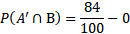

Hence, the required probability is 84/100.
Add Answer to:
Question 7 A, B and C are three events, such that: - A and Care independent;...
Question 11 5 pts Let A, B and C be three non-empty events defined on a...
 Question 11 5 pts Let A, B and C be three non-empty events defined on a sample space 12. Furthermore, suppose that • B and Care mutually exclusive, • A and B are independent and • A and C are independent. Show that P (BUC | A) = P (BUC)
In a sample space, events A and B are independent, events B and C are mutually...
In a sample space, events A and B are independent, events B and C are mutually exclusive, and A and C are independent. a) Show that P(AUB) = P(B) + P(A)P(B') = P(A) + P(A')P(B) b) If P(AUBUC) = 0.9, P(B) = 0.5 and P(C) = 0.3 find P(A).
Given the following information about events A, B. and C, determine which pairs of events,if any,...
 Given the following information about events A, B. and C, determine which pairs of events,if any, are independent and which pairs are mutually exclusive. P(A)-0.3 P(BIA) 0.3 P(B)0.5 P(CB) 0.33 P(C) 0.33 P(AIC)-0.33 Select all correct answers. Select all that apply: A and Care mutually exclusive D A and Care independent O Band C are independent 0 Band C are mutually exclusive D Aand B are mutualy exclusive A and B are independ
Question 19 Given the following information about events A, B, and C, determine which pairs of...
Question 19 Given the following information about events A, B, and C, determine which pairs of events, if any, are independent and which pairs are mutually exclusive. P(A)P(B)P(C)=0.26=0.5=0.45P(A|B)P(B|C)P(C|A)=0.26=0=0.26 Select all correct answers. Select all that apply: B and C are independent A and C are mutually exclusive A and B are independent A and C are independent B and C are mutually exclusive A and B are mutually exclusive
11)IfA, B and Care mutually exclusive and exhaustive events and P(A)= P (B)= P(C, find P (A), P (B) and P (C)
11)IfA, B and Care mutually exclusive and exhaustive events andP(A)= P (B)= P(C, find P (A), P (B) and P (C)
Question 4 You are given the following information on Events A, B, C, and D. P(A)...
Question 4 You are given the following information on Events A, B, C, and D. P(A) = .5 P(B) = .3 P (C) = .15 P(A U D) = .7 P(A ∩ C) = 0.05 P (A │B) = 0.22 P (A ∩ D) = 0.25 Compute P(D). Compute P(A ∩ B). Compute P(A | C). Compute the probability of the complement of C. What does it mean to be mutually exclusive? Give an example of two events that are...
. Events A and C are mutually exclusive, and Events A and B are independent. ?(?)...
. Events A and C are mutually exclusive, and Events A and B are independent. ?(?) = 0.1,?(?) = 0.3, and ?(?) = .45. Calculate the following probabilities: a. ?(? AND ?) b. ?(?|?) c. ?(? AND ?)
Chapter 3 3.2 Independent and Mutually Exclusive Events 40. E and Fare mutually exclusive events. P(E)-0.4;...
 Chapter 3 3.2 Independent and Mutually Exclusive Events 40. E and Fare mutually exclusive events. P(E)-0.4; P(F) 0.5. Find P(E1F) 41.J and Kare independent events. PUlK) 0.3. Find PC) 42. Uand V are mutually exclusive events. P(U) 0.26; P(V)-0.37. Find: a. P(U AND V)= 43.Q and R are independent events. PQ) 0.4 and P(Q AND R) 0.1. Find P 3.3 Two Basic Rules of Probability Use the following information to answer the next ten exercises Forty-eight perc Californians registered voters...
Explain when will two events be independent and when will two events be mutually exclusive. Can...
Explain when will two events be independent and when will two events be mutually exclusive. Can two mutually exclusive events be independent also? Can two independent events be mutually exclusive? Suppose the experiment is roll two dice. Consider events E= both numbers are even. F = both numbers are odd, Are E and F mutually exclusive? Are they independent? Consider events U and V. U= the first number is even, V= the second number is even. Are U and V mutually...
In parts (a) and (b), identify whether the events are mutually exclusive, independent, or neither (events...
 In parts (a) and (b), identify whether the events are mutually exclusive, independent, or neither (events cannot be both mutually exclusive and independent). a) You and a randomly selected student from your class both earn A's in this course. neither independent mutually exclusive b) You and your class partner both earn A's in this course. neither mutually exclusive independent c) If two events can occur at the same time, they must be independent. false true
 Question 11 5 pts Let A, B and C be three non-empty events defined on a sample space 12. Furthermore, suppose that • B and Care mutually exclusive, • A and B are independent and • A and C are independent. Show that P (BUC | A) = P (BUC)
 Given the following information about events A, B. and C, determine which pairs of events,if any, are independent and which pairs are mutually exclusive. P(A)-0.3 P(BIA) 0.3 P(B)0.5 P(CB) 0.33 P(C) 0.33 P(AIC)-0.33 Select all correct answers. Select all that apply: A and Care mutually exclusive D A and Care independent O Band C are independent 0 Band C are mutually exclusive D Aand B are mutualy exclusive A and B are independ
 Chapter 3 3.2 Independent and Mutually Exclusive Events 40. E and Fare mutually exclusive events. P(E)-0.4; P(F) 0.5. Find P(E1F) 41.J and Kare independent events. PUlK) 0.3. Find PC) 42. Uand V are mutually exclusive events. P(U) 0.26; P(V)-0.37. Find: a. P(U AND V)= 43.Q and R are independent events. PQ) 0.4 and P(Q AND R) 0.1. Find P 3.3 Two Basic Rules of Probability Use the following information to answer the next ten exercises Forty-eight perc Californians registered voters...
 In parts (a) and (b), identify whether the events are mutually exclusive, independent, or neither (events cannot be both mutually exclusive and independent). a) You and a randomly selected student from your class both earn A's in this course. neither independent mutually exclusive b) You and your class partner both earn A's in this course. neither mutually exclusive independent c) If two events can occur at the same time, they must be independent. false true
Most questions answered within 3 hours.
-
Where is the error in this code sequence?
String s1 = "Hello";
String s2 = "ello";...
asked 10 months ago -
Financial data for Joel de Paris, Inc., for last year
follow:
Joel de Paris, Inc.
Balance...
asked 10 months ago -
Consider this reaction:
Al2(SO4)3 (aq)+ BaCl3
(aq) Al2Cl6 (aq)- +
3BaSO4(s) . What is the...
asked 10 months ago -
Suppose that Savneet is considering increasing her
recent random sample from 20 car rentals to 40...
asked 10 months ago -
Trucks arrive at an unloading terminal at an average rate of 120
per hour.
Trucks arrive...
asked 10 months ago -
Why are methanol and ethanol completely soluble in water while
octanol is not very little soluble....
asked 10 months ago -
A facilities manager at a university reads in a research report
that the mean amount of...
asked 10 months ago -
When the CuSO4 is rehydrated by adding water to the anhydrous
compound, is this an endothermic...
asked 10 months ago -
A ray of sunlight is passing from diamond into crown glass; the
angle of incidence is...
asked 10 months ago -
A block of mass 0.249 kg is placed on top of a light, vertical
spring of...
asked 10 months ago -
how do the kidneys compensate in the presences of acidosis
a) trigger hyperventilate
b) reserve acid...
asked 10 months ago -
Question 501 pts
The rental rate of capital to the firm increases. Which of the
following...
asked 10 months ago