At 31 July 20X6, Helios International had non-current assets which had cost $310,000. At the same...
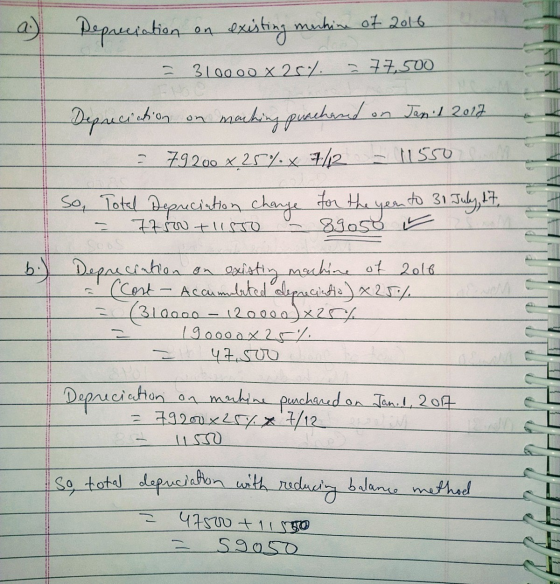
At 31 July 20X6, Helios International had non-current assets which had cost $310,000. At the same date, the accumulated depreciation on the assets was $120,000. The company had not disposed of any non-current assets during the year to 31 July 20X7, but acquired an asset at a cost of $79,200 on 1 January 20X7.
Helios International depreciates non-current assets at a rate of 25% per annum. What is the company’s depreciation charge for the year to 31 July 20X7 using:
a. The straight line method
b. The reducing balance method Assume that depreciation is charged from the first year of acquisition.
(25 marks)
Homework Answers
*** If you are satisfied with the solution, kindly UPVOTE ? this answer. Thank You.
ALL THE BEST
Add Answer to:
At 31 July 20X6, Helios International had non-current assets
which had cost $310,000. At the same...
Question21.16A 21.16A A company maintains its non-current assets at cost. An accumulated provision for deprecia- tion...
 Question21.16A
21.16A A company maintains its non-current assets at cost. An accumulated provision for deprecia- tion account is used for each type of asset. Machinery is to be depreciated at the rate of 15 per cent per annum, and fixtures at the rate of 5 per cent per annum, using the reducing balance method. Depreciation is to be calculated on assets in existence at the end of each year, giving a full year's depreciation even though the asset was bought...
Question21.16A
21.16A A company maintains its non-current assets at cost. An accumulated provision for deprecia- tion account is used for each type of asset. Machinery is to be depreciated at the rate of 15 per cent per annum, and fixtures at the rate of 5 per cent per annum, using the reducing balance method. Depreciation is to be calculated on assets in existence at the end of each year, giving a full year's depreciation even though the asset was bought...
A company depreciates its motor vehicles based on reducing balance method on strict time basis at the rate of 25 per cent per annum on 31 December each year. Depreciation on its plant at the rate of 10 per cent per annum, straight line method with a full
A company depreciates its motor vehicles based on reducing balance method on strict time basis at the rate of 25 per cent per annum on 31 December each year.Depreciation on its plant at the rate of 10 per cent per annum, straight line method with a full year’s depreciation charged in the year of acquisition and none in the year of disposal.The following are the balances of the non-current assets as at 31 December 2015: Motor Vehicles $Original cost 50,000Accumulated depreciation (15,000)Net...
Use the following data to answer questions in this part: Balance sheet data Assets 20X7 20X6...
Use the following data to answer questions in this part: Balance sheet data Assets 20X7 20X6 Cash $2,900 $1,000 Accounts receivable 2,500 2,000 Inventory 7,400 8,000 Property, plant, equipment 9,200 9,000 Accumulated depreciation (2,900) (2,500) Total assets $19,100 $17,500 Liabilities and Equity Accounts payable $4,700 $4,500 Interest payable 1,500 1,000 Dividends payable 1,000 2,500 Long-term debt 4,350 3,700 Bank note 1,000 800 Common stock 3,300 3,000 Retained earnings 3,250 2,000 Total liabilities and equity $19,100 $17,500 Income statement for the...
At 31 December 2016, Jasa Maju Sdn. Bhd. reported the following as non-current assets. Cost Decumulared...
 At 31 December 2016, Jasa Maju Sdn. Bhd. reported the following as non-current assets. Cost Decumulared Accumulated Depreciation RM Land RM Ner Realizable Value RM 210,000 Buildings 280,500 56,100 224,400 Equipment Total non-current assets 84,000 36,000 32.400 466.800 Equipment consists of Equipment A (cost RM6,000, purchased on 1 January 2012), Equipment B (cost RM50,000, purchased on 1 January 2015) and Equipment 3 (cost RM28,000, purchased on 1 January 2015). During 2017, the following selected transactions occurred: July 1 Purchased new...
Use the following data to answer questions in this part: Balance sheet data Assets 20X7 20X6...
Use the following data to answer questions in this part: Balance sheet data Assets 20X7 20X6 Cash $2,900 $1,000 Accounts receivable 2,500 2,000 Inventory 7,400 8,000 Property, plant, equipment 9,200 9,000 Accumulated depreciation (2,900) (2,500) Total assets $19,100 $17,500 Liabilities and Equity Accounts payable $4,700 $4,500 Interest payable 1,500 1,000 Dividends payable 1,000 2,500 Long-term debt 4,350 3,700 Bank note 1,000 800 Common stock 3,300 3,000 Retained earnings 3,250 2,000 Total liabilities and equity $19,100 $17,500 Income statement for the...
During the year to 30 June 20X7, Eugene Ltd sold a non-current asset for $36,000. It...
During the year to 30 June 20X7, Eugene Ltd sold a non-current asset for $36,000. It had been acquired three years ago at a cost of $180,000. At the date of disposal of the asset, the accumulated depreciation was $138,000. What was the profit or loss on disposal, and what journal entries are needed to record the disposal? (25 marks)
Question 3 (15 marks) Busy Bee Enterprises, a manufacturing company, had the following assets recorded in...
 Question 3 (15 marks) Busy Bee Enterprises, a manufacturing company, had the following assets recorded in its books at 31 July 2019: Asset type Date of purchase Cost Depreciation method 1 November 2017 600 000 Manufacturing equipment Straight-line method at 20% per annum Residual value: Nil Furniture 1 December 2018 120 000 Straight-line method at 12.5% per annum Residual value: 10% of initial cost Diminishing balance method at 33% Computer equipment 1 February 2019 60 000 June 88000 During the...
On December 31, 20X7, trial balances for Posey and Stargell appeared as follows: Posey Company Stargell...
 On December 31, 20X7, trial balances for Posey and Stargell appeared as follows: Posey Company Stargell Corporation Item Credit Debit Credit Debit Cash $ $ 39,000 49,500 Current Receivables 121,500 90,100 Inventory 317,000 364,900 Investment in Stargell Stock Investment in Stargell Bonds Investment in Posey Bonds 1,243,800 985,000 200,000 Land 518,000 1,241,000 Buildings and Equipment 1,915,000 2,940,000 Cost of Goods Sold 426,000 1,829,000 Depreciation & Amortization Other Expenses 184,000 65,000 632,000 206,000 51,000 Dividends Declared 61,000 $ $1,050,000 597,000 213,000...
financial reporting
A non-current asset (a machine) was purchased by Lotus plc on 1 July 2020 at a cost of $50,000. The company prepares its annual accounts to 31 March in each year. The policy of the company is to depreciate such assets at the rate of 15% straight line (with depreciation being charged pro rata on a time-apportionment basis in the year of purchase). The company was granted capital allowances at 25% per annum on the reducing balance method (such capital...
Financial position 2016: Machinery = $50,600 Some machinery (a non-current asset), which was bought on 1...
Financial position 2016: Machinery = $50,600 Some machinery (a non-current asset), which was bought on 1 January 2013 for $26,000, has proved to be unsatisfactory. It was part-exchanged for some new machinery on 1 January 2014, and WW Associates paid a cash amount of $12,000. The new machinery would have cost $30,000 had the business bought it without the trade-in. The business uses the reducing-balance method of depreciation for non-current assets at the rate of 30% each year How to...
 Question21.16A
21.16A A company maintains its non-current assets at cost. An accumulated provision for deprecia- tion account is used for each type of asset. Machinery is to be depreciated at the rate of 15 per cent per annum, and fixtures at the rate of 5 per cent per annum, using the reducing balance method. Depreciation is to be calculated on assets in existence at the end of each year, giving a full year's depreciation even though the asset was bought...
Question21.16A
21.16A A company maintains its non-current assets at cost. An accumulated provision for deprecia- tion account is used for each type of asset. Machinery is to be depreciated at the rate of 15 per cent per annum, and fixtures at the rate of 5 per cent per annum, using the reducing balance method. Depreciation is to be calculated on assets in existence at the end of each year, giving a full year's depreciation even though the asset was bought...
 At 31 December 2016, Jasa Maju Sdn. Bhd. reported the following as non-current assets. Cost Decumulared Accumulated Depreciation RM Land RM Ner Realizable Value RM 210,000 Buildings 280,500 56,100 224,400 Equipment Total non-current assets 84,000 36,000 32.400 466.800 Equipment consists of Equipment A (cost RM6,000, purchased on 1 January 2012), Equipment B (cost RM50,000, purchased on 1 January 2015) and Equipment 3 (cost RM28,000, purchased on 1 January 2015). During 2017, the following selected transactions occurred: July 1 Purchased new...
 Question 3 (15 marks) Busy Bee Enterprises, a manufacturing company, had the following assets recorded in its books at 31 July 2019: Asset type Date of purchase Cost Depreciation method 1 November 2017 600 000 Manufacturing equipment Straight-line method at 20% per annum Residual value: Nil Furniture 1 December 2018 120 000 Straight-line method at 12.5% per annum Residual value: 10% of initial cost Diminishing balance method at 33% Computer equipment 1 February 2019 60 000 June 88000 During the...
 On December 31, 20X7, trial balances for Posey and Stargell appeared as follows: Posey Company Stargell Corporation Item Credit Debit Credit Debit Cash $ $ 39,000 49,500 Current Receivables 121,500 90,100 Inventory 317,000 364,900 Investment in Stargell Stock Investment in Stargell Bonds Investment in Posey Bonds 1,243,800 985,000 200,000 Land 518,000 1,241,000 Buildings and Equipment 1,915,000 2,940,000 Cost of Goods Sold 426,000 1,829,000 Depreciation & Amortization Other Expenses 184,000 65,000 632,000 206,000 51,000 Dividends Declared 61,000 $ $1,050,000 597,000 213,000...
Most questions answered within 3 hours.
-
Where is the error in this code sequence?
String s1 = "Hello";
String s2 = "ello";...
asked 11 months ago -
Financial data for Joel de Paris, Inc., for last year
follow:
Joel de Paris, Inc.
Balance...
asked 11 months ago -
Consider this reaction:
Al2(SO4)3 (aq)+ BaCl3
(aq) Al2Cl6 (aq)- +
3BaSO4(s) . What is the...
asked 11 months ago -
Suppose that Savneet is considering increasing her
recent random sample from 20 car rentals to 40...
asked 11 months ago -
Trucks arrive at an unloading terminal at an average rate of 120
per hour.
Trucks arrive...
asked 11 months ago -
Why are methanol and ethanol completely soluble in water while
octanol is not very little soluble....
asked 11 months ago -
A facilities manager at a university reads in a research report
that the mean amount of...
asked 11 months ago -
When the CuSO4 is rehydrated by adding water to the anhydrous
compound, is this an endothermic...
asked 11 months ago -
A ray of sunlight is passing from diamond into crown glass; the
angle of incidence is...
asked 11 months ago -
A block of mass 0.249 kg is placed on top of a light, vertical
spring of...
asked 11 months ago -
how do the kidneys compensate in the presences of acidosis
a) trigger hyperventilate
b) reserve acid...
asked 11 months ago -
Question 501 pts
The rental rate of capital to the firm increases. Which of the
following...
asked 11 months ago