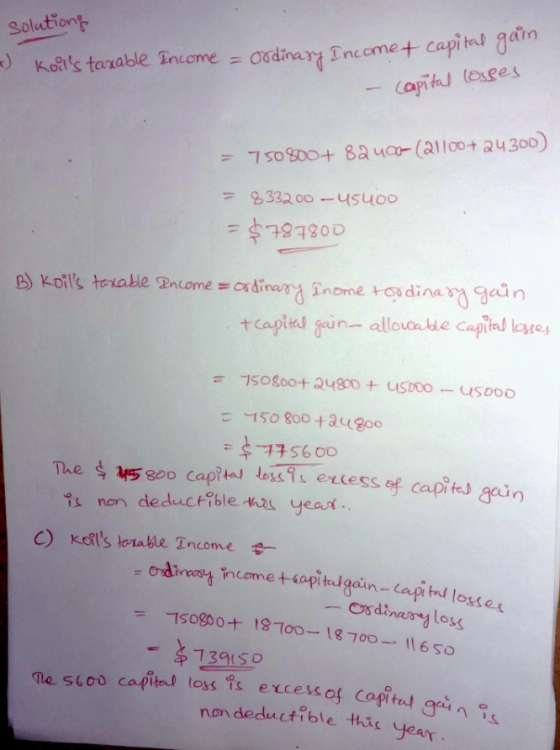
Koil Corporation generated $750,800 ordinary income from the sale of inventory to its customers. It also...
Koil Corporation generated $750,800 ordinary income from the sale of inventory to its customers. It also sold three noninventory assets during the year. Required: Compute Koil’s taxable income assuming that the first sale resulted in a $82,400 capital gain, the second sale resulted in a $21,100 capital loss, and the third sale resulted in a $24,300 capital loss. Compute Koil’s taxable income assuming that the first sale resulted in a $24,800 ordinary gain, the second sale resulted in a $45,000 capital gain, and the third sale resulted in a $90,800 capital loss. Compute Koil’s taxable income assuming that the first sale resulted in a $18,700 capital gain, the second sale resulted in a $24,300 capital loss, and the third sale resulted in an $11,650 ordinary loss.
Homework Answers
Add Answer to:
Koil Corporation generated $750,800 ordinary income from the
sale of inventory to its customers. It also...
Koil Corporation generated $742,000 ordinary income from the sale of inventory to its customers. It also...
Koil Corporation generated $742,000 ordinary income from the sale of inventory to its customers. It also sold three noninventory assets during the year. Compute Koil’s taxable income assuming that: a.The first sale resulted in a $82,800 capital gain, the second sale resulted in a $16,900 capital loss, and the third sale resulted in a $27,900 capital loss. b.The first sale resulted in a $24,600 ordinary gain, the second sale resulted in a $42,750 capital gain, and the third sale resulted...
Zeno Inc. sold two capital assets in 2019. The first sale resulted in a $53,000 capital...
Zeno Inc. sold two capital assets in 2019. The first sale resulted in a $53,000 capital loss, and the second sale resulted in a $25,600 capital gain. Zeno was incorporated in 2015, and its tax records provide the following information: 2015 2016 2017 2018 Ordinary income $443,000 $509,700 $810,300 $921,000 Net capital gain 22,000 0 4,120 13,600 Taxable income $465,000 $509,700 $814,420 $934,600 Compute Zeno’s tax refund from the carryback of its 2019 nondeductible capital loss. Assume Zeno's marginal tax...
This year, Sigma Inc. generated $635,000 income from its routine business operations. In addition, the corporation...
This year, Sigma Inc. generated $635,000 income from its routine business operations. In addition, the corporation sold the following assets, all of which were held for more than 12 months. Initial Basis Acc. Depr.* Sale Price Marketable securities $ 163,200 $ 0 $ 57,000 Production equipment 108,800 87,040 37,750 Business realty: Land 186,000 0 207,000 Building 273,000 81,900 279,000 *Through date of sale. Compute Sigma’s taxable income assuming that it used the straight-line method to calculate depreciation on the building...
This year, Sigma Inc. generated $636,000 income from its routine business operations. In addition, the corporation...
This year, Sigma Inc. generated $636,000 income from its routine business operations. In addition, the corporation sold the following assets, all of which were held for more than 12 months: Initial Basis Acc. Depr.* Sale Price Marketable securities $ 157,600 $ 0 $ 74,000 Production equipment 115,600 92,480 36,000 Business realty: Land 235,500 0 241,750 Building 263,000 78,900 218,000 *Through date of sale. Required: Compute Sigma’s taxable income assuming that it used the straight-line method to calculate depreciation on the...
EFG, a calendar year, accrual basis corporation, reported $479,900 net income after tax on its financial...
EFG, a calendar year, accrual basis corporation, reported $479,900 net income after tax on its financial statements prepared in accordance with GAAP. The corporation’s financial records reveal the following information: EFG earned $10,700 on an investment in tax-exempt municipal bonds. EFG’s allowance for bad debts as of January 1 was $21,000. Write-offs for the year totaled $4,400, while the addition to the allowance was $3,700. The allowance as of December 31 was $20,300. On August 7, EFG paid a $6,000...
This year, SIgma Inc. generated $633,750 Income from Its routine business operations. In addition, the corporation...
 This year, SIgma Inc. generated $633,750 Income from Its routine business operations. In addition, the corporation sold the following assets, all of which were held for more than 12 months. InitiaL Acc Basis 11,5 88,488 31,see 171,758 Depr.Sale Price $ 69 , see 168,60e $ Marketable securities Production equipment Business realty: Land Building 21e,800 231 , see 234,eee 70 , 2ee Through date of sale. a. Compute Sigma's taxable Income assuming that it used the straight-line method to calculate depreciation...
This year, Sigma Inc. generated $636,000 income from its routine business operations. In addition, the corporation...
This year, Sigma Inc. generated $636,000 income from its routine business operations. In addition, the corporation sold the following assets, all of which were held for more than 12 months: Initial Basis Acc. Depr.* Sale Price Marketable securities $ 157,600 $ 0 $ 74,000 Production equipment 115,600 92,480 36,000 Business realty: Land 235,500 0 241,750 Building 263,000 78,900 218,000 *Through date of sale. Compute Sigma’s taxable income assuming that it used the straight-line method to calculate depreciation on the building...
EFG, a calendar year, accrual basis corporation, reported $479,900 net income after tax on its financial...
EFG, a calendar year, accrual basis corporation, reported $479,900 net income after tax on its financial statements prepared in accordance with GAAP. The corporation’s financial records reveal the following information: EFG earned $10,700 on an investment in tax-exempt municipal bonds. EFG’s allowance for bad debts as of January 1 was $21,000. Write-offs for the year totaled $4,400, while the addition to the allowance was $3,700. The allowance as of December 31 was $20,300. On August 7, EFG paid a $6,000...
This year, Sigma Inc. generated $627,000 income from its routine business operations. In addition, the corporation...
 This year, Sigma Inc. generated $627,000 income from its routine business operations. In addition, the corporation sold the following assets, all of which were held for more than 12 months. Initial Acc. Basis Depr. * Sale Price $ 153,400 $ 0 $ 72,750 121,600 97,280 35,250 Marketable securities Production equipment Business realty: Land Building 68,750 255,000 0 500 190,000 211,000 *Through date of sale. b. Recompute taxable income assuming that Sigma sold the securities for $159,500 rather than $72,750.
Which of the following is not classified as portfolio income for tax purposes? a.Dividend income from...
Which of the following is not classified as portfolio income for tax purposes? a.Dividend income from stock. b.Interest income on savings accounts. c.Dividends paid from a credit union. d.Net rental income from real estate partnership. e.All of these choices are classified as portfolio income. John owns a second home in Palm Springs, CA. During the year, he rented the house for $5,000 for 56 days and used the house for 14 days during the summer. The house remained vacant during...
 This year, SIgma Inc. generated $633,750 Income from Its routine business operations. In addition, the corporation sold the following assets, all of which were held for more than 12 months. InitiaL Acc Basis 11,5 88,488 31,see 171,758 Depr.Sale Price $ 69 , see 168,60e $ Marketable securities Production equipment Business realty: Land Building 21e,800 231 , see 234,eee 70 , 2ee Through date of sale. a. Compute Sigma's taxable Income assuming that it used the straight-line method to calculate depreciation...
 This year, Sigma Inc. generated $627,000 income from its routine business operations. In addition, the corporation sold the following assets, all of which were held for more than 12 months. Initial Acc. Basis Depr. * Sale Price $ 153,400 $ 0 $ 72,750 121,600 97,280 35,250 Marketable securities Production equipment Business realty: Land Building 68,750 255,000 0 500 190,000 211,000 *Through date of sale. b. Recompute taxable income assuming that Sigma sold the securities for $159,500 rather than $72,750.
Most questions answered within 3 hours.
-
Where is the error in this code sequence?
String s1 = "Hello";
String s2 = "ello";...
asked 10 months ago -
Financial data for Joel de Paris, Inc., for last year
follow:
Joel de Paris, Inc.
Balance...
asked 10 months ago -
Consider this reaction:
Al2(SO4)3 (aq)+ BaCl3
(aq) Al2Cl6 (aq)- +
3BaSO4(s) . What is the...
asked 10 months ago -
Suppose that Savneet is considering increasing her
recent random sample from 20 car rentals to 40...
asked 10 months ago -
Trucks arrive at an unloading terminal at an average rate of 120
per hour.
Trucks arrive...
asked 10 months ago -
Why are methanol and ethanol completely soluble in water while
octanol is not very little soluble....
asked 10 months ago -
A facilities manager at a university reads in a research report
that the mean amount of...
asked 10 months ago -
When the CuSO4 is rehydrated by adding water to the anhydrous
compound, is this an endothermic...
asked 10 months ago -
A ray of sunlight is passing from diamond into crown glass; the
angle of incidence is...
asked 10 months ago -
A block of mass 0.249 kg is placed on top of a light, vertical
spring of...
asked 10 months ago -
how do the kidneys compensate in the presences of acidosis
a) trigger hyperventilate
b) reserve acid...
asked 10 months ago -
Question 501 pts
The rental rate of capital to the firm increases. Which of the
following...
asked 10 months ago