
Homework Answers
The standard axioms are completeness (given any two options x and y then either x is at least as good as y or y is at least as good as x), transitivity (if x is at least as good as y and y is at least as good as z, then x is at least as good as z), and reflexivity (x is at least as good as x).
Basic Representation Theorem
Suppose an agent chooses from a set of goods X = {a, b, c, . . .}.
For example, one can think of
these goods as different TV sets or cars.
Given two goods, x and y, the agent weakly prefers x over y if x is
at least as good as y. To
avoid us having to write “weakly prefers” repeatedly, we simply
write x < y. We now put some
basic structure on the agent’s preferences by adopting two
axioms.1
Completeness Axiom: For every pair x, y ∈ X, either x < y, y
< x, or both.
Transitivity Axiom: For every triple x, y, z ∈ X, if x < y
and y < z then x < z.
An agent has complete preferences if she can compare any two
objects. An agent has transitive
preferences if her preferences are internally consistent. Let’s
consider some examples.
First, suppose that, given any two cars, the agent prefers the
faster one. These preferences are
complete: given any two cars x and y, then either x is faster, y is
faster or they have the same
speed. These preferences are also transitive: if x is faster than y
and y is faster than z, then x
is faster than z.
Second, suppose that, given any two cars, the agent prefers x to y
if it is both faster and bigger.
These preferences are transitive: if x is faster and bigger than y
and y is faster and bigger than
z, then x is faster and bigger than z. However, these preferences
are not complete: an SUV
is bigger and slower than a BMW, so it is unclear which the agent
prefers. The completeness
axiom says these preferences are unreasonable: after examining the
SUV and BMW, the agent
will have a preference between the two.
Add Answer to:
JR Exercise 1.14: Suppose the preferences are represented by a continuous utility func- tion. Show that...
Cobb-Douglas Preferences: Cobb-Douglas preferences on the consump- tion set R2+ can be represented by a utility...
Cobb-Douglas Preferences: Cobb-Douglas preferences on the consump- tion set R2+ can be represented by a utility function of the form U (q1,q2) = Aq1αq2β, where A > 0, α ∈ (0,1), and β ∈ (0,1) are fixed parameters. 1. If we assume that preferences are ordinal, explain why these precise preferences are also represented by the utility function U(q ,q )=qγq1−γ, 1212 whereγ= α .Isγ∈(0,1)? (α+β) 2. If we assume that preferences are ordinal and restrict attention to the consumption...
4. Suppose preferences are represented by the Cobb-Douglas utility function, u(x1x2) = xx-. a) Show that...
 4. Suppose preferences are represented by the Cobb-Douglas utility function, u(x1x2) = xx-. a) Show that marginal utility is decreasing in X and X2. What is the interpretation of this property? b) Calculate the marginal rate of substitution c) Assuming an interior solution, solve for the Marshallian demand functions.
1. Suppose that preferences are represented by u q1 2q2. Which of the following utility functions...
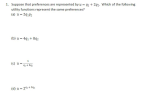 1. Suppose that preferences are represented by u q1 2q2. Which of the following utility functions represent the same preferences? (a) u 2q192 (b) u 41 8q2 91 + 2q2 (d) u 2+22
Suppose a consumer’s preferences over goods 1 and 2 are represented by the utility function U(x1,...
Suppose a consumer’s preferences over goods 1 and 2 are represented by the utility function U(x1, x2) = (x1 + x2) 3 . Draw an indifference curve for this consumer and indicate its slope.
I only need answer for part D please. 3. Sam and Dean are twin brothers. Each gets a weekly allowance of $2. Sam's preferences for fidget spinners (good and water guns (good y) can be represented...
 I only need answer for part D please.
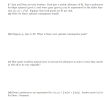
3. Sam and Dean are twin brothers. Each gets a weekly allowance of $2. Sam's preferences for fidget spinners (good and water guns (good y) can be represented by the utility func- tion u(x, y) -xiyi. Suppose that both goods are S1 per unit. (a) Solve for Sam's optimal consumption bundle. (b) Suppose p rises to $2. What is Sam's new optimal consumption point? (c) How much would his parents have to...
I only need answer for part D please.
3. Sam and Dean are twin brothers. Each gets a weekly allowance of $2. Sam's preferences for fidget spinners (good and water guns (good y) can be represented by the utility func- tion u(x, y) -xiyi. Suppose that both goods are S1 per unit. (a) Solve for Sam's optimal consumption bundle. (b) Suppose p rises to $2. What is Sam's new optimal consumption point? (c) How much would his parents have to...
Suppose a consumer’s preferences are represented by the utility function U(X,Y) = X2*Y. Therefore, MUx =...
Suppose a consumer’s preferences are represented by the utility function U(X,Y) = X2*Y. Therefore, MUx = 2XY • MUy = X2 Also, suppose the consumer has $32 to spend (M = $32), PY = 1, and that they spend all of their money on goods X and Y. Also, assume the consumer maximizes their utility subject to their budget constraint. Complete the following table: Px Quantity Demanded of X $1 $2 $3
Suppose Alex’s preferences are represented by u(x1,x2) = x1x32. The marginal utilities for this utility function...
Suppose Alex’s preferences are represented by u(x1,x2) = x1x32. The marginal utilities for this utility function are MU1 = x23 and MU2 = 3x1x22. (a) Show that Alex’s utility function belongs to a class of functions that are known to be well-behaved and strictly convex. (b) Find the MRS. [Note: find the MRS for the original utility function, not some monotonic transformation of it.] (c) Write down the tangency condition needed to find an optimal consumption bundle for well-behaved preferences....
Suppose Bill has preferences over chocolate,x, and ice cream,y, that are represented by the Cobb-Douglas utility...
Suppose Bill has preferences over chocolate,x, and ice cream,y, that are represented by the Cobb-Douglas utility function u(x, y) =x^2 y. 1. Write down two other Cobb-Douglas utility functions, besides the one above, that represent Bill’s preferences. 2. Write down two more Cobb-Douglas utility functions that do NOT represent Bill’s prefer- ences. 3. Draw 3 indifference curves that represents Bill’s preferences at 3 different levels of satsifaction. 4. What is Bill’s marginal rate of substitution between chocolate and ice cream?...
please show all steps 10. A consumer's preferences over bundles of two goods can be represented...
 please show all steps
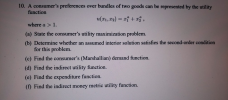
10. A consumer's preferences over bundles of two goods can be represented by the utility function where a >1. (a) State the consumer's utility maximization problem (b) Determine whether an assumed interior solution satisfies the second-order condition for this problem. (c) Find the consumer's (Marshallian) demand function. (d) Find the indirect utility function. (e) Find the expenditure function. (f) Find the indirect money metric utility function.
please show all steps
10. A consumer's preferences over bundles of two goods can be represented by the utility function where a >1. (a) State the consumer's utility maximization problem (b) Determine whether an assumed interior solution satisfies the second-order condition for this problem. (c) Find the consumer's (Marshallian) demand function. (d) Find the indirect utility function. (e) Find the expenditure function. (f) Find the indirect money metric utility function.
Suppose the preferences of an individual are represented by a quasilinear utility function: U (x, y)...
Suppose the preferences of an individual are represented by a quasilinear utility function: U (x, y) = ln(x) + y (a)Suppose px =1, py =5 and I = 20. The price of x increases to 2 (px = 2). Calculate the changes in the demand for x. What can you say about the substitution and income effects for small changes in the price of x? What happens to the demand for y? Is y a gross substitute? (b)Now suppose px...
 4. Suppose preferences are represented by the Cobb-Douglas utility function, u(x1x2) = xx-. a) Show that marginal utility is decreasing in X and X2. What is the interpretation of this property? b) Calculate the marginal rate of substitution c) Assuming an interior solution, solve for the Marshallian demand functions.
 1. Suppose that preferences are represented by u q1 2q2. Which of the following utility functions represent the same preferences? (a) u 2q192 (b) u 41 8q2 91 + 2q2 (d) u 2+22
 I only need answer for part D please.
3. Sam and Dean are twin brothers. Each gets a weekly allowance of $2. Sam's preferences for fidget spinners (good and water guns (good y) can be represented by the utility func- tion u(x, y) -xiyi. Suppose that both goods are S1 per unit. (a) Solve for Sam's optimal consumption bundle. (b) Suppose p rises to $2. What is Sam's new optimal consumption point? (c) How much would his parents have to...
I only need answer for part D please.
3. Sam and Dean are twin brothers. Each gets a weekly allowance of $2. Sam's preferences for fidget spinners (good and water guns (good y) can be represented by the utility func- tion u(x, y) -xiyi. Suppose that both goods are S1 per unit. (a) Solve for Sam's optimal consumption bundle. (b) Suppose p rises to $2. What is Sam's new optimal consumption point? (c) How much would his parents have to...
 please show all steps
10. A consumer's preferences over bundles of two goods can be represented by the utility function where a >1. (a) State the consumer's utility maximization problem (b) Determine whether an assumed interior solution satisfies the second-order condition for this problem. (c) Find the consumer's (Marshallian) demand function. (d) Find the indirect utility function. (e) Find the expenditure function. (f) Find the indirect money metric utility function.
please show all steps
10. A consumer's preferences over bundles of two goods can be represented by the utility function where a >1. (a) State the consumer's utility maximization problem (b) Determine whether an assumed interior solution satisfies the second-order condition for this problem. (c) Find the consumer's (Marshallian) demand function. (d) Find the indirect utility function. (e) Find the expenditure function. (f) Find the indirect money metric utility function.
Most questions answered within 3 hours.
-
Where is the error in this code sequence?
String s1 = "Hello";
String s2 = "ello";...
asked 10 months ago -
Financial data for Joel de Paris, Inc., for last year
follow:
Joel de Paris, Inc.
Balance...
asked 10 months ago -
Consider this reaction:
Al2(SO4)3 (aq)+ BaCl3
(aq) Al2Cl6 (aq)- +
3BaSO4(s) . What is the...
asked 10 months ago -
Suppose that Savneet is considering increasing her
recent random sample from 20 car rentals to 40...
asked 10 months ago -
Trucks arrive at an unloading terminal at an average rate of 120
per hour.
Trucks arrive...
asked 10 months ago -
Why are methanol and ethanol completely soluble in water while
octanol is not very little soluble....
asked 10 months ago -
A facilities manager at a university reads in a research report
that the mean amount of...
asked 10 months ago -
When the CuSO4 is rehydrated by adding water to the anhydrous
compound, is this an endothermic...
asked 10 months ago -
A ray of sunlight is passing from diamond into crown glass; the
angle of incidence is...
asked 10 months ago -
A block of mass 0.249 kg is placed on top of a light, vertical
spring of...
asked 10 months ago -
how do the kidneys compensate in the presences of acidosis
a) trigger hyperventilate
b) reserve acid...
asked 10 months ago -
Question 501 pts
The rental rate of capital to the firm increases. Which of the
following...
asked 10 months ago