1. The AMZ Balderdash Company has two brands ("A" & "B"). Price and cost data for...
The AMZ Balderdash Company has two brands ("A" & "B"). Price and cost data for each are presented below.
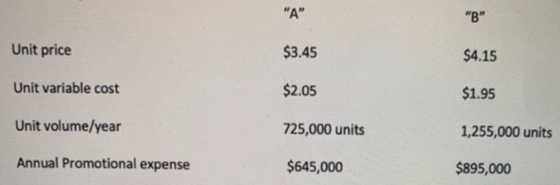
a) What are the respective brand contribution margins ($) of "A" and "B" to the AMZ Company? Assuming that AMZ Company is profit oriented and wishes to retain only one of these brands which brand would you recommend for retention? Explain your reasoning and state your assumptions!
b) Given a 15% price cut, estimate the breakeven elasticity of each brand. Briefly discuss the implications of each B/E elasticity. (4 points)
c) It has been proposed that the price of each brand be reduced by 15%. Unit variable costs are unchanged. What would be the new unit contribution margin and unit contribution margin ratio for each brand, assuming no change in unit variable costs? (4 POINTS)
Homework Answers
| Answer 1 | Brand A | Brand B |
| Unit selling price | $ 3.45 | $ 4.15 |
| Less: Variable cost per unit | $ 2.05 | $ 1.95 |
| Unit Contribution margin | $ 1.40 | $ 2.20 |
| Unit Sold | 725,000 | 1,255,000 |
| Multiply: Unit contribution margin | $ 1.40 | $ 2.20 |
| Brand Contribution margin | $ 1,015,000 | $ 2,761,000 |
| Brand Contribution margin | $ 1,015,000 | $ 2,761,000 |
| Less: Fixed expenses | $ 645,000 | $ 895,000 |
| Net operating (loss) | $ 370,000 | $ 1,866,000 |
| Company would retain the Brand B. Because the Brand B has Higher net income. | ||
| Answer 2 | Brand A | Brand B |
| Fixed expense | $ 645,000 | $ 895,000 |
| Divided by : Unit Contribution margin | $ 1.4000 | $ 2.2000 |
| Break even point in Unit sales | 460,714 | 406,818 |
| Using New prices | ||
| Unit selling price | $ 3.4500 | $ 4.1500 |
| Less: Decrease in price (Selling price * 15%) | $ 0.5175 | $ 0.6225 |
| Revised Unit selling price | $ 2.9325 | $ 3.5275 |
| Revised Unit selling price | $ 2.9325 | $ 3.5275 |
| Less: Variable cost per unit | $ 2.0500 | $ 1.9500 |
| Unit Contribution margin | $ 0.8825 | $ 1.5775 |
| Fixed expense | $ 645,000 | $ 895,000 |
| Divided by : Unit Contribution margin | $ 0.8825 | $ 1.5775 |
| Revised Break even point in Unit sales | 730,878 | 567,353 |
| Revised Break even point in Unit sales | 730,878 | 567,353 |
| Less: Break even point in Unit sales | 460,714 | 406,818 |
| Increase in break even | 270,164 | 160,535 |
| Divided by: Break even point in Unit sales | 460,714 | 406,818 |
| Increase in units required (%) | 59% | 39% |
| Increase in units required (%) | 59% | 39% |
| Divided by: Decrease in price | 15% | 15% |
| BREAK-EVEN ELASTICITY | 3.91 | 2.63 |
| Brand A is more risky if the price will drop compared to the Brand B. | ||
| Answer 3 | Brand A | Brand B |
| Using New prices | ||
| Unit selling price | $ 3.4500 | $ 4.1500 |
| Less: Decrease in price (Selling price * 15%) | $ 0.5175 | $ 0.6225 |
| Revised Unit selling price | $ 2.9325 | $ 3.5275 |
| Revised Unit selling price | $ 2.9325 | $ 3.5275 |
| Less: Variable cost per unit | $ 2.0500 | $ 1.9500 |
| Unit Contribution margin | $ 0.8825 | $ 1.5775 |
| Unit Contribution margin | $ 0.8825 | $ 1.5775 |
| Divided by: Revised Unit selling price | $ 2.9325 | $ 3.5275 |
| Contribution margin Ratio | 30.09% | 44.72% |
Add Answer to:
1. The AMZ Balderdash Company has two brands ("A" & "B"). Price and cost data for...
1. The AMZ Balderdash Company has two brands ("A" & "B"). Price and cost data for...
 1. The AMZ Balderdash Company has two brands ("A" & "B"). Price and cost data for each are presented below. "A" "B" Unit price $3.45 $4.15 Unit variable cost $2.05 $1.95 Unit volume/year 725,000 units 1,255,000 units Annual Promotional expense $645,000 $895,000 a) What are the respective brand contribution margins ($) of "A" and "B" to the AMZ Company? Assuming that AMZ Company is profit oriented and wishes to retain only one of these brands which brand would you recommend...
Spring 2020 MAR 4804/002 (MON) Financial/Analytical Question #2 (FAQ#2): note that there are conceptual issues in...
 Spring 2020 MAR 4804/002 (MON) Financial/Analytical Question #2 (FAQ#2): note that there are conceptual issues in each of the Financial/Analytical Assignments. You should specifically identify any assumptions that you make and justify the decision(s) made. This FAQ explores some marketing implications of the concept of "price elasticity of demand". Consider the 2 following income statements (limited in detail) of 2 different brands (DEF, XYZ) of the Furton Corporation: Brand "DEF" Brand “XYZ" FY2019 Income Statement FY2019 Income Statement Revenue: $1,210,000.00...
1. A lawnmower manufacturer has a unit cost of $140 and wishes to achieve a...
1. A lawnmower manufacturer has a unit cost of $140 and wishes to achieve a margin of 30% based on selling price. If the manufacturer sells directly to a retailer who then adds a set margin of 40% based on retail selling price, determine the retail price charged to consumers. 2. A firm is able to sell 25,000 units at $ 10 per piece. The company fixed cost is $50,000. Variable cost is $5 per unit. a. What is...
I. A company sells a product which has a unit sales price of $10, unit variable...
 I. A company sells a product which has a unit sales price of $10, unit variable cost of $5 and total fixed costs of $280,000. The number of units the company must sell to break even is: 2. At the breakeven point of 3.000 units, variable costs are $300,000, and fixed costs are S180,000. How much is the selling price per unit? 3. A company has total fixed costs of $160,000 and a contribution margin ratio of 20%. The total...
BOOK Calculator Print Item Price, Variable Cost per Unit, Contribution Margin, Contribution Margin Ratio, Fixed Expense...
 BOOK Calculator Print Item Price, Variable Cost per Unit, Contribution Margin, Contribution Margin Ratio, Fixed Expense For each of the following independent situations, calculate the amount(s) required. Unless otherwise instructed, round all total dollar figures (e.g. sales, total contribution margin) to the nearest dollar, breakeven or target units to the nearest unit, and unit costs and unit contribution margins to the nearest cent. Round ratios to four significant digits. Required: 1. At the break-even point, Jefferson Company sells 115,000 units...
XYZ Inc. sells two products, A and B. The selling price, variable cost and contribution margin...
XYZ Inc. sells two products, A and B. The selling price, variable cost and contribution margin per unit of product are shown below: Product A B Selling Price $24 $28 Variable Cost $10 $24 Contribution Margin $14 $4 Fixed costs amount to $640,000. The company sells twice as many units of A as it does B. How many units of each product does the company have to sell to breakeven? Multiple Choice A: 10,000 units; B: 5,000 units. B: 9,000...
Smith Company can produce two types of carpet cleaners, Brighter and Cleaner. Data on these two...
 Smith Company can produce two types of carpet cleaners, Brighter and Cleaner. Data on these two products are as follows: Sales volume in units Unit sales price Unit variable cost Brighter Cleaner 960 S675 $1.600 720 640 The number of machine-hours to produce one unit of Brighter is 1 while the number of machine-hours for each unit of Cleaner is 2. Total fixed costs for the manufacture of both products are $260.000 Required: 1.Using a spreadsheet, determine the breakeven point...
Smith Company can produce two types of carpet cleaners, Brighter and Cleaner. Data on these two products are as follows...
 Smith Company can produce two types of carpet cleaners, Brighter and Cleaner. Data on these two products are as follows: Brighter 400 Cleaner Sales volume in units 600 Unit sales price Unit variable cost $1,000 $1,000 200 700 The number of machine hours to produce one unit of Brighter is 1, while the number of machine hours for each unit of Cleane is 2. Total fixed costs for the manufacture of both products are $295,000. Required: 1. Determine the breakeven...
Sales mix, three products. The Kenosha Company has three product lines of beer mugs—A, B, and...
Sales mix, three products. The Kenosha Company has three product lines of beer mugs—A, B, and C—with contribution margins of $15, $12, and $9, respectively. The president foresees sales of 150,000 units in the coming period, consisting of 25,000 units of A, 50,000 units of B, and 75,000 units of C. The company’s fixed costs for the period are $251,000. Required 1. What is the company’s breakeven point in units, assuming that the given sales mix is maintained? 2. If...
Check my work Smith Company can produce two types of carpet cleaners, Brighter and Cleaner. Data on these two products...
 Check my work Smith Company can produce two types of carpet cleaners, Brighter and Cleaner. Data on these two products are as follows: Brighter 400 Cleaner Sales volume in units 600 0.25 Unit sales price $1,000 $1,000 points Unit variable cost 200 700 Skipped The number of machine hours to produce one unit of Brighter is 1, while the number of machine hours for each unit of Cleaner is 2. Total fixed costs for the manufacture of both products are...
 1. The AMZ Balderdash Company has two brands ("A" & "B"). Price and cost data for each are presented below. "A" "B" Unit price $3.45 $4.15 Unit variable cost $2.05 $1.95 Unit volume/year 725,000 units 1,255,000 units Annual Promotional expense $645,000 $895,000 a) What are the respective brand contribution margins ($) of "A" and "B" to the AMZ Company? Assuming that AMZ Company is profit oriented and wishes to retain only one of these brands which brand would you recommend...
 Spring 2020 MAR 4804/002 (MON) Financial/Analytical Question #2 (FAQ#2): note that there are conceptual issues in each of the Financial/Analytical Assignments. You should specifically identify any assumptions that you make and justify the decision(s) made. This FAQ explores some marketing implications of the concept of "price elasticity of demand". Consider the 2 following income statements (limited in detail) of 2 different brands (DEF, XYZ) of the Furton Corporation: Brand "DEF" Brand “XYZ" FY2019 Income Statement FY2019 Income Statement Revenue: $1,210,000.00...
 I. A company sells a product which has a unit sales price of $10, unit variable cost of $5 and total fixed costs of $280,000. The number of units the company must sell to break even is: 2. At the breakeven point of 3.000 units, variable costs are $300,000, and fixed costs are S180,000. How much is the selling price per unit? 3. A company has total fixed costs of $160,000 and a contribution margin ratio of 20%. The total...
 BOOK Calculator Print Item Price, Variable Cost per Unit, Contribution Margin, Contribution Margin Ratio, Fixed Expense For each of the following independent situations, calculate the amount(s) required. Unless otherwise instructed, round all total dollar figures (e.g. sales, total contribution margin) to the nearest dollar, breakeven or target units to the nearest unit, and unit costs and unit contribution margins to the nearest cent. Round ratios to four significant digits. Required: 1. At the break-even point, Jefferson Company sells 115,000 units...
 Smith Company can produce two types of carpet cleaners, Brighter and Cleaner. Data on these two products are as follows: Sales volume in units Unit sales price Unit variable cost Brighter Cleaner 960 S675 $1.600 720 640 The number of machine-hours to produce one unit of Brighter is 1 while the number of machine-hours for each unit of Cleaner is 2. Total fixed costs for the manufacture of both products are $260.000 Required: 1.Using a spreadsheet, determine the breakeven point...
 Smith Company can produce two types of carpet cleaners, Brighter and Cleaner. Data on these two products are as follows: Brighter 400 Cleaner Sales volume in units 600 Unit sales price Unit variable cost $1,000 $1,000 200 700 The number of machine hours to produce one unit of Brighter is 1, while the number of machine hours for each unit of Cleane is 2. Total fixed costs for the manufacture of both products are $295,000. Required: 1. Determine the breakeven...
 Check my work Smith Company can produce two types of carpet cleaners, Brighter and Cleaner. Data on these two products are as follows: Brighter 400 Cleaner Sales volume in units 600 0.25 Unit sales price $1,000 $1,000 points Unit variable cost 200 700 Skipped The number of machine hours to produce one unit of Brighter is 1, while the number of machine hours for each unit of Cleaner is 2. Total fixed costs for the manufacture of both products are...
Most questions answered within 3 hours.
-
Where is the error in this code sequence?
String s1 = "Hello";
String s2 = "ello";...
asked 11 months ago -
Financial data for Joel de Paris, Inc., for last year
follow:
Joel de Paris, Inc.
Balance...
asked 11 months ago -
Consider this reaction:
Al2(SO4)3 (aq)+ BaCl3
(aq) Al2Cl6 (aq)- +
3BaSO4(s) . What is the...
asked 11 months ago -
Suppose that Savneet is considering increasing her
recent random sample from 20 car rentals to 40...
asked 11 months ago -
Trucks arrive at an unloading terminal at an average rate of 120
per hour.
Trucks arrive...
asked 11 months ago -
Why are methanol and ethanol completely soluble in water while
octanol is not very little soluble....
asked 11 months ago -
A facilities manager at a university reads in a research report
that the mean amount of...
asked 11 months ago -
When the CuSO4 is rehydrated by adding water to the anhydrous
compound, is this an endothermic...
asked 11 months ago -
A ray of sunlight is passing from diamond into crown glass; the
angle of incidence is...
asked 11 months ago -
A block of mass 0.249 kg is placed on top of a light, vertical
spring of...
asked 11 months ago -
how do the kidneys compensate in the presences of acidosis
a) trigger hyperventilate
b) reserve acid...
asked 11 months ago -
Question 501 pts
The rental rate of capital to the firm increases. Which of the
following...
asked 11 months ago