
Homework Answers
Answer:- The initial purchasers of a security offered for sale undera registration statement are coverd for liability by the 1933 act.
Securities Act of 1933
Primary tabs
The Securities Act was Congress's opening shot in the war on securities fraud. Congress primarily targeted the issuers of securities. Companies which issue securities (called issuers) seek to raise money to fund new projects or investments or to expand their operations. These companies must attract potential investors. Therefore issuers have an incentive to present the company in a way that is attractive to investors. The Securities Act serves the dual purpose of ensuring that issuers selling securities to the public disclose material information, and that any securities transactions are not based on fraudulent information or practices. In this context, "material" means information that would affect a reasonable investor's evaluation of the company's stock. The goal is to provide investors with accurate information so that they can make informed investment decisions.
Mandatory Disclosures
The Securities Act effectuates disclosure through a mandatory registration process in any sale of any securities. In reality, due to a number of exemptions (for trading on the secondary market and small offerings), the Act is mainly applied to primary market offerings by issuers. Under Section 5 of the Securities Act, all issuers must register non-exempt securities with the Securities and Exchange Commission (SEC). Section 5 regulates the timeline and distribution process for issuers who offer securities for sale. The actual registration process is laid out in Section 6, under which registration entails two parts:
- First, the issuer must submit information that will form the basis of the prospectus, to be provided to prospective investors.
- Second, the issuer must submit additional information that does not go into the prospectus but is accessible to the public.
The SEC rules dictate the appropriate registration form, which depends on the type of issuer and the securities offered. Section 7 gives the SEC full authority to determine what information issuers must submit, but generally required is information about the issuer and the terms of the offered securities that would help investors form a reasoned opinion about the investment.
The requirements are extensive, and include descriptions of the issuer's business, past performance, information about the issuer's officers and managers, audited financial statements, information on executive compensation, risks of the business, tax and legal issues, and the terms of the securities issued. Often, the issuer will submit the prospectus with the registration statement. All of this information becomes public soon after filing with the SEC, through the SEC's online EDGAR system.
The SEC reviews registration statements to ensure that all required disclosures have been made. Barring glaring deficiencies or omissions, the registration statement is effective within 20 days, per Section 8. The SEC substantively evaluates the registration statement and prospectus, and can issue "deficiency letters" suggesting changes.
Thus, the SEC can aid issuers in shaping disclosures to meet investor needs. Companies tend to comply because the SEC has the power to accelerate the effective date, which allows the company to sell its stock and raise capital earlier.
The registration process protects investors in two ways. Issuers cannot offer to sell securities without disclosing information about the company, and developing and delivering a prospectus that the SEC has reviewed. In addition, issuers are strictly liable for any material misstatements or omissions in the prospectus or registration statement.
Enforcing the Securities Act
SEC enforcement actions are the primary mechanism for enforcing federal securities laws. The SEC can prosecute issuers and sellers of unregistered securities. Under Section 20(b)can seek injunctions against the sale or issue of securities if the Securities Act has been violated, or if a violation is imminent. Section 8A also allows the SEC to issue orders to issuers to cease and desist from certain activities, and bar officers and directors who have violated the Securities Act's anti-fraud provisions. Additionally, the SEC can seek civil penalties under Section 20(d) if a party violated the Securities Act, an SEC rule, or a cease-and-desist order.
The SEC may not bring actions on behalf of individual investors, but the Securities Act allows individual investors to bring civil actions under several provisions:
- Section 11 makes issuers strictly liable for registration statements that contain "an untrue statement of a material fact or omit to state a material fact required...to make the statements there in no misleading." Under this provision, a purchaser of the security can bring suit under Section 11, even if he bought the security after the initial offering, on the secondary markets. As long as the purchaser can trace the purchase back to the initial offering and is within the statute of limitations, he can sue - there is no need to prove causation or reliance on the misstatements or omissions. Damages are limited to the difference between the offering price and value of the securities at the time of the lawsuit. Although the purchaser can sue the issuer, underwriter, or subsequent seller, all defendants but the issuer have a "due diligence" defense that they had no grounds to believe the statement had a misstatement or omission.
- Section 5 and Section 12(a)(1) allow purchasers to sue sellers for offering or selling a non-exempt security without registering it. As long as the purchaser can prove a direct link between the purchaser and the seller, and the suit is within the statute of limitations, the purchaser may obtain rescission with interest, or damages if the investor sold his securities for less than he purchased them.
- Section 12(a)(2) creates liability for any person who offers or sells a security through a prospectus or an oral communication containing a material misstatement or omission, is liable to the purchaser for rescission of the purchase or damages, provided that the purchaser did not know about the misstatement or omission at the time of the purchase. Court holdings imply that the cause of action only applies to purchasers in the initial offering, not secondary purchases, but this is not settled law yet. Investors suing under 12(a)(2) can only recover from sellers.
- Section 15 aids investors by making "control persons," or persons who "control" defendants liable under Sections 11 and 12 by owning stock or under agency principals, jointly and severally liable. This helps investors collect damages in cases where the defendant is insolvent or does not have enough money to pay the investor, a frequent situation in securities litigation (most investors sue after their investment has soured).
- Section 17(a) is a key anti-fraud provision in the Securities Act. It provides for liability for fraudulent sales of securities. Some courts have found an implied right of private action under this provision, though this is becoming a less favored position. However, some courts continue to accept private suits under this provision. Section 17(a) makes it unlawful to "employ any device, scheme, or artifice to defraud", "obtain money or property" by using material misstatements or omissions, or to "engage in any transaction, practice, or course of business which operates or would operate as a fraud or deceit upon the purchaser." This provision is closely tracked by Section 10b of the Securities Exchange Act and Rule 10b-5, which is used more widely by investors suing for fraud.
Add Answer to:
The initial purchasers of a security offered for sale under a registration statement are covered for...
The initial and subsequent purchasers of a security offered for sale are covered for liability by...
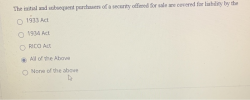 The initial and subsequent purchasers of a security offered for sale are covered for liability by the o 1933 Act O 1934 Act O RICO Act All of the Above None of the above
33 Read the overview below and complete the activities that follow. The 1933 and 1934 acts...
 33
Read the overview below and complete the activities that follow. The 1933 and 1934 acts are different in the way they protect investors and the burden of proof required. The 1933 Act pertains to those acquiring an initial distribution of a security, the 1934 Act is for anyone buying or selling the security CONCEPT REVIEW: Auditors have different liability responsibility under the different acts. For example, under the 1933 Act, the third party does not need to prove reliance...
33
Read the overview below and complete the activities that follow. The 1933 and 1934 acts are different in the way they protect investors and the burden of proof required. The 1933 Act pertains to those acquiring an initial distribution of a security, the 1934 Act is for anyone buying or selling the security CONCEPT REVIEW: Auditors have different liability responsibility under the different acts. For example, under the 1933 Act, the third party does not need to prove reliance...
c. Which is the true statement conce O 1. The Securities Act of 1933 broadened the...
 c. Which is the true statement conce O 1. The Securities Act of 1933 broadened the auditor's liability relafive to common law and the Securities Exchange Act of 1934 narrowed t O 2. Criminal liability only arises under state law O 3. The auditor may limit exposure to liability by destroying documents that might suggest an improper act O 4. The auditor has a greater burden of defense under the Securities Act of 1933 than the Securities Exchange Act of...
1. Which the following requires new issues to file a registration statement and issue a prospectus?...
1. Which the following requires new issues to file a registration statement and issue a prospectus? a. Dodd-Frank Act of 2010 b. Glass- Steagall Act of 1933 c. Securities Exchange Act of 1934 d. Securities Act of 1933 2. The best criterion for in an investment decision: a. finance all capital budgeting projects with debt b. minimize the cost of the investment c. maximize the difference between cash inflows and cost d. maximize the number of capital budgeting projects 3....
An external auditor's involvement with a Form 10-Q that is being prepared for filing with the SEC would most likely...
 An external auditor's involvement with a Form 10-Q that is being prepared for filing with the SEC would most likely consist of An audit of the financial statements included in the Form 10-Q b. а. A compilation report of the financial statements included in the Form 10-Q A review of the interim financial statements included in the Form 10-Q d. с. The issuance of an opinion on the internal controls under which the Form 10-Q data were developed Which of...
Please Help Thank You!! 1. The SEC was established in 1934 to help regulate the United States securities market. Whi...
 Please Help Thank You!!
1. The SEC was established in 1934 to help regulate the United States securities market. Which of the follow ing statements is true concerning the SEC? The SEC prohibits the sale of speculative securities. b. a. Registration with the SEC guarantees the accuracy of the registrant's prospectus The SEC's initial influence and authority has diminished in recent years as stock exchanges have come more organized and better able to police themselves. d. c. The SEC regulates...
Please Help Thank You!!
1. The SEC was established in 1934 to help regulate the United States securities market. Which of the follow ing statements is true concerning the SEC? The SEC prohibits the sale of speculative securities. b. a. Registration with the SEC guarantees the accuracy of the registrant's prospectus The SEC's initial influence and authority has diminished in recent years as stock exchanges have come more organized and better able to police themselves. d. c. The SEC regulates...
1. Insiders must file a statement of the amount of such issues of which they are...
1. Insiders must file a statement of the amount of such issues of which they are the owners: a. only after 10 days of becoming an insider b. only at the time of the registration c. only after 30 days of becoming an insider d. at the time of the registration or within 10 days after becoming an insider e. within 5 days of becoming an insider 2. The members of the Public Company Accounting Oversight Board are appointed by...
investment management ER Blackboard NA Question Completion Status: QUESTION 18 Electronic communication systems: allow investors to...
 investment management
ER Blackboard NA Question Completion Status: QUESTION 18 Electronic communication systems: allow investors to communicate with others in investor chat rooms. allow markets to trade American Depository Receipts online in Europe and Asia. automatically match buy and sell orders at specified prices. are operated by the investment bankers to stabilize new issue markets. QUESTION 19 Full disclosure of all pertinent investment information in the sale of new securities is a provision of the Securities Act of 1933 Securities...
investment management
ER Blackboard NA Question Completion Status: QUESTION 18 Electronic communication systems: allow investors to communicate with others in investor chat rooms. allow markets to trade American Depository Receipts online in Europe and Asia. automatically match buy and sell orders at specified prices. are operated by the investment bankers to stabilize new issue markets. QUESTION 19 Full disclosure of all pertinent investment information in the sale of new securities is a provision of the Securities Act of 1933 Securities...
Select the necessary words from the list of possibilities to complete the following statements. Statements Answer...
 Select the necessary words from the list of possibilities to complete the following statements. Statements Answer of financial statements involves the performance of limited investigative procedures that provide a basis for the expression of limited assurance that there are no material departures from generally accepted accounting principles is the written contract summarizing the relationship between the auditors and the client 2. An Under the Securities Act of 1933, initial purchasers of securities may sue the auditors for misleading audited financial...
In March 2012, Daniela motor financing, offered some security is for sale to the public. Under...
In March 2012, Daniela motor financing, offered some security is for sale to the public. Under the terms of the deal, DMF promised to repay the owner of one of these securities $500 in March 2037, but investors would receive nothing until then. Investors paid DMF $250 for each of the securities; so they gave up $250 in March 2012 for the promise of a five her dollar payment 25 years later. Suppose are the terms of the bond you...
 The initial and subsequent purchasers of a security offered for sale are covered for liability by the o 1933 Act O 1934 Act O RICO Act All of the Above None of the above
 33
Read the overview below and complete the activities that follow. The 1933 and 1934 acts are different in the way they protect investors and the burden of proof required. The 1933 Act pertains to those acquiring an initial distribution of a security, the 1934 Act is for anyone buying or selling the security CONCEPT REVIEW: Auditors have different liability responsibility under the different acts. For example, under the 1933 Act, the third party does not need to prove reliance...
33
Read the overview below and complete the activities that follow. The 1933 and 1934 acts are different in the way they protect investors and the burden of proof required. The 1933 Act pertains to those acquiring an initial distribution of a security, the 1934 Act is for anyone buying or selling the security CONCEPT REVIEW: Auditors have different liability responsibility under the different acts. For example, under the 1933 Act, the third party does not need to prove reliance...
 c. Which is the true statement conce O 1. The Securities Act of 1933 broadened the auditor's liability relafive to common law and the Securities Exchange Act of 1934 narrowed t O 2. Criminal liability only arises under state law O 3. The auditor may limit exposure to liability by destroying documents that might suggest an improper act O 4. The auditor has a greater burden of defense under the Securities Act of 1933 than the Securities Exchange Act of...
 An external auditor's involvement with a Form 10-Q that is being prepared for filing with the SEC would most likely consist of An audit of the financial statements included in the Form 10-Q b. а. A compilation report of the financial statements included in the Form 10-Q A review of the interim financial statements included in the Form 10-Q d. с. The issuance of an opinion on the internal controls under which the Form 10-Q data were developed Which of...
 Please Help Thank You!!
1. The SEC was established in 1934 to help regulate the United States securities market. Which of the follow ing statements is true concerning the SEC? The SEC prohibits the sale of speculative securities. b. a. Registration with the SEC guarantees the accuracy of the registrant's prospectus The SEC's initial influence and authority has diminished in recent years as stock exchanges have come more organized and better able to police themselves. d. c. The SEC regulates...
Please Help Thank You!!
1. The SEC was established in 1934 to help regulate the United States securities market. Which of the follow ing statements is true concerning the SEC? The SEC prohibits the sale of speculative securities. b. a. Registration with the SEC guarantees the accuracy of the registrant's prospectus The SEC's initial influence and authority has diminished in recent years as stock exchanges have come more organized and better able to police themselves. d. c. The SEC regulates...
 investment management
ER Blackboard NA Question Completion Status: QUESTION 18 Electronic communication systems: allow investors to communicate with others in investor chat rooms. allow markets to trade American Depository Receipts online in Europe and Asia. automatically match buy and sell orders at specified prices. are operated by the investment bankers to stabilize new issue markets. QUESTION 19 Full disclosure of all pertinent investment information in the sale of new securities is a provision of the Securities Act of 1933 Securities...
investment management
ER Blackboard NA Question Completion Status: QUESTION 18 Electronic communication systems: allow investors to communicate with others in investor chat rooms. allow markets to trade American Depository Receipts online in Europe and Asia. automatically match buy and sell orders at specified prices. are operated by the investment bankers to stabilize new issue markets. QUESTION 19 Full disclosure of all pertinent investment information in the sale of new securities is a provision of the Securities Act of 1933 Securities...
 Select the necessary words from the list of possibilities to complete the following statements. Statements Answer of financial statements involves the performance of limited investigative procedures that provide a basis for the expression of limited assurance that there are no material departures from generally accepted accounting principles is the written contract summarizing the relationship between the auditors and the client 2. An Under the Securities Act of 1933, initial purchasers of securities may sue the auditors for misleading audited financial...
Most questions answered within 3 hours.
-
Where is the error in this code sequence?
String s1 = "Hello";
String s2 = "ello";...
asked 10 months ago -
Financial data for Joel de Paris, Inc., for last year
follow:
Joel de Paris, Inc.
Balance...
asked 10 months ago -
Consider this reaction:
Al2(SO4)3 (aq)+ BaCl3
(aq) Al2Cl6 (aq)- +
3BaSO4(s) . What is the...
asked 10 months ago -
Suppose that Savneet is considering increasing her
recent random sample from 20 car rentals to 40...
asked 10 months ago -
Trucks arrive at an unloading terminal at an average rate of 120
per hour.
Trucks arrive...
asked 10 months ago -
Why are methanol and ethanol completely soluble in water while
octanol is not very little soluble....
asked 10 months ago -
A facilities manager at a university reads in a research report
that the mean amount of...
asked 10 months ago -
When the CuSO4 is rehydrated by adding water to the anhydrous
compound, is this an endothermic...
asked 10 months ago -
A ray of sunlight is passing from diamond into crown glass; the
angle of incidence is...
asked 10 months ago -
A block of mass 0.249 kg is placed on top of a light, vertical
spring of...
asked 10 months ago -
how do the kidneys compensate in the presences of acidosis
a) trigger hyperventilate
b) reserve acid...
asked 10 months ago -
Question 501 pts
The rental rate of capital to the firm increases. Which of the
following...
asked 10 months ago