Satterlee Co. produces 11,000 scanners per week. If 1.6% of these are defective, how many defective...
Satterlee Co. produces 11,000 scanners per week. If 1.6% of these are defective, how many defective scanners are produced per week?
Homework Answers
Weekly production = 11,000 scanners
Defective rate = 1.6%
Defective production = Weekly production x Defective rate = 11,000 x 1.6%
= 176
176 defective scanners are produced per week.
Kindly comment if you need further assistance. Thanks
Add Answer to:
Satterlee Co. produces 11,000 scanners per week. If
1.6% of these are defective, how many defective...
A company produces 1,100 refrigerators per week at three plants. Plant A produces 370 refrigerators per week, Plant B produces 285 refrigerators per week, and plant C produces 445 refrigerators per we...
A company produces 1,100 refrigerators per week at three plants. Plant A produces 370 refrigerators per week, Plant B produces 285 refrigerators per week, and plant C produces 445 refrigerators per week. Suppose you know that 6% of the refrigerators produced at Plant A are defective, 4% of the refrigerators produced at Plant B are defective, and 3% of the refrigerators produced at Plant C are defective. a) What is the probability that a randomly selected refrigerator is defective? b)...
Madison 101 honored scanners (from #7 above). (#7. Madison Co. sells 13,000 scanners at a price...
Madison 101 honored scanners (from #7 above). (#7. Madison Co. sells 13,000 scanners at a price of $250.00 each. The selling price includes a warranty (1 year) on parts. Madison expects that 4.5% of the scanners will be defective and that warranty repair costs will be $56 per unit. Complete the following: a. Journalize the sale (assume a 7.75% sales tax rate). b. Estimate, and then journalize the warranty liability.)
A company has two machines that produce widgets. An older machine produces 20% defective widgets, while...
 A company has two machines that produce widgets. An older machine produces 20% defective widgets, while the new machine produces only 4% defective widgets. However, the older machine produces 5 times as many widgets as the new machine does. What is the probability that a randomly chosen widget produced by the company is both produced by the new machine and is not defective?
A company has two machines that produce widgets. An older machine produces 20% defective widgets, while...
A company has two machines that produce widgets. An older machine produces 20% defective widgets, while the new machine produces only 3% defective widgets. However, the older machine produces 8 times as many widgets as the new machine does. What is the probability that a randomly chosen widget produced by the company is both produced by the new machine and is defective? Answer is 0.0033
A machinist produces 22 items during a shift. Three of the 22 items are defective and...
 A machinist produces 22 items during a shift. Three of the 22 items are defective and the rest are not defective. In how many different orders can the 22 items be arranged if all the defective items are considered identical and all the non-defective items are identical of a different class?
I asked six (female) friends, co-workers, and family members how many times per week they wear...
I asked six (female) friends, co-workers, and family members how many times per week they wear their hair in a ponytail. I found the results interesting, since I myself seem to wear my hair in a ponytail more often than my friends do. The results were 1, 0, 1, 2, 1, 1. Calculate a 95% confidence interval for the population mean, place your answer below. Please walk me through this problem as simply as you can. Thanks!
9. A machinist produces 22 items during a shift. Three of the 22 items are defective...
 9. A machinist produces 22 items during a shift. Three of the 22 items are defective and the rest are not defective. In how many different orders can the 22 items be arranged if all the defective items are considered identical and all the non-defective items are identical of a different class?
A manufacturing company produces two models of an HDTV per week, x units of model A...
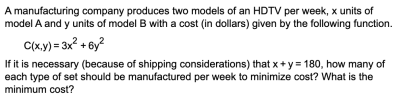 A manufacturing company produces two models of an HDTV per week, x units of model A and y units of model B with a cost (in dollars) given by the following function. C(x,y)= 3x² + 6y2 If it is necessary (because of shipping considerations) that x + y = 180, how many of each type of set should be manufactured per week to minimize cost? What is the minimum cost?
A machine produces an average of 10% defective bolts. A batch is accepted if a sample...
A machine produces an average of 10% defective bolts. A batch is accepted if a sample of five bolts taken from the batch that contains no defective and rejected if the sample contains 3 or more defectives. In other cases, a second sample is taken. 1- ehatvis rhe probability that the second sample will be required 2- what Is the probability that the sample is rejected 3- if 15 bolts are taken from a batch, how many bolts are defective
If 8.19 mol of C,H, reacts with excess o, how many moles of Co, will be produced by the following combustion rea...
 If 8.19 mol of C,H, reacts with excess o, how many moles of Co, will be produced by the following combustion reaction? CH2 +80, 6H,0+ 500, The reaction for producing glucose in plants, called photosynthesis, is light 6CO2 + 6H2O=CH206 + 602 If a plant produces 7.06 mol CH206, how many moles of Co, are needed? moles CO,
 A company has two machines that produce widgets. An older machine produces 20% defective widgets, while the new machine produces only 4% defective widgets. However, the older machine produces 5 times as many widgets as the new machine does. What is the probability that a randomly chosen widget produced by the company is both produced by the new machine and is not defective?
 A machinist produces 22 items during a shift. Three of the 22 items are defective and the rest are not defective. In how many different orders can the 22 items be arranged if all the defective items are considered identical and all the non-defective items are identical of a different class?
 9. A machinist produces 22 items during a shift. Three of the 22 items are defective and the rest are not defective. In how many different orders can the 22 items be arranged if all the defective items are considered identical and all the non-defective items are identical of a different class?
 A manufacturing company produces two models of an HDTV per week, x units of model A and y units of model B with a cost (in dollars) given by the following function. C(x,y)= 3x² + 6y2 If it is necessary (because of shipping considerations) that x + y = 180, how many of each type of set should be manufactured per week to minimize cost? What is the minimum cost?
 If 8.19 mol of C,H, reacts with excess o, how many moles of Co, will be produced by the following combustion reaction? CH2 +80, 6H,0+ 500, The reaction for producing glucose in plants, called photosynthesis, is light 6CO2 + 6H2O=CH206 + 602 If a plant produces 7.06 mol CH206, how many moles of Co, are needed? moles CO,
Most questions answered within 3 hours.
-
Where is the error in this code sequence?
String s1 = "Hello";
String s2 = "ello";...
asked 11 months ago -
Financial data for Joel de Paris, Inc., for last year
follow:
Joel de Paris, Inc.
Balance...
asked 11 months ago -
Consider this reaction:
Al2(SO4)3 (aq)+ BaCl3
(aq) Al2Cl6 (aq)- +
3BaSO4(s) . What is the...
asked 11 months ago -
Suppose that Savneet is considering increasing her
recent random sample from 20 car rentals to 40...
asked 11 months ago -
Trucks arrive at an unloading terminal at an average rate of 120
per hour.
Trucks arrive...
asked 11 months ago -
Why are methanol and ethanol completely soluble in water while
octanol is not very little soluble....
asked 11 months ago -
A facilities manager at a university reads in a research report
that the mean amount of...
asked 11 months ago -
When the CuSO4 is rehydrated by adding water to the anhydrous
compound, is this an endothermic...
asked 11 months ago -
A ray of sunlight is passing from diamond into crown glass; the
angle of incidence is...
asked 11 months ago -
A block of mass 0.249 kg is placed on top of a light, vertical
spring of...
asked 11 months ago -
how do the kidneys compensate in the presences of acidosis
a) trigger hyperventilate
b) reserve acid...
asked 11 months ago -
Question 501 pts
The rental rate of capital to the firm increases. Which of the
following...
asked 11 months ago