Create a UML diagram to help design the class described in exercise 3 below. Do this...
Create a UML diagram to help design the class described in exercise 3 below.
Do this exercise before you attempt to code the solution. Think about what
instance variables will be required to describe a Baby class object; should they
be private or public? Determine what class methods are required; should they
be private or public?
3. Write Java code for a Baby class. A Baby has a name of type String and an age
of type integer.
Supply two constructors: one will be the default constructor, that just sets
default values for the name and age; the second constructor will take two
parameters, a string to set the name and an integer to set the age. Also, supply
methods for setting the name, setting the age, getting the name and getting the
age.
The class should not contain I/O methods; input of values to the instance
variables must be done with a set method or constructor, output of values from
the instance variables must be done with get methods. The set method for the
name instance variable should ensure that the input is not empty or contain
whitespaces (otherwise set a default value). The set method for the age
instance variable should validate the input to be between 1 and 4 inclusive
(otherwise set a default value).
Give Java code for an equals method for the Baby class. Babies count as
being the same (i.e. equal) if their names and their ages are exactly identical
(names should not be case sensitive). The method will take a Baby type
parameter and use the calling object (thus comparing these two objects via
name and age); it should return Boolean - true or false as appropriate.
Remember, if comparing Strings, you must use String comparison methods.
4. Test your Baby class by writing a client program which uses an array to store
information about 4 babies. That is, each of the four elements of the array
must store a Baby object.
If you have an array for baby names and another array for baby ages,
then you have missed the point of the exercise and therefore not met
the requirement of this exercise.
A Baby class object stores the required information about a Baby. So
each Baby object will have its own relevant information, and thus each
object must be stored in one element of the array.
The client program should:
a. Enter details for each baby (name and age) and thus populate the
Baby array
b. Output the details of each baby from the array (name and age)
c. Calculate and display the average age of all babies in the array
d. Determine whether any two babies in the array are the same
As the required information for these tasks is stored in the Baby array, you
will need to use a loop to access each array element (and use the dot notation
to access the appropriate set and get methods to assign/retrieve the
information).
For part d above, a nested loop is required.
Homework Answers
// UML Diagrm of Baby class:

===========================================
// Baby.java
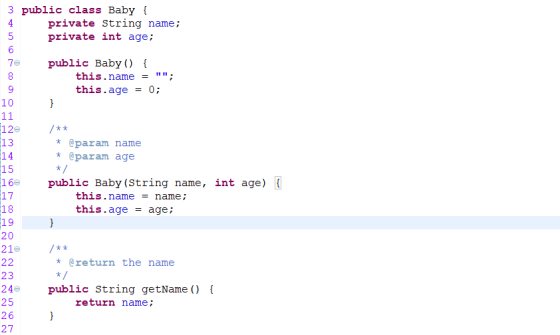
public class Baby {
private String name;
private int age;
public Baby() {
this.name = "";
this.age = 0;
}
/**
* @param name
* @param age
*/
public Baby(String name, int age) {
this.name = name;
this.age = age;
}
/**
* @return the name
*/
public String getName() {
return name;
}
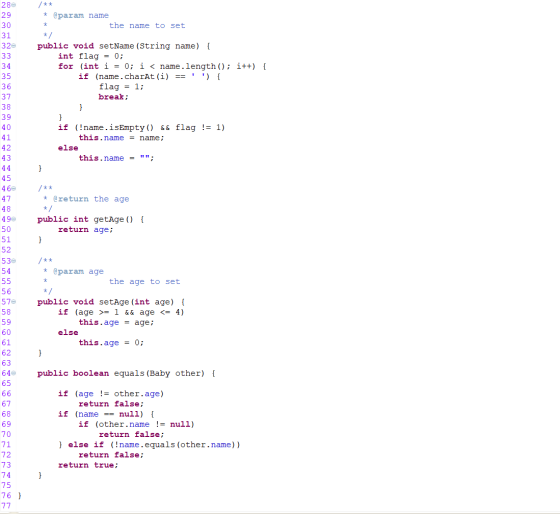
/**
* @param name
* the name to set
*/
public void setName(String name) {
int flag = 0;
for (int i = 0; i <
name.length(); i++) {
if
(name.charAt(i) == ' ') {
flag = 1;
break;
}
}
if (!name.isEmpty() && flag
!= 1)
this.name =
name;
else
this.name =
"";
}
/**
* @return the age
*/
public int getAge() {
return age;
}
/**
* @param age
* the age to set
*/
public void setAge(int age) {
if (age >= 1 && age
<= 4)
this.age =
age;
else
this.age =
0;
}
public boolean equals(Baby other) {
if (age != other.age)
return
false;
if (name == null) {
if (other.name
!= null)
return false;
} else if
(!name.equals(other.name))
return
false;
return true;
}
}
==========================================
===========================================
// Test.java
import java.util.Scanner;
public class Test {
public static void main(String[] args) {
String name;
int age;
/*
* Creating an Scanner class object
which is used to get the inputs
* entered by the user
*/
Scanner sc = new
Scanner(System.in);
// Creating Baby class array of
size 4
Baby babies[] = new Baby[4];
for (int i = 0; i <
babies.length; i++) {
// Getting the
input entered by the user
System.out.print("Enter name of Baby#" + (i + 1) + ":");
name =
sc.next();
System.out.print("Enter age:");
age =
sc.nextInt();
// Creating an
instance of Baby class
Baby b = new
Baby(name, age);
// Assign the
Baby class instance to the array
babies[i] =
b;
}
// Calling the method
display(babies);
double avgAge =
calcAvgAgeOfAllBabies(babies);
// Displaying the average age of
all babies
System.out.println("Average age of
all babies :" + avgAge);
boolean b =
areAnyBabiesAreSame(babies);
if (b) {
System.out.println("All babies are not unique");
} else {
System.out.println("All babies are unique");
}
}
// This method will check whether any babies are
same or not
private static boolean areAnyBabiesAreSame(Baby[]
babies) {
for (int i = 0; i <
babies.length; i++) {
for (int j = i +
1; j < babies.length; j++) {
if (babies[i].equals(babies[j])) {
return true;
}
}
}
return false;
}
// This method will calculate the average age of
all babies
private static double calcAvgAgeOfAllBabies(Baby[]
babies) {
double sum = 0;
for (int i = 0; i <
babies.length; i++) {
sum +=
babies[i].getAge();
}
return sum / babies.length;
}
// This method will display each baby info
private static void display(Baby[] babies) {
for (int i = 0; i <
babies.length; i++) {
System.out.println("\nBaby#" + (i + 1) + ":");
System.out.println("Name :" + babies[i].getName() + ", Age :"+
babies[i].getAge());
}
}
}
==========================================
![import java.util.Scanner; public class Test { public static void main(String[] args) { String name; int age; * Creating an Sc](http://img.homeworklib.com/questions/af375920-19e5-11eb-ac1e-079881b91d65.png?x-oss-process=image/resize,w_560)

![// This method will display each baby info private static void display (Baby[] babies) { for (int i = 0; i < babies.length; i](http://img.homeworklib.com/questions/b0499150-19e5-11eb-b39c-e5ead906f541.png?x-oss-process=image/resize,w_560)
==============================================
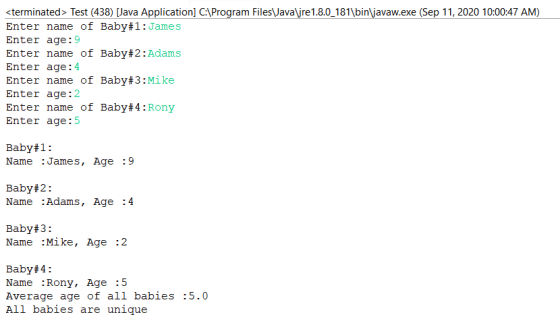
Output:
=====================Could you plz rate me
well.Thank You
Add Answer to:
Create a UML diagram to help design the class described in
exercise 3 below.
Do this...
Create a UML diagram to help design the class described in exercise 3 below. Do this...
Create a UML diagram to help design the class described in exercise 3 below. Do this exercise before you attempt to code the solution. Think about what instance variables will be required to describe a Baby class object; should they be private or public? Determine what class methods are required; should they be private or public? Write Java code for a Baby class. A Baby has a name of type String and an age of type integer. Supply two constructors:...
Java Object Array With 2 Elements In 1 Object
1. Create a UML diagram to help design the class described in Q2 below. Do this exercise before you attempt to code the solution. Think about what instance variables will be required to describe a Person class object; should they be private or public? Determine what class methods are required; should they be private or public?2. Write Java code for a Person class. A Person has a name of type String and an age of type integer.Supply two constructors: one will be...
1- Create the base class Book that has the following instance variables, constructor, and methods title...
1- Create the base class Book that has the following instance variables, constructor, and methods title ( String) isbn ( String) authors (String) publisher (String) edition ( int) published_year (int) Constructor that takes all of the above variables as input parameters. set/get methods ToString method // that return sting representation of Book object. 2- Create the sub class New_Book that is derived from the base class Book and has the following instance variables, constructor, and methods: title ( String) isbn...
Hello. I need help writing the following Java Program. Thank you Develop a class encapsulating the...
Hello. I need help writing the following Java Program. Thank you Develop a class encapsulating the concept of a college course, assuming that a course has following attributers: code (for instance COSC1337), a description, and a number of credits (for instance 3). Include a constructor, the accessors, mutators and methods ‘toString’, ‘equals’, and ‘finalize’. Write a client class to test the behavior of the class and its methods. The outline of the class is given as follows: public class Course...
Write a Java class named Employee to meet the requirements described in the UML Class Diagram...
 Write a Java class named Employee to meet the
requirements described in the UML Class Diagram below:
Note: Code added in the toString cell are not usually included
in a regular UML class diagram. This was added so you can
understand what I expect from you.
If your code compiles cleanly, is defined correctly and
functions exactly as required, the expected output of your program
will solve the following problem:
“An IT company with four departments and a staff strength...
Write a Java class named Employee to meet the
requirements described in the UML Class Diagram below:
Note: Code added in the toString cell are not usually included
in a regular UML class diagram. This was added so you can
understand what I expect from you.
If your code compiles cleanly, is defined correctly and
functions exactly as required, the expected output of your program
will solve the following problem:
“An IT company with four departments and a staff strength...
C# programming 50 pts Question 2:2 1- Create the base class Book that has the following instance variables, constructor, and methods title (String) isbn (String) authors (String) publisher (Strin...
 C# programming
50 pts Question 2:2 1- Create the base class Book that has the following instance variables, constructor, and methods title (String) isbn (String) authors (String) publisher (String) edition ( int) published year (int) Constructor that takes all of the above variables as input parameters. set/get methods ToString method// that return sting representation of Book object. 2-Create the sub class New_Book that is derived from the base class Book and has the following instance variables, constructor, and methods: title...
C# programming
50 pts Question 2:2 1- Create the base class Book that has the following instance variables, constructor, and methods title (String) isbn (String) authors (String) publisher (String) edition ( int) published year (int) Constructor that takes all of the above variables as input parameters. set/get methods ToString method// that return sting representation of Book object. 2-Create the sub class New_Book that is derived from the base class Book and has the following instance variables, constructor, and methods: title...
Code in JAVA UML //TEST HARNESS //DO NOT CHANGE CODE FOR TEST HARNESS import java.util.Scanner; //...
 Code in JAVA
UML
//TEST HARNESS
//DO NOT CHANGE CODE FOR TEST HARNESS
import java.util.Scanner; // Scanner class to support user input
public class TestPetHierarchy
{
/*
* All the 'work' of the process takes place in the main method. This is actually poor design/structure,
* but we will use this (very simple) form to begin the semester...
*/
public static void main( String[] args )
{
/*
* Variables required for processing
*/
Scanner input = new Scanner( System.in...
Code in JAVA
UML
//TEST HARNESS
//DO NOT CHANGE CODE FOR TEST HARNESS
import java.util.Scanner; // Scanner class to support user input
public class TestPetHierarchy
{
/*
* All the 'work' of the process takes place in the main method. This is actually poor design/structure,
* but we will use this (very simple) form to begin the semester...
*/
public static void main( String[] args )
{
/*
* Variables required for processing
*/
Scanner input = new Scanner( System.in...
Exercise #3: Create the “MathTest” class. It will have two class variables: 1) a question and...
Exercise #3: Create the “MathTest” class. It will have two class variables: 1) a question and 2) the answer to that question. Exercise #4: Please create an accessor and mutator method for both of those variables, without which we would not be able to see or change the question or the answer. Exercise #5: There should be a constructor method. We will also have a “ToString” method, which will print the question followed by its answer. The constructor method has...
PLEASE DO BOTH OF THESE IN PYTHON 1) Exercise #1: Design and implement class Rectangle to...
PLEASE DO BOTH OF THESE IN PYTHON 1) Exercise #1: Design and implement class Rectangle to represent a rectangle object. The class defines the following attributes (variables) and methods: Two Class variables of type double named height and width to represent the height and width of the rectangle. Set their default values to 1.0 in the default constructor. A non-argument constructor method to create a default rectangle. Another constructor method to create a rectangle with user-specified height and width. Python...
Please help me with this code. Thank you Implement the following Java class: Vehicle Class should...
Please help me with this code. Thank you Implement the following Java class: Vehicle Class should contain next instance variables: Integer numberOfWheels; Double engineCapacity; Boolean isElectric, String manufacturer; Array of integers productionYears; Supply your class with: Default constructor (which sets all variables to their respective default values) Constructor which accepts all the variables All the appropriate getters and setters (you may skip comments for this methods. Also, make sure that for engineCapacity setter method you check first if the vehicle...
 Write a Java class named Employee to meet the
requirements described in the UML Class Diagram below:
Note: Code added in the toString cell are not usually included
in a regular UML class diagram. This was added so you can
understand what I expect from you.
If your code compiles cleanly, is defined correctly and
functions exactly as required, the expected output of your program
will solve the following problem:
“An IT company with four departments and a staff strength...
Write a Java class named Employee to meet the
requirements described in the UML Class Diagram below:
Note: Code added in the toString cell are not usually included
in a regular UML class diagram. This was added so you can
understand what I expect from you.
If your code compiles cleanly, is defined correctly and
functions exactly as required, the expected output of your program
will solve the following problem:
“An IT company with four departments and a staff strength...
 C# programming
50 pts Question 2:2 1- Create the base class Book that has the following instance variables, constructor, and methods title (String) isbn (String) authors (String) publisher (String) edition ( int) published year (int) Constructor that takes all of the above variables as input parameters. set/get methods ToString method// that return sting representation of Book object. 2-Create the sub class New_Book that is derived from the base class Book and has the following instance variables, constructor, and methods: title...
C# programming
50 pts Question 2:2 1- Create the base class Book that has the following instance variables, constructor, and methods title (String) isbn (String) authors (String) publisher (String) edition ( int) published year (int) Constructor that takes all of the above variables as input parameters. set/get methods ToString method// that return sting representation of Book object. 2-Create the sub class New_Book that is derived from the base class Book and has the following instance variables, constructor, and methods: title...
 Code in JAVA
UML
//TEST HARNESS
//DO NOT CHANGE CODE FOR TEST HARNESS
import java.util.Scanner; // Scanner class to support user input
public class TestPetHierarchy
{
/*
* All the 'work' of the process takes place in the main method. This is actually poor design/structure,
* but we will use this (very simple) form to begin the semester...
*/
public static void main( String[] args )
{
/*
* Variables required for processing
*/
Scanner input = new Scanner( System.in...
Code in JAVA
UML
//TEST HARNESS
//DO NOT CHANGE CODE FOR TEST HARNESS
import java.util.Scanner; // Scanner class to support user input
public class TestPetHierarchy
{
/*
* All the 'work' of the process takes place in the main method. This is actually poor design/structure,
* but we will use this (very simple) form to begin the semester...
*/
public static void main( String[] args )
{
/*
* Variables required for processing
*/
Scanner input = new Scanner( System.in...
Most questions answered within 3 hours.
-
Where is the error in this code sequence?
String s1 = "Hello";
String s2 = "ello";...
asked 10 months ago -
Financial data for Joel de Paris, Inc., for last year
follow:
Joel de Paris, Inc.
Balance...
asked 10 months ago -
Consider this reaction:
Al2(SO4)3 (aq)+ BaCl3
(aq) Al2Cl6 (aq)- +
3BaSO4(s) . What is the...
asked 10 months ago -
Suppose that Savneet is considering increasing her
recent random sample from 20 car rentals to 40...
asked 10 months ago -
Trucks arrive at an unloading terminal at an average rate of 120
per hour.
Trucks arrive...
asked 10 months ago -
Why are methanol and ethanol completely soluble in water while
octanol is not very little soluble....
asked 10 months ago -
A facilities manager at a university reads in a research report
that the mean amount of...
asked 10 months ago -
When the CuSO4 is rehydrated by adding water to the anhydrous
compound, is this an endothermic...
asked 10 months ago -
A ray of sunlight is passing from diamond into crown glass; the
angle of incidence is...
asked 10 months ago -
A block of mass 0.249 kg is placed on top of a light, vertical
spring of...
asked 10 months ago -
how do the kidneys compensate in the presences of acidosis
a) trigger hyperventilate
b) reserve acid...
asked 10 months ago -
Question 501 pts
The rental rate of capital to the firm increases. Which of the
following...
asked 10 months ago