Additional info:
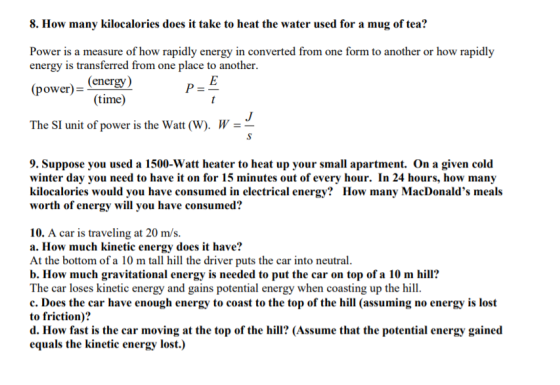
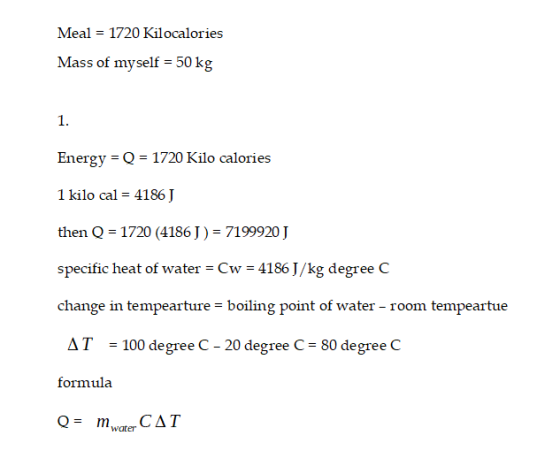
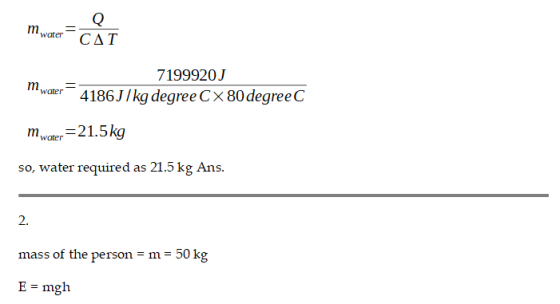
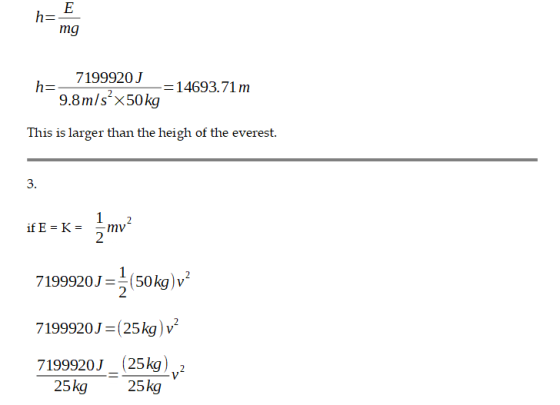
Meal = 1720 Kilocalories
Mass of myself = 50 kg

Homework Answers

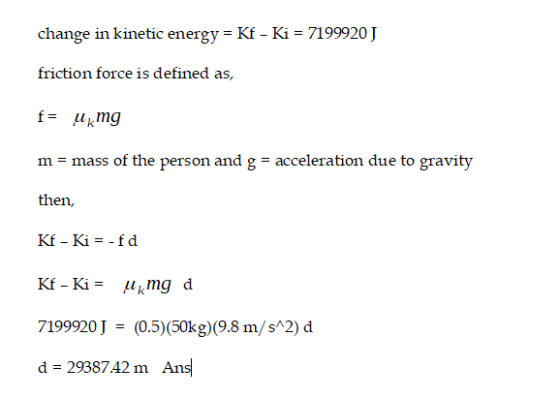
Add Answer to:
Additional info:
Meal = 1720 Kilocalories
Mass of myself = 50 kg
The Joule () is...
A fast food meal has 5660 kJ of energy. A person uses energy at a rate...
A fast food meal has 5660 kJ of energy. A person uses energy at a rate of 380 W while walking. The efficiency of the human body is 25%. If the person is walking up hill, how much of the energy is converted into gravitational potential energy and how much is converted into heat?
A. Food Energy. Energy is stored in food as the potential energy of the electrical bonds...
A. Food Energy. Energy is stored in food as the potential energy of the electrical bonds in molecules. Your body converts food energy to mechanical energy and heat. Food energy is expressed in “calories”, which are actually kilocalories (kcal, with 1 kcal= 4.185 kJ) How many joules are in a 130-kcal serving of breakfast cereal? B. A glass of 1 percent milk contains 130 kcal. How many glasses would a 70-kg person have to drink to get the energy needed...
A 60 kg pole-vaulter runs with an average velocity of 8 m/s down the track. If...
A 60 kg pole-vaulter runs with an average velocity of 8 m/s down the track. If all of the vaulter’s kinetic energy is converted into potential gravitational energy, how high will her center of mass be elevated above her initial height? On another jump, the same vaulter reaches a height of 4 meters. If this height is completely due to the potential strain energy that is stored in the pole, not the kinetic energy related to her running, how much...
5. A 1000-kg car is at the top of a hill as shown, where its elevation...
 5. A 1000-kg car is at the top of a hill as shown, where its elevation above the bottom of the hill is 120 m. a. What is its gravitational potential energy? 120 m b. If the cart starts from rest and rolls down the hill with negligible friction and air resistance, what will its kinetic energy be when it reaches the bottom? c. What will be its speed when it reaches the bottom? Suppose instead that there is noticeable...
In the figure, a frictionless roller coaster car of mass m = 637 kg tops the...
 In the
figure, a frictionless roller coaster car of mass m = 637 kg tops the first
hill with speed v0 = 19.3 m/s at
height h = 37.2 m. How much work
does the gravitational force do on the car from that point
to (a) point A, (b) point B, and (c) point C? If the gravitational
potential energy of the car-Earth system is taken to be zero
at C, what is its value when
the car is at...
In the
figure, a frictionless roller coaster car of mass m = 637 kg tops the first
hill with speed v0 = 19.3 m/s at
height h = 37.2 m. How much work
does the gravitational force do on the car from that point
to (a) point A, (b) point B, and (c) point C? If the gravitational
potential energy of the car-Earth system is taken to be zero
at C, what is its value when
the car is at...
You are testing a new roller coaster ride in which a car of mass m moves...
You are testing a new roller coaster ride in which a car of mass m moves around a vertical circle of radius R. In one test, the car starts at the bottom of the circle (point A) with initial kinetic energy Ki. When the car reaches the top of the circle (point B), its kinetic energy is Ki/4, and its gravitational potential energy has increased by Ki/2. What was the speed of the car at point A, in terms of...
Einstein's mass-energy equation is E=mc 2 , where mass is in kilograms and the speed of...
Einstein's mass-energy equation is E=mc 2 , where mass is in kilograms and the speed of light is 3.00×10⁸m/s. The unit of energy is the joule (4.184J=1cal;1000cal=1kcal,1J=1kg⋅m2/s2). A. Calculate the energy released, in calories, when 5 g of matter is converted to energy. Express your answer with the appropriate units. B. Calculate the energy released, in kilocalories, when 5 g of matter is converted to energy. Express your answer with the appropriate units. C. A bowl of cornflakes supplies 110...
1. I drag a mass m = 21 kg in a straight line, along a horizontal surface,...
1. I drag a mass m = 21 kg in a straight line, along a horizontal surface, a distance D=23 m . I drag it at constant speed v = 0.90 m.s^−1 in a straight line using a horizontal force. The coefficients of friction are μs = 1.2 and μk = 1.1. How much work do I do? W = _____ J . ( Retain accurate values until the final calculation, but remember significant figures. ) 2. A rubber band has mass m...
A car of mass 1100 kg starts from rest at sea level and climbs a hill...
A car of mass 1100 kg starts from rest at sea level and climbs a hill of height 50.0 m. At the top of the hill, the car has a speed of 25.0 m/s, and at this instant, the driver shuts off the engine of the car. The car then coasts down the other side of the hill to height of 15.0 m above sea level. Assume that friction and air resistance are negligibly small. a) (6 pts) How much...
4. A roller-coaster car with a mass of 250 kg carries a 75 kg passenger and...
 4. A roller-coaster car with a mass of 250 kg carries a 75 kg passenger and starts from rest from a point 20 m above the ground. At point C, it is 15 m above the ground. A. What is the initial potential energy of the car (in kJ) at point A? - 75 kg 250. kg B. What is the potential energy at point B? C. If the initial kinetic energy was zero and the work done against friction...
 5. A 1000-kg car is at the top of a hill as shown, where its elevation above the bottom of the hill is 120 m. a. What is its gravitational potential energy? 120 m b. If the cart starts from rest and rolls down the hill with negligible friction and air resistance, what will its kinetic energy be when it reaches the bottom? c. What will be its speed when it reaches the bottom? Suppose instead that there is noticeable...
 In the
figure, a frictionless roller coaster car of mass m = 637 kg tops the first
hill with speed v0 = 19.3 m/s at
height h = 37.2 m. How much work
does the gravitational force do on the car from that point
to (a) point A, (b) point B, and (c) point C? If the gravitational
potential energy of the car-Earth system is taken to be zero
at C, what is its value when
the car is at...
In the
figure, a frictionless roller coaster car of mass m = 637 kg tops the first
hill with speed v0 = 19.3 m/s at
height h = 37.2 m. How much work
does the gravitational force do on the car from that point
to (a) point A, (b) point B, and (c) point C? If the gravitational
potential energy of the car-Earth system is taken to be zero
at C, what is its value when
the car is at...
 4. A roller-coaster car with a mass of 250 kg carries a 75 kg passenger and starts from rest from a point 20 m above the ground. At point C, it is 15 m above the ground. A. What is the initial potential energy of the car (in kJ) at point A? - 75 kg 250. kg B. What is the potential energy at point B? C. If the initial kinetic energy was zero and the work done against friction...
Most questions answered within 3 hours.
-
Where is the error in this code sequence?
String s1 = "Hello";
String s2 = "ello";...
asked 11 months ago -
Financial data for Joel de Paris, Inc., for last year
follow:
Joel de Paris, Inc.
Balance...
asked 11 months ago -
Consider this reaction:
Al2(SO4)3 (aq)+ BaCl3
(aq) Al2Cl6 (aq)- +
3BaSO4(s) . What is the...
asked 11 months ago -
Suppose that Savneet is considering increasing her
recent random sample from 20 car rentals to 40...
asked 11 months ago -
Trucks arrive at an unloading terminal at an average rate of 120
per hour.
Trucks arrive...
asked 11 months ago -
Why are methanol and ethanol completely soluble in water while
octanol is not very little soluble....
asked 11 months ago -
A facilities manager at a university reads in a research report
that the mean amount of...
asked 11 months ago -
When the CuSO4 is rehydrated by adding water to the anhydrous
compound, is this an endothermic...
asked 11 months ago -
A ray of sunlight is passing from diamond into crown glass; the
angle of incidence is...
asked 11 months ago -
A block of mass 0.249 kg is placed on top of a light, vertical
spring of...
asked 11 months ago -
how do the kidneys compensate in the presences of acidosis
a) trigger hyperventilate
b) reserve acid...
asked 11 months ago -
Question 501 pts
The rental rate of capital to the firm increases. Which of the
following...
asked 11 months ago