2. Use the Heckscher-Ohlin model to consider the production of hand-made pottery and silicon microchips in...
Homework Answers
Add Answer to:
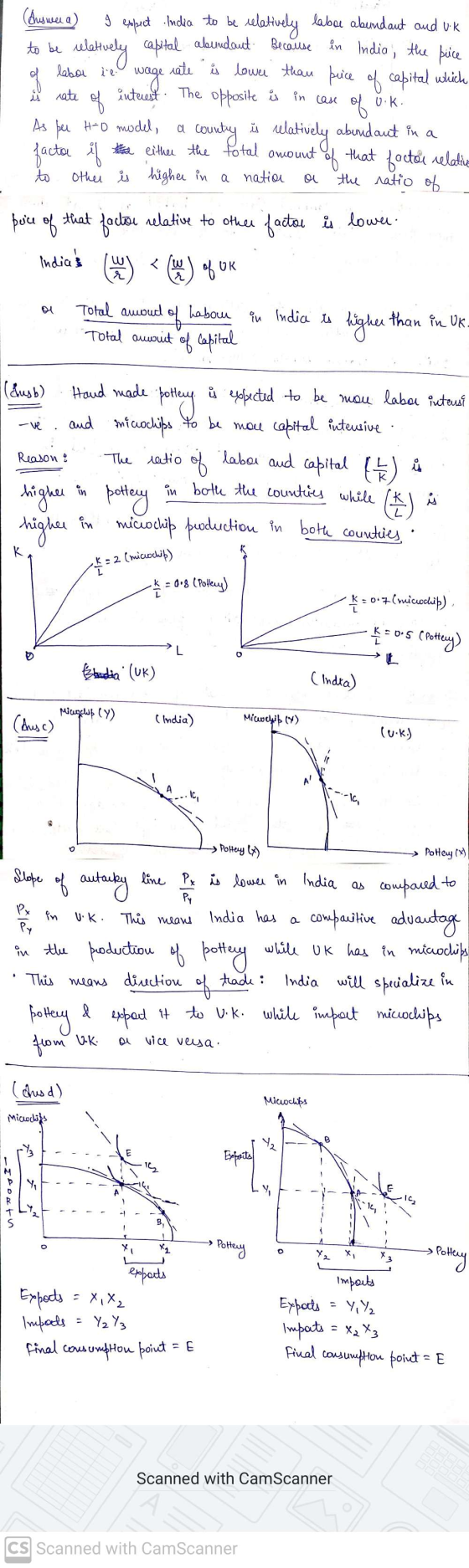
2. Use the Heckscher-Ohlin model to consider the production of
hand-made pottery and silicon microchips in...
1. This problem uses the Heckscher-Ohlin model to predict the direction of trade. Consider the production...
1. This problem uses the Heckscher-Ohlin model to predict the direction of trade. Consider the production of handmade rugs and assembly line robots in Canada and India. a. Which country would you expect to be relatively labor-abundant, and which is capital-abundant? Why? b. Which industry would you expect to be relatively labor-intensive, and which is capital-intensive? Why? c. Given your answers to (a) and (b), draw production possibilities frontiers for each country. Assuming that consumer preferences are the same in...
2. This problem uses the Heckscher-Ohlin model to predict the direction of trade. Consider the production...
 2. This problem uses the Heckscher-Ohlin model to predict the direction of trade. Consider the production of handmade rugs and assembly line robots in Canada and India. a. Which country would you expect to be rela- tively labor-abundant, and which is capital- abundant? Why? b. Which industry would you expect to be rel- atively labor-intensive, and which is capital- intensive? Why? c. Given your answers to (a) and (b), draw production possibilities frontiers for each country. Assurning that consumer preferences...
will have a production possibility In the Heckscher-Ohlin model, the country with the relative abundance of...
 will have a production possibility In the Heckscher-Ohlin model, the country with the relative abundance of frontier that is biased toward the production of the good. Select one: O A. land; labor intensive O B. land; capital intensive C. labor; capital intensive O D. labor; labor intensive In the Heckscher-Ohlin, gains from international trade come from Select one: A. the increased wages. O B. the improvement in technology. C. the increasing on the consumption choices available to consumers. D. the...
2. Answer the following question under the assumptions of the Heckscher-Ohlin model. There are two industries of pr...
 2. Answer the following question under the assumptions of the Heckscher-Ohlin model. There are two industries of production: clothing (Qd) and food (Qr). Clothing is capital-intensive and food is labor-intensive. There are two countries: Home and Foreign. Home is capital abundant and Foreign is labor abundant. (Same as in class) a. Draw a "box" graph that represents the labor and capital inputs into each industry in Home b. What do the slopes of the lines drawn in part (a) represent?...
In the 2-factor, 2 good Heckscher-Ohlin model, a change from autarky (no trade) to trade will benefit the owners of...
 In the 2-factor, 2 good Heckscher-Ohlin model, a change from autarky (no trade) to trade will benefit the owners of: capital the relatively abundant factor of production labor the relatively inelastic factor of production
Starting from an autarky (no-trade) situation with Heckscher-Ohlin model, if Country His relatively labor abundant, then...
 Starting from an autarky (no-trade) situation with Heckscher-Ohlin model, if Country His relatively labor abundant, then once trade begins: c. wage/rent ratio rises in H wage/rent ratio falls in H wage/rent ratio remains constant in H. None of the above.
PROBLEM 1 Consider the typical HO setting: 2 countries, the United States and Canada, produce two goods,...
PROBLEM 1 Consider the typical HO setting: 2 countries, the United States and Canada, produce two goods, maiz (corn) and cloth, with two factors, land and labor. Both countries share the same tastes and the same technology. Maiz production is land intensive, and therefore cloth production is labor intensive. Furthermore, resource endowments are as follows: in the US there are 100 units of labor and 100 of land, in Canada there are 60 units of labor and 90 of land. Which...
These questions are about international trade. I want to know the answers. 5 Heckscher-Ohlin Model. Suppose...
 These questions are about international trade.
I want to know the answers.
5 Heckscher-Ohlin Model. Suppose the production of cloth is labour intensive and the production of food is land intensive and suppose the United States (US) is labour abundant and Canada is land abundant. (a) Show how the US production possibility frontier (PPF) differs from the Canadian PPF. Briefly explain. (Use the general version of the PPF's) (b) Which country will have the lower price of cloth Pc relative...
These questions are about international trade.
I want to know the answers.
5 Heckscher-Ohlin Model. Suppose the production of cloth is labour intensive and the production of food is land intensive and suppose the United States (US) is labour abundant and Canada is land abundant. (a) Show how the US production possibility frontier (PPF) differs from the Canadian PPF. Briefly explain. (Use the general version of the PPF's) (b) Which country will have the lower price of cloth Pc relative...
Heckscher-Ohlin model Country A produces cellphone (C) and food (F) with capital and labor. Both sectors...
Heckscher-Ohlin model Country A produces cellphone (C) and food (F) with capital and labor. Both sectors are perfect competitive. Capital (K) and labor (L) are not substitutable with each other. Thus, unit capital requirement and unit labor requirement are fixed. ??? = 3, ??? = 1, ??? = 2, ??? = 4, where ??? is the number of units of K-capital required to produce and unit of C-cellphone. a. Which sector is relatively capital intensive? Which sector is relatively labor...
Thank you so much. Heckscher-Ohlin Model 2. There are two countries, Home and Foreign. There are...
 Thank you so much.
Heckscher-Ohlin Model 2. There are two countries, Home and Foreign. There are two goods: beer (6) and corn (C), which are produced in both countries using capital (K) and labor (L). In both countries, it takes 2 units of labor and 1 unit of capital to make beer (a Lb = 2, akb = 1); and it takes 5 units of labor and 5 units of capital to make corn (ale = 5, ako = 5)....
Thank you so much.
Heckscher-Ohlin Model 2. There are two countries, Home and Foreign. There are two goods: beer (6) and corn (C), which are produced in both countries using capital (K) and labor (L). In both countries, it takes 2 units of labor and 1 unit of capital to make beer (a Lb = 2, akb = 1); and it takes 5 units of labor and 5 units of capital to make corn (ale = 5, ako = 5)....
 2. This problem uses the Heckscher-Ohlin model to predict the direction of trade. Consider the production of handmade rugs and assembly line robots in Canada and India. a. Which country would you expect to be rela- tively labor-abundant, and which is capital- abundant? Why? b. Which industry would you expect to be rel- atively labor-intensive, and which is capital- intensive? Why? c. Given your answers to (a) and (b), draw production possibilities frontiers for each country. Assurning that consumer preferences...
 will have a production possibility In the Heckscher-Ohlin model, the country with the relative abundance of frontier that is biased toward the production of the good. Select one: O A. land; labor intensive O B. land; capital intensive C. labor; capital intensive O D. labor; labor intensive In the Heckscher-Ohlin, gains from international trade come from Select one: A. the increased wages. O B. the improvement in technology. C. the increasing on the consumption choices available to consumers. D. the...
 2. Answer the following question under the assumptions of the Heckscher-Ohlin model. There are two industries of production: clothing (Qd) and food (Qr). Clothing is capital-intensive and food is labor-intensive. There are two countries: Home and Foreign. Home is capital abundant and Foreign is labor abundant. (Same as in class) a. Draw a "box" graph that represents the labor and capital inputs into each industry in Home b. What do the slopes of the lines drawn in part (a) represent?...
 In the 2-factor, 2 good Heckscher-Ohlin model, a change from autarky (no trade) to trade will benefit the owners of: capital the relatively abundant factor of production labor the relatively inelastic factor of production
 Starting from an autarky (no-trade) situation with Heckscher-Ohlin model, if Country His relatively labor abundant, then once trade begins: c. wage/rent ratio rises in H wage/rent ratio falls in H wage/rent ratio remains constant in H. None of the above.
 These questions are about international trade.
I want to know the answers.
5 Heckscher-Ohlin Model. Suppose the production of cloth is labour intensive and the production of food is land intensive and suppose the United States (US) is labour abundant and Canada is land abundant. (a) Show how the US production possibility frontier (PPF) differs from the Canadian PPF. Briefly explain. (Use the general version of the PPF's) (b) Which country will have the lower price of cloth Pc relative...
These questions are about international trade.
I want to know the answers.
5 Heckscher-Ohlin Model. Suppose the production of cloth is labour intensive and the production of food is land intensive and suppose the United States (US) is labour abundant and Canada is land abundant. (a) Show how the US production possibility frontier (PPF) differs from the Canadian PPF. Briefly explain. (Use the general version of the PPF's) (b) Which country will have the lower price of cloth Pc relative...
 Thank you so much.
Heckscher-Ohlin Model 2. There are two countries, Home and Foreign. There are two goods: beer (6) and corn (C), which are produced in both countries using capital (K) and labor (L). In both countries, it takes 2 units of labor and 1 unit of capital to make beer (a Lb = 2, akb = 1); and it takes 5 units of labor and 5 units of capital to make corn (ale = 5, ako = 5)....
Thank you so much.
Heckscher-Ohlin Model 2. There are two countries, Home and Foreign. There are two goods: beer (6) and corn (C), which are produced in both countries using capital (K) and labor (L). In both countries, it takes 2 units of labor and 1 unit of capital to make beer (a Lb = 2, akb = 1); and it takes 5 units of labor and 5 units of capital to make corn (ale = 5, ako = 5)....
Most questions answered within 3 hours.
-
Where is the error in this code sequence?
String s1 = "Hello";
String s2 = "ello";...
asked 10 months ago -
Financial data for Joel de Paris, Inc., for last year
follow:
Joel de Paris, Inc.
Balance...
asked 10 months ago -
Consider this reaction:
Al2(SO4)3 (aq)+ BaCl3
(aq) Al2Cl6 (aq)- +
3BaSO4(s) . What is the...
asked 10 months ago -
Suppose that Savneet is considering increasing her
recent random sample from 20 car rentals to 40...
asked 10 months ago -
Trucks arrive at an unloading terminal at an average rate of 120
per hour.
Trucks arrive...
asked 10 months ago -
Why are methanol and ethanol completely soluble in water while
octanol is not very little soluble....
asked 10 months ago -
A facilities manager at a university reads in a research report
that the mean amount of...
asked 10 months ago -
When the CuSO4 is rehydrated by adding water to the anhydrous
compound, is this an endothermic...
asked 10 months ago -
A ray of sunlight is passing from diamond into crown glass; the
angle of incidence is...
asked 10 months ago -
A block of mass 0.249 kg is placed on top of a light, vertical
spring of...
asked 10 months ago -
how do the kidneys compensate in the presences of acidosis
a) trigger hyperventilate
b) reserve acid...
asked 10 months ago -
Question 501 pts
The rental rate of capital to the firm increases. Which of the
following...
asked 10 months ago