PART A- Please assist in drawing a step by step mechanism with detailed arrows for the formation of phosphorus ylide. please also give essential reagants where necessary.
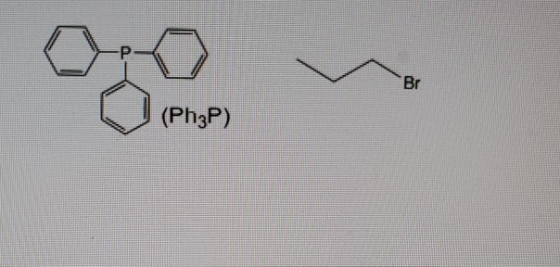
PART B- what would be the proper product of the
reaction in part A with acetone?
Homework Answers
Request Answer!
We need at least 10 more requests to produce the answer.
0 / 10 have requested this problem solution
The more requests, the faster the answer.
Add Answer to:
PART A- Please assist in drawing a step by step
mechanism with detailed arrows for the...
Give the products and produce a step-by-step reaction mechanism of the following reaction. Use curved arrows...
 Give the products and produce a step-by-step reaction mechanism
of the following reaction. Use curved arrows to show the flow of
electrons. Also, show how Ph3P+--C:-HCH2CH3
is prepared.
+ + Ph3P—CHCH2CH3
Give the products and produce a step-by-step reaction mechanism
of the following reaction. Use curved arrows to show the flow of
electrons. Also, show how Ph3P+--C:-HCH2CH3
is prepared.
+ + Ph3P—CHCH2CH3
Draw curved arrows to show the movement of electrons in this step of the mechanism.
 Electrophilic addition of hypohalous acids to alkenes yields a 1,2-haloalcohol called a halohydrin. Halohydrin formation, however, does not result from the addition of HO-Br, for example. Instead the addition is done indirectly by reaction of the alkene with Br2 in the presence of water. The reaction also works with Cl2 to give chlorohydrins instead of bromohydrins. The reaction proceeds through a cyclic intermediate known as a bromonium ion. In the second step of the reaction, water is the nucleophile and reacts with the...
First step correct rest wrong---- Please provide clear drawing with arrows when necessary Hydrolysis of 2-bromo-2-methylpropane...
 First step correct rest
wrong---- Please provide clear drawing with arrows when
necessary
Hydrolysis of 2-bromo-2-methylpropane (tert-butyl bromide) yields 2-methylpropan-2-ol. (CH3)3 CBr + 2H2O rightarrow (CH3)3 COH + H30+ + Br- Give the SN1 mechanism. The reactants are already given in step 1; you need to start by adding curved arrow(s) to the reactants. For each remaining step, draw all species regardless of if they are involved in that step or not. Also, include electrons and charges where necessary. Details...
First step correct rest
wrong---- Please provide clear drawing with arrows when
necessary
Hydrolysis of 2-bromo-2-methylpropane (tert-butyl bromide) yields 2-methylpropan-2-ol. (CH3)3 CBr + 2H2O rightarrow (CH3)3 COH + H30+ + Br- Give the SN1 mechanism. The reactants are already given in step 1; you need to start by adding curved arrow(s) to the reactants. For each remaining step, draw all species regardless of if they are involved in that step or not. Also, include electrons and charges where necessary. Details...
Devise a detailed mechanism for formation of the major product of the elimination reaction below.
 Devise a detailed mechanism for formation of the major product of the elimination reaction below. Draw curved arrows to show electron reorganization for the mechanism step below. Make the ends of your arrows specify the origin and destination of reorganizing electrons. Devise a detailed mechanism for formation of the major product of the elimination reaction below. Draw curved arrows to show electron reorganization for the mechanism step below. Make the ends of your arrows specify the origin and destination of reorganizing electrons. Devise a...
5. Mechanism: (20 pts) Show the detailed reaction mechanism including all relevant arrows, intermediates, inorganic products,...
 5. Mechanism: (20 pts) Show the detailed reaction mechanism including all relevant arrows, intermediates, inorganic products, relevant resonance structures, and stereochemistry for the following reaction heat OH H-Br Step 1 step 2 Step 3 Step 4 Product(s) a. This is a Sx2/S1/E/Ez/ reduction / oxidation mechanism. b. What is the product if the starting alcohol is reacted with PBry? Product(s) with PBry c. Reaction with PBr; is a S2/S1/E/Ez/reduction / oxidation mechanism.
5. Mechanism: (20 pts) Show the detailed reaction mechanism including all relevant arrows, intermediates, inorganic products,...
 5. Mechanism: (20 pts) Show the detailed reaction mechanism including all relevant arrows, intermediates, inorganic products, relevant resonance structures, and stereochemistry for the following reaction. heat OH H-Br step 1 step 2 step 3 step 4 Product(s) a. This is a S2/Sx1/E/E2/ reduction / oxidation mechanism. b. What is the product if the starting alcohol is reacted with PBrz? Product(s) with PBrz c. Reaction with PBr3 is a S2/S1/Ej / E2 / reduction / oxidation mechanism.
1. Provide the products of the reaction below and a detailed reaction mechanism using curved arrows...
 1. Provide the products of the reaction below and a detailed reaction mechanism using curved arrows to indicate the movement of electrons. (a) (b) КОН (c) Note that formation of 4- or 7-membered rings is disfavored. Hiyo KOH acidie workup 2. An interesting problem that involves a bit of review (imines and Grignard chemistry) and application of what you previously learned to a new reaction: The Carbon of an imine functional group (i.e. R.C-NR) is sufficiently electron deficient to be...
Complete the electron-pushing mechanism for the reaction by drawing the necessary organic structures and curved arrows...
 Complete the electron-pushing mechanism for the reaction by
drawing the necessary organic structures and curved arrows for each
step. Make sure to include all nonbonding electron pairs.
Complete the mechanism for the conversion
of the following deuterated alcohol to deuterated chloroalkane via
the mesylate intermediate by adding any missing atoms, bonds,
charges, nonbonding electrons, and curved arrows. Also, select the
correct absolute stereochemistry of the starting material and the
final product. (Note the use of a generic alcohol representing the...
Complete the electron-pushing mechanism for the reaction by
drawing the necessary organic structures and curved arrows for each
step. Make sure to include all nonbonding electron pairs.
Complete the mechanism for the conversion
of the following deuterated alcohol to deuterated chloroalkane via
the mesylate intermediate by adding any missing atoms, bonds,
charges, nonbonding electrons, and curved arrows. Also, select the
correct absolute stereochemistry of the starting material and the
final product. (Note the use of a generic alcohol representing the...
Provide the product of this reaction; please draw a detailed step by step mechanism! Thank you,...
 Provide the product of this reaction; please draw a detailed
step by step mechanism! Thank you, will give a rating!
HO K2CrO tosih H20
Provide the product of this reaction; please draw a detailed
step by step mechanism! Thank you, will give a rating!
HO K2CrO tosih H20
Can you please show ( step by step with arrows )the mechanism for how each reaction...
 Can you please show ( step by step with arrows )the
mechanism for how each reaction came about with its product. Thank
you
1. Br, hv 2. NaOCH, CH,OH 1. BrMgCH2CH3 CH3CH2OCH2CH3 2. dilute HCI. H20 110 DIASTEREAMERS 1. NaBH, CH,OH 2. HCI, H20 Br 141 HBr (excess) NaOC(CH3), HOC(CH3)3
Can you please show ( step by step with arrows )the
mechanism for how each reaction came about with its product. Thank
you
1. Br, hv 2. NaOCH, CH,OH 1. BrMgCH2CH3 CH3CH2OCH2CH3 2. dilute HCI. H20 110 DIASTEREAMERS 1. NaBH, CH,OH 2. HCI, H20 Br 141 HBr (excess) NaOC(CH3), HOC(CH3)3
 Give the products and produce a step-by-step reaction mechanism
of the following reaction. Use curved arrows to show the flow of
electrons. Also, show how Ph3P+--C:-HCH2CH3
is prepared.
+ + Ph3P—CHCH2CH3
Give the products and produce a step-by-step reaction mechanism
of the following reaction. Use curved arrows to show the flow of
electrons. Also, show how Ph3P+--C:-HCH2CH3
is prepared.
+ + Ph3P—CHCH2CH3
 First step correct rest
wrong---- Please provide clear drawing with arrows when
necessary
Hydrolysis of 2-bromo-2-methylpropane (tert-butyl bromide) yields 2-methylpropan-2-ol. (CH3)3 CBr + 2H2O rightarrow (CH3)3 COH + H30+ + Br- Give the SN1 mechanism. The reactants are already given in step 1; you need to start by adding curved arrow(s) to the reactants. For each remaining step, draw all species regardless of if they are involved in that step or not. Also, include electrons and charges where necessary. Details...
First step correct rest
wrong---- Please provide clear drawing with arrows when
necessary
Hydrolysis of 2-bromo-2-methylpropane (tert-butyl bromide) yields 2-methylpropan-2-ol. (CH3)3 CBr + 2H2O rightarrow (CH3)3 COH + H30+ + Br- Give the SN1 mechanism. The reactants are already given in step 1; you need to start by adding curved arrow(s) to the reactants. For each remaining step, draw all species regardless of if they are involved in that step or not. Also, include electrons and charges where necessary. Details...
 5. Mechanism: (20 pts) Show the detailed reaction mechanism including all relevant arrows, intermediates, inorganic products, relevant resonance structures, and stereochemistry for the following reaction heat OH H-Br Step 1 step 2 Step 3 Step 4 Product(s) a. This is a Sx2/S1/E/Ez/ reduction / oxidation mechanism. b. What is the product if the starting alcohol is reacted with PBry? Product(s) with PBry c. Reaction with PBr; is a S2/S1/E/Ez/reduction / oxidation mechanism.
 5. Mechanism: (20 pts) Show the detailed reaction mechanism including all relevant arrows, intermediates, inorganic products, relevant resonance structures, and stereochemistry for the following reaction. heat OH H-Br step 1 step 2 step 3 step 4 Product(s) a. This is a S2/Sx1/E/E2/ reduction / oxidation mechanism. b. What is the product if the starting alcohol is reacted with PBrz? Product(s) with PBrz c. Reaction with PBr3 is a S2/S1/Ej / E2 / reduction / oxidation mechanism.
 1. Provide the products of the reaction below and a detailed reaction mechanism using curved arrows to indicate the movement of electrons. (a) (b) КОН (c) Note that formation of 4- or 7-membered rings is disfavored. Hiyo KOH acidie workup 2. An interesting problem that involves a bit of review (imines and Grignard chemistry) and application of what you previously learned to a new reaction: The Carbon of an imine functional group (i.e. R.C-NR) is sufficiently electron deficient to be...
 Complete the electron-pushing mechanism for the reaction by
drawing the necessary organic structures and curved arrows for each
step. Make sure to include all nonbonding electron pairs.
Complete the mechanism for the conversion
of the following deuterated alcohol to deuterated chloroalkane via
the mesylate intermediate by adding any missing atoms, bonds,
charges, nonbonding electrons, and curved arrows. Also, select the
correct absolute stereochemistry of the starting material and the
final product. (Note the use of a generic alcohol representing the...
Complete the electron-pushing mechanism for the reaction by
drawing the necessary organic structures and curved arrows for each
step. Make sure to include all nonbonding electron pairs.
Complete the mechanism for the conversion
of the following deuterated alcohol to deuterated chloroalkane via
the mesylate intermediate by adding any missing atoms, bonds,
charges, nonbonding electrons, and curved arrows. Also, select the
correct absolute stereochemistry of the starting material and the
final product. (Note the use of a generic alcohol representing the...
 Provide the product of this reaction; please draw a detailed
step by step mechanism! Thank you, will give a rating!
HO K2CrO tosih H20
Provide the product of this reaction; please draw a detailed
step by step mechanism! Thank you, will give a rating!
HO K2CrO tosih H20
 Can you please show ( step by step with arrows )the
mechanism for how each reaction came about with its product. Thank
you
1. Br, hv 2. NaOCH, CH,OH 1. BrMgCH2CH3 CH3CH2OCH2CH3 2. dilute HCI. H20 110 DIASTEREAMERS 1. NaBH, CH,OH 2. HCI, H20 Br 141 HBr (excess) NaOC(CH3), HOC(CH3)3
Can you please show ( step by step with arrows )the
mechanism for how each reaction came about with its product. Thank
you
1. Br, hv 2. NaOCH, CH,OH 1. BrMgCH2CH3 CH3CH2OCH2CH3 2. dilute HCI. H20 110 DIASTEREAMERS 1. NaBH, CH,OH 2. HCI, H20 Br 141 HBr (excess) NaOC(CH3), HOC(CH3)3
Most questions answered within 3 hours.
-
Where is the error in this code sequence?
String s1 = "Hello";
String s2 = "ello";...
asked 10 months ago -
Financial data for Joel de Paris, Inc., for last year
follow:
Joel de Paris, Inc.
Balance...
asked 10 months ago -
Consider this reaction:
Al2(SO4)3 (aq)+ BaCl3
(aq) Al2Cl6 (aq)- +
3BaSO4(s) . What is the...
asked 10 months ago -
Suppose that Savneet is considering increasing her
recent random sample from 20 car rentals to 40...
asked 10 months ago -
Trucks arrive at an unloading terminal at an average rate of 120
per hour.
Trucks arrive...
asked 10 months ago -
Why are methanol and ethanol completely soluble in water while
octanol is not very little soluble....
asked 10 months ago -
A facilities manager at a university reads in a research report
that the mean amount of...
asked 10 months ago -
When the CuSO4 is rehydrated by adding water to the anhydrous
compound, is this an endothermic...
asked 10 months ago -
A ray of sunlight is passing from diamond into crown glass; the
angle of incidence is...
asked 10 months ago -
A block of mass 0.249 kg is placed on top of a light, vertical
spring of...
asked 10 months ago -
how do the kidneys compensate in the presences of acidosis
a) trigger hyperventilate
b) reserve acid...
asked 10 months ago -
Question 501 pts
The rental rate of capital to the firm increases. Which of the
following...
asked 10 months ago