
Homework Answers
Answer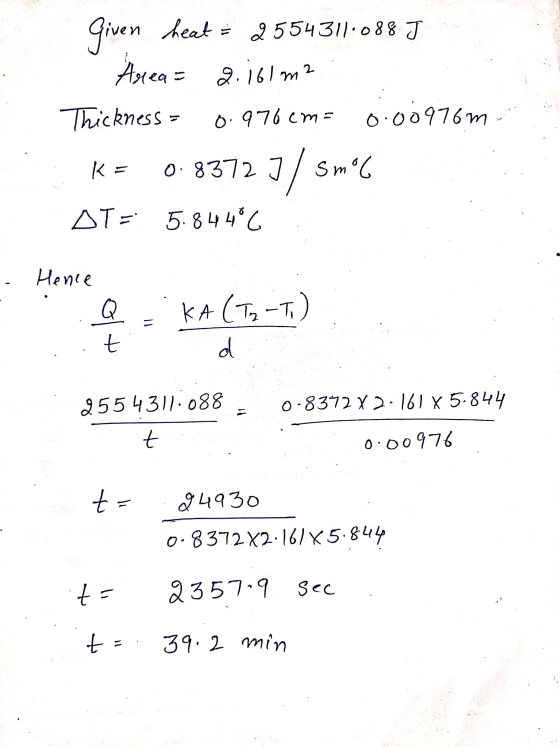
Add Answer to:
Question 7 1 pts How long will it take, in seconds, to transfer 2,554,311.088 J of...
How long will it take, in seconds, to transfer 1,972,190.861 J of heat through a 4.537...
How long will it take, in seconds, to transfer 1,972,190.861 J of heat through a 4.537 m^2 pane of 0.197 cm thick glass (k = 0.8372 J/smøC) if the temperature differential is 19.156øC?
A Thermopane window consists of two glass panes, each 0.50 cm thick, with a 1.0 cm...
A Thermopane window consists of two glass panes, each 0.50 cm thick, with a 1.0 cm thick sealed layer of air between. If the inside temperature is 23.5°C and the outside temperature is 0.0°C, determine the rate of heat transfer through 2.0 m2 of the window. Compare this with the rate of heat transfer through 2.0 m2 of a single 1.0 cm thick pane of glass. J/s (Thermopane window) J/s (Single pane window)
please answer the 2 questions :) Question 8 A tank of water has been outdoors in...
 please answer the 2 questions :)
Question 8 A tank of water has been outdoors in cold weather, and a slab of ice 3.9 cm thick has formed on its surface (see the figure). The air above the ice is at 13°C. Calculate the rate of formation of ice (in centimeters per hour) on the ice slab. Take the thermal conductivity of ice to be 0.0040 cal/s cm-C°, its density to be 0.92 g/cm3, and its latent heat of fusion...
please answer the 2 questions :)
Question 8 A tank of water has been outdoors in cold weather, and a slab of ice 3.9 cm thick has formed on its surface (see the figure). The air above the ice is at 13°C. Calculate the rate of formation of ice (in centimeters per hour) on the ice slab. Take the thermal conductivity of ice to be 0.0040 cal/s cm-C°, its density to be 0.92 g/cm3, and its latent heat of fusion...
I figured out the first question but im not sure how to answer question 2 and 3?
 i
figured out the first question but im not sure how to answer
question 2 and 3?
i
have figured out question 2. Question #3 is what is diffcult to
grasp because i have to guess my Fo #. Fo=time
1. To reduce building heating costs, modern building codes in many parts of the country require the use of double-pane windows (sometimes, called "double-glazed" or "thermopane" windows). Some of In one design of a double-pane window, each glass layer is...
i
figured out the first question but im not sure how to answer
question 2 and 3?
i
have figured out question 2. Question #3 is what is diffcult to
grasp because i have to guess my Fo #. Fo=time
1. To reduce building heating costs, modern building codes in many parts of the country require the use of double-pane windows (sometimes, called "double-glazed" or "thermopane" windows). Some of In one design of a double-pane window, each glass layer is...
Question 13 (1 point) How much heat (in MJ) does it take to completely convert 0.80...
 Question 13 (1 point) How much heat (in MJ) does it take to completely convert 0.80 kg of ice initially at a temperature of -15°C to steam (water vapor) at a final temperature of 130°C? Specific heats (in J/kg.K): ice (2100), water (4190), steam (2000) Latent heats (in J/kg): fusion (3.34 x 10⁵), vaporization (2.256 X 10⁶) 1.0 2.0 1.5 2.5 0.5 3.0
30. How much heat energy, in joules, is required to raise the temperature of 1 mole of sulfur from 100. to 500.°C? S...
 30. How much heat energy, in joules, is required to raise the temperature of 1 mole of sulfur from 100. to 500.°C? Specific heat for sulfur is 0.705 J/g-°C. a. 280 b. 1.28 X 10⁴ c. 9.04 X 10³ d. 22.6 e. 567 31. What is the final temperature, in °C, when 60.0 g of water at 80°C is mixed with 40.0 g of water at 25°C? The specific heat of water is 4.184 J/g-°C. a. 53 b. 58 c....
An ice cube with a mass of 46.4 g at 0.0 ∘C is added to a...
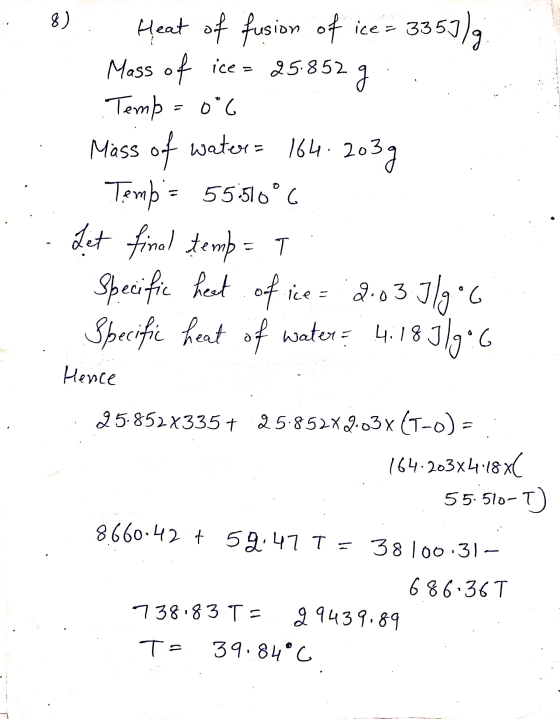
An ice cube with a mass of 46.4 g at 0.0 ∘C is added to a glass containing 4.20×10² g of water at 45.0 ∘C . Determine the final temperature of the system at equilibrium. The specific heat capacity of water, ?s , is 4.184 J/g⋅∘C , and the standard enthalpy of fusion, Δ?∘fus , of water is 6.01×10³ J/mol . Assume that no energy is transferred to or from the surroundings.
An ice cube with a mass of 53.0 g at 0.0 °C is added to a...
An ice cube with a mass of 53.0 g at 0.0 °C is added to a glass containing 368 g of water at 45.0 °C. Determine the final temperature of the system at equilibrium. The specific heat capacity of water, Cs, is 4.184 J/g·°C and the standard enthalpy of fusion, ΔH°fus, of water is 6.01 × 10³ J/mol. Assume that no energy is transferred to or from the surroundings.
To reduce building heating costs, modern building codes in many parts of the country require the...
 To reduce building heating costs, modern building codes in many parts of the country require the use of double-pane windows (sometimes, called "double-glazed" or "thermopane" windows). Ivpically, a double-pane window consists of two panes of glass separated by a space that contains trapped stagnant air. In one design of a double-pane window, each glass layer is 0.7 cm thick, the stagnant air layer is 2 cm thick, and the area is 4 m2 In the living room of a large...
Question 17 3 pts A 771.0-kg copper bar is put into a smelter for melting. The...
 Question 17 3 pts A 771.0-kg copper bar is put into a smelter for melting. The initial temperature of the copper is 300.0 K. How much heat must the smelter produce to completely melt the copper bar? The specific heat for copper is 386 J/kg · K, the heat of fusion for copper is 205,000 J/kg, and its melting point is 1357 K. O 3.15 x 10¹¹kg 4.73 x 10⁵ kJ 3.15 x 10⁸ kJ 5.62× 10⁵ kJ Question 18...
 please answer the 2 questions :)
Question 8 A tank of water has been outdoors in cold weather, and a slab of ice 3.9 cm thick has formed on its surface (see the figure). The air above the ice is at 13°C. Calculate the rate of formation of ice (in centimeters per hour) on the ice slab. Take the thermal conductivity of ice to be 0.0040 cal/s cm-C°, its density to be 0.92 g/cm3, and its latent heat of fusion...
please answer the 2 questions :)
Question 8 A tank of water has been outdoors in cold weather, and a slab of ice 3.9 cm thick has formed on its surface (see the figure). The air above the ice is at 13°C. Calculate the rate of formation of ice (in centimeters per hour) on the ice slab. Take the thermal conductivity of ice to be 0.0040 cal/s cm-C°, its density to be 0.92 g/cm3, and its latent heat of fusion...
 i
figured out the first question but im not sure how to answer
question 2 and 3?
i
have figured out question 2. Question #3 is what is diffcult to
grasp because i have to guess my Fo #. Fo=time
1. To reduce building heating costs, modern building codes in many parts of the country require the use of double-pane windows (sometimes, called "double-glazed" or "thermopane" windows). Some of In one design of a double-pane window, each glass layer is...
i
figured out the first question but im not sure how to answer
question 2 and 3?
i
have figured out question 2. Question #3 is what is diffcult to
grasp because i have to guess my Fo #. Fo=time
1. To reduce building heating costs, modern building codes in many parts of the country require the use of double-pane windows (sometimes, called "double-glazed" or "thermopane" windows). Some of In one design of a double-pane window, each glass layer is...
 Question 13 (1 point) How much heat (in MJ) does it take to completely convert 0.80 kg of ice initially at a temperature of -15°C to steam (water vapor) at a final temperature of 130°C? Specific heats (in J/kg.K): ice (2100), water (4190), steam (2000) Latent heats (in J/kg): fusion (3.34 x 10⁵), vaporization (2.256 X 10⁶) 1.0 2.0 1.5 2.5 0.5 3.0
 30. How much heat energy, in joules, is required to raise the temperature of 1 mole of sulfur from 100. to 500.°C? Specific heat for sulfur is 0.705 J/g-°C. a. 280 b. 1.28 X 10⁴ c. 9.04 X 10³ d. 22.6 e. 567 31. What is the final temperature, in °C, when 60.0 g of water at 80°C is mixed with 40.0 g of water at 25°C? The specific heat of water is 4.184 J/g-°C. a. 53 b. 58 c....
 To reduce building heating costs, modern building codes in many parts of the country require the use of double-pane windows (sometimes, called "double-glazed" or "thermopane" windows). Ivpically, a double-pane window consists of two panes of glass separated by a space that contains trapped stagnant air. In one design of a double-pane window, each glass layer is 0.7 cm thick, the stagnant air layer is 2 cm thick, and the area is 4 m2 In the living room of a large...
 Question 17 3 pts A 771.0-kg copper bar is put into a smelter for melting. The initial temperature of the copper is 300.0 K. How much heat must the smelter produce to completely melt the copper bar? The specific heat for copper is 386 J/kg · K, the heat of fusion for copper is 205,000 J/kg, and its melting point is 1357 K. O 3.15 x 10¹¹kg 4.73 x 10⁵ kJ 3.15 x 10⁸ kJ 5.62× 10⁵ kJ Question 18...
Most questions answered within 3 hours.
-
Where is the error in this code sequence?
String s1 = "Hello";
String s2 = "ello";...
asked 10 months ago -
Financial data for Joel de Paris, Inc., for last year
follow:
Joel de Paris, Inc.
Balance...
asked 10 months ago -
Consider this reaction:
Al2(SO4)3 (aq)+ BaCl3
(aq) Al2Cl6 (aq)- +
3BaSO4(s) . What is the...
asked 10 months ago -
Suppose that Savneet is considering increasing her
recent random sample from 20 car rentals to 40...
asked 10 months ago -
Trucks arrive at an unloading terminal at an average rate of 120
per hour.
Trucks arrive...
asked 10 months ago -
Why are methanol and ethanol completely soluble in water while
octanol is not very little soluble....
asked 10 months ago -
A facilities manager at a university reads in a research report
that the mean amount of...
asked 10 months ago -
When the CuSO4 is rehydrated by adding water to the anhydrous
compound, is this an endothermic...
asked 10 months ago -
A ray of sunlight is passing from diamond into crown glass; the
angle of incidence is...
asked 10 months ago -
A block of mass 0.249 kg is placed on top of a light, vertical
spring of...
asked 10 months ago -
how do the kidneys compensate in the presences of acidosis
a) trigger hyperventilate
b) reserve acid...
asked 10 months ago -
Question 501 pts
The rental rate of capital to the firm increases. Which of the
following...
asked 10 months ago