
Homework Answers
![IS Seary) da = 39 - 13 x 4 / 4 Lentas] EIF np (1 + 8), S EI = Up (f + x) SS](http://img.homeworklib.com/questions/e6a911b0-1cad-11eb-9082-79cf21261380.png?x-oss-process=image/resize,w_560)
Add Answer to:
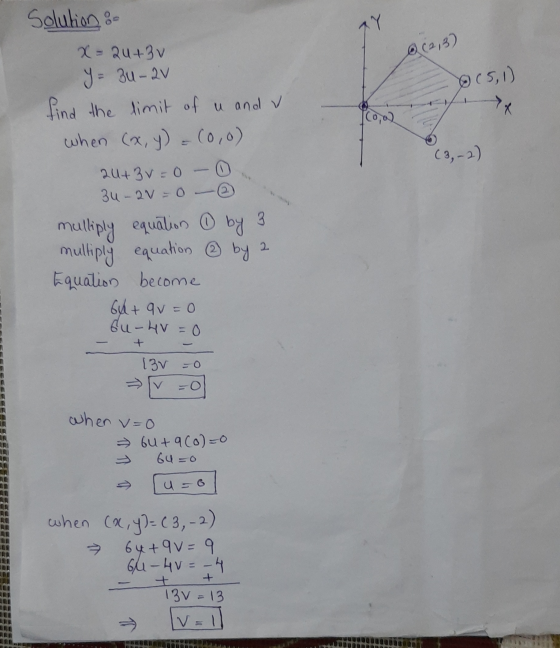
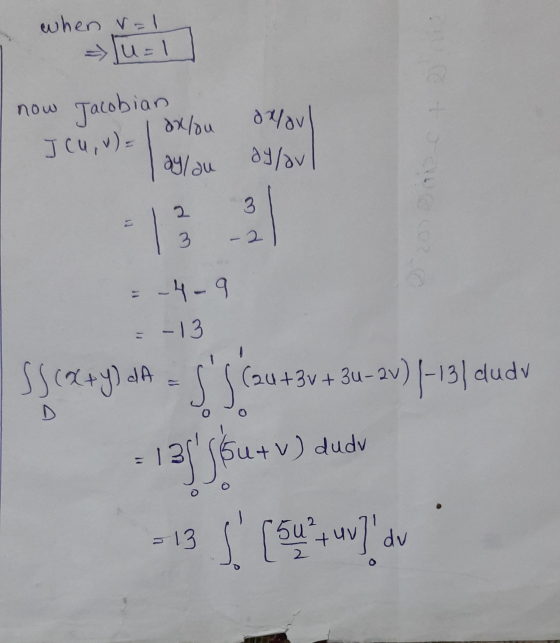
2. Use the transformation X= 2ut 3v and y=3u-Zv to evaluate (xrydd where D is the...
Using Change of Variables.. Evaluate ∫∫ R 15y/x dA where R is the region bounded by xy = 2, xy = 6 , y = 4 and y =10 using the transformation x=v , y=2u/3v.
 Using Change of Variables..Evaluate ∫∫ R 15y/x dA where R is the region bounded by xy = 2, xy = 6 , y = 4 and y =10 usingthe transformation x=v , y=2u/3v.
Use the given transformation to evaluate the given integral, where R is the parallelogram with vertices...
 Use the given transformation to evaluate the given integral, where R is the parallelogram with vertices (-2, 6), (2, -6), (5,-3), and (1,9). L = SUR(16.+12y) dA; r = {(u +v), y=(v – 3u) L =
Let I=∫∫∫4zdV over the region D where D is the parallelepiped {(x,y,z):3≤y+z≤8,−2≤z−y≤5,1≤x−y≤3.}...
Let I=∫∫∫4zdV over the region D where D is the parallelepiped {(x,y,z):3≤y+z≤8,−2≤z−y≤5,1≤x−y≤3.} Find an appropriate transformation that maps D to a rectangular box in uvw space. Then use the Jacobian to simplify and evaluate I. I=
QUESTION 4 Use the appropriate transformation to evaluate SX (2x + y)(x - y)dA where R...
 QUESTION 4 Use the appropriate transformation to evaluate SX (2x + y)(x - y)dA where R is the region bounded by the line y = 4 - 2x, y = 7 - 2x, y = x - 2 and y = x +1. (8 marks)
1. Use Green's theorem to evaluate the integral $ xy dx - x^2 y^3 dy, where...
 1. Use Green's theorem to evaluate the integral $ xy dx - x^2 y^3 dy, where C is the triangle with vertices (0,0), (1,0) y (1,2)
5. Evaluate SS x+2y da where R is the triangle with vertices (0,3), (4,1), and (2,6)....
 5. Evaluate SS x+2y da where R is the triangle with vertices (0,3), (4,1), and (2,6). Use the transformation x=-(u- *=£cu-v),= (3u+v+12). 6. Evaluate S 2 ydx+(1 – x)dy along the curve C given by y=1 –x" from x = -1 to x = 2.
Use the given transformation to evaluate the integral. -5x dx dy where R is the parallelogram bou...
 Use the given transformation to evaluate the integral. -5x dx dy where R is the parallelogram bounded by the linesy-x+1, y-x +4 y#2x+2y»2x + 5 A) -5 B) 10 C)5 D)-10 32) y+ x where R is the trapezoid with vertices at (6,0), ,0).。. 6), (0.9) 45 45 B) ÷ sin l 45 C) sin 2 45 A) sin 2
Use the given transformation to evaluate the integral. -5x dx dy where R is the parallelogram bounded by the linesy-x+1,...
Use the given transformation to evaluate the integral. -5x dx dy where R is the parallelogram bounded by the linesy-x+1, y-x +4 y#2x+2y»2x + 5 A) -5 B) 10 C)5 D)-10 32) y+ x where R is the trapezoid with vertices at (6,0), ,0).。. 6), (0.9) 45 45 B) ÷ sin l 45 C) sin 2 45 A) sin 2
Use the given transformation to evaluate the integral. -5x dx dy where R is the parallelogram bounded by the linesy-x+1,...
(b) Evaluate the double integral e(y-2)/(y+2) dA where D is the triangle with vertices (0,0), (2,0)...
 (b) Evaluate the double integral e(y-2)/(y+2) dA where D is the triangle with vertices (0,0), (2,0) and (0,2). (Hint: Change variables, let u = y - x and v = y + x.)
Use the given transformation to evaluate the integral Sa 3x² d A where is the region...
 Use the given transformation to evaluate the integral Sa 3x² d A where is the region bounded by the ellipse 16x² +257 = 400 and the transformation is x = 50, yehv
...HELPPPP....Use Green’s theorem to evaluate Z C (−y + √3 x 2 )dx + (x 3...
 ...HELPPPP....Use Green’s theorem to evaluate Z C (−y + √3 x 2
)dx + (x 3 − ln (y 2 ))dy where C is the rectangle with vertices
(0, 0), (1, 0), (0, 2), and (1, 2).
4. Use Green's theorem to evaluate vertices (0,0), (1,0), (0, 2), and (1,2). Sc(-y + V 22)dx + (z? – In (y?))dy where C is the rectangle with
...HELPPPP....Use Green’s theorem to evaluate Z C (−y + √3 x 2
)dx + (x 3 − ln (y 2 ))dy where C is the rectangle with vertices
(0, 0), (1, 0), (0, 2), and (1, 2).
4. Use Green's theorem to evaluate vertices (0,0), (1,0), (0, 2), and (1,2). Sc(-y + V 22)dx + (z? – In (y?))dy where C is the rectangle with
 Use the given transformation to evaluate the given integral, where R is the parallelogram with vertices (-2, 6), (2, -6), (5,-3), and (1,9). L = SUR(16.+12y) dA; r = {(u +v), y=(v – 3u) L =
 QUESTION 4 Use the appropriate transformation to evaluate SX (2x + y)(x - y)dA where R is the region bounded by the line y = 4 - 2x, y = 7 - 2x, y = x - 2 and y = x +1. (8 marks)
 1. Use Green's theorem to evaluate the integral $ xy dx - x^2 y^3 dy, where C is the triangle with vertices (0,0), (1,0) y (1,2)
 5. Evaluate SS x+2y da where R is the triangle with vertices (0,3), (4,1), and (2,6). Use the transformation x=-(u- *=£cu-v),= (3u+v+12). 6. Evaluate S 2 ydx+(1 – x)dy along the curve C given by y=1 –x" from x = -1 to x = 2.
 Use the given transformation to evaluate the integral. -5x dx dy where R is the parallelogram bounded by the linesy-x+1, y-x +4 y#2x+2y»2x + 5 A) -5 B) 10 C)5 D)-10 32) y+ x where R is the trapezoid with vertices at (6,0), ,0).。. 6), (0.9) 45 45 B) ÷ sin l 45 C) sin 2 45 A) sin 2
Use the given transformation to evaluate the integral. -5x dx dy where R is the parallelogram bounded by the linesy-x+1,...
Use the given transformation to evaluate the integral. -5x dx dy where R is the parallelogram bounded by the linesy-x+1, y-x +4 y#2x+2y»2x + 5 A) -5 B) 10 C)5 D)-10 32) y+ x where R is the trapezoid with vertices at (6,0), ,0).。. 6), (0.9) 45 45 B) ÷ sin l 45 C) sin 2 45 A) sin 2
Use the given transformation to evaluate the integral. -5x dx dy where R is the parallelogram bounded by the linesy-x+1,...
 (b) Evaluate the double integral e(y-2)/(y+2) dA where D is the triangle with vertices (0,0), (2,0) and (0,2). (Hint: Change variables, let u = y - x and v = y + x.)
 Use the given transformation to evaluate the integral Sa 3x² d A where is the region bounded by the ellipse 16x² +257 = 400 and the transformation is x = 50, yehv
 ...HELPPPP....Use Green’s theorem to evaluate Z C (−y + √3 x 2
)dx + (x 3 − ln (y 2 ))dy where C is the rectangle with vertices
(0, 0), (1, 0), (0, 2), and (1, 2).
4. Use Green's theorem to evaluate vertices (0,0), (1,0), (0, 2), and (1,2). Sc(-y + V 22)dx + (z? – In (y?))dy where C is the rectangle with
...HELPPPP....Use Green’s theorem to evaluate Z C (−y + √3 x 2
)dx + (x 3 − ln (y 2 ))dy where C is the rectangle with vertices
(0, 0), (1, 0), (0, 2), and (1, 2).
4. Use Green's theorem to evaluate vertices (0,0), (1,0), (0, 2), and (1,2). Sc(-y + V 22)dx + (z? – In (y?))dy where C is the rectangle with
Most questions answered within 3 hours.
-
Where is the error in this code sequence?
String s1 = "Hello";
String s2 = "ello";...
asked 11 months ago -
Financial data for Joel de Paris, Inc., for last year
follow:
Joel de Paris, Inc.
Balance...
asked 11 months ago -
Consider this reaction:
Al2(SO4)3 (aq)+ BaCl3
(aq) Al2Cl6 (aq)- +
3BaSO4(s) . What is the...
asked 11 months ago -
Suppose that Savneet is considering increasing her
recent random sample from 20 car rentals to 40...
asked 11 months ago -
Trucks arrive at an unloading terminal at an average rate of 120
per hour.
Trucks arrive...
asked 11 months ago -
Why are methanol and ethanol completely soluble in water while
octanol is not very little soluble....
asked 11 months ago -
A facilities manager at a university reads in a research report
that the mean amount of...
asked 11 months ago -
When the CuSO4 is rehydrated by adding water to the anhydrous
compound, is this an endothermic...
asked 11 months ago -
A ray of sunlight is passing from diamond into crown glass; the
angle of incidence is...
asked 11 months ago -
A block of mass 0.249 kg is placed on top of a light, vertical
spring of...
asked 11 months ago -
how do the kidneys compensate in the presences of acidosis
a) trigger hyperventilate
b) reserve acid...
asked 11 months ago -
Question 501 pts
The rental rate of capital to the firm increases. Which of the
following...
asked 11 months ago