
Homework Answers
Add Answer to:
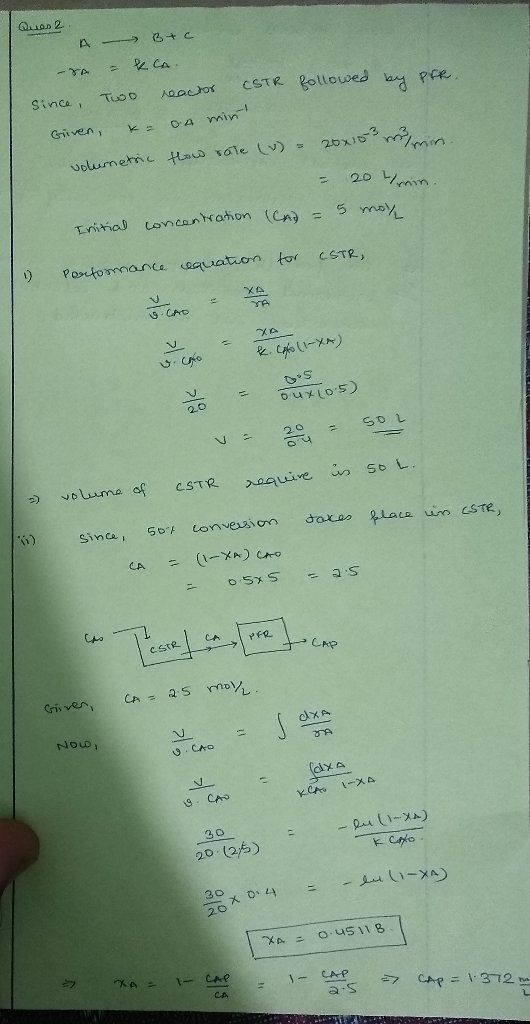
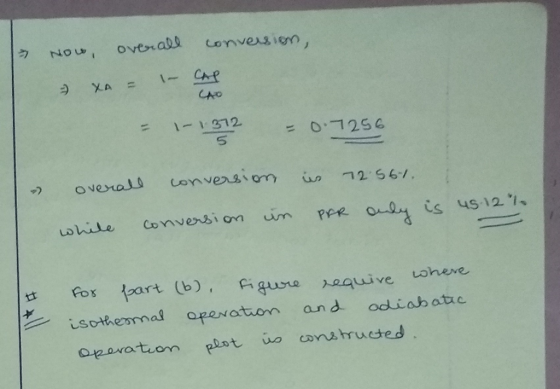
QUESTION 2: Design of Multiple Reactors: 30 marks B +C was a a) An elementary reaction...
Question 1: Design of isothermal reactors 30 Marks The irreversible, gas-phase reaction A+B D is to be carried out...
 Question 1: Design of isothermal reactors 30 Marks The irreversible, gas-phase reaction A+B D is to be carried out in an isotherma °C) plug-flow reactor (PFR) at 5.0 atm. The mole fractions of the feed streams are A 0 B 0.50, and inerts 0.30. The activation energy for the above reaction is 80 000 cal/mol. the pressure drop due to fluid friction in the reactor is so small that it can be ignored, perform the following tasks: 2T a s...
QUESTION 5: 10 marks An elementary aqueous phase reaction A --> B+C is to be carried...
 QUESTION 5: 10 marks An elementary aqueous phase reaction A --> B+C is to be carried out in 10 points a non-ideal CSTR which has both bypassing and a dead zone in it. The measured liquid volume in the reactor is 500 dm3 and the volumetric flow rate to the reactor is 10 dm3/min with a concentration of A as Imol/dm3. The reaction rate constant is 0.5 min^-1. a) Calculate the conversion that can be expected in this reactor if...
3. The gas phase reaction A B -C, withkCACB, is to be carried out in a...
 3. The gas phase reaction A B -C, withkCACB, is to be carried out in a steady-state PFR with feed composition of 60% A. 40% B, 0% C and 0% inerts. In the 50 L reactor, 60% of the stoichiometrically limiting reactant is converted. It is desired to achieve 85% conversion of this reactant by placing a CSTR after the PFR. How large should the CSTR be? Consider constant pressure operation in both reactors.
advanced CRE subject step by step solution QUESTION 5: 10 marks An elementary aqueous phase reaction...
 advanced CRE subject
step by step solution
QUESTION 5: 10 marks An elementary aqueous phase reaction A --> B+C is to be carried out in 10 point a non-ideal CSTR which has both bypassing and a dead zone in it. The measured liquid volume in the reactor is 500 dm3 and the volumetric flow rate to the reactor is 10 dm3/min with a concentration of A as Imol/dm3. The reaction rate constant is 0.5 min-1. a) Calculate the conversion that...
advanced CRE subject
step by step solution
QUESTION 5: 10 marks An elementary aqueous phase reaction A --> B+C is to be carried out in 10 point a non-ideal CSTR which has both bypassing and a dead zone in it. The measured liquid volume in the reactor is 500 dm3 and the volumetric flow rate to the reactor is 10 dm3/min with a concentration of A as Imol/dm3. The reaction rate constant is 0.5 min-1. a) Calculate the conversion that...
R1 - LIQUID PHASE CHEMICAL REACTOR The elementary liquid phase reaction given below is carried out...
 R1 - LIQUID PHASE CHEMICAL REACTOR The elementary liquid phase reaction given below is carried out in a CSTR by isothermal operation. k > NaOAC + EtOH k = 3.59 L/mol.min NaOH + EtOAC (A) (B) (C) (D) The volume of the CSTR is 2 L and the flowrates of the feeds in the individual streams are 50 ml/min for both reactants. The concentrations of NaOH and EtoAc are 0.05 mol/L and 0.1 mol/L, respectively. [6] a) Calculate the conversion...
The reversible liquid reaction 2A ↔ B + C is carried out in an isothermal CSTR...
The reversible liquid reaction 2A ↔ B + C is carried out in an isothermal CSTR with no pressure drop. The feed has an A concentration of 0.1 lbmol/ft3 and T=300K. The forward reaction rate constant is 1800 ft3/lbmol-s and the concentration equilibrium constant is 0.3. a. Determine the equilibrium conversion. b. Determine the reactor volume necessary to achieve 98% of the equilibrium conversion of A if the feed is 10 lb mol/min.
[TOTAL 30 MARKS! A plug flow reactor (C le and reaction is reversible and represented by...
 [TOTAL 30 MARKS! A plug flow reactor (C le and reaction is reversible and represented by (0,04 minT)CA - (0,01 min- 2.2. 2.3, Find the equilibrium conversion Find the actual conversion of A in the reactor We wish to achieve 97.5% of the equilibrium n by adding a CSTR in series with the plug flow reactor. What volume must the CSTR be in order to achieve this? TOTAL 20 MARKS Pure gaseous A at about 3 vanous Row rates. There...
The elementary gas phase reaction (A <--> 2B) is to be carried out in an adiabatic...
The elementary gas phase reaction (A <--> 2B) is to be carried out in an adiabatic CSTR. The feed which is at a temperature of 27oC, consists of 80% of A and the remainder inerts. The volumetric flow rate entering the reactor at this temperature is 100 l/min. The concentration of A in the feed at 27oC is 0.5 mol/liter. For 80% of the adiabatic equilibrium conversion, calculate the required reactor volume. DATA: CpA=12 J/mol.K; CpB=10 J/mol.K; CpI=15 J/mol.K deltaHrxn=-75000...
. Question 2: The elementary, reversible, organic, liquid-phase reaction is carried out adiabatically in a CSTR...
 .
Question 2: The elementary, reversible, organic, liquid-phase reaction is carried out adiabatically in a CSTR where 65% conversion is achiewd Ated'anonn of A and 50% excess 8, enters the reactor at 27°C with a volumetric flow rate of 2 L/s and a Cos of O.1 mol/L culate the temperature inside the reactor 2. Calculate the equilibrium conversion at the operating temperature. How close (in 3. Calculate the CSTR volume percentage) the conversion is from the equilsbrium conversion? If the...
.
Question 2: The elementary, reversible, organic, liquid-phase reaction is carried out adiabatically in a CSTR where 65% conversion is achiewd Ated'anonn of A and 50% excess 8, enters the reactor at 27°C with a volumetric flow rate of 2 L/s and a Cos of O.1 mol/L culate the temperature inside the reactor 2. Calculate the equilibrium conversion at the operating temperature. How close (in 3. Calculate the CSTR volume percentage) the conversion is from the equilsbrium conversion? If the...
QUESTION 1: 20 marks 20 points It is planned to carry out the following second-order, elementary,...
 QUESTION 1: 20 marks 20 points It is planned to carry out the following second-order, elementary, non- catalytic gas-phase reaction in an adiabatic CSTR: A+B_C+3D. Only A and B (no inerts) are fed to the reactor at equimolar flow rates of 150 mol/min each. The rate constant is related to the temperature by Arrhenius law as follows: k = 37.68x10^10 exp(-80000/RT) L/mol.min. The heats of formation of A, B, C and D (at 298 K) in kJ/mol are -235.3, -393.5,...
 Question 1: Design of isothermal reactors 30 Marks The irreversible, gas-phase reaction A+B D is to be carried out in an isotherma °C) plug-flow reactor (PFR) at 5.0 atm. The mole fractions of the feed streams are A 0 B 0.50, and inerts 0.30. The activation energy for the above reaction is 80 000 cal/mol. the pressure drop due to fluid friction in the reactor is so small that it can be ignored, perform the following tasks: 2T a s...
 QUESTION 5: 10 marks An elementary aqueous phase reaction A --> B+C is to be carried out in 10 points a non-ideal CSTR which has both bypassing and a dead zone in it. The measured liquid volume in the reactor is 500 dm3 and the volumetric flow rate to the reactor is 10 dm3/min with a concentration of A as Imol/dm3. The reaction rate constant is 0.5 min^-1. a) Calculate the conversion that can be expected in this reactor if...
 3. The gas phase reaction A B -C, withkCACB, is to be carried out in a steady-state PFR with feed composition of 60% A. 40% B, 0% C and 0% inerts. In the 50 L reactor, 60% of the stoichiometrically limiting reactant is converted. It is desired to achieve 85% conversion of this reactant by placing a CSTR after the PFR. How large should the CSTR be? Consider constant pressure operation in both reactors.
 advanced CRE subject
step by step solution
QUESTION 5: 10 marks An elementary aqueous phase reaction A --> B+C is to be carried out in 10 point a non-ideal CSTR which has both bypassing and a dead zone in it. The measured liquid volume in the reactor is 500 dm3 and the volumetric flow rate to the reactor is 10 dm3/min with a concentration of A as Imol/dm3. The reaction rate constant is 0.5 min-1. a) Calculate the conversion that...
advanced CRE subject
step by step solution
QUESTION 5: 10 marks An elementary aqueous phase reaction A --> B+C is to be carried out in 10 point a non-ideal CSTR which has both bypassing and a dead zone in it. The measured liquid volume in the reactor is 500 dm3 and the volumetric flow rate to the reactor is 10 dm3/min with a concentration of A as Imol/dm3. The reaction rate constant is 0.5 min-1. a) Calculate the conversion that...
 R1 - LIQUID PHASE CHEMICAL REACTOR The elementary liquid phase reaction given below is carried out in a CSTR by isothermal operation. k > NaOAC + EtOH k = 3.59 L/mol.min NaOH + EtOAC (A) (B) (C) (D) The volume of the CSTR is 2 L and the flowrates of the feeds in the individual streams are 50 ml/min for both reactants. The concentrations of NaOH and EtoAc are 0.05 mol/L and 0.1 mol/L, respectively. [6] a) Calculate the conversion...
 [TOTAL 30 MARKS! A plug flow reactor (C le and reaction is reversible and represented by (0,04 minT)CA - (0,01 min- 2.2. 2.3, Find the equilibrium conversion Find the actual conversion of A in the reactor We wish to achieve 97.5% of the equilibrium n by adding a CSTR in series with the plug flow reactor. What volume must the CSTR be in order to achieve this? TOTAL 20 MARKS Pure gaseous A at about 3 vanous Row rates. There...
 .
Question 2: The elementary, reversible, organic, liquid-phase reaction is carried out adiabatically in a CSTR where 65% conversion is achiewd Ated'anonn of A and 50% excess 8, enters the reactor at 27°C with a volumetric flow rate of 2 L/s and a Cos of O.1 mol/L culate the temperature inside the reactor 2. Calculate the equilibrium conversion at the operating temperature. How close (in 3. Calculate the CSTR volume percentage) the conversion is from the equilsbrium conversion? If the...
.
Question 2: The elementary, reversible, organic, liquid-phase reaction is carried out adiabatically in a CSTR where 65% conversion is achiewd Ated'anonn of A and 50% excess 8, enters the reactor at 27°C with a volumetric flow rate of 2 L/s and a Cos of O.1 mol/L culate the temperature inside the reactor 2. Calculate the equilibrium conversion at the operating temperature. How close (in 3. Calculate the CSTR volume percentage) the conversion is from the equilsbrium conversion? If the...
 QUESTION 1: 20 marks 20 points It is planned to carry out the following second-order, elementary, non- catalytic gas-phase reaction in an adiabatic CSTR: A+B_C+3D. Only A and B (no inerts) are fed to the reactor at equimolar flow rates of 150 mol/min each. The rate constant is related to the temperature by Arrhenius law as follows: k = 37.68x10^10 exp(-80000/RT) L/mol.min. The heats of formation of A, B, C and D (at 298 K) in kJ/mol are -235.3, -393.5,...
Most questions answered within 3 hours.
-
Where is the error in this code sequence?
String s1 = "Hello";
String s2 = "ello";...
asked 10 months ago -
Financial data for Joel de Paris, Inc., for last year
follow:
Joel de Paris, Inc.
Balance...
asked 10 months ago -
Consider this reaction:
Al2(SO4)3 (aq)+ BaCl3
(aq) Al2Cl6 (aq)- +
3BaSO4(s) . What is the...
asked 10 months ago -
Suppose that Savneet is considering increasing her
recent random sample from 20 car rentals to 40...
asked 10 months ago -
Trucks arrive at an unloading terminal at an average rate of 120
per hour.
Trucks arrive...
asked 10 months ago -
Why are methanol and ethanol completely soluble in water while
octanol is not very little soluble....
asked 10 months ago -
A facilities manager at a university reads in a research report
that the mean amount of...
asked 10 months ago -
When the CuSO4 is rehydrated by adding water to the anhydrous
compound, is this an endothermic...
asked 10 months ago -
A ray of sunlight is passing from diamond into crown glass; the
angle of incidence is...
asked 10 months ago -
A block of mass 0.249 kg is placed on top of a light, vertical
spring of...
asked 10 months ago -
how do the kidneys compensate in the presences of acidosis
a) trigger hyperventilate
b) reserve acid...
asked 10 months ago -
Question 501 pts
The rental rate of capital to the firm increases. Which of the
following...
asked 10 months ago