
Homework Answers
The answer is B. Given a number 'n' we need to calculate the sum of the following series
which can further be simplified into the following form
To get the sum of the above series, we need to first find
compute the value of
and add it to the sum of the
, which is upto (n-1)th term.
Now, to get the sum of the above series, we need to first compute
the value of
and it to the sum of the remaining series
, which is upto (n-2)th term. And so on, we compute the value of
the entire series, in a recursive manner.
The following function does the same thing as discussed above. It
first computes the value of 1/(n * n) and add it to the sum of the
series upto (n-1)th term, computed in a recursive manner. Each time
you go on decrementing n by 1 until you reach 1. At this point you
will return 1 and all the terms starts up getting added.
double computePI(int number) {
if (number <= 1) {
return 1.0;
// This is the base case
}
return 1 / (number * number ) + computePI(number - 1);
}
Add Answer to:
below o A double coer utePI(int eurber) 1) return (number comput PI(number number) return (number return...
Suppose we have three variables declared as char *pc; int *pi; struct point {double x; double...
Suppose we have three variables declared as char *pc; int *pi; struct point {double x; double y;}; struct point *p1; struct point *p2[10]; Assume sizeof(char)=1, sizeof(int)=4, sizeof(double)=8. The values of pc, pi, p1 and p2 are 240, 258, 410 and 480 respectively. What are the values of pc+1, pi+2, p1+4 and p2+3
double sinLoops (double x) { int i = 7; //this didn't exist. double result = 1/(m+1)...
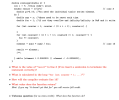 double sinLoops (double x) { int i = 7; //this didn't exist. double result = 1/(m+1) // line 3 double pi=3.14; //You need the individual taylor series element. do { double num = x; //these need to be reset each time. double fac = 1; //if not they overflow and infinity/infinity is NaN and it exits. for (int counter = 1; counter < (2 * i + 1); counter++) { } (2 * i + 1); counter2 >= 1; counter2--)...
Program 2 #include <iostream> #include <cmath> using namespace std; int main() { const double PI...
Program 2 #include <iostream> #include <cmath> using namespace std; int main() { const double PI = 3.141592653; int degrees; double radians; cout << "Enter a value for the degree of an angle\n"; cin >> degrees; // translate the formula for converting degrees to radians into C++: // // degrees x PI // ------------ = radians // 180 radians = _____________________________________; // Refer to p. 127 for help below....
Given following method, public static double getQuotient (int num1, int num2){ return num1/(double) num2; } Write...
Given following method, public static double getQuotient (int num1, int num2){ return num1/(double) num2; } Write Java statement to invoke the method.
Consider the following program: # include <iostream> using namesapce std; void Func(int a, int bl double...
 Consider the following program: # include <iostream> using namesapce std; void Func(int a, int bl double number-25.0: int main) f int x-18, y-20; cout<c"Before: x- kex<" and y-eyecendl; Fundxy 1// end of main void Funcfint a, int b) int sum a+b; a-200; b-300; numberanumber+1.0 Which of the statements below are correct? (Select only the correct answers. There may be more than one) D A The statement double number-25.0; declares a global variable number B. The variables x and y are...
Big-O notation for each public static double accumulate (double[] a) { double sum = 0.0; for...
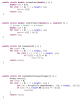 Big-O notation for each
public static double accumulate (double[] a) { double sum = 0.0; for (int i = 0; i < a.length; i++) sum += a[i]; return sum; } public static double innerProduct(double[] a, double[] b) { // assume a. length == b.length double sum = 0; for (int i = 0; i < a.length; i++) sum += a[i] * b[i]; return sum; } public static int twoSum(int[] a) { int count = 0; for (int i = 0;...
Big-O notation for each
public static double accumulate (double[] a) { double sum = 0.0; for (int i = 0; i < a.length; i++) sum += a[i]; return sum; } public static double innerProduct(double[] a, double[] b) { // assume a. length == b.length double sum = 0; for (int i = 0; i < a.length; i++) sum += a[i] * b[i]; return sum; } public static int twoSum(int[] a) { int count = 0; for (int i = 0;...
c++ • return type function name (parameter); • Ex: int Joe(int, int); • Ex: void gg(int,...
 c++
• return type function name (parameter); • Ex: int Joe(int, int); • Ex: void gg(int, float); • Ex: double Two_sol(double, double, double): 2. fC → function call • Ex: cout << Joe(); • Ex: Joe(5, 0); 3. fD → function definition return type function name of STATEMENT(S) return function name: **program84 Void functions to print "Welcome to the world of functions!" programs. To print the sum and product of 2 numbers using functions w/out parameters. program86: to print the...
c++
• return type function name (parameter); • Ex: int Joe(int, int); • Ex: void gg(int, float); • Ex: double Two_sol(double, double, double): 2. fC → function call • Ex: cout << Joe(); • Ex: Joe(5, 0); 3. fD → function definition return type function name of STATEMENT(S) return function name: **program84 Void functions to print "Welcome to the world of functions!" programs. To print the sum and product of 2 numbers using functions w/out parameters. program86: to print the...
typedef double (*price_fn)(void* obj); typedef double (*bulk_price_fn)(void* obj, unsigned int quantity); // Compares the price of...
typedef double (*price_fn)(void* obj); typedef double (*bulk_price_fn)(void* obj, unsigned int quantity); // Compares the price of obj1 with obj2 // Returns a negative number if the price of obj1 is less than the price of obj2 // Returns a positive number if the price of obj1 is greater than the price of obj2 // Returns 0 if the price of obj1 is equal to the price of obj2 int compare_by_price(Object* obj1, Object* obj2) { // IMPLEMENT THIS return...
Rewrite the following for loop into a whileloop. 1 2 3 4 int s = 0;...
 Rewrite the following for loop into a
whileloop.
1
2
3
4
int s = 0;
for (int i = 1; i <= 10; i++) {
s = s + i;
}
Given variables int n and
double pi, write a snippet of code that assigns to
pi the approximation of π resulting from adding the first
nterms in the Gregory-Leibniz series:
Given
variables int areaBound and int
sum, write a snippet of code that assigns to sum the result...
Rewrite the following for loop into a
whileloop.
1
2
3
4
int s = 0;
for (int i = 1; i <= 10; i++) {
s = s + i;
}
Given variables int n and
double pi, write a snippet of code that assigns to
pi the approximation of π resulting from adding the first
nterms in the Gregory-Leibniz series:
Given
variables int areaBound and int
sum, write a snippet of code that assigns to sum the result...
#include<iostream> using namespace std; double hey(int x){ if(x==2) return 1; int i=0; if (x%2==0){ while(i<=2){ cout<<(x/2)<<endl;...
#include<iostream> using namespace std; double hey(int x){ if(x==2) return 1; int i=0; if (x%2==0){ while(i<=2){ cout<<(x/2)<<endl; i++; break; } } if (x%2==1){ while(i<=2){ i=3*x+1; cout<<i<<endl; } return 1; } } int main() { int n; cout<<"insert a number to check how many steps to reduce down to 2"<<endl; cin>>n; cout<<hey(n)<<endl; return 0; } I couldn't
 double sinLoops (double x) { int i = 7; //this didn't exist. double result = 1/(m+1) // line 3 double pi=3.14; //You need the individual taylor series element. do { double num = x; //these need to be reset each time. double fac = 1; //if not they overflow and infinity/infinity is NaN and it exits. for (int counter = 1; counter < (2 * i + 1); counter++) { } (2 * i + 1); counter2 >= 1; counter2--)...
 Consider the following program: # include <iostream> using namesapce std; void Func(int a, int bl double number-25.0: int main) f int x-18, y-20; cout<c"Before: x- kex<" and y-eyecendl; Fundxy 1// end of main void Funcfint a, int b) int sum a+b; a-200; b-300; numberanumber+1.0 Which of the statements below are correct? (Select only the correct answers. There may be more than one) D A The statement double number-25.0; declares a global variable number B. The variables x and y are...
 Big-O notation for each
public static double accumulate (double[] a) { double sum = 0.0; for (int i = 0; i < a.length; i++) sum += a[i]; return sum; } public static double innerProduct(double[] a, double[] b) { // assume a. length == b.length double sum = 0; for (int i = 0; i < a.length; i++) sum += a[i] * b[i]; return sum; } public static int twoSum(int[] a) { int count = 0; for (int i = 0;...
Big-O notation for each
public static double accumulate (double[] a) { double sum = 0.0; for (int i = 0; i < a.length; i++) sum += a[i]; return sum; } public static double innerProduct(double[] a, double[] b) { // assume a. length == b.length double sum = 0; for (int i = 0; i < a.length; i++) sum += a[i] * b[i]; return sum; } public static int twoSum(int[] a) { int count = 0; for (int i = 0;...
 c++
• return type function name (parameter); • Ex: int Joe(int, int); • Ex: void gg(int, float); • Ex: double Two_sol(double, double, double): 2. fC → function call • Ex: cout << Joe(); • Ex: Joe(5, 0); 3. fD → function definition return type function name of STATEMENT(S) return function name: **program84 Void functions to print "Welcome to the world of functions!" programs. To print the sum and product of 2 numbers using functions w/out parameters. program86: to print the...
c++
• return type function name (parameter); • Ex: int Joe(int, int); • Ex: void gg(int, float); • Ex: double Two_sol(double, double, double): 2. fC → function call • Ex: cout << Joe(); • Ex: Joe(5, 0); 3. fD → function definition return type function name of STATEMENT(S) return function name: **program84 Void functions to print "Welcome to the world of functions!" programs. To print the sum and product of 2 numbers using functions w/out parameters. program86: to print the...
 Rewrite the following for loop into a
whileloop.
1
2
3
4
int s = 0;
for (int i = 1; i <= 10; i++) {
s = s + i;
}
Given variables int n and
double pi, write a snippet of code that assigns to
pi the approximation of π resulting from adding the first
nterms in the Gregory-Leibniz series:
Given
variables int areaBound and int
sum, write a snippet of code that assigns to sum the result...
Rewrite the following for loop into a
whileloop.
1
2
3
4
int s = 0;
for (int i = 1; i <= 10; i++) {
s = s + i;
}
Given variables int n and
double pi, write a snippet of code that assigns to
pi the approximation of π resulting from adding the first
nterms in the Gregory-Leibniz series:
Given
variables int areaBound and int
sum, write a snippet of code that assigns to sum the result...
Most questions answered within 3 hours.
-
Where is the error in this code sequence?
String s1 = "Hello";
String s2 = "ello";...
asked 10 months ago -
Financial data for Joel de Paris, Inc., for last year
follow:
Joel de Paris, Inc.
Balance...
asked 10 months ago -
Consider this reaction:
Al2(SO4)3 (aq)+ BaCl3
(aq) Al2Cl6 (aq)- +
3BaSO4(s) . What is the...
asked 10 months ago -
Suppose that Savneet is considering increasing her
recent random sample from 20 car rentals to 40...
asked 10 months ago -
Trucks arrive at an unloading terminal at an average rate of 120
per hour.
Trucks arrive...
asked 10 months ago -
Why are methanol and ethanol completely soluble in water while
octanol is not very little soluble....
asked 10 months ago -
A facilities manager at a university reads in a research report
that the mean amount of...
asked 10 months ago -
When the CuSO4 is rehydrated by adding water to the anhydrous
compound, is this an endothermic...
asked 10 months ago -
A ray of sunlight is passing from diamond into crown glass; the
angle of incidence is...
asked 10 months ago -
A block of mass 0.249 kg is placed on top of a light, vertical
spring of...
asked 10 months ago -
how do the kidneys compensate in the presences of acidosis
a) trigger hyperventilate
b) reserve acid...
asked 10 months ago -
Question 501 pts
The rental rate of capital to the firm increases. Which of the
following...
asked 10 months ago