Assume that the economy is hit with successive positive demand shocks, lowering unemployment and inflation. What...
Assume that the economy is hit with successive positive demand shocks, lowering unemployment and inflation. What policy would the central bank pursue if the decrease in inflation lowered inflation below their target (assuming the CB is operating under an inflation rule for monetary policy).
Homework Answers
This has to be understood first how a positive demand shock can decrease both inflation and unemployment.
Suppose the government of the country imposes a reduction in taxes rates – like income tax, sales tax, excise tax, etc. This increases purchasing power of consumers; it increases aggregate demand (AD) and the curve should shift to the right as AD1. This also increases supply facilities (like lower taxes of inputs); therefore, the short run aggregate supply (SRAS) should shift to the right as SRAS1.
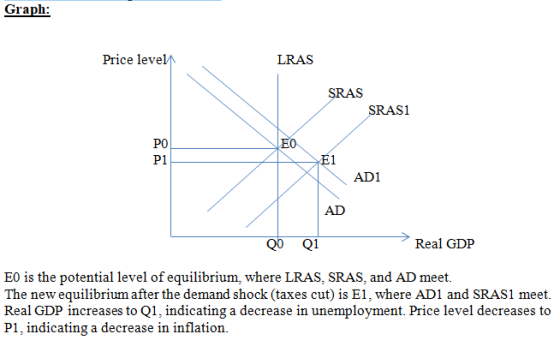
If the rate of inflation becomes too low (below the target), the CB has to take a policy that reduces the gap between SRAS and SRAS1, or increases the gap between AD and AD1, or both.
The CB should take an Expansionary Monetary policy. It includes a reduction in interest rates, purchase of government bonds in open market, etc. Any one policy could have been taken. This increases money supply in the market, which increases purchasing power, and a shift of AD curve to the right further. This policy should shift SRAS curve to left as well, since inputs prices increase. The net effect is the increase in price level in a way so that the target inflation could be achieved.
Add Answer to:
Assume that the economy is hit with successive positive demand
shocks, lowering unemployment and inflation. What...
Create your own monetary policy rule that would insulate the aggregate economy completely from aggregate demand...
Create your own monetary policy rule that would insulate the aggregate economy completely from aggregate demand shocks - so that neither inflation nor output would change if an aggregate demand shock hit the economy. Explain why your policy works. (Assume that policymakers can observe the aggregate demand shocks directly)
Consider an economy in which the unemployment rate is at the natural level and the inflation...
Consider an economy in which the unemployment rate is at the natural level and the inflation rate is 10%. Suppose that the domestic central bank wants to reduce inflation to 5%. Starting from year t the central bank reduces the money supply in such a way that unemployment remains above the natural level by one percent each year. After 5 years the inflation reaches the new target of 5%. Compute the sacrifice ratio of this policy. What is the slope...
Supposed that the targeted inflation rate by the Central Bank is 3%. However, a positive supply...
Supposed that the targeted inflation rate by the Central Bank is 3%. However, a positive supply shocks and a contraction of aggregate demand has caused the current level of inflation rate is below than its targeted level. a. Using IS-PC-MR model, explain how the central bank stabilize the inflation rate. b. Discuss the relationship between the central bank preferences with the two strategies to stabilize the inflation rate, namely a ‘cold turkey’ and ‘gradualist’. c. Explain the cost and the...
1. How the AD/AS Model incorporation Growth, Unemployment, and inflation. 2. What causes changes in unemployment...
1. How the AD/AS Model incorporation Growth, Unemployment, and inflation. 2. What causes changes in unemployment over the short run? 3. How a central bank excutes monetary policy? 4. What is rule of law with examples
1. Is the Phillips curve a myth? Intertemporal tradeoff between inflation and unemployment After the World...
 1. Is the Phillips curve a myth? Intertemporal tradeoff between inflation and unemployment After the World War II, empirical economists noticed that, in many advanced economies, as unemployment fell, inflation tended to rise, and vice versa. The inverse relationship between unemployment and Inflation, was depicted as the Phillips curve, after William Phillips of the London School of Economics. In the 1950s and 1960s, the Phillips curve convinced many policy makers that they could use the relationship to pick acceptable levels...
Assume the economy is in short-run equilibrium with significant unemployment. The Central Bank policymakers do not...
Assume the economy is in short-run equilibrium with significant unemployment. The Central Bank policymakers do not want the interest rates to fall, and there is no current threat of inflation. What course of action can the policymakers follow to move the economy toward full employment? Should they use monetary policy? Explain how they should do that.
14) Suppose the AE curve is mis-measured such that the Central Bank under- estimates the effects...
 14) Suppose the AE curve is mis-measured such that the Central Bank under- estimates the effects of interest rates on expenditure. The economy starts off at Y* and TT and then experiences an adverse supply shock. The Central Bank follows non-accommodative policy using the incorrectly measured AE curve. For simplicity assume there are no lags. This leaves the economy in which of the following states? a) Recession; inflation above target b) Recession; inflation below target c) Expansion; inflation above target...
6. 7. Inflation targeting and the Taylor rule in the IS-LM model Consider a closed economy...
 6.
7.
Inflation targeting and the Taylor rule in the IS-LM model Consider a closed economy in which the central bank follows an interest rate rule. The IS relation is given by Y C(Y- T) I(Y,r) G Where r is the real interest rate. The central bank sets the nominal interest rate according to the rule i = i* + a(n° =- T*) + b(Y- Y1) Where T is expected inflation, T* is the target rate of inflation, and Yn...
6.
7.
Inflation targeting and the Taylor rule in the IS-LM model Consider a closed economy in which the central bank follows an interest rate rule. The IS relation is given by Y C(Y- T) I(Y,r) G Where r is the real interest rate. The central bank sets the nominal interest rate according to the rule i = i* + a(n° =- T*) + b(Y- Y1) Where T is expected inflation, T* is the target rate of inflation, and Yn...
6. 7. Inflation targeting and the Taylor rule in the IS-LM model Consider a closed economy...
 6.
7.
Inflation targeting and the Taylor rule in the IS-LM model Consider a closed economy in which the central bank follows an interest rate rule. The IS relation is given by Y C(Y- T) I(Y,r) G Where r is the real interest rate. The central bank sets the nominal interest rate according to the rule i = i* + a(n° =- T*) + b(Y- Y1) Where T is expected inflation, T* is the target rate of inflation, and Yn...
6.
7.
Inflation targeting and the Taylor rule in the IS-LM model Consider a closed economy in which the central bank follows an interest rate rule. The IS relation is given by Y C(Y- T) I(Y,r) G Where r is the real interest rate. The central bank sets the nominal interest rate according to the rule i = i* + a(n° =- T*) + b(Y- Y1) Where T is expected inflation, T* is the target rate of inflation, and Yn...
1.Milton Friedman argued that: the natural rate of unemployment will be lowered. the effectiveness of expansionary...
1.Milton Friedman argued that: the natural rate of unemployment will be lowered. the effectiveness of expansionary fiscal policy is often limited by the effects of crowding out. a discretionary monetary policy should be used to offset the fluctuations of the business cycle. a central bank following a monetary policy rule would destabilize the economy. 2. If inventories in an economy increase unexpectedly, actual investment exceeds planned investment True False 3. In presenting his analogy of the “invisible hand,” Adam Smith...
 1. Is the Phillips curve a myth? Intertemporal tradeoff between inflation and unemployment After the World War II, empirical economists noticed that, in many advanced economies, as unemployment fell, inflation tended to rise, and vice versa. The inverse relationship between unemployment and Inflation, was depicted as the Phillips curve, after William Phillips of the London School of Economics. In the 1950s and 1960s, the Phillips curve convinced many policy makers that they could use the relationship to pick acceptable levels...
 14) Suppose the AE curve is mis-measured such that the Central Bank under- estimates the effects of interest rates on expenditure. The economy starts off at Y* and TT and then experiences an adverse supply shock. The Central Bank follows non-accommodative policy using the incorrectly measured AE curve. For simplicity assume there are no lags. This leaves the economy in which of the following states? a) Recession; inflation above target b) Recession; inflation below target c) Expansion; inflation above target...
 6.
7.
Inflation targeting and the Taylor rule in the IS-LM model Consider a closed economy in which the central bank follows an interest rate rule. The IS relation is given by Y C(Y- T) I(Y,r) G Where r is the real interest rate. The central bank sets the nominal interest rate according to the rule i = i* + a(n° =- T*) + b(Y- Y1) Where T is expected inflation, T* is the target rate of inflation, and Yn...
6.
7.
Inflation targeting and the Taylor rule in the IS-LM model Consider a closed economy in which the central bank follows an interest rate rule. The IS relation is given by Y C(Y- T) I(Y,r) G Where r is the real interest rate. The central bank sets the nominal interest rate according to the rule i = i* + a(n° =- T*) + b(Y- Y1) Where T is expected inflation, T* is the target rate of inflation, and Yn...
 6.
7.
Inflation targeting and the Taylor rule in the IS-LM model Consider a closed economy in which the central bank follows an interest rate rule. The IS relation is given by Y C(Y- T) I(Y,r) G Where r is the real interest rate. The central bank sets the nominal interest rate according to the rule i = i* + a(n° =- T*) + b(Y- Y1) Where T is expected inflation, T* is the target rate of inflation, and Yn...
6.
7.
Inflation targeting and the Taylor rule in the IS-LM model Consider a closed economy in which the central bank follows an interest rate rule. The IS relation is given by Y C(Y- T) I(Y,r) G Where r is the real interest rate. The central bank sets the nominal interest rate according to the rule i = i* + a(n° =- T*) + b(Y- Y1) Where T is expected inflation, T* is the target rate of inflation, and Yn...
Most questions answered within 3 hours.
-
Where is the error in this code sequence?
String s1 = "Hello";
String s2 = "ello";...
asked 11 months ago -
Financial data for Joel de Paris, Inc., for last year
follow:
Joel de Paris, Inc.
Balance...
asked 11 months ago -
Consider this reaction:
Al2(SO4)3 (aq)+ BaCl3
(aq) Al2Cl6 (aq)- +
3BaSO4(s) . What is the...
asked 11 months ago -
Suppose that Savneet is considering increasing her
recent random sample from 20 car rentals to 40...
asked 11 months ago -
Trucks arrive at an unloading terminal at an average rate of 120
per hour.
Trucks arrive...
asked 11 months ago -
Why are methanol and ethanol completely soluble in water while
octanol is not very little soluble....
asked 11 months ago -
A facilities manager at a university reads in a research report
that the mean amount of...
asked 11 months ago -
When the CuSO4 is rehydrated by adding water to the anhydrous
compound, is this an endothermic...
asked 11 months ago -
A ray of sunlight is passing from diamond into crown glass; the
angle of incidence is...
asked 11 months ago -
A block of mass 0.249 kg is placed on top of a light, vertical
spring of...
asked 11 months ago -
how do the kidneys compensate in the presences of acidosis
a) trigger hyperventilate
b) reserve acid...
asked 11 months ago -
Question 501 pts
The rental rate of capital to the firm increases. Which of the
following...
asked 11 months ago