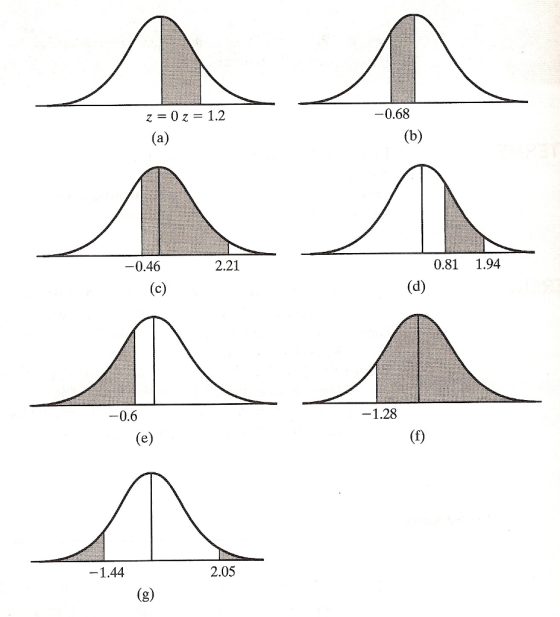
Using the “NormalDistributionTable.pdf” Table, find the areas under the curve in each of the cases in the following figure. (Remember that the total area under the curve is equal to one, and this area is divided in two equal (0.50) areas by the mean, at the peak value of the bell shape.)
Homework Answers
a)
b)
c)
d)
e)
f)
g)
Add Answer to:
Using the “NormalDistributionTable.pdf” Table, find the areas
under the curve in each of the cases in...
Use the table of areas under the standard normal curve to find the probability that a...
Use the table of areas under the standard normal curve to find the probability that a z-score from the standard normal distribution will lie within the interval. (Round your answer to four decimal places.) 0 ≤ z ≤ 1.5 −0.8 ≤ z ≤ 0 −0.8 ≤ z ≤ −0.6 −1.6 ≤ z ≤ 2.4
Use a table of areas to find the specified area under the standard normal curve. 12)...
Use a table of areas to find the specified area under the standard normal curve. 12) The area that lies between 0 and 3.01 A) 0.4987 B) 0.9987 C) 0.5013 How is A the answer and not B?
Use a table of cumulative areas under the normal curve to find the z-score that corresponds to the given cumulative area
Use a table of cumulative areas under the normal curve to find the z-score that corresponds to the given cumulative area. If the area is not in the table, use the entry closest to the area. If the area is halfway between two entries, use the z-score halfway between the corresponding z-scores. If convenient, use technology to find the z-score.0.049The cumulative area corresponds to the z-score of _______
12 Find the percent of area under a normal curve between the mean and - 1.12...
 12
Find the percent of area under a normal curve between the mean and - 1.12 standard deviations from the mean. (Note that positive indicates above the mean, while negative indicates below the mean.) Click here to see page 1 of the table for areas under the standard normal curve Click here to see page 2 of the table for areas under the standard normal curve. %. The percentage of area under a normal curve between the mean and -1.12...
12
Find the percent of area under a normal curve between the mean and - 1.12 standard deviations from the mean. (Note that positive indicates above the mean, while negative indicates below the mean.) Click here to see page 1 of the table for areas under the standard normal curve Click here to see page 2 of the table for areas under the standard normal curve. %. The percentage of area under a normal curve between the mean and -1.12...
1. Use a standard normal table to obtain the areas under the normal curve described below....
1. Use a standard normal table to obtain the areas under the normal curve described below. Sketch a standard normal curve and shade the area of interest. a. The area either to the left of negative 1.71 or to the right of 1.09. b. The area either to the left of 0.58 or to the right of 1.63. 2. A variable is normally distributed with mean 13 and standard deviation 4 a. Find the percentage of all possible values of...
Use a table of cumulative areas under the normal curve to find the z-score that corresponds to the given cumulative area
Use a table of cumulative areas under the normal curve to find the z-score that corresponds to the given cumulative area. If the area is not in the table, use the entry closest to the area. If the area is halfway between two entries, use the z-score halfway between the corresponding z-scores. If convenient, use technology to find the z-score.0.053Click to view page 1 of the table. Click to view page 2 of the table.The cumulative area corresponds to the...
Using table II to obtain the areas under the standard normal curve required in exercises 6.59-6.66....
Using table II to obtain the areas under the standard normal curve required in exercises 6.59-6.66. Sketch a standard normal curve and shade the area of interest in each problem. 6.64 determine the area under the standard normal curve that lies between a. -0.88 and 2.24 b-2.5 and -2 c. 1.48 and 2.72 d -5.1 and 1
Use a table of areas for the standard normal curve to find the required z-score. 5)...
 Use a table of areas for the standard normal curve to find the required z-score. 5) Find the z-score having area 0.09 to its left under the standard normal curve.
Use the table of areas under the standard normal curve to find the probability that a...
Use the table of areas under the standard normal curve to find the probability that a z-score from the standard normal distribution will lie within the interval. (Round your answer to four decimal places.) z > 3
Use a standard normal table to obtain the areas under the normal curve described below. Sketch...
Use a standard normal table to obtain the areas under the normal curve described below. Sketch a standard normal curve and shade the area of interest. a. The area either to the left of negative 1.83−1.83 or to the right of 1.431.43 b. The area either to the left of 0.670.67 or to the right of 1.631.63
 12
Find the percent of area under a normal curve between the mean and - 1.12 standard deviations from the mean. (Note that positive indicates above the mean, while negative indicates below the mean.) Click here to see page 1 of the table for areas under the standard normal curve Click here to see page 2 of the table for areas under the standard normal curve. %. The percentage of area under a normal curve between the mean and -1.12...
12
Find the percent of area under a normal curve between the mean and - 1.12 standard deviations from the mean. (Note that positive indicates above the mean, while negative indicates below the mean.) Click here to see page 1 of the table for areas under the standard normal curve Click here to see page 2 of the table for areas under the standard normal curve. %. The percentage of area under a normal curve between the mean and -1.12...
 Use a table of areas for the standard normal curve to find the required z-score. 5) Find the z-score having area 0.09 to its left under the standard normal curve.
Most questions answered within 3 hours.
-
Where is the error in this code sequence?
String s1 = "Hello";
String s2 = "ello";...
asked 10 months ago -
Financial data for Joel de Paris, Inc., for last year
follow:
Joel de Paris, Inc.
Balance...
asked 10 months ago -
Consider this reaction:
Al2(SO4)3 (aq)+ BaCl3
(aq) Al2Cl6 (aq)- +
3BaSO4(s) . What is the...
asked 10 months ago -
Suppose that Savneet is considering increasing her
recent random sample from 20 car rentals to 40...
asked 10 months ago -
Trucks arrive at an unloading terminal at an average rate of 120
per hour.
Trucks arrive...
asked 10 months ago -
Why are methanol and ethanol completely soluble in water while
octanol is not very little soluble....
asked 10 months ago -
A facilities manager at a university reads in a research report
that the mean amount of...
asked 10 months ago -
When the CuSO4 is rehydrated by adding water to the anhydrous
compound, is this an endothermic...
asked 10 months ago -
A ray of sunlight is passing from diamond into crown glass; the
angle of incidence is...
asked 10 months ago -
A block of mass 0.249 kg is placed on top of a light, vertical
spring of...
asked 10 months ago -
how do the kidneys compensate in the presences of acidosis
a) trigger hyperventilate
b) reserve acid...
asked 10 months ago -
Question 501 pts
The rental rate of capital to the firm increases. Which of the
following...
asked 10 months ago