
Homework Answers
Add Answer to:
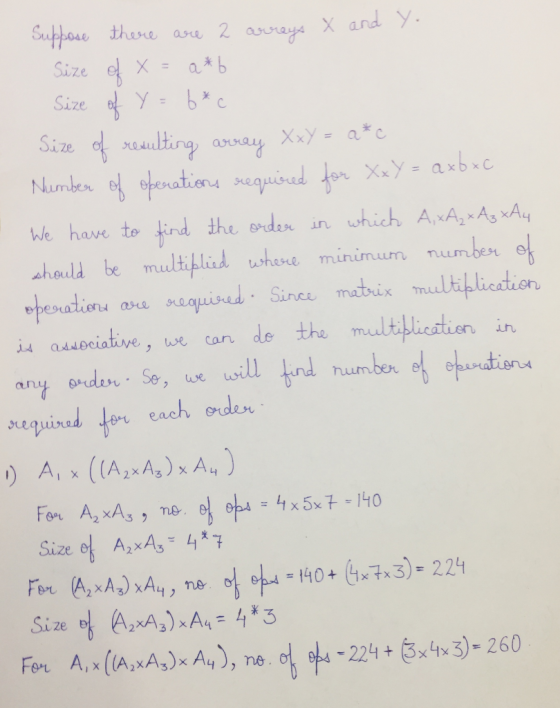
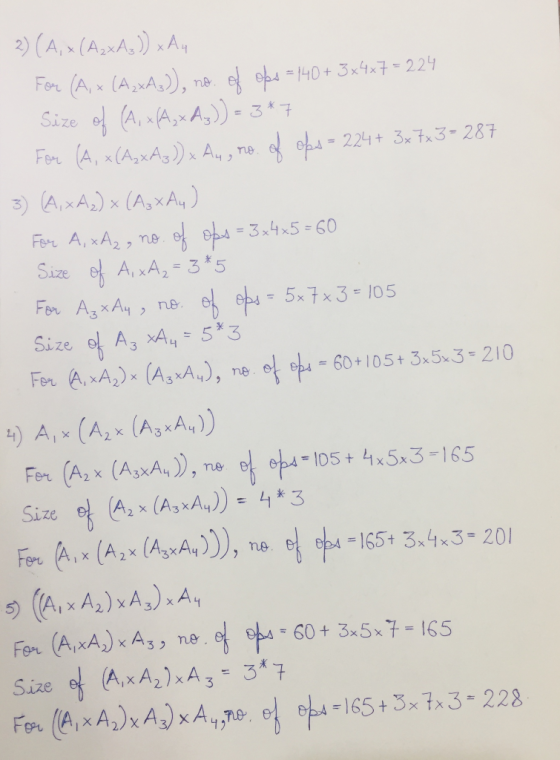
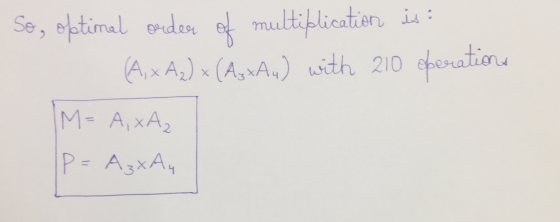
Given arrays of the following sizes, determine the optimal order of multiplication. Show the arrays M...
Compute the optimal solution for MATRIX-CHAIN-multiplication for a matrix-chain whose dimension...
Compute the optimal solution for MATRIX-CHAIN-multiplication for a matrix-chain whose dimensions is given by p = [2, 3, 7, 5, 6, 4, 3]. ( give the number of scalar multiplication, and the optimal order of multiplication)
show work pleas Given the following sample sizes, determine the df. n1 = 18 and n2...
show work pleas Given the following sample sizes, determine the df. n1 = 18 and n2 = 22 3. Given the following sample sizes, determine the df. n1 = 40 and n2 = 40
Find an optimal parenthesizing to multiply the following matrices. Apply dynamic programming and show your work:...
Find an optimal parenthesizing to multiply the following matrices. Apply dynamic programming and show your work: A1 x A2 x A3 x A4 x A5 x A6 Size of A1 : 30 x 80 Size of A2 : 80 x 100 Size of A3 : 100 x 5 Size of A4 : 5 x 200 Size of A5 :200 x 7 Size of A6: 7 x 7
Consider the following matrices for the matrix-chain multiplication problem: A1: 30 × 5 A2: 5 ×...
Consider the following matrices for the matrix-chain multiplication problem: A1: 30 × 5 A2: 5 × 40 A3: 40 × 10 A4: 10 × 25 A5: 25 × 20 Compute the values of M[i, j], 1 ≤ i ≤ j ≤ 5 and s[i, j], 1 ≤ i < j ≤ 5. Show the optimal factorization found.
4. Given the following linear programming problem, determine which situation (choose one) a. An optimal solution...
 4. Given the following linear programming problem, determine which situation (choose one) a. An optimal solution exists at a single vertex point. b. There is more than one optimal solution. C. There is no optimal solution because the feasible region does not exist d. There is no optimal solution because the feasible region is unbounded. Maximize: 2x +3y Subject to: x +2y 28 5. Graph the inequality: 2x +3y >12 6. Graph the system of inequalities: 7. Graph the system...
10×8,8×6,6×15,15×12 4. [15] Dynamic Programming. We are given a set of matrices Ap.A1, A2. .. .An-1. which we must multiply in this order. We let (d, dira) be the dimension of matrix A. The minima...
 10×8,8×6,6×15,15×12
4. [15] Dynamic Programming. We are given a set of matrices Ap.A1, A2. .. .An-1. which we must multiply in this order. We let (d, dira) be the dimension of matrix A. The minimal number Nij of operations required to multiply matrices (A, Ati .. A) is defined by: a. Explain this formula. Apply this formula to compute the optimal parenthetization of the product of matrices Ao-A1,Az,A3, where the dimensions of these matrices are, respectively: 6x15, and 15x12. b....
10×8,8×6,6×15,15×12
4. [15] Dynamic Programming. We are given a set of matrices Ap.A1, A2. .. .An-1. which we must multiply in this order. We let (d, dira) be the dimension of matrix A. The minimal number Nij of operations required to multiply matrices (A, Ati .. A) is defined by: a. Explain this formula. Apply this formula to compute the optimal parenthetization of the product of matrices Ao-A1,Az,A3, where the dimensions of these matrices are, respectively: 6x15, and 15x12. b....
Given that A is the matrix 5-3 1 1-5 7 6 3 –77 -4 -5] The...
 Given that A is the matrix 5-3 1 1-5 7 6 3 –77 -4 -5] The cofactor expansion of the determinant of A along column 1 is: det(A) = a1 · |A1| + a2 · |A2| + az · |A3|, where a1 = num @ az = numi @ a3 = num @ and A2 = Thus det(A) = num
Use C programming Swap two arrays using pointers Given two integer arrays, swap the two arrays...
Use C programming Swap two arrays using pointers Given two integer arrays, swap the two arrays using pointers. Input: 4 1 2 3 4 5 4 5 6 7 8 where: First line represents the number of elements in the first array. Second line represents the elements in the first array. Third line represents the number of elements in the second array. Fourth line represents the elements in the second array. Output: 4 5 6 7...
Order Statistics: A. Given two sorted arrays X and Y of equal size n, use Quick-Select...
Order Statistics: A. Given two sorted arrays X and Y of equal size n, use Quick-Select to find the median of all 2n elements in arrays X and Y. Can you improve Quick-Select by choosing better pivots at every step?(in java) B. Show some experiments of your improved Quick-Select with arrays of size n=50. You can assume, if you want, that all the elements in the two arrays are distinct.
input: Task3: Given two int arrays, output true if the two arrays are identical and false...
 input:
Task3: Given two int arrays, output true if the two arrays are identical and false if they are not. Input: task3 input Output: Array 1: 2 3 1 6 7 8 1 3 9 5 Array 2: 5 4 7 9 3 2 4 1 6 2 False 10 ܕ ܃ ܃ ܃ ܃ ܃ ܃ ܃ ܃ ܃ ܃ ܃ ܃ ܃ ܃ : : 7 s a
input:
Task3: Given two int arrays, output true if the two arrays are identical and false if they are not. Input: task3 input Output: Array 1: 2 3 1 6 7 8 1 3 9 5 Array 2: 5 4 7 9 3 2 4 1 6 2 False 10 ܕ ܃ ܃ ܃ ܃ ܃ ܃ ܃ ܃ ܃ ܃ ܃ ܃ ܃ ܃ : : 7 s a
 4. Given the following linear programming problem, determine which situation (choose one) a. An optimal solution exists at a single vertex point. b. There is more than one optimal solution. C. There is no optimal solution because the feasible region does not exist d. There is no optimal solution because the feasible region is unbounded. Maximize: 2x +3y Subject to: x +2y 28 5. Graph the inequality: 2x +3y >12 6. Graph the system of inequalities: 7. Graph the system...
 10×8,8×6,6×15,15×12
4. [15] Dynamic Programming. We are given a set of matrices Ap.A1, A2. .. .An-1. which we must multiply in this order. We let (d, dira) be the dimension of matrix A. The minimal number Nij of operations required to multiply matrices (A, Ati .. A) is defined by: a. Explain this formula. Apply this formula to compute the optimal parenthetization of the product of matrices Ao-A1,Az,A3, where the dimensions of these matrices are, respectively: 6x15, and 15x12. b....
10×8,8×6,6×15,15×12
4. [15] Dynamic Programming. We are given a set of matrices Ap.A1, A2. .. .An-1. which we must multiply in this order. We let (d, dira) be the dimension of matrix A. The minimal number Nij of operations required to multiply matrices (A, Ati .. A) is defined by: a. Explain this formula. Apply this formula to compute the optimal parenthetization of the product of matrices Ao-A1,Az,A3, where the dimensions of these matrices are, respectively: 6x15, and 15x12. b....
 Given that A is the matrix 5-3 1 1-5 7 6 3 –77 -4 -5] The cofactor expansion of the determinant of A along column 1 is: det(A) = a1 · |A1| + a2 · |A2| + az · |A3|, where a1 = num @ az = numi @ a3 = num @ and A2 = Thus det(A) = num
 input:
Task3: Given two int arrays, output true if the two arrays are identical and false if they are not. Input: task3 input Output: Array 1: 2 3 1 6 7 8 1 3 9 5 Array 2: 5 4 7 9 3 2 4 1 6 2 False 10 ܕ ܃ ܃ ܃ ܃ ܃ ܃ ܃ ܃ ܃ ܃ ܃ ܃ ܃ ܃ : : 7 s a
input:
Task3: Given two int arrays, output true if the two arrays are identical and false if they are not. Input: task3 input Output: Array 1: 2 3 1 6 7 8 1 3 9 5 Array 2: 5 4 7 9 3 2 4 1 6 2 False 10 ܕ ܃ ܃ ܃ ܃ ܃ ܃ ܃ ܃ ܃ ܃ ܃ ܃ ܃ ܃ : : 7 s a
Most questions answered within 3 hours.
-
Where is the error in this code sequence?
String s1 = "Hello";
String s2 = "ello";...
asked 11 months ago -
Financial data for Joel de Paris, Inc., for last year
follow:
Joel de Paris, Inc.
Balance...
asked 11 months ago -
Consider this reaction:
Al2(SO4)3 (aq)+ BaCl3
(aq) Al2Cl6 (aq)- +
3BaSO4(s) . What is the...
asked 11 months ago -
Suppose that Savneet is considering increasing her
recent random sample from 20 car rentals to 40...
asked 11 months ago -
Trucks arrive at an unloading terminal at an average rate of 120
per hour.
Trucks arrive...
asked 11 months ago -
Why are methanol and ethanol completely soluble in water while
octanol is not very little soluble....
asked 11 months ago -
A facilities manager at a university reads in a research report
that the mean amount of...
asked 11 months ago -
When the CuSO4 is rehydrated by adding water to the anhydrous
compound, is this an endothermic...
asked 11 months ago -
A ray of sunlight is passing from diamond into crown glass; the
angle of incidence is...
asked 11 months ago -
A block of mass 0.249 kg is placed on top of a light, vertical
spring of...
asked 11 months ago -
how do the kidneys compensate in the presences of acidosis
a) trigger hyperventilate
b) reserve acid...
asked 11 months ago -
Question 501 pts
The rental rate of capital to the firm increases. Which of the
following...
asked 11 months ago