Draw an electron pushing mechanism that demonstrates the isomerization from the cyclic isomer of glucose to...
Draw an electron pushing mechanism that demonstrates the isomerization from the cyclic isomer of glucose to the open-chain isomer.
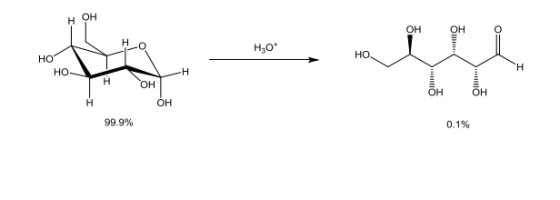
Saccharides, such as glucose, exist in biological systems in as
open-chain and cyclic
isomers. The cyclic isomer results from the nucleophilic addition
reaction between the aldehyde
and a hydroxyl group.
Homework Answers
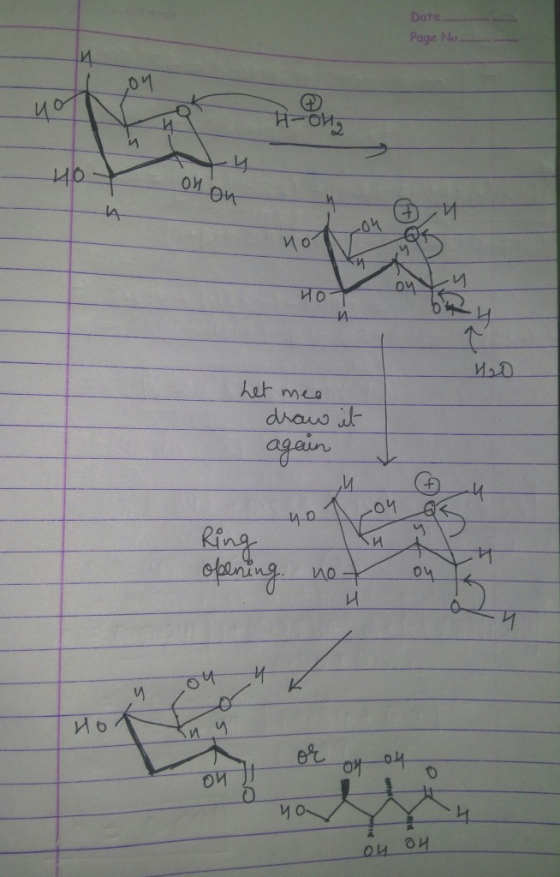
This is ring opening of glucose in presence of acid
The mechanism will be like
Add Answer to:
Draw an electron pushing mechanism that demonstrates the
isomerization from the cyclic isomer of glucose to...
3) Show the formation of cyclic glucose from liner glucose (C6H1206). (Use arrow pushing mechanism 4)...
 3) Show the formation of cyclic glucose from liner glucose (C6H1206). (Use arrow pushing mechanism 4) Identify A and B molecules as D or L isomer. Give the IUPAC names for A and B molecules. H Н. HO -H H- -OH H- -ОН HO- -C-H H -ОН. CH2OH HO- -H CH2OH A B
8. Draw an arrow-pushing mechanism to show the alkene isomerization from to B CH3 cat. H3O* A B A Draw the reaction coo...
 8. Draw an arrow-pushing mechanism to show the alkene isomerization from to B CH3 cat. H3O* A B A Draw the reaction coordinate diagram for the reaction above from A to B. reaction coordinate Regardless of the ratio of A to B at equilibrium, when the above transformation is run dilute in H2O at lower temperature, another product forms as the major product. Draw that product below. Free Enely
8. Draw an arrow-pushing mechanism to show the alkene isomerization from...
8. Draw an arrow-pushing mechanism to show the alkene isomerization from to B CH3 cat. H3O* A B A Draw the reaction coordinate diagram for the reaction above from A to B. reaction coordinate Regardless of the ratio of A to B at equilibrium, when the above transformation is run dilute in H2O at lower temperature, another product forms as the major product. Draw that product below. Free Enely
8. Draw an arrow-pushing mechanism to show the alkene isomerization from...
explain the mechanism in words c Draw the full electron-pushing mechanism (using proper electron-pushing arrows, intermediates,...
 explain the mechanism in words
c Draw the full electron-pushing mechanism (using proper electron-pushing arrows, intermediates, and structures) for the synthesis of phenolphthalein from phenol and phthalic anhydride. It's an electrophilic aromatic substitution reaction!
c Draw the full electron-pushing mechanism (using proper electron-pushing arrows, intermediates, and structures) for the synthesis of phenolphthalein from phenol and phthalic anhydride. It's an electrophilic aromatic substitution reaction!
explain the mechanism in words
c Draw the full electron-pushing mechanism (using proper electron-pushing arrows, intermediates, and structures) for the synthesis of phenolphthalein from phenol and phthalic anhydride. It's an electrophilic aromatic substitution reaction!
c Draw the full electron-pushing mechanism (using proper electron-pushing arrows, intermediates, and structures) for the synthesis of phenolphthalein from phenol and phthalic anhydride. It's an electrophilic aromatic substitution reaction!
answer all parts Draw the mechanism (electron pushing and main organic product) for the first step...
 answer all parts
Draw the mechanism (electron pushing and main organic product) for the first step of this Kolbe-Schmitt reaction. The Kolbe-Schmitt reaction adds a carboxyl group ortho to the hydroxyl group of phenol. After acidification, salicylic acid is produced. он 1) NaOH OH 2) CO, (100 atm, 125°C) 3) H0 DO A ¢ % o Ć . I I O Z o os Draw the starting material and electron pushing arrows for the third step of this Kolbe-Schmitt reaction....
answer all parts
Draw the mechanism (electron pushing and main organic product) for the first step of this Kolbe-Schmitt reaction. The Kolbe-Schmitt reaction adds a carboxyl group ortho to the hydroxyl group of phenol. After acidification, salicylic acid is produced. он 1) NaOH OH 2) CO, (100 atm, 125°C) 3) H0 DO A ¢ % o Ć . I I O Z o os Draw the starting material and electron pushing arrows for the third step of this Kolbe-Schmitt reaction....
Complete the electron-pushing mechanism for the E1 reaction when 2-methylbutan-2-ol is treated with 20% sulfuric acid....
 Complete the electron-pushing mechanism for the E1 reaction when
2-methylbutan-2-ol is treated with 20% sulfuric acid.
Hint: The E1 mechanism involves dissociation of the hydroxyl
group from the substrate. The acid is used to convert the hydroxyl
group to a good leaving group. Do not delete any pre-drawn
bonds/charges/lone pairs.
Complete the electron-pushing mechanism for the E1 reaction when 2-methylbutan-2-ol is treated with 20% sulfuric acid Map a) Use two curved arrows to show the fast b) Use a curved...
Complete the electron-pushing mechanism for the E1 reaction when
2-methylbutan-2-ol is treated with 20% sulfuric acid.
Hint: The E1 mechanism involves dissociation of the hydroxyl
group from the substrate. The acid is used to convert the hydroxyl
group to a good leaving group. Do not delete any pre-drawn
bonds/charges/lone pairs.
Complete the electron-pushing mechanism for the E1 reaction when 2-methylbutan-2-ol is treated with 20% sulfuric acid Map a) Use two curved arrows to show the fast b) Use a curved...
Draw the SN1 mechanism of the reaction between (R)-3-methylhexane and ethanol. Show lone pairs, electron pushing...
 Draw the SN1 mechanism of the reaction between (R)-3-methylhexane
and ethanol. Show lone pairs, electron pushing arrows, 3-D view to
reflect appropriate stereochemistry, reactants,intermediates, and
products. name the product. draw and completely label a reaction
energy diagram corresponding to the mechanism you have drawn.
B. Draw the Snl mechanism of the reaction between (R)-3-bromo-3-methylhexane and ethanol. Show lone pairs, electron pushing arrows, 3-D view to reflect appropriate stereochemistry, reactants, intermediates, and products. You do not have to show transition states....
Draw the SN1 mechanism of the reaction between (R)-3-methylhexane
and ethanol. Show lone pairs, electron pushing arrows, 3-D view to
reflect appropriate stereochemistry, reactants,intermediates, and
products. name the product. draw and completely label a reaction
energy diagram corresponding to the mechanism you have drawn.
B. Draw the Snl mechanism of the reaction between (R)-3-bromo-3-methylhexane and ethanol. Show lone pairs, electron pushing arrows, 3-D view to reflect appropriate stereochemistry, reactants, intermediates, and products. You do not have to show transition states....
3. Draw the chemical mechanism (with electron-pushing arrows) for the first step of RNA splicing (as...
 3. Draw the chemical mechanism (with electron-pushing arrows) for the first step of RNA splicing (as catalyzed by the splicosome). Be sure to explicitly show the attacking nucleophile, the phosphate at the intron-exon junction, the intron branch point and the leaving group in the reaction.
6) a. The two electron 'arrow pushing' mechanism below involves the only alkene unit found in...
 6) a. The two electron 'arrow pushing' mechanism below involves the only alkene unit found in cholesterol. The rest of the cholesterol molecule (which is large and made up of saturated carbons) is unaffected so it's not shown in the 'arrow pushing' diagram (left). с с cholesterol HIH Based on the concerted (at the same time) heterolytic bond breaking-making going on for this reaction, draw the structure for each of the two products. NOTE: For the product formed from the...
Complete the electron-pushing mechanism for the E1 reaction when 2-methylbutan-2-ol is treated with 20% sulfuric acid....
 Complete the electron-pushing mechanism for the E1 reaction when
2-methylbutan-2-ol is treated with 20% sulfuric acid.
Use two curved arrows to show the fast protonation of the alcohol. Use a curved arrow to show the dissociation of the leaving group from the substrate. Draw the organic product of the E1 dehydration Use two curved arrow to show the deprotonation of the carbocation intermediate.
Complete the electron-pushing mechanism for the E1 reaction when
2-methylbutan-2-ol is treated with 20% sulfuric acid.
Use two curved arrows to show the fast protonation of the alcohol. Use a curved arrow to show the dissociation of the leaving group from the substrate. Draw the organic product of the E1 dehydration Use two curved arrow to show the deprotonation of the carbocation intermediate.
QUESTION: Draw an arrow-pushing mechanism for the FIRST STEP of this synthetic sequence. In this laboratory...
 QUESTION: Draw an arrow-pushing mechanism for the FIRST STEP of
this synthetic sequence.
In this laboratory experiment, you will synthesize a RTIL, 1-hexyl-3-methylimidazolium hexafluorophosphate, using a two-step process involving nucleophilic substitution and anion exchange. 1-Hexyl-3-methylimidazolium hexafluorophosphate and its structural analogs have long names. Therefore, they are often abbreviated as [Cn-mim X, where n = the number of carbons in the alkyl chain of the cation, ‘mim' stands for methylimidazolium and X = the anion. P -N N N-methylimidazole - NON...
QUESTION: Draw an arrow-pushing mechanism for the FIRST STEP of
this synthetic sequence.
In this laboratory experiment, you will synthesize a RTIL, 1-hexyl-3-methylimidazolium hexafluorophosphate, using a two-step process involving nucleophilic substitution and anion exchange. 1-Hexyl-3-methylimidazolium hexafluorophosphate and its structural analogs have long names. Therefore, they are often abbreviated as [Cn-mim X, where n = the number of carbons in the alkyl chain of the cation, ‘mim' stands for methylimidazolium and X = the anion. P -N N N-methylimidazole - NON...
 3) Show the formation of cyclic glucose from liner glucose (C6H1206). (Use arrow pushing mechanism 4) Identify A and B molecules as D or L isomer. Give the IUPAC names for A and B molecules. H Н. HO -H H- -OH H- -ОН HO- -C-H H -ОН. CH2OH HO- -H CH2OH A B
 8. Draw an arrow-pushing mechanism to show the alkene isomerization from to B CH3 cat. H3O* A B A Draw the reaction coordinate diagram for the reaction above from A to B. reaction coordinate Regardless of the ratio of A to B at equilibrium, when the above transformation is run dilute in H2O at lower temperature, another product forms as the major product. Draw that product below. Free Enely
8. Draw an arrow-pushing mechanism to show the alkene isomerization from...
8. Draw an arrow-pushing mechanism to show the alkene isomerization from to B CH3 cat. H3O* A B A Draw the reaction coordinate diagram for the reaction above from A to B. reaction coordinate Regardless of the ratio of A to B at equilibrium, when the above transformation is run dilute in H2O at lower temperature, another product forms as the major product. Draw that product below. Free Enely
8. Draw an arrow-pushing mechanism to show the alkene isomerization from...
 explain the mechanism in words
c Draw the full electron-pushing mechanism (using proper electron-pushing arrows, intermediates, and structures) for the synthesis of phenolphthalein from phenol and phthalic anhydride. It's an electrophilic aromatic substitution reaction!
c Draw the full electron-pushing mechanism (using proper electron-pushing arrows, intermediates, and structures) for the synthesis of phenolphthalein from phenol and phthalic anhydride. It's an electrophilic aromatic substitution reaction!
explain the mechanism in words
c Draw the full electron-pushing mechanism (using proper electron-pushing arrows, intermediates, and structures) for the synthesis of phenolphthalein from phenol and phthalic anhydride. It's an electrophilic aromatic substitution reaction!
c Draw the full electron-pushing mechanism (using proper electron-pushing arrows, intermediates, and structures) for the synthesis of phenolphthalein from phenol and phthalic anhydride. It's an electrophilic aromatic substitution reaction!
 answer all parts
Draw the mechanism (electron pushing and main organic product) for the first step of this Kolbe-Schmitt reaction. The Kolbe-Schmitt reaction adds a carboxyl group ortho to the hydroxyl group of phenol. After acidification, salicylic acid is produced. он 1) NaOH OH 2) CO, (100 atm, 125°C) 3) H0 DO A ¢ % o Ć . I I O Z o os Draw the starting material and electron pushing arrows for the third step of this Kolbe-Schmitt reaction....
answer all parts
Draw the mechanism (electron pushing and main organic product) for the first step of this Kolbe-Schmitt reaction. The Kolbe-Schmitt reaction adds a carboxyl group ortho to the hydroxyl group of phenol. After acidification, salicylic acid is produced. он 1) NaOH OH 2) CO, (100 atm, 125°C) 3) H0 DO A ¢ % o Ć . I I O Z o os Draw the starting material and electron pushing arrows for the third step of this Kolbe-Schmitt reaction....
 Complete the electron-pushing mechanism for the E1 reaction when
2-methylbutan-2-ol is treated with 20% sulfuric acid.
Hint: The E1 mechanism involves dissociation of the hydroxyl
group from the substrate. The acid is used to convert the hydroxyl
group to a good leaving group. Do not delete any pre-drawn
bonds/charges/lone pairs.
Complete the electron-pushing mechanism for the E1 reaction when 2-methylbutan-2-ol is treated with 20% sulfuric acid Map a) Use two curved arrows to show the fast b) Use a curved...
Complete the electron-pushing mechanism for the E1 reaction when
2-methylbutan-2-ol is treated with 20% sulfuric acid.
Hint: The E1 mechanism involves dissociation of the hydroxyl
group from the substrate. The acid is used to convert the hydroxyl
group to a good leaving group. Do not delete any pre-drawn
bonds/charges/lone pairs.
Complete the electron-pushing mechanism for the E1 reaction when 2-methylbutan-2-ol is treated with 20% sulfuric acid Map a) Use two curved arrows to show the fast b) Use a curved...
 Draw the SN1 mechanism of the reaction between (R)-3-methylhexane
and ethanol. Show lone pairs, electron pushing arrows, 3-D view to
reflect appropriate stereochemistry, reactants,intermediates, and
products. name the product. draw and completely label a reaction
energy diagram corresponding to the mechanism you have drawn.
B. Draw the Snl mechanism of the reaction between (R)-3-bromo-3-methylhexane and ethanol. Show lone pairs, electron pushing arrows, 3-D view to reflect appropriate stereochemistry, reactants, intermediates, and products. You do not have to show transition states....
Draw the SN1 mechanism of the reaction between (R)-3-methylhexane
and ethanol. Show lone pairs, electron pushing arrows, 3-D view to
reflect appropriate stereochemistry, reactants,intermediates, and
products. name the product. draw and completely label a reaction
energy diagram corresponding to the mechanism you have drawn.
B. Draw the Snl mechanism of the reaction between (R)-3-bromo-3-methylhexane and ethanol. Show lone pairs, electron pushing arrows, 3-D view to reflect appropriate stereochemistry, reactants, intermediates, and products. You do not have to show transition states....
 3. Draw the chemical mechanism (with electron-pushing arrows) for the first step of RNA splicing (as catalyzed by the splicosome). Be sure to explicitly show the attacking nucleophile, the phosphate at the intron-exon junction, the intron branch point and the leaving group in the reaction.
 6) a. The two electron 'arrow pushing' mechanism below involves the only alkene unit found in cholesterol. The rest of the cholesterol molecule (which is large and made up of saturated carbons) is unaffected so it's not shown in the 'arrow pushing' diagram (left). с с cholesterol HIH Based on the concerted (at the same time) heterolytic bond breaking-making going on for this reaction, draw the structure for each of the two products. NOTE: For the product formed from the...
 Complete the electron-pushing mechanism for the E1 reaction when
2-methylbutan-2-ol is treated with 20% sulfuric acid.
Use two curved arrows to show the fast protonation of the alcohol. Use a curved arrow to show the dissociation of the leaving group from the substrate. Draw the organic product of the E1 dehydration Use two curved arrow to show the deprotonation of the carbocation intermediate.
Complete the electron-pushing mechanism for the E1 reaction when
2-methylbutan-2-ol is treated with 20% sulfuric acid.
Use two curved arrows to show the fast protonation of the alcohol. Use a curved arrow to show the dissociation of the leaving group from the substrate. Draw the organic product of the E1 dehydration Use two curved arrow to show the deprotonation of the carbocation intermediate.
 QUESTION: Draw an arrow-pushing mechanism for the FIRST STEP of
this synthetic sequence.
In this laboratory experiment, you will synthesize a RTIL, 1-hexyl-3-methylimidazolium hexafluorophosphate, using a two-step process involving nucleophilic substitution and anion exchange. 1-Hexyl-3-methylimidazolium hexafluorophosphate and its structural analogs have long names. Therefore, they are often abbreviated as [Cn-mim X, where n = the number of carbons in the alkyl chain of the cation, ‘mim' stands for methylimidazolium and X = the anion. P -N N N-methylimidazole - NON...
QUESTION: Draw an arrow-pushing mechanism for the FIRST STEP of
this synthetic sequence.
In this laboratory experiment, you will synthesize a RTIL, 1-hexyl-3-methylimidazolium hexafluorophosphate, using a two-step process involving nucleophilic substitution and anion exchange. 1-Hexyl-3-methylimidazolium hexafluorophosphate and its structural analogs have long names. Therefore, they are often abbreviated as [Cn-mim X, where n = the number of carbons in the alkyl chain of the cation, ‘mim' stands for methylimidazolium and X = the anion. P -N N N-methylimidazole - NON...
Most questions answered within 3 hours.
-
Where is the error in this code sequence?
String s1 = "Hello";
String s2 = "ello";...
asked 10 months ago -
Financial data for Joel de Paris, Inc., for last year
follow:
Joel de Paris, Inc.
Balance...
asked 10 months ago -
Consider this reaction:
Al2(SO4)3 (aq)+ BaCl3
(aq) Al2Cl6 (aq)- +
3BaSO4(s) . What is the...
asked 10 months ago -
Suppose that Savneet is considering increasing her
recent random sample from 20 car rentals to 40...
asked 10 months ago -
Trucks arrive at an unloading terminal at an average rate of 120
per hour.
Trucks arrive...
asked 10 months ago -
Why are methanol and ethanol completely soluble in water while
octanol is not very little soluble....
asked 10 months ago -
A facilities manager at a university reads in a research report
that the mean amount of...
asked 10 months ago -
When the CuSO4 is rehydrated by adding water to the anhydrous
compound, is this an endothermic...
asked 10 months ago -
A ray of sunlight is passing from diamond into crown glass; the
angle of incidence is...
asked 10 months ago -
A block of mass 0.249 kg is placed on top of a light, vertical
spring of...
asked 10 months ago -
how do the kidneys compensate in the presences of acidosis
a) trigger hyperventilate
b) reserve acid...
asked 10 months ago -
Question 501 pts
The rental rate of capital to the firm increases. Which of the
following...
asked 10 months ago