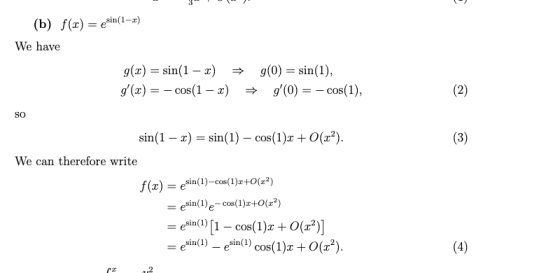
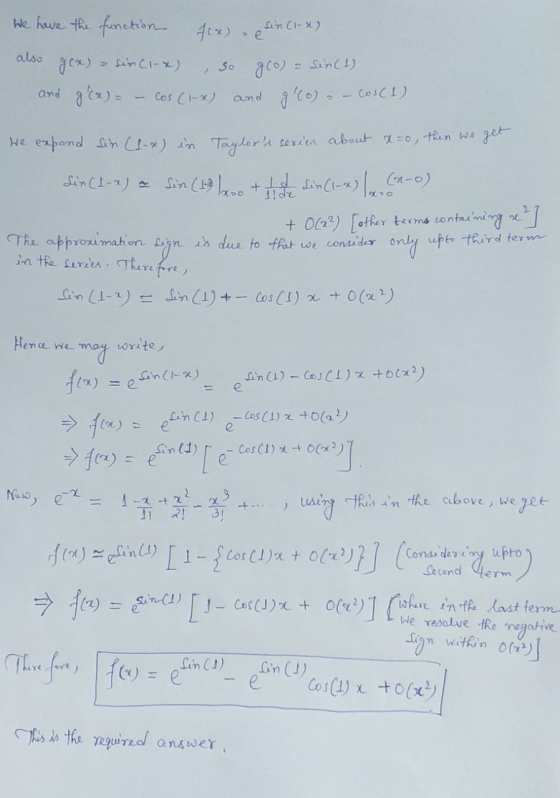
so this is the solution to the problem but im still confused on how they got from the second line to the third line and on. Please help, explain and show all work
Homework Answers
Add Answer to:
so this is the solution to the problem but im still confused on
how they got...
please fully explain how you got the answer im so confused on this concept 5) (THIS...
 please fully explain how you got the answer im so confused on this
concept
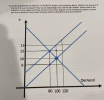
5) (THIS QUESTION IS WORTH 10 POINTS) Refer to the following figure. What is the amount of the tax that was imposed? How much deadweight loss did the tax create? Which side of the market is more elastic and how do you know (note, graphs is not necessarily drawn to scale, use the numbers)? How much revenue will be collected by the government? Demand 80 100...
please fully explain how you got the answer im so confused on this
concept
5) (THIS QUESTION IS WORTH 10 POINTS) Refer to the following figure. What is the amount of the tax that was imposed? How much deadweight loss did the tax create? Which side of the market is more elastic and how do you know (note, graphs is not necessarily drawn to scale, use the numbers)? How much revenue will be collected by the government? Demand 80 100...
Convolution Integrals. For part A the solution I got was t*exp(z*t) and for part B the...
 Convolution Integrals. For part A the solution I got was
t*exp(z*t) and for part B the solution I got was (exp(z2*t) -
exp(z1*t))/(z2-z1). I need help with the third part of the question
calculating (f * f)(t) without computing any integrals.
f(t -s)g(s)ds by hand for (a) and (b) below Calculate (a) f(t) g(t) = et where z is a constant e21t and g(t) e22t where z1 and z2 are constants (b) f(t) Use your results from parts (a) and...
Convolution Integrals. For part A the solution I got was
t*exp(z*t) and for part B the solution I got was (exp(z2*t) -
exp(z1*t))/(z2-z1). I need help with the third part of the question
calculating (f * f)(t) without computing any integrals.
f(t -s)g(s)ds by hand for (a) and (b) below Calculate (a) f(t) g(t) = et where z is a constant e21t and g(t) e22t where z1 and z2 are constants (b) f(t) Use your results from parts (a) and...
For part c, I tried -242 and +242 and I still got it incorrect. (20%) Problem...
 For part c, I tried -242 and +242 and I still got it
incorrect.
(20%) Problem 4: The shadow of a pendulum cast on a flat board moves on a straight line. By placing the x-axis on the straight line with the origin at the middle of the total path, the x-coordinate of the shadow is given by the following function: x(t) = 49cos(st), where t is in seconds and x is in centimeters. 25% Part (a) Find the speed,...
For part c, I tried -242 and +242 and I still got it
incorrect.
(20%) Problem 4: The shadow of a pendulum cast on a flat board moves on a straight line. By placing the x-axis on the straight line with the origin at the middle of the total path, the x-coordinate of the shadow is given by the following function: x(t) = 49cos(st), where t is in seconds and x is in centimeters. 25% Part (a) Find the speed,...
Verify the following using MATLAB 2) (a) Consider the following function f(t)=e"" sinwt u (t (1)...
 Verify the following using MATLAB
2) (a) Consider the following function f(t)=e"" sinwt u (t (1) .... Write the formula for Laplace transform. L[f)]=F(6) F(6))e"d Where f(t is the function in time domain. F(s) is the function in frequency domain Apply Laplace transform to equation 1. Le sin cot u()]F(s) Consider, f() sin wtu(t). From the frequency shifting theorem, L(e"f()F(s+a) (2) Apply Laplace transform to f(t). F,(s)sin ot u (t)e" "dt Define the step function, u(t u(t)= 1 fort >0...
Verify the following using MATLAB
2) (a) Consider the following function f(t)=e"" sinwt u (t (1) .... Write the formula for Laplace transform. L[f)]=F(6) F(6))e"d Where f(t is the function in time domain. F(s) is the function in frequency domain Apply Laplace transform to equation 1. Le sin cot u()]F(s) Consider, f() sin wtu(t). From the frequency shifting theorem, L(e"f()F(s+a) (2) Apply Laplace transform to f(t). F,(s)sin ot u (t)e" "dt Define the step function, u(t u(t)= 1 fort >0...
be quick please 8. Determine the appropriate form of the particular solution for the following non-homogeneous...
 be quick please
8. Determine the appropriate form of the particular solution for the following non-homogeneous linear differential equation with constant coefficients. * (8 Puan) y (4) - 9y" = 5 + e* (x – 3) +e3x + 4 sin(3x). none of these O Ar? + Bxe3x + Cet + Dxet + Esin(3x) + F cos(3x) O AX + B + C sin (3x) + D cos(3x) + Exet O A + Be-3x + CxeBr + Det + Exel +...
be quick please
8. Determine the appropriate form of the particular solution for the following non-homogeneous linear differential equation with constant coefficients. * (8 Puan) y (4) - 9y" = 5 + e* (x – 3) +e3x + 4 sin(3x). none of these O Ar? + Bxe3x + Cet + Dxet + Esin(3x) + F cos(3x) O AX + B + C sin (3x) + D cos(3x) + Exet O A + Be-3x + CxeBr + Det + Exel +...
I am little confused on this problem..g(t) = 3π sin(8πt + 1.3)cos(4πt − 0.8) e^sin(12πt) MATHLAB...
 I am little confused on this problem..g(t) = 3π sin(8πt +
1.3)cos(4πt − 0.8) e^sin(12πt)
MATHLAB help
4. For the signal g(x) in problem 1, calculate the energy of the signal in the window te [0.25, 0.75]. Also calculate the power of the signal.
I am little confused on this problem..g(t) = 3π sin(8πt +
1.3)cos(4πt − 0.8) e^sin(12πt)
MATHLAB help
4. For the signal g(x) in problem 1, calculate the energy of the signal in the window te [0.25, 0.75]. Also calculate the power of the signal.
mechanical engineering analysis help, get from problem to solution, pls show all work, thanks. Problem 2....
 mechanical engineering
analysis help, get from problem to solution, pls show all work,
thanks.
Problem 2. Find the Fourier series approximation of the following periodic function f(x), where the first two leading cosine and sine functions must be included. f(x) Angle sum formulas for sine / cosine functions sin(A + B) = sin A cos B + cos A sin B sin(A – B) = sin A cos B – cos A sin B TT cos(A + B) = cos...
mechanical engineering
analysis help, get from problem to solution, pls show all work,
thanks.
Problem 2. Find the Fourier series approximation of the following periodic function f(x), where the first two leading cosine and sine functions must be included. f(x) Angle sum formulas for sine / cosine functions sin(A + B) = sin A cos B + cos A sin B sin(A – B) = sin A cos B – cos A sin B TT cos(A + B) = cos...
sorry guys, im a bit confused. could someone please explain how the ‘x’ to the power...
 sorry guys, im a bit confused. could someone please explain how the
‘x’ to the power of 3 was achived. does it not have to be multiples
by the y?
thanks
9, 46 of ° Rex, y) = (х2)3 - zs.x. (8) - ( -) (x-3---| # c»,9) = Ч. 4 = (-4) (ог ,ч) = f (x,8%) ot (x = 0-2s {}=4 ) со, ) = (0-25 +4= (1,4- 1 | f(o-2ѕ, ч]=1) Armex
sorry guys, im a bit confused. could someone please explain how the
‘x’ to the power of 3 was achived. does it not have to be multiples
by the y?
thanks
9, 46 of ° Rex, y) = (х2)3 - zs.x. (8) - ( -) (x-3---| # c»,9) = Ч. 4 = (-4) (ог ,ч) = f (x,8%) ot (x = 0-2s {}=4 ) со, ) = (0-25 +4= (1,4- 1 | f(o-2ѕ, ч]=1) Armex
could someone please help me with the calculations. im very confused 2. The heat of solution...
 could someone please help me with the calculations. im very
confused
2. The heat of solution of 10 M H,SO Data Trail 1, Trail 2 222 22.1°C 23.0°C 22.8°C 31.500 / 630.0°c Initial temperature of IO MH,SO (10 mL in a graduated cylinder) Initial temperature of water in calorimeter 1 (90 mL deionized water) Final temperature of calorimeter 1 (90 ml water + added 10 mL H,SO) Triali Trial 2 Calculations (a) Temperature change of water in calorimeter 1 (ATC...
could someone please help me with the calculations. im very
confused
2. The heat of solution of 10 M H,SO Data Trail 1, Trail 2 222 22.1°C 23.0°C 22.8°C 31.500 / 630.0°c Initial temperature of IO MH,SO (10 mL in a graduated cylinder) Initial temperature of water in calorimeter 1 (90 mL deionized water) Final temperature of calorimeter 1 (90 ml water + added 10 mL H,SO) Triali Trial 2 Calculations (a) Temperature change of water in calorimeter 1 (ATC...
Please explain how a) is solved, write what formula is used and explain in detail so...
 Please explain how a) is
solved, write what formula is used and explain in detail so I can
solve any problem of this type.
2) Find the power and energy of the following signals (20 Points). a) x(t) = sin(t) b) y[n] = (-0.3)”u[n – 2] Solutions: Part (a): The signal r(t) is periodic because 1-cos(2t) (t) = sin(t) = ? Therefore, E = 0. To find the power, we can use the fact that the signal is sinusoid: P:...
Please explain how a) is
solved, write what formula is used and explain in detail so I can
solve any problem of this type.
2) Find the power and energy of the following signals (20 Points). a) x(t) = sin(t) b) y[n] = (-0.3)”u[n – 2] Solutions: Part (a): The signal r(t) is periodic because 1-cos(2t) (t) = sin(t) = ? Therefore, E = 0. To find the power, we can use the fact that the signal is sinusoid: P:...
 please fully explain how you got the answer im so confused on this
concept
5) (THIS QUESTION IS WORTH 10 POINTS) Refer to the following figure. What is the amount of the tax that was imposed? How much deadweight loss did the tax create? Which side of the market is more elastic and how do you know (note, graphs is not necessarily drawn to scale, use the numbers)? How much revenue will be collected by the government? Demand 80 100...
please fully explain how you got the answer im so confused on this
concept
5) (THIS QUESTION IS WORTH 10 POINTS) Refer to the following figure. What is the amount of the tax that was imposed? How much deadweight loss did the tax create? Which side of the market is more elastic and how do you know (note, graphs is not necessarily drawn to scale, use the numbers)? How much revenue will be collected by the government? Demand 80 100...
 Convolution Integrals. For part A the solution I got was
t*exp(z*t) and for part B the solution I got was (exp(z2*t) -
exp(z1*t))/(z2-z1). I need help with the third part of the question
calculating (f * f)(t) without computing any integrals.
f(t -s)g(s)ds by hand for (a) and (b) below Calculate (a) f(t) g(t) = et where z is a constant e21t and g(t) e22t where z1 and z2 are constants (b) f(t) Use your results from parts (a) and...
Convolution Integrals. For part A the solution I got was
t*exp(z*t) and for part B the solution I got was (exp(z2*t) -
exp(z1*t))/(z2-z1). I need help with the third part of the question
calculating (f * f)(t) without computing any integrals.
f(t -s)g(s)ds by hand for (a) and (b) below Calculate (a) f(t) g(t) = et where z is a constant e21t and g(t) e22t where z1 and z2 are constants (b) f(t) Use your results from parts (a) and...
 For part c, I tried -242 and +242 and I still got it
incorrect.
(20%) Problem 4: The shadow of a pendulum cast on a flat board moves on a straight line. By placing the x-axis on the straight line with the origin at the middle of the total path, the x-coordinate of the shadow is given by the following function: x(t) = 49cos(st), where t is in seconds and x is in centimeters. 25% Part (a) Find the speed,...
For part c, I tried -242 and +242 and I still got it
incorrect.
(20%) Problem 4: The shadow of a pendulum cast on a flat board moves on a straight line. By placing the x-axis on the straight line with the origin at the middle of the total path, the x-coordinate of the shadow is given by the following function: x(t) = 49cos(st), where t is in seconds and x is in centimeters. 25% Part (a) Find the speed,...
 Verify the following using MATLAB
2) (a) Consider the following function f(t)=e"" sinwt u (t (1) .... Write the formula for Laplace transform. L[f)]=F(6) F(6))e"d Where f(t is the function in time domain. F(s) is the function in frequency domain Apply Laplace transform to equation 1. Le sin cot u()]F(s) Consider, f() sin wtu(t). From the frequency shifting theorem, L(e"f()F(s+a) (2) Apply Laplace transform to f(t). F,(s)sin ot u (t)e" "dt Define the step function, u(t u(t)= 1 fort >0...
Verify the following using MATLAB
2) (a) Consider the following function f(t)=e"" sinwt u (t (1) .... Write the formula for Laplace transform. L[f)]=F(6) F(6))e"d Where f(t is the function in time domain. F(s) is the function in frequency domain Apply Laplace transform to equation 1. Le sin cot u()]F(s) Consider, f() sin wtu(t). From the frequency shifting theorem, L(e"f()F(s+a) (2) Apply Laplace transform to f(t). F,(s)sin ot u (t)e" "dt Define the step function, u(t u(t)= 1 fort >0...
 be quick please
8. Determine the appropriate form of the particular solution for the following non-homogeneous linear differential equation with constant coefficients. * (8 Puan) y (4) - 9y" = 5 + e* (x – 3) +e3x + 4 sin(3x). none of these O Ar? + Bxe3x + Cet + Dxet + Esin(3x) + F cos(3x) O AX + B + C sin (3x) + D cos(3x) + Exet O A + Be-3x + CxeBr + Det + Exel +...
be quick please
8. Determine the appropriate form of the particular solution for the following non-homogeneous linear differential equation with constant coefficients. * (8 Puan) y (4) - 9y" = 5 + e* (x – 3) +e3x + 4 sin(3x). none of these O Ar? + Bxe3x + Cet + Dxet + Esin(3x) + F cos(3x) O AX + B + C sin (3x) + D cos(3x) + Exet O A + Be-3x + CxeBr + Det + Exel +...
 I am little confused on this problem..g(t) = 3π sin(8πt +
1.3)cos(4πt − 0.8) e^sin(12πt)
MATHLAB help
4. For the signal g(x) in problem 1, calculate the energy of the signal in the window te [0.25, 0.75]. Also calculate the power of the signal.
I am little confused on this problem..g(t) = 3π sin(8πt +
1.3)cos(4πt − 0.8) e^sin(12πt)
MATHLAB help
4. For the signal g(x) in problem 1, calculate the energy of the signal in the window te [0.25, 0.75]. Also calculate the power of the signal.
 mechanical engineering
analysis help, get from problem to solution, pls show all work,
thanks.
Problem 2. Find the Fourier series approximation of the following periodic function f(x), where the first two leading cosine and sine functions must be included. f(x) Angle sum formulas for sine / cosine functions sin(A + B) = sin A cos B + cos A sin B sin(A – B) = sin A cos B – cos A sin B TT cos(A + B) = cos...
mechanical engineering
analysis help, get from problem to solution, pls show all work,
thanks.
Problem 2. Find the Fourier series approximation of the following periodic function f(x), where the first two leading cosine and sine functions must be included. f(x) Angle sum formulas for sine / cosine functions sin(A + B) = sin A cos B + cos A sin B sin(A – B) = sin A cos B – cos A sin B TT cos(A + B) = cos...
 sorry guys, im a bit confused. could someone please explain how the
‘x’ to the power of 3 was achived. does it not have to be multiples
by the y?
thanks
9, 46 of ° Rex, y) = (х2)3 - zs.x. (8) - ( -) (x-3---| # c»,9) = Ч. 4 = (-4) (ог ,ч) = f (x,8%) ot (x = 0-2s {}=4 ) со, ) = (0-25 +4= (1,4- 1 | f(o-2ѕ, ч]=1) Armex
sorry guys, im a bit confused. could someone please explain how the
‘x’ to the power of 3 was achived. does it not have to be multiples
by the y?
thanks
9, 46 of ° Rex, y) = (х2)3 - zs.x. (8) - ( -) (x-3---| # c»,9) = Ч. 4 = (-4) (ог ,ч) = f (x,8%) ot (x = 0-2s {}=4 ) со, ) = (0-25 +4= (1,4- 1 | f(o-2ѕ, ч]=1) Armex
 could someone please help me with the calculations. im very
confused
2. The heat of solution of 10 M H,SO Data Trail 1, Trail 2 222 22.1°C 23.0°C 22.8°C 31.500 / 630.0°c Initial temperature of IO MH,SO (10 mL in a graduated cylinder) Initial temperature of water in calorimeter 1 (90 mL deionized water) Final temperature of calorimeter 1 (90 ml water + added 10 mL H,SO) Triali Trial 2 Calculations (a) Temperature change of water in calorimeter 1 (ATC...
could someone please help me with the calculations. im very
confused
2. The heat of solution of 10 M H,SO Data Trail 1, Trail 2 222 22.1°C 23.0°C 22.8°C 31.500 / 630.0°c Initial temperature of IO MH,SO (10 mL in a graduated cylinder) Initial temperature of water in calorimeter 1 (90 mL deionized water) Final temperature of calorimeter 1 (90 ml water + added 10 mL H,SO) Triali Trial 2 Calculations (a) Temperature change of water in calorimeter 1 (ATC...
 Please explain how a) is
solved, write what formula is used and explain in detail so I can
solve any problem of this type.
2) Find the power and energy of the following signals (20 Points). a) x(t) = sin(t) b) y[n] = (-0.3)”u[n – 2] Solutions: Part (a): The signal r(t) is periodic because 1-cos(2t) (t) = sin(t) = ? Therefore, E = 0. To find the power, we can use the fact that the signal is sinusoid: P:...
Please explain how a) is
solved, write what formula is used and explain in detail so I can
solve any problem of this type.
2) Find the power and energy of the following signals (20 Points). a) x(t) = sin(t) b) y[n] = (-0.3)”u[n – 2] Solutions: Part (a): The signal r(t) is periodic because 1-cos(2t) (t) = sin(t) = ? Therefore, E = 0. To find the power, we can use the fact that the signal is sinusoid: P:...
Most questions answered within 3 hours.
-
Where is the error in this code sequence?
String s1 = "Hello";
String s2 = "ello";...
asked 10 months ago -
Financial data for Joel de Paris, Inc., for last year
follow:
Joel de Paris, Inc.
Balance...
asked 10 months ago -
Consider this reaction:
Al2(SO4)3 (aq)+ BaCl3
(aq) Al2Cl6 (aq)- +
3BaSO4(s) . What is the...
asked 10 months ago -
Suppose that Savneet is considering increasing her
recent random sample from 20 car rentals to 40...
asked 10 months ago -
Trucks arrive at an unloading terminal at an average rate of 120
per hour.
Trucks arrive...
asked 10 months ago -
Why are methanol and ethanol completely soluble in water while
octanol is not very little soluble....
asked 10 months ago -
A facilities manager at a university reads in a research report
that the mean amount of...
asked 10 months ago -
When the CuSO4 is rehydrated by adding water to the anhydrous
compound, is this an endothermic...
asked 10 months ago -
A ray of sunlight is passing from diamond into crown glass; the
angle of incidence is...
asked 10 months ago -
A block of mass 0.249 kg is placed on top of a light, vertical
spring of...
asked 10 months ago -
how do the kidneys compensate in the presences of acidosis
a) trigger hyperventilate
b) reserve acid...
asked 10 months ago -
Question 501 pts
The rental rate of capital to the firm increases. Which of the
following...
asked 10 months ago