
Homework Answers
Questions 1. Equation () can also be obtained by drawing separate free body diagrams for the...
 Questions 1. Equation () can also be obtained by drawing separate free body diagrams for the two masses in the system, applying Newton's Laws to each body to get 2 equations with T (string tension force) unknowns, and solving the 2 equations simultaneously and a as m1g m 2 8 Write the 2 equations and solve them simultaneously to obtain formulas for T and a in te m2 and g. This experiment has stressed Newton's Second Law of Motion, F...
Mass m2 = 4.75-kg is connected to mass m2 = 3.70-kg by a string that passes...
 Mass m2 = 4.75-kg is connected to mass m2 = 3.70-kg by a string that passes through a massless and frictionless pulley. Mass my is connected to mass m2 = 3.00-kg by a string. T TI m2 m T2 m3 Find the tension in the strings. T = N T2 = N
Also how do you figure it out? In the figure, M2 has more mass than M1...
 Also how do you figure it out?
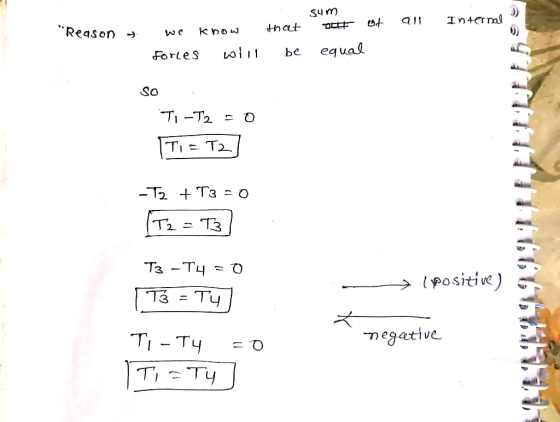
In the figure, M2 has more mass than M1 and M1 has more mass than M3. The questions refer to the magnitudes of tensions and weights M2 12 T3 T1 T4 MI M3 There is friction between the horizontal plane and M2 (μk 0). M2 is observed to travel at a constant speed. Assume that the pulleys are frictionless and have negligible mass. Select the appropriate statements to complete the following sentences Equal...
Also how do you figure it out?
In the figure, M2 has more mass than M1 and M1 has more mass than M3. The questions refer to the magnitudes of tensions and weights M2 12 T3 T1 T4 MI M3 There is friction between the horizontal plane and M2 (μk 0). M2 is observed to travel at a constant speed. Assume that the pulleys are frictionless and have negligible mass. Select the appropriate statements to complete the following sentences Equal...
Can someone please explain the last point as I don't quite understand? Thanks! li m2[T2 –...
 Can someone please explain the last point as I don't quite
understand? Thanks!
li m2[T2 – T3] – m1[T3 – T1] = 0 Q2 01 Experiment 1 Watch the experiment 1 video and extract measurements of T1, T2,T3 and m = mı + m2. Find the mass of each quantity of water without using CAL = 4184J/kg°C. value Please show your working below m = 0.1540 kg m2 (55.6 – 18] – m1 [18 – 3.4] = 0 m2 =...
Can someone please explain the last point as I don't quite
understand? Thanks!
li m2[T2 – T3] – m1[T3 – T1] = 0 Q2 01 Experiment 1 Watch the experiment 1 video and extract measurements of T1, T2,T3 and m = mı + m2. Find the mass of each quantity of water without using CAL = 4184J/kg°C. value Please show your working below m = 0.1540 kg m2 (55.6 – 18] – m1 [18 – 3.4] = 0 m2 =...
Problem 4 Two identical small spheres with mass, m, are hung from a very thin string...
 Problem 4 Two identical small spheres with mass, m, are hung from a very thin string of length L, as shown in figure (17.56). The radius of the spheres is small and we can treat the spheres as point like objects. The charge on each sphere is q. Determine the angle, θ, each string makes with the vertical direction. Assume that the angle is small, (Hint: when θ is small you can use that θ sin θ tan θ) mass...
I need to figure out how to solve a polynomial in MATLAB My equation i have is... heat(i) == (m/M)*(((A-R)*(T3-T2))+((B/2)*(T3^2-T2^2))+((C/3)*(T3^3-T2^3))+((D/4)*(T3^4-T2^4)))) ...all variables are k...
I need to figure out how to solve a polynomial in MATLAB My equation i have is... heat(i) == (m/M)*(((A-R)*(T3-T2))+((B/2)*(T3^2-T2^2))+((C/3)*(T3^3-T2^3))+((D/4)*(T3^4-T2^4)))) ...all variables are known, including heat(i), except for T3.
How do you calculate the period when given time. In other words how do you calculate...
 How do you calculate the period when given time. In other
words how do you calculate question 1.
NOTE: I'm only Looking to complete the Table.
Mass, m (kg): 0.100 kg I ti Time (s) 6.24 Period t2 0.94 t3 t4 7.66 2.34 ts 3.01 to 3.76 t7 to 4.50 5.18 to 5.90 (s) Calculate the experimental values for the period of oscillation between each consecutive time value, then use those values to calculate the experimental average period value. (10...
How do you calculate the period when given time. In other
words how do you calculate question 1.
NOTE: I'm only Looking to complete the Table.
Mass, m (kg): 0.100 kg I ti Time (s) 6.24 Period t2 0.94 t3 t4 7.66 2.34 ts 3.01 to 3.76 t7 to 4.50 5.18 to 5.90 (s) Calculate the experimental values for the period of oscillation between each consecutive time value, then use those values to calculate the experimental average period value. (10...
An object of mass m1 hangs from a string that passes over a very light fixed...
 An object of mass m1 hangs from a string that passes over a very light fixed pulley P1 as shown in the figure below. The string connects to a second very light pulley P2. A second string passes around this pulley with one end attached to a wall and the other to an object of mass m2 on a frictionless, horizontal table.(a) If a1 and a2 are the accelerations of m1 and m2, respectively, what is the relation between these...
show work pls Assuming we know g = 9.8 m/s2. If m2 has mass of 1...
 show work pls
Assuming we know g = 9.8 m/s2. If m2 has mass of 1 .20 kg how much time would be for m2 to hit the ground (mi is still equal to 1 kg)? (20 points) m lkg m2-L.aky L.2 マ
show work pls
Assuming we know g = 9.8 m/s2. If m2 has mass of 1 .20 kg how much time would be for m2 to hit the ground (mi is still equal to 1 kg)? (20 points) m lkg m2-L.aky L.2 マ
using MATLAB solve for T3 if ALL other variable are known heat(1) == (m/M)*(((A-R)*(T3-T2))+((B/2)*(T3^2-T2^2))+((C/3)*(T3^3-T2^3))+((D/4)*(T3^4-T2^4))))
using MATLAB solve for T3 if ALL other variable are known heat(1) == (m/M)*(((A-R)*(T3-T2))+((B/2)*(T3^2-T2^2))+((C/3)*(T3^3-T2^3))+((D/4)*(T3^4-T2^4))))
 Questions 1. Equation () can also be obtained by drawing separate free body diagrams for the two masses in the system, applying Newton's Laws to each body to get 2 equations with T (string tension force) unknowns, and solving the 2 equations simultaneously and a as m1g m 2 8 Write the 2 equations and solve them simultaneously to obtain formulas for T and a in te m2 and g. This experiment has stressed Newton's Second Law of Motion, F...
 Mass m2 = 4.75-kg is connected to mass m2 = 3.70-kg by a string that passes through a massless and frictionless pulley. Mass my is connected to mass m2 = 3.00-kg by a string. T TI m2 m T2 m3 Find the tension in the strings. T = N T2 = N
 Also how do you figure it out?
In the figure, M2 has more mass than M1 and M1 has more mass than M3. The questions refer to the magnitudes of tensions and weights M2 12 T3 T1 T4 MI M3 There is friction between the horizontal plane and M2 (μk 0). M2 is observed to travel at a constant speed. Assume that the pulleys are frictionless and have negligible mass. Select the appropriate statements to complete the following sentences Equal...
Also how do you figure it out?
In the figure, M2 has more mass than M1 and M1 has more mass than M3. The questions refer to the magnitudes of tensions and weights M2 12 T3 T1 T4 MI M3 There is friction between the horizontal plane and M2 (μk 0). M2 is observed to travel at a constant speed. Assume that the pulleys are frictionless and have negligible mass. Select the appropriate statements to complete the following sentences Equal...
 Can someone please explain the last point as I don't quite
understand? Thanks!
li m2[T2 – T3] – m1[T3 – T1] = 0 Q2 01 Experiment 1 Watch the experiment 1 video and extract measurements of T1, T2,T3 and m = mı + m2. Find the mass of each quantity of water without using CAL = 4184J/kg°C. value Please show your working below m = 0.1540 kg m2 (55.6 – 18] – m1 [18 – 3.4] = 0 m2 =...
Can someone please explain the last point as I don't quite
understand? Thanks!
li m2[T2 – T3] – m1[T3 – T1] = 0 Q2 01 Experiment 1 Watch the experiment 1 video and extract measurements of T1, T2,T3 and m = mı + m2. Find the mass of each quantity of water without using CAL = 4184J/kg°C. value Please show your working below m = 0.1540 kg m2 (55.6 – 18] – m1 [18 – 3.4] = 0 m2 =...
 Problem 4 Two identical small spheres with mass, m, are hung from a very thin string of length L, as shown in figure (17.56). The radius of the spheres is small and we can treat the spheres as point like objects. The charge on each sphere is q. Determine the angle, θ, each string makes with the vertical direction. Assume that the angle is small, (Hint: when θ is small you can use that θ sin θ tan θ) mass...
 How do you calculate the period when given time. In other
words how do you calculate question 1.
NOTE: I'm only Looking to complete the Table.
Mass, m (kg): 0.100 kg I ti Time (s) 6.24 Period t2 0.94 t3 t4 7.66 2.34 ts 3.01 to 3.76 t7 to 4.50 5.18 to 5.90 (s) Calculate the experimental values for the period of oscillation between each consecutive time value, then use those values to calculate the experimental average period value. (10...
How do you calculate the period when given time. In other
words how do you calculate question 1.
NOTE: I'm only Looking to complete the Table.
Mass, m (kg): 0.100 kg I ti Time (s) 6.24 Period t2 0.94 t3 t4 7.66 2.34 ts 3.01 to 3.76 t7 to 4.50 5.18 to 5.90 (s) Calculate the experimental values for the period of oscillation between each consecutive time value, then use those values to calculate the experimental average period value. (10...
 An object of mass m1 hangs from a string that passes over a very light fixed pulley P1 as shown in the figure below. The string connects to a second very light pulley P2. A second string passes around this pulley with one end attached to a wall and the other to an object of mass m2 on a frictionless, horizontal table.(a) If a1 and a2 are the accelerations of m1 and m2, respectively, what is the relation between these...
 show work pls
Assuming we know g = 9.8 m/s2. If m2 has mass of 1 .20 kg how much time would be for m2 to hit the ground (mi is still equal to 1 kg)? (20 points) m lkg m2-L.aky L.2 マ
show work pls
Assuming we know g = 9.8 m/s2. If m2 has mass of 1 .20 kg how much time would be for m2 to hit the ground (mi is still equal to 1 kg)? (20 points) m lkg m2-L.aky L.2 マ
Most questions answered within 3 hours.
-
Where is the error in this code sequence?
String s1 = "Hello";
String s2 = "ello";...
asked 10 months ago -
Financial data for Joel de Paris, Inc., for last year
follow:
Joel de Paris, Inc.
Balance...
asked 10 months ago -
Consider this reaction:
Al2(SO4)3 (aq)+ BaCl3
(aq) Al2Cl6 (aq)- +
3BaSO4(s) . What is the...
asked 10 months ago -
Suppose that Savneet is considering increasing her
recent random sample from 20 car rentals to 40...
asked 10 months ago -
Trucks arrive at an unloading terminal at an average rate of 120
per hour.
Trucks arrive...
asked 10 months ago -
Why are methanol and ethanol completely soluble in water while
octanol is not very little soluble....
asked 10 months ago -
A facilities manager at a university reads in a research report
that the mean amount of...
asked 10 months ago -
When the CuSO4 is rehydrated by adding water to the anhydrous
compound, is this an endothermic...
asked 10 months ago -
A ray of sunlight is passing from diamond into crown glass; the
angle of incidence is...
asked 10 months ago -
A block of mass 0.249 kg is placed on top of a light, vertical
spring of...
asked 10 months ago -
how do the kidneys compensate in the presences of acidosis
a) trigger hyperventilate
b) reserve acid...
asked 10 months ago -
Question 501 pts
The rental rate of capital to the firm increases. Which of the
following...
asked 10 months ago