The carbocations below can react with ethanol to give a
substitution product.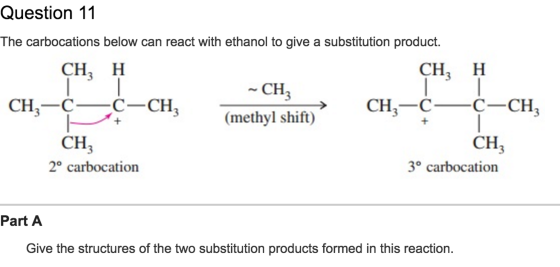
Homework Answers
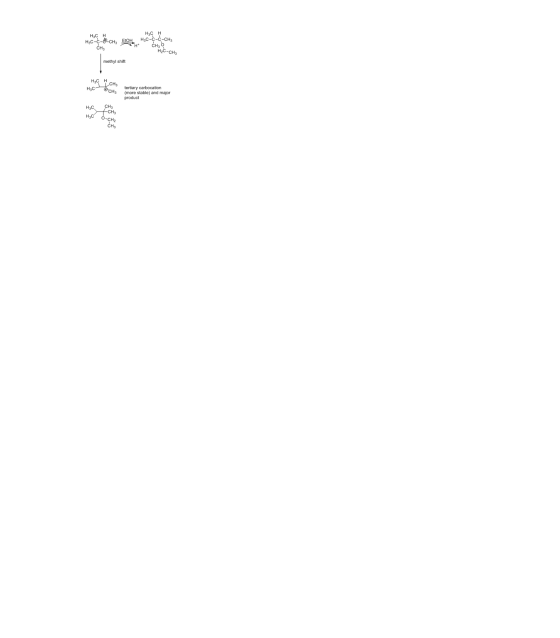
Add Answer to:
The carbocations below can react with ethanol to give a
substitution product.
The carbocations below can...
2. The reactions performed during this week's lab proceed via tertiary carbocation intermediates. These carbocations can...
 2. The reactions performed during this week's lab proceed via tertiary carbocation intermediates. These carbocations can react with nucleophiles/bases (ie. Cl and Br) to produce both Syl and El products. For each of the structures below, provide all of the possible substitution and elimination products: 1.) HSO,, H20 2.) NH Br OH
4 (b) Some of the compounds below may carbocation. Please draw the structures of the carbocations...
 4 (b) Some of the compounds below may carbocation. Please draw the structures of the carbocations that are formed. α undergo loss of the tooylane pop o form reaction" if no carbocation can be formed. If a carbocation consists of madiple res structure, draw two resonance structures. Also indicate which carbocation is the stable one. (20 points) NH2
(1pt) Give the substitution product expected from solvolysis of the compound shown below by heating in...
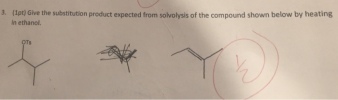 (1pt) Give the substitution product expected from solvolysis of the compound shown below by heating in ethanol. 3. OTS
please help 13. Consider the carbocations that could be formed from the compounds below through substitution reactio...
 please help
13. Consider the carbocations that could be formed from the compounds below through substitution reactions and assuming no rearrangements. Circle the compounds whose carbocations would be stabilized by resonance. Он OH Br OH Br CI OTs Br- Hас. OTf NH2 OMs - CH3
please help
13. Consider the carbocations that could be formed from the compounds below through substitution reactions and assuming no rearrangements. Circle the compounds whose carbocations would be stabilized by resonance. Он OH Br OH Br CI OTs Br- Hас. OTf NH2 OMs - CH3
Consider the reaction below. Understanding what you know about resonance stabilities provides the 2 possible carbocations...
 Consider the reaction below. Understanding what you know about resonance stabilities provides the 2 possible carbocations and the resonance structures of H+ addition to the reactant. Circle the carbocation that is the major product due to resonance stabilities. Provide the 1, 2 and 1, 4 products of that carbocation: Why did you pick that carbocation? Provide the 2 unlikely products of 1, 2 and 1, 4 additions from the other carbocation intermediate not chosen above. Hopefully you noted that the...
Draw a structural formula for the substitution product of the reaction shown below. Draw a structural...
 Draw a structural formula for the substitution product of the
reaction shown below.
Draw a structural formula for the substitution product of the reaction show below. Use the wedge/hash bond tools to indicate stereochemistry. If more than one stereoisomer of product is formed, draw both. Separate multiple products using the + sign from the dropdown menu.
Draw a structural formula for the substitution product of the
reaction shown below.
Draw a structural formula for the substitution product of the reaction show below. Use the wedge/hash bond tools to indicate stereochemistry. If more than one stereoisomer of product is formed, draw both. Separate multiple products using the + sign from the dropdown menu.
Draw a structural formula for the substitution product of the reaction shown below. Nat i acetone...
 Draw a structural formula for the substitution product of the reaction shown below. Nat i acetone • Use the wedge/hash bond tools to indicate stereochemistry where it exists. • If more than one stereoisomer of product is formed, draw both. • Separate multiple products using the + sign from the drop-down menu. • Products that are initially formed as ions should be drawn in their neutral forms. ChemDoodle Draw a structural formula for the substitution product of the reaction shown...
5. a) Give the major product forme "oduct formed by the following S2 substitution reactions: (6...
 5. a) Give the major product forme "oduct formed by the following S2 substitution reactions: (6 points) La CryCILSH U. KON I equivalent b) Give the major product formed by the following S1 substitution reactions: (6 points) MeNH OTS c) Give the major product formed by the following Syl substitution reaction and the mechanism for its formation: (9 points)
Draw a structural formula for the substitution product of the reaction shown below. OCH + Br...
 Draw a structural formula for the substitution product of the reaction shown below. OCH + Br Nac Na OCCHE DMSO DMSO = dimethyl sulfoxide • Use the wedge/hash bond tools to indicate stereochemistry where it exists. • If more than one stereoisomer of product is formed, draw both. • Separate multiple products using the + sign from the drop-down menu. • Products that are initially formed as ions should be drawn in their neutral forms. We were unable to transcribe...
Give an IUPAC name for the compound below.
 Give an IUPAC name for the compound below.Accepted names for branched allkyl groups are isopropyl, isobutyl, sec-butyl. and tert-butyl.Give an IUPAC name for the compound below.Accepted names for branched alkyl groups are isopropyl, isobutyl, seo-butyl, and tert-butyl.How many monochloro substitution products are produced when the alkanes below are chlorinated?Consider constitutional isomers only, ignore stereoisomers.a) The number of monochloro substitution products is _______ b)The number of monochloro substitution products is _______ In radical chlorination of alkanes, non-equivalent hydrogens react with chlorine atoms at different...
 2. The reactions performed during this week's lab proceed via tertiary carbocation intermediates. These carbocations can react with nucleophiles/bases (ie. Cl and Br) to produce both Syl and El products. For each of the structures below, provide all of the possible substitution and elimination products: 1.) HSO,, H20 2.) NH Br OH
 4 (b) Some of the compounds below may carbocation. Please draw the structures of the carbocations that are formed. α undergo loss of the tooylane pop o form reaction" if no carbocation can be formed. If a carbocation consists of madiple res structure, draw two resonance structures. Also indicate which carbocation is the stable one. (20 points) NH2
 (1pt) Give the substitution product expected from solvolysis of the compound shown below by heating in ethanol. 3. OTS
 please help
13. Consider the carbocations that could be formed from the compounds below through substitution reactions and assuming no rearrangements. Circle the compounds whose carbocations would be stabilized by resonance. Он OH Br OH Br CI OTs Br- Hас. OTf NH2 OMs - CH3
please help
13. Consider the carbocations that could be formed from the compounds below through substitution reactions and assuming no rearrangements. Circle the compounds whose carbocations would be stabilized by resonance. Он OH Br OH Br CI OTs Br- Hас. OTf NH2 OMs - CH3
 Consider the reaction below. Understanding what you know about resonance stabilities provides the 2 possible carbocations and the resonance structures of H+ addition to the reactant. Circle the carbocation that is the major product due to resonance stabilities. Provide the 1, 2 and 1, 4 products of that carbocation: Why did you pick that carbocation? Provide the 2 unlikely products of 1, 2 and 1, 4 additions from the other carbocation intermediate not chosen above. Hopefully you noted that the...
 Draw a structural formula for the substitution product of the
reaction shown below.
Draw a structural formula for the substitution product of the reaction show below. Use the wedge/hash bond tools to indicate stereochemistry. If more than one stereoisomer of product is formed, draw both. Separate multiple products using the + sign from the dropdown menu.
Draw a structural formula for the substitution product of the
reaction shown below.
Draw a structural formula for the substitution product of the reaction show below. Use the wedge/hash bond tools to indicate stereochemistry. If more than one stereoisomer of product is formed, draw both. Separate multiple products using the + sign from the dropdown menu.
 Draw a structural formula for the substitution product of the reaction shown below. Nat i acetone • Use the wedge/hash bond tools to indicate stereochemistry where it exists. • If more than one stereoisomer of product is formed, draw both. • Separate multiple products using the + sign from the drop-down menu. • Products that are initially formed as ions should be drawn in their neutral forms. ChemDoodle Draw a structural formula for the substitution product of the reaction shown...
 5. a) Give the major product forme "oduct formed by the following S2 substitution reactions: (6 points) La CryCILSH U. KON I equivalent b) Give the major product formed by the following S1 substitution reactions: (6 points) MeNH OTS c) Give the major product formed by the following Syl substitution reaction and the mechanism for its formation: (9 points)
 Draw a structural formula for the substitution product of the reaction shown below. OCH + Br Nac Na OCCHE DMSO DMSO = dimethyl sulfoxide • Use the wedge/hash bond tools to indicate stereochemistry where it exists. • If more than one stereoisomer of product is formed, draw both. • Separate multiple products using the + sign from the drop-down menu. • Products that are initially formed as ions should be drawn in their neutral forms. We were unable to transcribe...
Most questions answered within 3 hours.
-
Where is the error in this code sequence?
String s1 = "Hello";
String s2 = "ello";...
asked 10 months ago -
Financial data for Joel de Paris, Inc., for last year
follow:
Joel de Paris, Inc.
Balance...
asked 10 months ago -
Consider this reaction:
Al2(SO4)3 (aq)+ BaCl3
(aq) Al2Cl6 (aq)- +
3BaSO4(s) . What is the...
asked 10 months ago -
Suppose that Savneet is considering increasing her
recent random sample from 20 car rentals to 40...
asked 10 months ago -
Trucks arrive at an unloading terminal at an average rate of 120
per hour.
Trucks arrive...
asked 10 months ago -
Why are methanol and ethanol completely soluble in water while
octanol is not very little soluble....
asked 10 months ago -
A facilities manager at a university reads in a research report
that the mean amount of...
asked 10 months ago -
When the CuSO4 is rehydrated by adding water to the anhydrous
compound, is this an endothermic...
asked 10 months ago -
A ray of sunlight is passing from diamond into crown glass; the
angle of incidence is...
asked 10 months ago -
A block of mass 0.249 kg is placed on top of a light, vertical
spring of...
asked 10 months ago -
how do the kidneys compensate in the presences of acidosis
a) trigger hyperventilate
b) reserve acid...
asked 10 months ago -
Question 501 pts
The rental rate of capital to the firm increases. Which of the
following...
asked 10 months ago