
Homework Answers
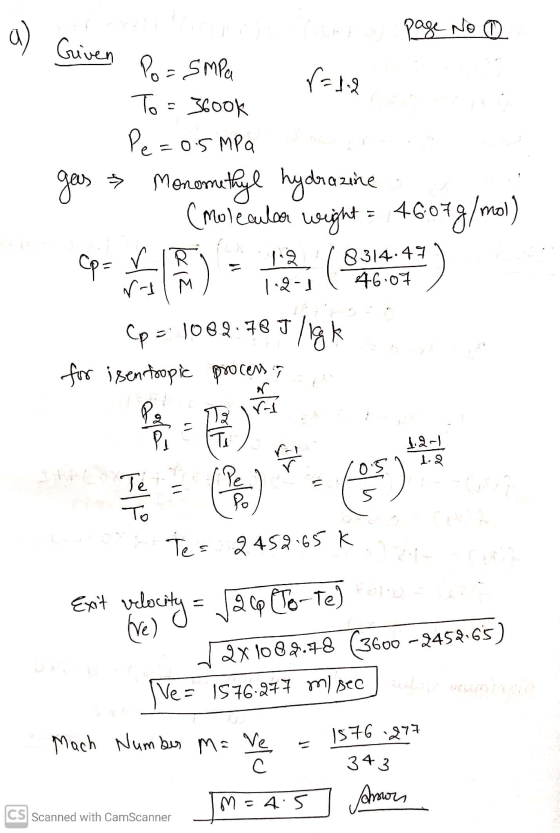
In the question ambient pressure is not given so I am assuming it to be 100KPa.

Add Answer to:
SP 7. The SpaceX Super Draco reaction control thrusters employ a converging-diverging nozzle to isentropically accelerate...
[15 pts] Consider a converging diverging nozzle with an exit-to-throat area ratio of Ae/At = 1.25...
 [15 pts] Consider a converging diverging nozzle with an exit-to-throat area ratio of Ae/At = 1.25 as shown below. The stagnation pressure upstream of the throat is 8.5 atm and the stagnation temperature is 1000 K. (a) Assume the air is expanded isentropically to supersonic speed at the exit. Determine the following properties at the nozzle exit: Me, Pe, Te, Pe, ue, Poe, Toe (b) If the area ratio in the subsonic part of the converging diverging nozzle, A1/A is...
Poblem Comergini sentropie regim (no shock waves) Consider isentropic flow through a converging-diverging nozzle. The exit...
 Poblem Comergini sentropie regim (no shock waves) Consider isentropic flow through a converging-diverging nozzle. The exit area of the nozzle is , and the throat area of the nozzle is . The air entering the nozzle has stagnation conditions: , and Use Figure D.1 or Table D (a) Calculate the mass flow rate for choked flow (that is, sonic flow at the throat). Hints: See Section 11.7, use Figure D.1 to find density and temperature at M 1 (throat), find...
Air, at po = 160 lbf/in2 and To = 300°F, flows isentropically through a converging-diverging nozzle....
Air, at po = 160 lbf/in2 and To = 300°F, flows isentropically through a converging-diverging nozzle. At section 1, where A1 = 288 in2, the velocity is V1 = 2068 ft/s. Calculate the inlet Mach number (Ma1) and the throat area (A*). The inlet Mach number is-------- . The throat area is---------- ft2.es Determine the inlet pressure (p1) and the mass flow rate (m.). Round the final answer to three decimal places. The inlet pressure is ----------- lbf/ft2. The mass...
A converging-diverging nozzle is supplied with a hypersonic flow at a pressure of 31 MPa. A...
A converging-diverging nozzle is supplied with a hypersonic flow at a pressure of 31 MPa. A normal shock is maintained at the exit plane of the nozzle, which causes the Mach number to decrease from 3.5 to 0.45. The nozzle exits into an ambient pressure of 0.1 MPa. In this situation, is the exit pressure equal to the ambient pressure? If so, please explain why. If not, please explain the steps on how to find the exit pressure after the...
Problem 2 was... Air exapands in a frictionless adiabatic flow through a converging-diverging nozzle at a...
 Problem 2 was...
Air exapands in a frictionless adiabatic flow through a
converging-diverging nozzle at a mass flow rate of 2.5 kg/s. Source
stagnation condition are 1.1 Mpa and 115 C. If the nozzle exit
pressure is 141 kPa, and there are no shocks in the nozzle, find
the (a) the exit area Ae; (b) the throat At.
And I got (a) Ae = 1.11 * 10^(-3) m^2 and (b) At = 1.87 *
10^(-3) m^2
3. For the nozzle...
Problem 2 was...
Air exapands in a frictionless adiabatic flow through a
converging-diverging nozzle at a mass flow rate of 2.5 kg/s. Source
stagnation condition are 1.1 Mpa and 115 C. If the nozzle exit
pressure is 141 kPa, and there are no shocks in the nozzle, find
the (a) the exit area Ae; (b) the throat At.
And I got (a) Ae = 1.11 * 10^(-3) m^2 and (b) At = 1.87 *
10^(-3) m^2
3. For the nozzle...
B4 (a) Ste the parameter that is normally used to differentiate between incompressible and compressible flow conditions. What value is normally chosen for this parameter to signify a change from one...
 B4 (a) Ste the parameter that is normally used to differentiate between incompressible and compressible flow conditions. What value is normally chosen for this parameter to signify a change from one condition to another? (5%] For isentropic flow conditions, sketch a subsonic and a supersonic nozzle (b) Sketch also a subsonic and a supersonic diffuser. [1096] (c) A converging-diverging nozzle is attached at one end to a large supply tank that contains air, and at the other end to a...
A converging-diverging nozzle has a throat area of 1 cm2 and an exit area of 4 cm2. The inlet sta...
 A converging-diverging nozzle has a throat area of 1 cm2 and an exit area of 4 cm2. The inlet stagnation conditions are Po 500 kPa and To 300 K. The nozzle discharges to an infinite surroundings at Po. The flowing medium is air as a perfect gas with k-1.4 Answer the following: i What are the two isentropic flow solutions for this nozzle with M 1 at the throat? What are the Mach number, P, Po and T, To at...
UBAV Air flows through a converging-diverging nozzle diffuser. A normal shock stands in the diverging section...
 UBAV Air flows through a converging-diverging nozzle diffuser. A normal shock stands in the diverging section of the nozzle. Assuming isentropie flow, air as an ideal gas, and constant specific heat determine the state at several locations in the system. Solve wsing equations rather than with the tables Note: The Specific heat ratio and gas constant for air are given as k-1 and R 0.287 kJ/kg-K respectively Give Values Inlet Temperature: TI(K)-340 Inlet pressure: P1 (kPa) - 550 Inlet Velocity:...
Air flows through a converging-diverging nozzle/diffuser. Assuming isentropic flow, air as an ideal gas, and constant...
 Air flows through a converging-diverging nozzle/diffuser. Assuming isentropic flow, air as an ideal gas, and constant specific heats determine the state at several locations the system. Solve using equations rather than with the tables. Note: The specific heat ratio and gas constant for air are given as k=1.4 and R=0.287 kJ/kg-K respectively. --Given Values-- Inlet Temperature: T1 (K) = 353 Inlet pressure: Pl (kPa) = 546 Inlet Velocity: V1 (m/s) = 61 Area at nozzle inlet: A1 (cm^2) = 7.24...
Air flows through a converging-diverging nozzle/diffuser. Assuming isentropic flow, air as an ideal gas, and constant...
Air flows through a converging-diverging nozzle/diffuser. Assuming isentropic flow, air as an ideal gas, and constant specific heats determine the state at several locations in the system. Solve using equations rather than with the tables. Note: The specific heat ratio and gas constant for air are given as k=1.4 and R=0.287 kJ/kg-K respectively. --Given Values-- Inlet Temperature: T1 (K) = 321 Inlet pressure: P1 (kPa) = 588 Inlet Velocity: V1 (m/s) = 97 Area at nozzle inlet: A1 (cm^2) =...
 [15 pts] Consider a converging diverging nozzle with an exit-to-throat area ratio of Ae/At = 1.25 as shown below. The stagnation pressure upstream of the throat is 8.5 atm and the stagnation temperature is 1000 K. (a) Assume the air is expanded isentropically to supersonic speed at the exit. Determine the following properties at the nozzle exit: Me, Pe, Te, Pe, ue, Poe, Toe (b) If the area ratio in the subsonic part of the converging diverging nozzle, A1/A is...
 Poblem Comergini sentropie regim (no shock waves) Consider isentropic flow through a converging-diverging nozzle. The exit area of the nozzle is , and the throat area of the nozzle is . The air entering the nozzle has stagnation conditions: , and Use Figure D.1 or Table D (a) Calculate the mass flow rate for choked flow (that is, sonic flow at the throat). Hints: See Section 11.7, use Figure D.1 to find density and temperature at M 1 (throat), find...
 Problem 2 was...
Air exapands in a frictionless adiabatic flow through a
converging-diverging nozzle at a mass flow rate of 2.5 kg/s. Source
stagnation condition are 1.1 Mpa and 115 C. If the nozzle exit
pressure is 141 kPa, and there are no shocks in the nozzle, find
the (a) the exit area Ae; (b) the throat At.
And I got (a) Ae = 1.11 * 10^(-3) m^2 and (b) At = 1.87 *
10^(-3) m^2
3. For the nozzle...
Problem 2 was...
Air exapands in a frictionless adiabatic flow through a
converging-diverging nozzle at a mass flow rate of 2.5 kg/s. Source
stagnation condition are 1.1 Mpa and 115 C. If the nozzle exit
pressure is 141 kPa, and there are no shocks in the nozzle, find
the (a) the exit area Ae; (b) the throat At.
And I got (a) Ae = 1.11 * 10^(-3) m^2 and (b) At = 1.87 *
10^(-3) m^2
3. For the nozzle...
 B4 (a) Ste the parameter that is normally used to differentiate between incompressible and compressible flow conditions. What value is normally chosen for this parameter to signify a change from one condition to another? (5%] For isentropic flow conditions, sketch a subsonic and a supersonic nozzle (b) Sketch also a subsonic and a supersonic diffuser. [1096] (c) A converging-diverging nozzle is attached at one end to a large supply tank that contains air, and at the other end to a...
 A converging-diverging nozzle has a throat area of 1 cm2 and an exit area of 4 cm2. The inlet stagnation conditions are Po 500 kPa and To 300 K. The nozzle discharges to an infinite surroundings at Po. The flowing medium is air as a perfect gas with k-1.4 Answer the following: i What are the two isentropic flow solutions for this nozzle with M 1 at the throat? What are the Mach number, P, Po and T, To at...
 UBAV Air flows through a converging-diverging nozzle diffuser. A normal shock stands in the diverging section of the nozzle. Assuming isentropie flow, air as an ideal gas, and constant specific heat determine the state at several locations in the system. Solve wsing equations rather than with the tables Note: The Specific heat ratio and gas constant for air are given as k-1 and R 0.287 kJ/kg-K respectively Give Values Inlet Temperature: TI(K)-340 Inlet pressure: P1 (kPa) - 550 Inlet Velocity:...
 Air flows through a converging-diverging nozzle/diffuser. Assuming isentropic flow, air as an ideal gas, and constant specific heats determine the state at several locations the system. Solve using equations rather than with the tables. Note: The specific heat ratio and gas constant for air are given as k=1.4 and R=0.287 kJ/kg-K respectively. --Given Values-- Inlet Temperature: T1 (K) = 353 Inlet pressure: Pl (kPa) = 546 Inlet Velocity: V1 (m/s) = 61 Area at nozzle inlet: A1 (cm^2) = 7.24...
Most questions answered within 3 hours.
-
Where is the error in this code sequence?
String s1 = "Hello";
String s2 = "ello";...
asked 10 months ago -
Financial data for Joel de Paris, Inc., for last year
follow:
Joel de Paris, Inc.
Balance...
asked 10 months ago -
Consider this reaction:
Al2(SO4)3 (aq)+ BaCl3
(aq) Al2Cl6 (aq)- +
3BaSO4(s) . What is the...
asked 10 months ago -
Suppose that Savneet is considering increasing her
recent random sample from 20 car rentals to 40...
asked 10 months ago -
Trucks arrive at an unloading terminal at an average rate of 120
per hour.
Trucks arrive...
asked 10 months ago -
Why are methanol and ethanol completely soluble in water while
octanol is not very little soluble....
asked 10 months ago -
A facilities manager at a university reads in a research report
that the mean amount of...
asked 10 months ago -
When the CuSO4 is rehydrated by adding water to the anhydrous
compound, is this an endothermic...
asked 10 months ago -
A ray of sunlight is passing from diamond into crown glass; the
angle of incidence is...
asked 10 months ago -
A block of mass 0.249 kg is placed on top of a light, vertical
spring of...
asked 10 months ago -
how do the kidneys compensate in the presences of acidosis
a) trigger hyperventilate
b) reserve acid...
asked 10 months ago -
Question 501 pts
The rental rate of capital to the firm increases. Which of the
following...
asked 10 months ago