QUESTION 2 Given the unbalanced equation: ____ Al(s) + ____Cl2(g) → _____AlCl3(s) If 50.00 g of...
QUESTION 2 Given the unbalanced equation: ____ Al(s) + ____Cl2(g) → _____AlCl3(s) If 50.00 g of aluminum and 150.00 g of chlorine gas are reacted.Calculate the maximum number of moles of AlCl3 that can be formed. a)1.0579 mol b) 2.1157 mol c) 1.853 mol d)1.4104 mol e) 0.9266 mol
Homework Answers
Molar mass of Al = 26.98 g/mol
mass(Al)= 50.0 g
use:
number of mol of Al,
n = mass of Al/molar mass of Al
=(50 g)/(26.98 g/mol)
= 1.853 mol
Molar mass of Cl2 = 70.9 g/mol
mass(Cl2)= 150.0 g
use:
number of mol of Cl2,
n = mass of Cl2/molar mass of Cl2
=(1.5*10^2 g)/(70.9 g/mol)
= 2.116 mol
Balanced chemical equation is:
2 Al + 3 Cl2 ---> 2 AlCl3 +
2 mol of Al reacts with 3 mol of Cl2
for 1.853 mol of Al, 2.78 mol of Cl2 is required
But we have 2.116 mol of Cl2
so, Cl2 is limiting reagent
we will use Cl2 in further calculation
According to balanced equation
mol of AlCl3 formed = (2/3)* moles of Cl2
= (2/3)*2.116
= 1.4107 mol
Answer: d
Add Answer to:
QUESTION 2 Given the unbalanced equation: ____ Al(s) +
____Cl2(g) → _____AlCl3(s) If 50.00 g of...
he balanced equation for the reaction of aluminum metal and chlorine gas is 2Al(s) + 3Cl2(g)...
he balanced equation for the reaction of aluminum metal and chlorine gas is 2Al(s) + 3Cl2(g) → 2AlCl3(s) Assume that 0.43 g Al is mixed with 0.54 g Cl2. (a) What is the limiting reactant? Cl2 or Al (b) What is the maximum amount of AlCl3, in grams, that can be produced?
4. Given the following balanced chemical reaction, find the mass of aluminum chloride formed from 7.75...
 4. Given the following balanced chemical reaction, find the mass of aluminum chloride formed from 7.75 g of aluminum using the following steps: 2 Al(s) + 3 CuCl2 (aq) + 3 Cu (s) + 2 AlCl3 (aq) a. Given 7.75 g of aluminum (Al), how many moles of aluminum are there? b. What is the molar ratio of aluminum chloride (AICI3) to aluminum? C. How many moles of aluminum chloride are formed from the number of moles of aluminum found...
In the following chemical reaction, 2 mol of A will react with 1 mol of B...
In the following chemical reaction, 2 mol of A will react with 1 mol of B to produce 1 mol of A2B without anything left over: 2A+B→A2B But what if you're given 2.8 mol of A and 3.2 mol of B? The amount of product formed is limited by the reactant that runs out first, called the limiting reactant. To identify the limiting reactant, calculate the amount of product formed from each amount of reactant separately: 2.8 mol A×1 mol...
X 1. Aluminum reacts with oxygen to produce aluminum oxide 4 Al(s) + 3 O2(g) +...
 X 1. Aluminum reacts with oxygen to produce aluminum oxide 4 Al(s) + 3 O2(g) + 2 Al2O3(s) IF 3.0 moles of Alreact with excess O2, how many moles of AlzO3 can be formed? a) 1.0 mol b) 1.50 mol c) 3.0 mol d ) 4.0 mol e) 4.5 mol 10. What is the log of 5,400.05? a) 3.07 b) 3.37 c) 3.73 d) 37.32 e) 37.23 Short Answer Questions (True or False)
Given the unbalanced reaction of Al(s) + O2 (g) ---> Al2O3 (s), determine which reagent, and...
Given the unbalanced reaction of Al(s) + O2 (g) ---> Al2O3 (s), determine which reagent, and how much will be left over after the reaction of 5.0 mol of Al (s) with 4.0 mol of O2 (g).
A. Given the following equation: 2 Al + 6 HCl → 2 AlCl3 + 3H2 If...
A. Given the following equation: 2 Al + 6 HCl → 2 AlCl3 + 3H2 If 20.0 mol of Al completely react, how many many moles of hydrogen gas would be produced? NOTE: All numbers located immediately after elemental symbols should be considered subscripts. 6.00 moles 12.00 moles 3.00 moles 30.0 moles B Given the following equation: 2 H2 + O2 → 2 H2O How many kg of water would be produced from the complete combustion of 800.0 kilograms of...
6.10 2 AICI, a. 2.224 12- 112 mol 112 x 61.9789 €6.949 Balance the chemical equation:...
 6.10 2 AICI, a. 2.224 12- 112 mol 112 x 61.9789 €6.949 Balance the chemical equation: 2 Al +3 Cl, How many moles of chlorine gas will react with 0.160 mole of aluminum? 29 b. The theoretical yield (Sec. 6.9) for a chemical reaction is the maximum amount of a product that can be obtained from given amounts of reactants. Calculate the theoretical yield, in grams, of aluminum chloride that could be produced from 5.27 moles of aluminum. (Assume that...
Given the balanced equation 2AI (s) + 3C1, (g) + 2AICI, (s), select all the conversion...
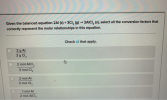 Given the balanced equation 2AI (s) + 3C1, (g) + 2AICI, (s), select all the conversion factors that correctly represent the molar relationships in this equation. Check all that apply. 2 g Al 3 g CI 2 mol AICI, 3 mol Cl, 2 mol Al 3 mol Cl, 1 mol Al 2 mol AICI, Balance the unbalanced equation given and match each substance to the correct coefficient as indicated. ALS, (s) +H,0 (Al(OH)2(aq) + H2S (g) Drag statements on the...
a For the following unbalanced equation, indicate how many moles of the second reactant would be...
 a For the following unbalanced equation, indicate how many moles of the second reactant would be required to react with exactly 0.275 mol of the first reactant. Clz (9) + KI(aq) +1(8) + KCl(aq) mol KI b For the following unbalanced equation, indicate how many moles of the second reactant would be required to react with exactly 0.355 mol of the first reactant. Co(s) +P$(s) + CogP2(8) mol P4 C For the following unbalanced equation, indicate how many moles of...
a. 2Al(s)+3Cl2(g)→2AlCl3(s) You are given 19.0 g of aluminum and 24.0 g of chlorine gas.If you had excess aluminum, how...
a. 2Al(s)+3Cl2(g)→2AlCl3(s) You are given 19.0 g of aluminum and 24.0 g of chlorine gas.If you had excess aluminum, how many moles of aluminum chloride could be produced from 24.0 g of chlorine gas, Cl2? b. Determine the balanced chemical equation for this reaction. C8H18(g)+O2(g)→CO2(g)+H2O(g) c. 3H2(g)+N2(g)→2NH3(g) 1.08 g H2 is allowed to react with 10.3 g N2, producing 1.04 g NH3. What is the theoretical yield for this reaction under the given conditions? What is the percent yield for...
 4. Given the following balanced chemical reaction, find the mass of aluminum chloride formed from 7.75 g of aluminum using the following steps: 2 Al(s) + 3 CuCl2 (aq) + 3 Cu (s) + 2 AlCl3 (aq) a. Given 7.75 g of aluminum (Al), how many moles of aluminum are there? b. What is the molar ratio of aluminum chloride (AICI3) to aluminum? C. How many moles of aluminum chloride are formed from the number of moles of aluminum found...
 X 1. Aluminum reacts with oxygen to produce aluminum oxide 4 Al(s) + 3 O2(g) + 2 Al2O3(s) IF 3.0 moles of Alreact with excess O2, how many moles of AlzO3 can be formed? a) 1.0 mol b) 1.50 mol c) 3.0 mol d ) 4.0 mol e) 4.5 mol 10. What is the log of 5,400.05? a) 3.07 b) 3.37 c) 3.73 d) 37.32 e) 37.23 Short Answer Questions (True or False)
 6.10 2 AICI, a. 2.224 12- 112 mol 112 x 61.9789 €6.949 Balance the chemical equation: 2 Al +3 Cl, How many moles of chlorine gas will react with 0.160 mole of aluminum? 29 b. The theoretical yield (Sec. 6.9) for a chemical reaction is the maximum amount of a product that can be obtained from given amounts of reactants. Calculate the theoretical yield, in grams, of aluminum chloride that could be produced from 5.27 moles of aluminum. (Assume that...
 Given the balanced equation 2AI (s) + 3C1, (g) + 2AICI, (s), select all the conversion factors that correctly represent the molar relationships in this equation. Check all that apply. 2 g Al 3 g CI 2 mol AICI, 3 mol Cl, 2 mol Al 3 mol Cl, 1 mol Al 2 mol AICI, Balance the unbalanced equation given and match each substance to the correct coefficient as indicated. ALS, (s) +H,0 (Al(OH)2(aq) + H2S (g) Drag statements on the...
 a For the following unbalanced equation, indicate how many moles of the second reactant would be required to react with exactly 0.275 mol of the first reactant. Clz (9) + KI(aq) +1(8) + KCl(aq) mol KI b For the following unbalanced equation, indicate how many moles of the second reactant would be required to react with exactly 0.355 mol of the first reactant. Co(s) +P$(s) + CogP2(8) mol P4 C For the following unbalanced equation, indicate how many moles of...
Most questions answered within 3 hours.
-
Where is the error in this code sequence?
String s1 = "Hello";
String s2 = "ello";...
asked 10 months ago -
Financial data for Joel de Paris, Inc., for last year
follow:
Joel de Paris, Inc.
Balance...
asked 10 months ago -
Consider this reaction:
Al2(SO4)3 (aq)+ BaCl3
(aq) Al2Cl6 (aq)- +
3BaSO4(s) . What is the...
asked 10 months ago -
Suppose that Savneet is considering increasing her
recent random sample from 20 car rentals to 40...
asked 10 months ago -
Trucks arrive at an unloading terminal at an average rate of 120
per hour.
Trucks arrive...
asked 10 months ago -
Why are methanol and ethanol completely soluble in water while
octanol is not very little soluble....
asked 10 months ago -
A facilities manager at a university reads in a research report
that the mean amount of...
asked 10 months ago -
When the CuSO4 is rehydrated by adding water to the anhydrous
compound, is this an endothermic...
asked 10 months ago -
A ray of sunlight is passing from diamond into crown glass; the
angle of incidence is...
asked 10 months ago -
A block of mass 0.249 kg is placed on top of a light, vertical
spring of...
asked 10 months ago -
how do the kidneys compensate in the presences of acidosis
a) trigger hyperventilate
b) reserve acid...
asked 10 months ago -
Question 501 pts
The rental rate of capital to the firm increases. Which of the
following...
asked 10 months ago