
Homework Answers
Let X denote the random variable representing the number of defective items in the random sample of 20 items.
Now, we are given that the prior distribution of  is the beta distribution with parameters 1 and 10
=>
~ Beta(α=1, β=10)
Moreover, since
is the proportion of defective items in the random sample of 20
items, we can conclude that:
X|
~ Binomial(n=20,
)
(a)
Now, the expected value and variance of prior distribution is given by:
![E(0) = +8 Var(@) = 1 + 10 [ANSWER] a 8 (a + b)2(a + 8 + 1) 1 * 10 (1 + 10)2 *(1 + 10 + 1) 10 112 * 12 5 726 ANSWER](http://img.homeworklib.com/questions/3e55c8b0-1f22-11eb-866c-bdcaed6fae27.png?x-oss-process=image/resize,w_560)
(b)
To find the posterior distribution, we use the following relation:
Posterior  Prior*Likelihood ................(1)
Now, we are given the following details about the prior:
~ Beta(α=1, β=10)
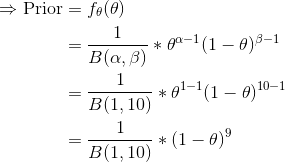
Also, we are given that X|
~ Binomial(n=20,
) and that we observed X = 1 (since in a random sample of 20 items
we found 1 defective item). Thus:

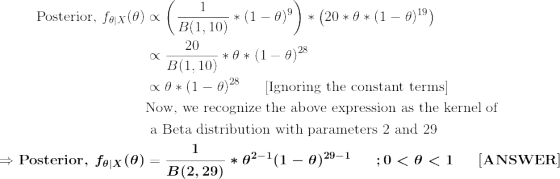
Now, substituting the value of Prior and Likelihood in equation (1), we get:

(c)
The Bayes estimator for
under the quadratic loss function is just the mean of the
Posterior disribution, thus we get:
![Bayes estimator for under quadratic loss = E[0|X] = E[Betala = 2,8 = 29)] at B 2+29 = 31 ANSWER = 0.064516 ANSWER](http://img.homeworklib.com/questions/419ffb50-1f22-11eb-aae6-d79eec29ba25.png?x-oss-process=image/resize,w_560)
(d)
The likelihood function is given by:
![Likelihood, L = Pxel X = 1) = (20)*(1 – 6)20-1 [Using the formula for PMF of a Binomial Distribution] = 20**(1 - 0) 19 Taking](http://img.homeworklib.com/questions/41f30eb0-1f22-11eb-90d4-c9dec35977b1.png?x-oss-process=image/resize,w_560)

To check that the last expression for
is indeed a point of maxima for the likelihood, we again
differentiate expression (2) w.r.t.
:
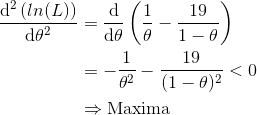
Thus, the MLE of
is: ![Ô= = 0.05 [ANSWER]](http://img.homeworklib.com/questions/43fa9fe0-1f22-11eb-9ee5-89246f5fa135.png?x-oss-process=image/resize,w_560)
From part (c) and the last expression we see that the
Bayes estimator under quadratic loss and the M.L.E. for
are not the same. [ANSWER]
Add Answer to:
6. Suppose that the proportion 0 of defective items in large shipment is unknown and that...
) Suppose that the proportion θ of defective items in a large shipment is unknown, and...
) Suppose that the proportion θ of defective items in a large shipment is unknown, and the prior distribution of θ is a Beta distribution with α = 5 and β = 10. Suppose also that 20 items are selected at random from the shipment, and that exactly one of these items is found to be defective. If the squared loss function is used, what is the Bayes estimate of θ? Hint: Estimator is a function of observations, while estimate...
M 1: Suppose that.X, form a random sample from a Bernoulli distribution for s unknown (0 θ < 1). ...
 m 1: Suppose that.X, form a random sample from a Bernoulli distribution for s unknown (0 θ < 1). Suppose also that the prior distribu- the beta distribution with parameters a >0 and 8> 0. Then the posterior distribution which the value of the parameter i of θ given that Xi z, (i l, where -n isthe beta distribution with parameters (0.3.), -: Proof:
m 1: Suppose that.X, form a random sample from a Bernoulli distribution for s unknown (0...
m 1: Suppose that.X, form a random sample from a Bernoulli distribution for s unknown (0 θ < 1). Suppose also that the prior distribu- the beta distribution with parameters a >0 and 8> 0. Then the posterior distribution which the value of the parameter i of θ given that Xi z, (i l, where -n isthe beta distribution with parameters (0.3.), -: Proof:
m 1: Suppose that.X, form a random sample from a Bernoulli distribution for s unknown (0...
The proportion of defective items in a large lot is p. Suppose a random sample of...
The proportion of defective items in a large lot is p. Suppose a random sample of n items is selected from the lot. Let X denote the number of defective items in the sample and let Ydenote the number of non-defective items (a) Specify the distributions of X and Y , respectively. Are they independent? (b) Find E(X −Y) and var(X −Y).
1. The proportion of defective items in a large lot is p. Suppose a random sample of n items is s...
 1. The proportion of defective items in a large lot is p. Suppose a random sample of n items is selected from the lot. Let X denote the mumber of defective itens in the sample and let denote the number of non-defective items. (a) Specify the distributions of X and Y, respectively. Are they independent? (b) Find E(X-Y) and var(X Y).
1. The proportion of defective items in a large lot is p. Suppose a random sample of n items...
1. The proportion of defective items in a large lot is p. Suppose a random sample of n items is selected from the lot. Let X denote the mumber of defective itens in the sample and let denote the number of non-defective items. (a) Specify the distributions of X and Y, respectively. Are they independent? (b) Find E(X-Y) and var(X Y).
1. The proportion of defective items in a large lot is p. Suppose a random sample of n items...
4. Suppose your prior distribution for θ the proportion of Iowans who support the death penalty, ...
 4. Suppose your prior distribution for θ the proportion of Iowans who support the death penalty, is beta with mean 0.60 and standard deviation 0.30. (a) Determine the parameters a and B of your prior distribution. Sketch the prior density function Feel free to use the following R code theta seqC0,1,.001) dens <- dbeta(theta,1,.67) plot (theta, dens, xlim-co,1), ylim-c(0,3), type-"1", xlab-"theta") (b) A random sarnple of 1,000 Iowans is taken, and 65% support the death penalty. What are your posterior...
Recall that the exponential distribution with parameter A > 0 has density g (x) Ae, (x > 0). We write X Exp (A)...
 Recall that the exponential distribution with parameter A > 0 has density g (x) Ae, (x > 0). We write X Exp (A) when a random variable X has this distribution. The Gamma distribution with positive parameters a (shape), B (rate) has density h (x) ox r e , (r > 0). and has expectation.We write X~ Gamma (a, B) when a random variable X has this distribution Suppose we have independent and identically distributed random variables X1,..., Xn, that...
* The joint pdf of x and Y is Fxy (x,y) = cx^3 y , 0...
* The joint pdf of x and Y is Fxy (x,y) = cx^3 y , 0 <x<y<1 . A) find the value of C to make this a valid pdf? * The proportion of defective parts shipped by a wholesaler varies from shipment to shipment. Suppose that the proportion of defective in shipment follow a beta distribution with a=4 and B = 2 . A) what is the probability that a shipment will have fewer than 20% defective parts ?
Number 4 turns out to be an inverse gamma function with parameters alpha= n and beta=...
 Number 4 turns out to be an inverse gamma function with
parameters alpha= n and beta= the sum of x sub i
PLEASE ANSWER #5 NOT #4
4. Suppose that X1,X2, 10 pts. the p.d.f. is given by form a random sample from a distribution for which where the unknown parameter θ > 0. Suppose also that the improper prior of θ is m(0) Find the posterior distribution π(θ x). Hint: The inverse gamina distribution from question 6 in Homework...
Number 4 turns out to be an inverse gamma function with
parameters alpha= n and beta= the sum of x sub i
PLEASE ANSWER #5 NOT #4
4. Suppose that X1,X2, 10 pts. the p.d.f. is given by form a random sample from a distribution for which where the unknown parameter θ > 0. Suppose also that the improper prior of θ is m(0) Find the posterior distribution π(θ x). Hint: The inverse gamina distribution from question 6 in Homework...
Question 3 [25] , Yn denote a random sample of size n from a Let Y,...
 Question 3 [25] , Yn denote a random sample of size n from a Let Y, Y2, population with an exponential distribution whose density is given by y > 0 if o, otherwise -E70 cumulative distribution function f(y) L ..,Y} denotes the smallest order statistics, show that Y1) = min{Y1, =nYa) 3.1 show that = nY1) is an unbiased estimator for 0. /12/ /13/ 3.2 find the mean square error for MSE(e). 2 f-llays Iat-k)-at 1-P Question 4[25] 4.1 Distinguish...
A random varible X taking values from [0,1] has Beta distribution of parameters a and B,...
 A random varible X taking values from [0,1] has Beta distribution of parameters a and B, which we denote by Beta(a,b), if it has PDF _f(a+B) fa-1(1 – X)B-1, fx(x) = T(a)l(B) where I(z) is the Euler Gamma function defined by I(z) = Sx2-1e-*dx. Bob has a coin with unknown probability of heads. Alice has the following Beta prior: A = Beta(2,3). Suppose that Bob gives Alice the data on = {x1,...,xn), which is the outcome of n indepen- dent...
 m 1: Suppose that.X, form a random sample from a Bernoulli distribution for s unknown (0 θ < 1). Suppose also that the prior distribu- the beta distribution with parameters a >0 and 8> 0. Then the posterior distribution which the value of the parameter i of θ given that Xi z, (i l, where -n isthe beta distribution with parameters (0.3.), -: Proof:
m 1: Suppose that.X, form a random sample from a Bernoulli distribution for s unknown (0...
m 1: Suppose that.X, form a random sample from a Bernoulli distribution for s unknown (0 θ < 1). Suppose also that the prior distribu- the beta distribution with parameters a >0 and 8> 0. Then the posterior distribution which the value of the parameter i of θ given that Xi z, (i l, where -n isthe beta distribution with parameters (0.3.), -: Proof:
m 1: Suppose that.X, form a random sample from a Bernoulli distribution for s unknown (0...
 1. The proportion of defective items in a large lot is p. Suppose a random sample of n items is selected from the lot. Let X denote the mumber of defective itens in the sample and let denote the number of non-defective items. (a) Specify the distributions of X and Y, respectively. Are they independent? (b) Find E(X-Y) and var(X Y).
1. The proportion of defective items in a large lot is p. Suppose a random sample of n items...
1. The proportion of defective items in a large lot is p. Suppose a random sample of n items is selected from the lot. Let X denote the mumber of defective itens in the sample and let denote the number of non-defective items. (a) Specify the distributions of X and Y, respectively. Are they independent? (b) Find E(X-Y) and var(X Y).
1. The proportion of defective items in a large lot is p. Suppose a random sample of n items...
 4. Suppose your prior distribution for θ the proportion of Iowans who support the death penalty, is beta with mean 0.60 and standard deviation 0.30. (a) Determine the parameters a and B of your prior distribution. Sketch the prior density function Feel free to use the following R code theta seqC0,1,.001) dens <- dbeta(theta,1,.67) plot (theta, dens, xlim-co,1), ylim-c(0,3), type-"1", xlab-"theta") (b) A random sarnple of 1,000 Iowans is taken, and 65% support the death penalty. What are your posterior...
 Recall that the exponential distribution with parameter A > 0 has density g (x) Ae, (x > 0). We write X Exp (A) when a random variable X has this distribution. The Gamma distribution with positive parameters a (shape), B (rate) has density h (x) ox r e , (r > 0). and has expectation.We write X~ Gamma (a, B) when a random variable X has this distribution Suppose we have independent and identically distributed random variables X1,..., Xn, that...
 Number 4 turns out to be an inverse gamma function with
parameters alpha= n and beta= the sum of x sub i
PLEASE ANSWER #5 NOT #4
4. Suppose that X1,X2, 10 pts. the p.d.f. is given by form a random sample from a distribution for which where the unknown parameter θ > 0. Suppose also that the improper prior of θ is m(0) Find the posterior distribution π(θ x). Hint: The inverse gamina distribution from question 6 in Homework...
Number 4 turns out to be an inverse gamma function with
parameters alpha= n and beta= the sum of x sub i
PLEASE ANSWER #5 NOT #4
4. Suppose that X1,X2, 10 pts. the p.d.f. is given by form a random sample from a distribution for which where the unknown parameter θ > 0. Suppose also that the improper prior of θ is m(0) Find the posterior distribution π(θ x). Hint: The inverse gamina distribution from question 6 in Homework...
 Question 3 [25] , Yn denote a random sample of size n from a Let Y, Y2, population with an exponential distribution whose density is given by y > 0 if o, otherwise -E70 cumulative distribution function f(y) L ..,Y} denotes the smallest order statistics, show that Y1) = min{Y1, =nYa) 3.1 show that = nY1) is an unbiased estimator for 0. /12/ /13/ 3.2 find the mean square error for MSE(e). 2 f-llays Iat-k)-at 1-P Question 4[25] 4.1 Distinguish...
 A random varible X taking values from [0,1] has Beta distribution of parameters a and B, which we denote by Beta(a,b), if it has PDF _f(a+B) fa-1(1 – X)B-1, fx(x) = T(a)l(B) where I(z) is the Euler Gamma function defined by I(z) = Sx2-1e-*dx. Bob has a coin with unknown probability of heads. Alice has the following Beta prior: A = Beta(2,3). Suppose that Bob gives Alice the data on = {x1,...,xn), which is the outcome of n indepen- dent...
Most questions answered within 3 hours.
-
Where is the error in this code sequence?
String s1 = "Hello";
String s2 = "ello";...
asked 10 months ago -
Financial data for Joel de Paris, Inc., for last year
follow:
Joel de Paris, Inc.
Balance...
asked 10 months ago -
Consider this reaction:
Al2(SO4)3 (aq)+ BaCl3
(aq) Al2Cl6 (aq)- +
3BaSO4(s) . What is the...
asked 10 months ago -
Suppose that Savneet is considering increasing her
recent random sample from 20 car rentals to 40...
asked 10 months ago -
Trucks arrive at an unloading terminal at an average rate of 120
per hour.
Trucks arrive...
asked 10 months ago -
Why are methanol and ethanol completely soluble in water while
octanol is not very little soluble....
asked 10 months ago -
A facilities manager at a university reads in a research report
that the mean amount of...
asked 10 months ago -
When the CuSO4 is rehydrated by adding water to the anhydrous
compound, is this an endothermic...
asked 10 months ago -
A ray of sunlight is passing from diamond into crown glass; the
angle of incidence is...
asked 10 months ago -
A block of mass 0.249 kg is placed on top of a light, vertical
spring of...
asked 10 months ago -
how do the kidneys compensate in the presences of acidosis
a) trigger hyperventilate
b) reserve acid...
asked 10 months ago -
Question 501 pts
The rental rate of capital to the firm increases. Which of the
following...
asked 10 months ago