Provide a clear and organized presentation. Show all of your work. Present completely simplified exact answers only. Any solution that involves work that resembles that of integration by integration tables will immediately earn a zero
Homework Answers
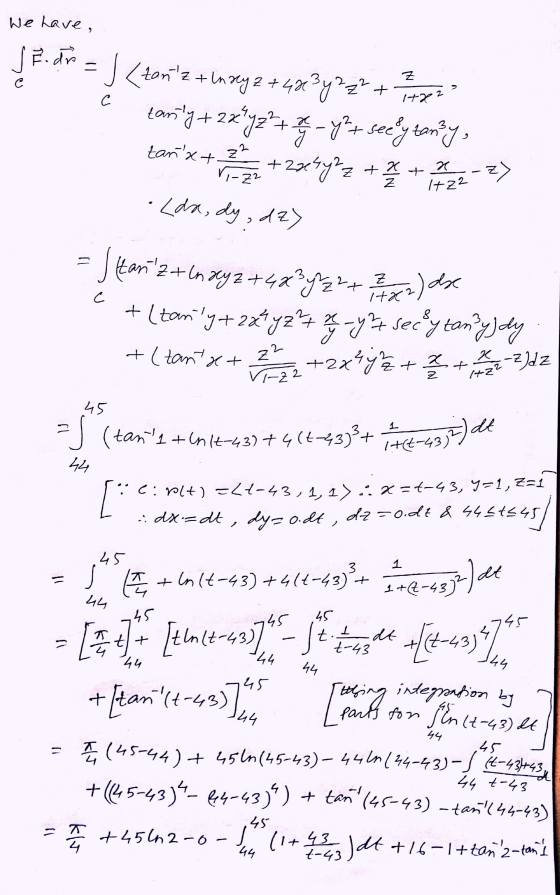
![→ = JFdB = 4 +456m2 - [4+43m1t431], s = 4512-[45+436145-431 – 44-4314144-431] +15+ tan2-7 4 44 +15+ tantz = 45.20 2. 2 1-432](http://img.homeworklib.com/questions/78f7f860-1f24-11eb-8a53-fd89fce46a2c.png?x-oss-process=image/resize,w_560)
Add Answer to:
Provide a clear and organized presentation. Show all of your
work. Present completely simplified exact answers...
please use completely simplified exact values only, thank you. 7. Evaluate F. dr if fr F(x,...
 please use completely
simplified exact values only, thank you.
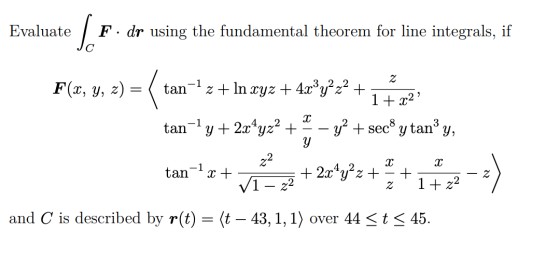
7. Evaluate F. dr if fr F(x, y, z) = { 2 tan z + In xyz + 4x°y2z2+ 1 + x2' х -1 tan y + 2x^yz2 + y2 + seco y tanº y, Y Υ х tan-1 + 2x4y2z + - + -2 1 + 22 and C is the curve of intersection of z = 1 – y and x2 + y2 = 1.
please use completely
simplified exact values only, thank you.
7. Evaluate F. dr if fr F(x, y, z) = { 2 tan z + In xyz + 4x°y2z2+ 1 + x2' х -1 tan y + 2x^yz2 + y2 + seco y tanº y, Y Υ х tan-1 + 2x4y2z + - + -2 1 + 22 and C is the curve of intersection of z = 1 – y and x2 + y2 = 1.
Provide a clear and organized presentation. Show all of your work, completely simplify your answer, and...
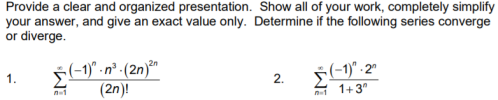 Provide a clear and organized presentation. Show all of your work, completely simplify your answer, and give an exact value only. Determine if the following series converge or diverge. 1. į (-1)".nº.(2n)? 2. * (-1)^.2" n=1 (2n)! 1+3" n.1
Please show all your work HW3: Problem 7 Previous Problem Problem List Next Problem (1 point)...
 Please show all your work
HW3: Problem 7 Previous Problem Problem List Next Problem (1 point) Fundamental Existence Theorem for Linear Differential Equations Given the IVP dz1 d"y d" - 4.(2) +4-1(2) +...+41 () dy +40()y=g(2) dr y(t) = yo, y(t)= y yn-1 (3.) = Yn1 If the coefficients (1),..., Go() and the right hand side of the equation g(1) are continuous on an interval I and if (1) #0 on I then the IVP has a unique solution for...
Please show all your work
HW3: Problem 7 Previous Problem Problem List Next Problem (1 point) Fundamental Existence Theorem for Linear Differential Equations Given the IVP dz1 d"y d" - 4.(2) +4-1(2) +...+41 () dy +40()y=g(2) dr y(t) = yo, y(t)= y yn-1 (3.) = Yn1 If the coefficients (1),..., Go() and the right hand side of the equation g(1) are continuous on an interval I and if (1) #0 on I then the IVP has a unique solution for...
help with questions 1-4 Show all work - give exact simplified values for all answers For...
 help with questions 1-4
Show all work - give exact simplified values for all answers For questions 1 and 2, algebraically find the given limit, if it exists. (8 pts each) 1. 3x 2. 4x2 - 9x - 9 lim lim *4- x2 + 9 *23 2x3 - 7x2 +9 3. (8 pts) Differentiate the given function. Completely factor your final answer. y = 7e-*cos x 4. (9 pts) Find the equation of the tangent line to the graph of...
help with questions 1-4
Show all work - give exact simplified values for all answers For questions 1 and 2, algebraically find the given limit, if it exists. (8 pts each) 1. 3x 2. 4x2 - 9x - 9 lim lim *4- x2 + 9 *23 2x3 - 7x2 +9 3. (8 pts) Differentiate the given function. Completely factor your final answer. y = 7e-*cos x 4. (9 pts) Find the equation of the tangent line to the graph of...
Show all of your work in an organized manner. Circle your answers. You may not use...
 Show all of your work in an organized manner. Circle your answers. You may not use a TI-89 graphing calculator on this test. If a function is given as y=..., then you may not use y'= ... or y" = ... 1) Use the graph of f(x) to answer the following questions: (5,6) (2, 2) a) Identify all intervals on which f(x) is increasing. b) Identify all intervals on which f(x) is decreasing. c) Find the x-coordinate for all local...
Show all work and use correct notation for full credit. Stokes' Theorem: Let S be an...
 Show all work and use correct notation for full credit. Stokes' Theorem: Let S be an orientable, piecewise smooth surface, bounded by a simple closed piecewise smooth curve C with positive orientation. Let F be a vector field with component functions that have continuous partial derivatives on an open region in R3 that contains S. Then | | curl(F) . ds F-dr = where curl(F) = ▽ × F. (2 Credits) Let S be the cone given by {(z, y,...
Questions. Please show all work. 1. Consider the vector field F(x, y, z) (-y, x-z, 3x + z)and the surface S, which is the part of the sphere x2 + y2 + z2 = 25 above the plane z = 3. Let C be the...
 Questions. Please show all work. 1. Consider the vector field F(x, y, z) (-y, x-z, 3x + z)and the surface S, which is the part of the sphere x2 + y2 + z2 = 25 above the plane z = 3. Let C be the boundary of S with counterclockwise orientation when looking down from the z-axis. Verify Stokes' Theorem as follows. (a) (i) Sketch the surface S and the curve C. Indicate the orientation of C (ii) Use the...
please show all your work . (6 points) Of the four initial or boundary value problems below, ouly one is guaranteed...
 please show all your work
. (6 points) Of the four initial or boundary value problems below, ouly one is guaranteed to have a unique solution according to the Existence and Uniqueness Theorons. Which one i i (a) ty"-Py, + e'y = ), y(1)s 0, V(1) = T. tan (f (b) ty" + 2/-3y = 0, y (0)0. y(0) = 2, y(5) = 0. (d) V, + sec(t)y = sin(2t),
. (6 points) Of the four initial or boundary value...
please show all your work
. (6 points) Of the four initial or boundary value problems below, ouly one is guaranteed to have a unique solution according to the Existence and Uniqueness Theorons. Which one i i (a) ty"-Py, + e'y = ), y(1)s 0, V(1) = T. tan (f (b) ty" + 2/-3y = 0, y (0)0. y(0) = 2, y(5) = 0. (d) V, + sec(t)y = sin(2t),
. (6 points) Of the four initial or boundary value...
You must show all your work to receive full credit for each problem. Final answers must...
 You must show all your work to receive full credit for each problem. Final answers must be simplified and circled. 1. Complete the table below (use fractions not decimals!) and use it to graph the function f(x) = 3*. X у -2 Domain -1 Range O coordinates of the y-intercept 1 equation of the asymptote N
2. Consider the vector field F = (yz - eyiz sinx)i + (x2 + eyiz cosz)j...
 2. Consider the vector field F = (yz - eyiz sinx)i + (x2 + eyiz cosz)j + (cy + eylz cos.) k. (a) Show that F is a gradient vector field by finding a function o such that F = Vº. (b) Show that F is conservative by showing for any loop C, which is a(t) for te (a, b) satisfying a(a) = a(6), ff.dr = $. 14. dr = 0. Hint: the explicit o from (a) is not needed....
 please use completely
simplified exact values only, thank you.
7. Evaluate F. dr if fr F(x, y, z) = { 2 tan z + In xyz + 4x°y2z2+ 1 + x2' х -1 tan y + 2x^yz2 + y2 + seco y tanº y, Y Υ х tan-1 + 2x4y2z + - + -2 1 + 22 and C is the curve of intersection of z = 1 – y and x2 + y2 = 1.
please use completely
simplified exact values only, thank you.
7. Evaluate F. dr if fr F(x, y, z) = { 2 tan z + In xyz + 4x°y2z2+ 1 + x2' х -1 tan y + 2x^yz2 + y2 + seco y tanº y, Y Υ х tan-1 + 2x4y2z + - + -2 1 + 22 and C is the curve of intersection of z = 1 – y and x2 + y2 = 1.
 Provide a clear and organized presentation. Show all of your work, completely simplify your answer, and give an exact value only. Determine if the following series converge or diverge. 1. į (-1)".nº.(2n)? 2. * (-1)^.2" n=1 (2n)! 1+3" n.1
 Please show all your work
HW3: Problem 7 Previous Problem Problem List Next Problem (1 point) Fundamental Existence Theorem for Linear Differential Equations Given the IVP dz1 d"y d" - 4.(2) +4-1(2) +...+41 () dy +40()y=g(2) dr y(t) = yo, y(t)= y yn-1 (3.) = Yn1 If the coefficients (1),..., Go() and the right hand side of the equation g(1) are continuous on an interval I and if (1) #0 on I then the IVP has a unique solution for...
Please show all your work
HW3: Problem 7 Previous Problem Problem List Next Problem (1 point) Fundamental Existence Theorem for Linear Differential Equations Given the IVP dz1 d"y d" - 4.(2) +4-1(2) +...+41 () dy +40()y=g(2) dr y(t) = yo, y(t)= y yn-1 (3.) = Yn1 If the coefficients (1),..., Go() and the right hand side of the equation g(1) are continuous on an interval I and if (1) #0 on I then the IVP has a unique solution for...
 help with questions 1-4
Show all work - give exact simplified values for all answers For questions 1 and 2, algebraically find the given limit, if it exists. (8 pts each) 1. 3x 2. 4x2 - 9x - 9 lim lim *4- x2 + 9 *23 2x3 - 7x2 +9 3. (8 pts) Differentiate the given function. Completely factor your final answer. y = 7e-*cos x 4. (9 pts) Find the equation of the tangent line to the graph of...
help with questions 1-4
Show all work - give exact simplified values for all answers For questions 1 and 2, algebraically find the given limit, if it exists. (8 pts each) 1. 3x 2. 4x2 - 9x - 9 lim lim *4- x2 + 9 *23 2x3 - 7x2 +9 3. (8 pts) Differentiate the given function. Completely factor your final answer. y = 7e-*cos x 4. (9 pts) Find the equation of the tangent line to the graph of...
 Show all of your work in an organized manner. Circle your answers. You may not use a TI-89 graphing calculator on this test. If a function is given as y=..., then you may not use y'= ... or y" = ... 1) Use the graph of f(x) to answer the following questions: (5,6) (2, 2) a) Identify all intervals on which f(x) is increasing. b) Identify all intervals on which f(x) is decreasing. c) Find the x-coordinate for all local...
 Show all work and use correct notation for full credit. Stokes' Theorem: Let S be an orientable, piecewise smooth surface, bounded by a simple closed piecewise smooth curve C with positive orientation. Let F be a vector field with component functions that have continuous partial derivatives on an open region in R3 that contains S. Then | | curl(F) . ds F-dr = where curl(F) = ▽ × F. (2 Credits) Let S be the cone given by {(z, y,...
 Questions. Please show all work. 1. Consider the vector field F(x, y, z) (-y, x-z, 3x + z)and the surface S, which is the part of the sphere x2 + y2 + z2 = 25 above the plane z = 3. Let C be the boundary of S with counterclockwise orientation when looking down from the z-axis. Verify Stokes' Theorem as follows. (a) (i) Sketch the surface S and the curve C. Indicate the orientation of C (ii) Use the...
 please show all your work
. (6 points) Of the four initial or boundary value problems below, ouly one is guaranteed to have a unique solution according to the Existence and Uniqueness Theorons. Which one i i (a) ty"-Py, + e'y = ), y(1)s 0, V(1) = T. tan (f (b) ty" + 2/-3y = 0, y (0)0. y(0) = 2, y(5) = 0. (d) V, + sec(t)y = sin(2t),
. (6 points) Of the four initial or boundary value...
please show all your work
. (6 points) Of the four initial or boundary value problems below, ouly one is guaranteed to have a unique solution according to the Existence and Uniqueness Theorons. Which one i i (a) ty"-Py, + e'y = ), y(1)s 0, V(1) = T. tan (f (b) ty" + 2/-3y = 0, y (0)0. y(0) = 2, y(5) = 0. (d) V, + sec(t)y = sin(2t),
. (6 points) Of the four initial or boundary value...
 You must show all your work to receive full credit for each problem. Final answers must be simplified and circled. 1. Complete the table below (use fractions not decimals!) and use it to graph the function f(x) = 3*. X у -2 Domain -1 Range O coordinates of the y-intercept 1 equation of the asymptote N
 2. Consider the vector field F = (yz - eyiz sinx)i + (x2 + eyiz cosz)j + (cy + eylz cos.) k. (a) Show that F is a gradient vector field by finding a function o such that F = Vº. (b) Show that F is conservative by showing for any loop C, which is a(t) for te (a, b) satisfying a(a) = a(6), ff.dr = $. 14. dr = 0. Hint: the explicit o from (a) is not needed....
Most questions answered within 3 hours.
-
Where is the error in this code sequence?
String s1 = "Hello";
String s2 = "ello";...
asked 10 months ago -
Financial data for Joel de Paris, Inc., for last year
follow:
Joel de Paris, Inc.
Balance...
asked 10 months ago -
Consider this reaction:
Al2(SO4)3 (aq)+ BaCl3
(aq) Al2Cl6 (aq)- +
3BaSO4(s) . What is the...
asked 10 months ago -
Suppose that Savneet is considering increasing her
recent random sample from 20 car rentals to 40...
asked 10 months ago -
Trucks arrive at an unloading terminal at an average rate of 120
per hour.
Trucks arrive...
asked 10 months ago -
Why are methanol and ethanol completely soluble in water while
octanol is not very little soluble....
asked 10 months ago -
A facilities manager at a university reads in a research report
that the mean amount of...
asked 10 months ago -
When the CuSO4 is rehydrated by adding water to the anhydrous
compound, is this an endothermic...
asked 10 months ago -
A ray of sunlight is passing from diamond into crown glass; the
angle of incidence is...
asked 10 months ago -
A block of mass 0.249 kg is placed on top of a light, vertical
spring of...
asked 10 months ago -
how do the kidneys compensate in the presences of acidosis
a) trigger hyperventilate
b) reserve acid...
asked 10 months ago -
Question 501 pts
The rental rate of capital to the firm increases. Which of the
following...
asked 10 months ago