I cannot figure out part b and e of this assignment.
![Determine a LCCDE which has an impulse response of h[n]-r cos(aon) u[n], where ωο-π/10, n 0. z - Transform 1- r(cos(wo))z1 Yz -r(cos(wo))z1 b) Write a MATLAB script to implement your LCCDE. Calculate the first 251 samples of the zero state response (ZSR) of your difference equation when the input x[n] i) r 0.99 ii) r=1 iir 1.01 Using filter function in MATLAB, repeat b). cos(n)u[n], and e)](http://img.homeworklib.com/questions/09678b00-1f90-11eb-8159-35730e243997.png?x-oss-process=image/resize,w_560)
Homework Answers
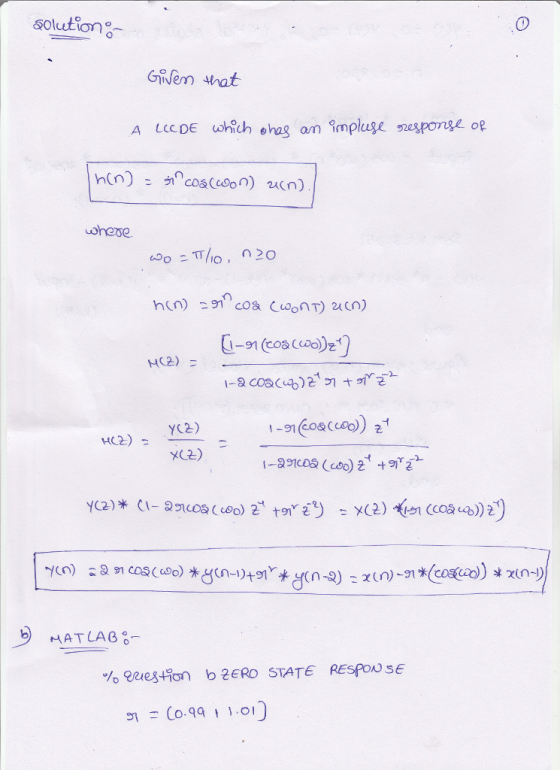
 i) r=0.99
![y[n] for r:0.99 50 40 30 20 10 0 -10 -20 -30 -40 -50 50 100 150 200 250](http://img.homeworklib.com/questions/2d3347c0-1f90-11eb-943e-27a5500c5316.png?x-oss-process=image/resize,w_560) ii) r=1
ii) r=1
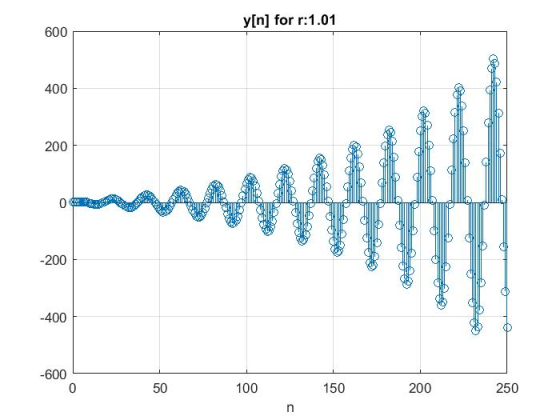
 iii) r=1.01
Add Answer to:
I cannot figure out part b and e of this assignment.
Determine a LCCDE which has...
[1].(20 Write a MATLAB program to design an FIR filter with the ssba (6KH2-12kHz) and draw the frequency response....
 [1].(20 Write a MATLAB program to design an FIR filter with the ssba (6KH2-12kHz) and draw the frequency response. The sampling rate is 40kHz and the filter order is 10. Hint: b- firl(10, passband), freqz(b, 1, n (Display the horizontal axis in terms of analog frequency.) [2].(25}) In the following system f,800 samples/sec. yln]= 0.5y/n-1+ z{n]+ z{n_1] - c) Ideal D-to-A Cunverter LTI System Ideal A-to-D Converter -1/F T.-1/P (a) Determine the impulse response h nl/ (b) Determine the output...
Can someone please help me with this, I'm really stuck. here a sample code provide for the matlab...
 can someone please help me with this, I'm really stuck.
here a sample code provide for the matlab:
clear all; close all;
% ---------- (a) ----------
a = 0.7; % attenuation coef.
D = 5; % digital time delay
UnitImpulse = [1 zeros(1,???)]; % creat unit impulse, starting from
n=0;
x = UnitImpulse;
y = filter(1, [1 zeros(1, D-1) -a], x); % help filter, do you know
the usage of filter() now?
n = 0:(length(y)-1); % check length of y[n]...
can someone please help me with this, I'm really stuck.
here a sample code provide for the matlab:
clear all; close all;
% ---------- (a) ----------
a = 0.7; % attenuation coef.
D = 5; % digital time delay
UnitImpulse = [1 zeros(1,???)]; % creat unit impulse, starting from
n=0;
x = UnitImpulse;
y = filter(1, [1 zeros(1, D-1) -a], x); % help filter, do you know
the usage of filter() now?
n = 0:(length(y)-1); % check length of y[n]...
5 pts D Question 1 A system has the following impulse response: .2 Sample number, n From the choices below, select the frequency response of this system. H (eju)-e(1.5 ) (2 sin( 1.5ώ) +...
 5 pts D Question 1 A system has the following impulse response: .2 Sample number, n From the choices below, select the frequency response of this system. H (eju)-e(1.5 ) (2 sin( 1.5ώ) + 4 sin(0.δώ)) H (ee) = e-j(1.5e-5) (cos( 1.5 ) +2 cos(0.54)) @ H (ee)-e-n1.si) (sin( 1.54) t. 2 sin(0.δώ)) (sin(l.50) +4sin(0.0) H (ee)-e-j(1.5i) (2 cos( 1.5ώ) + 4 cos(0.5a)) H (efo)-e-n1.5u) (cos( 1.50) + 2 cos(0.50)) https://rmitinstructure.comcoursesy 5 pts DQuestion 2 A system has the following...
1- Let's consider an LTI system with an impulse response of where Wo a) Find H(s) and the associa...
 1- Let's consider an LTI system with an impulse response of where Wo a) Find H(s) and the associated H(ja) b) For the cases of μ:0.2, 0.5, 1.0, and 2.0 sketch frequency spectra c) What type of filter can this system represent? d) How does the spectrum HI(jw) change as μ increases? Explain? 2- Consider the following waveform f(t) which is a one cycle of a sinusoid for 0 t π in seconds while zero elsewhere (Aperiodic Signal) fit) 10...
a. b. c. d. An IIR filter has the difference equation: y'n Select the correct transfer function for this system...
 a.
b.
c.
d.
An IIR filter has the difference equation: y'n Select the correct transfer function for this system from the selections below. 2+1.2 No transfer function exists for this system. H(0.5+1.2Y(2)21 2+0.5 H(2)220.5z +1.2 An IIR filter has the transfer function: H(z) 22 +0.92-0.14 Select the correct impulse response for this system from the selections below hn 2(0.2)n-1un - 1] - 2(0.7)n-uln - 1 -hin] = 2(-0.2)"u[n]-2(-0.7)"u[n] hin] = 2(-0.2)"-iuln-11-2(-0.7)"-1 u[n-1] No impulse response exists for this system....
a.
b.
c.
d.
An IIR filter has the difference equation: y'n Select the correct transfer function for this system from the selections below. 2+1.2 No transfer function exists for this system. H(0.5+1.2Y(2)21 2+0.5 H(2)220.5z +1.2 An IIR filter has the transfer function: H(z) 22 +0.92-0.14 Select the correct impulse response for this system from the selections below hn 2(0.2)n-1un - 1] - 2(0.7)n-uln - 1 -hin] = 2(-0.2)"u[n]-2(-0.7)"u[n] hin] = 2(-0.2)"-iuln-11-2(-0.7)"-1 u[n-1] No impulse response exists for this system....
2-If X1(z)Find the Z-Transform of X2[x]-X, ln +3]u[n] Find theZ-Transform of X211 ( I-hind the ...
 2-If X1(z)Find the Z-Transform of X2[x]-X, ln +3]u[n] Find theZ-Transform of X211 ( I-hind the Inverse Z-transform of given function. a) R(Z) =- (1-e") (-(z-e-ar) 3 +282+8-1 b) F (Z) = (2-2)2(2+2) Find the Z-Transform of X2 [x] = X1 [n + 3] u [n] 3- Solve the difference equation 3 4 With initial conditions y-1] 1 and yl-2] 3 4- Let the step response of a linear, time-invariant, causal system be 72 3) ulnl 15 3 a) Find the...
(e) Consider an LTI system with impulse response h(t) = π8ǐnc(2(t-1). i. (5 pts) Find the frequency response H(jw). Hint: Use the FT properties and pairs tables. ii. (5 pts) Find the output y(t) when...
 (e) Consider an LTI system with impulse response h(t) = π8ǐnc(2(t-1). i. (5 pts) Find the frequency response H(jw). Hint: Use the FT properties and pairs tables. ii. (5 pts) Find the output y(t) when the input is (tsin(t) by using the Fourier Transform method. 3. Fourier Transforms: LTI Systems Described by LCCDE (35 pts) (a) Consider a causal (meaning zero initial conditions) LTI system represented by its input-output relationship in the form of a differential equation:-p +3讐+ 2y(t)--r(t). i....
did i do ‘a’ correctly? and how do you do ‘b’, ‘c’, and ‘d’? Prob. 2 A DT system with real-valued impulse response hin), has the following magnitude and phase responses. Note that since hin] R, I...
 did i do ‘a’ correctly? and how do you do ‘b’, ‘c’, and
‘d’?
Prob. 2 A DT system with real-valued impulse response hin), has the following magnitude and phase responses. Note that since hin] R, IH(e) H(eo) and H(e)H(e-) (a) From the graphs, fill in the table below. Express the frequency response in polar form, Hea ZH(e) Cu -2 633 -1032 π/8 ~ 0.4 1.2 60 03 1.5 r/2x 1.6 6.4I66 6s Prob. 2 (cont.) (b) Suppose the input...
did i do ‘a’ correctly? and how do you do ‘b’, ‘c’, and
‘d’?
Prob. 2 A DT system with real-valued impulse response hin), has the following magnitude and phase responses. Note that since hin] R, IH(e) H(eo) and H(e)H(e-) (a) From the graphs, fill in the table below. Express the frequency response in polar form, Hea ZH(e) Cu -2 633 -1032 π/8 ~ 0.4 1.2 60 03 1.5 r/2x 1.6 6.4I66 6s Prob. 2 (cont.) (b) Suppose the input...
signals and systems How to solve if coefficients are: A= -2 B = 1 C =...
 signals and systems
How to solve if coefficients are:
A= -2
B = 1
C = 2
zBzC (b) (24 points) For the additional information given in each case below, determine the output ya for all n. (i) The system is causal and ipatn Inl (ii) The system is stable and input z--1 ii) The system is causal and stable, while the (bilateral) a-transform of input n has ROC of al<1 In (c) (8 points) For the (non-causal) system implied...
signals and systems
How to solve if coefficients are:
A= -2
B = 1
C = 2
zBzC (b) (24 points) For the additional information given in each case below, determine the output ya for all n. (i) The system is causal and ipatn Inl (ii) The system is stable and input z--1 ii) The system is causal and stable, while the (bilateral) a-transform of input n has ROC of al<1 In (c) (8 points) For the (non-causal) system implied...
' 1. Review Question a) Name three applications for feedback control systems. b) Functionally, ho...
 ' 1. Review Question a) Name three applications for feedback control systems. b) Functionally, how do closed-loop systems differ from open-loop systems? c) Name the three major design criteria for control systems. d) Name the performance specification for first-order systems. e) Briefly describe how the zeros of the open-loop system affect the root locus and the transient response. What does the Routh-Hurwitz criterion tell us? f) 2. Given the electric network shown in Figure. a) Write the differential equation for...
 [1].(20 Write a MATLAB program to design an FIR filter with the ssba (6KH2-12kHz) and draw the frequency response. The sampling rate is 40kHz and the filter order is 10. Hint: b- firl(10, passband), freqz(b, 1, n (Display the horizontal axis in terms of analog frequency.) [2].(25}) In the following system f,800 samples/sec. yln]= 0.5y/n-1+ z{n]+ z{n_1] - c) Ideal D-to-A Cunverter LTI System Ideal A-to-D Converter -1/F T.-1/P (a) Determine the impulse response h nl/ (b) Determine the output...
 can someone please help me with this, I'm really stuck.
here a sample code provide for the matlab:
clear all; close all;
% ---------- (a) ----------
a = 0.7; % attenuation coef.
D = 5; % digital time delay
UnitImpulse = [1 zeros(1,???)]; % creat unit impulse, starting from
n=0;
x = UnitImpulse;
y = filter(1, [1 zeros(1, D-1) -a], x); % help filter, do you know
the usage of filter() now?
n = 0:(length(y)-1); % check length of y[n]...
can someone please help me with this, I'm really stuck.
here a sample code provide for the matlab:
clear all; close all;
% ---------- (a) ----------
a = 0.7; % attenuation coef.
D = 5; % digital time delay
UnitImpulse = [1 zeros(1,???)]; % creat unit impulse, starting from
n=0;
x = UnitImpulse;
y = filter(1, [1 zeros(1, D-1) -a], x); % help filter, do you know
the usage of filter() now?
n = 0:(length(y)-1); % check length of y[n]...
 5 pts D Question 1 A system has the following impulse response: .2 Sample number, n From the choices below, select the frequency response of this system. H (eju)-e(1.5 ) (2 sin( 1.5ώ) + 4 sin(0.δώ)) H (ee) = e-j(1.5e-5) (cos( 1.5 ) +2 cos(0.54)) @ H (ee)-e-n1.si) (sin( 1.54) t. 2 sin(0.δώ)) (sin(l.50) +4sin(0.0) H (ee)-e-j(1.5i) (2 cos( 1.5ώ) + 4 cos(0.5a)) H (efo)-e-n1.5u) (cos( 1.50) + 2 cos(0.50)) https://rmitinstructure.comcoursesy 5 pts DQuestion 2 A system has the following...
 1- Let's consider an LTI system with an impulse response of where Wo a) Find H(s) and the associated H(ja) b) For the cases of μ:0.2, 0.5, 1.0, and 2.0 sketch frequency spectra c) What type of filter can this system represent? d) How does the spectrum HI(jw) change as μ increases? Explain? 2- Consider the following waveform f(t) which is a one cycle of a sinusoid for 0 t π in seconds while zero elsewhere (Aperiodic Signal) fit) 10...
 a.
b.
c.
d.
An IIR filter has the difference equation: y'n Select the correct transfer function for this system from the selections below. 2+1.2 No transfer function exists for this system. H(0.5+1.2Y(2)21 2+0.5 H(2)220.5z +1.2 An IIR filter has the transfer function: H(z) 22 +0.92-0.14 Select the correct impulse response for this system from the selections below hn 2(0.2)n-1un - 1] - 2(0.7)n-uln - 1 -hin] = 2(-0.2)"u[n]-2(-0.7)"u[n] hin] = 2(-0.2)"-iuln-11-2(-0.7)"-1 u[n-1] No impulse response exists for this system....
a.
b.
c.
d.
An IIR filter has the difference equation: y'n Select the correct transfer function for this system from the selections below. 2+1.2 No transfer function exists for this system. H(0.5+1.2Y(2)21 2+0.5 H(2)220.5z +1.2 An IIR filter has the transfer function: H(z) 22 +0.92-0.14 Select the correct impulse response for this system from the selections below hn 2(0.2)n-1un - 1] - 2(0.7)n-uln - 1 -hin] = 2(-0.2)"u[n]-2(-0.7)"u[n] hin] = 2(-0.2)"-iuln-11-2(-0.7)"-1 u[n-1] No impulse response exists for this system....
 2-If X1(z)Find the Z-Transform of X2[x]-X, ln +3]u[n] Find theZ-Transform of X211 ( I-hind the Inverse Z-transform of given function. a) R(Z) =- (1-e") (-(z-e-ar) 3 +282+8-1 b) F (Z) = (2-2)2(2+2) Find the Z-Transform of X2 [x] = X1 [n + 3] u [n] 3- Solve the difference equation 3 4 With initial conditions y-1] 1 and yl-2] 3 4- Let the step response of a linear, time-invariant, causal system be 72 3) ulnl 15 3 a) Find the...
 (e) Consider an LTI system with impulse response h(t) = π8ǐnc(2(t-1). i. (5 pts) Find the frequency response H(jw). Hint: Use the FT properties and pairs tables. ii. (5 pts) Find the output y(t) when the input is (tsin(t) by using the Fourier Transform method. 3. Fourier Transforms: LTI Systems Described by LCCDE (35 pts) (a) Consider a causal (meaning zero initial conditions) LTI system represented by its input-output relationship in the form of a differential equation:-p +3讐+ 2y(t)--r(t). i....
 did i do ‘a’ correctly? and how do you do ‘b’, ‘c’, and
‘d’?
Prob. 2 A DT system with real-valued impulse response hin), has the following magnitude and phase responses. Note that since hin] R, IH(e) H(eo) and H(e)H(e-) (a) From the graphs, fill in the table below. Express the frequency response in polar form, Hea ZH(e) Cu -2 633 -1032 π/8 ~ 0.4 1.2 60 03 1.5 r/2x 1.6 6.4I66 6s Prob. 2 (cont.) (b) Suppose the input...
did i do ‘a’ correctly? and how do you do ‘b’, ‘c’, and
‘d’?
Prob. 2 A DT system with real-valued impulse response hin), has the following magnitude and phase responses. Note that since hin] R, IH(e) H(eo) and H(e)H(e-) (a) From the graphs, fill in the table below. Express the frequency response in polar form, Hea ZH(e) Cu -2 633 -1032 π/8 ~ 0.4 1.2 60 03 1.5 r/2x 1.6 6.4I66 6s Prob. 2 (cont.) (b) Suppose the input...
 signals and systems
How to solve if coefficients are:
A= -2
B = 1
C = 2
zBzC (b) (24 points) For the additional information given in each case below, determine the output ya for all n. (i) The system is causal and ipatn Inl (ii) The system is stable and input z--1 ii) The system is causal and stable, while the (bilateral) a-transform of input n has ROC of al<1 In (c) (8 points) For the (non-causal) system implied...
signals and systems
How to solve if coefficients are:
A= -2
B = 1
C = 2
zBzC (b) (24 points) For the additional information given in each case below, determine the output ya for all n. (i) The system is causal and ipatn Inl (ii) The system is stable and input z--1 ii) The system is causal and stable, while the (bilateral) a-transform of input n has ROC of al<1 In (c) (8 points) For the (non-causal) system implied...
 ' 1. Review Question a) Name three applications for feedback control systems. b) Functionally, how do closed-loop systems differ from open-loop systems? c) Name the three major design criteria for control systems. d) Name the performance specification for first-order systems. e) Briefly describe how the zeros of the open-loop system affect the root locus and the transient response. What does the Routh-Hurwitz criterion tell us? f) 2. Given the electric network shown in Figure. a) Write the differential equation for...
Most questions answered within 3 hours.
-
Where is the error in this code sequence?
String s1 = "Hello";
String s2 = "ello";...
asked 10 months ago -
Financial data for Joel de Paris, Inc., for last year
follow:
Joel de Paris, Inc.
Balance...
asked 10 months ago -
Consider this reaction:
Al2(SO4)3 (aq)+ BaCl3
(aq) Al2Cl6 (aq)- +
3BaSO4(s) . What is the...
asked 10 months ago -
Suppose that Savneet is considering increasing her
recent random sample from 20 car rentals to 40...
asked 10 months ago -
Trucks arrive at an unloading terminal at an average rate of 120
per hour.
Trucks arrive...
asked 10 months ago -
Why are methanol and ethanol completely soluble in water while
octanol is not very little soluble....
asked 10 months ago -
A facilities manager at a university reads in a research report
that the mean amount of...
asked 10 months ago -
When the CuSO4 is rehydrated by adding water to the anhydrous
compound, is this an endothermic...
asked 10 months ago -
A ray of sunlight is passing from diamond into crown glass; the
angle of incidence is...
asked 10 months ago -
A block of mass 0.249 kg is placed on top of a light, vertical
spring of...
asked 10 months ago -
how do the kidneys compensate in the presences of acidosis
a) trigger hyperventilate
b) reserve acid...
asked 10 months ago -
Question 501 pts
The rental rate of capital to the firm increases. Which of the
following...
asked 10 months ago