
Homework Answers
Add Answer to:
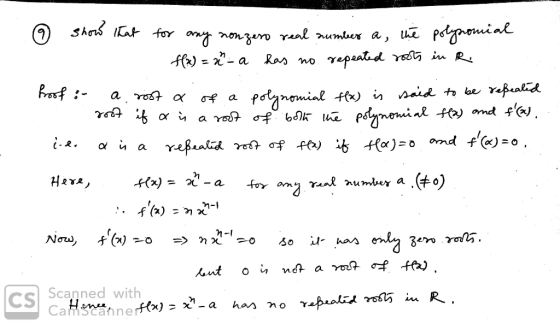
9. Show that for any non-zero real number a, the polynomial f(x)=" -a has no repeated...
Use the intermediate value theorem to show that the polynomial has a real zero between the...
 Use the intermediate value theorem to show that the polynomial has a real zero between the given integers. f(x) = 4x3 - 2x - 5; between 1 and 3 Select the correct choice below and, if necessary, fill in the answer box(es) within your choice. (Simplify your answers.) A. Because f(x) is a polynomial with f(1) = <0 and f(3) = <0, the function has a real zero between 1 and 3. B. Because f(x) is a polynomial with f(1)...
Let k 21 be a positive integer, and let r R be a non-zero real number. For any real number e, we ...
 Let k 21 be a positive integer, and let r R be a non-zero real number. For any real number e, we would like to show that for all 0 SjSk-, the function satisfies the advancement operator equation (A -r)f0 (a) Show that this is true whenever J-0. You can use the fact that f(n) = crn satisfies (A-r)f = 0. (b) Suppose fm n) satisfies the equation when m s k-2 for every choice of c. Show that )...
(i) Show that a non-zero polynomial in ??[?]Zp[x] has exactly ?−1p−1 associates. (ii) Let ?R be...
 (i) Show that a non-zero polynomial in ??[?]Zp[x] has exactly
?−1p−1 associates.
(ii) Let ?R be a field, 0≠?(?),?(?)∈?[?]0≠a(x),b(x)∈R[x]. Prove
that ?(?)a(x) ?(?)b(x) are associates of each other if and only if
?(?)∣?(?)a(x)∣b(x)and ?(?)∣?(?)b(x)∣a(x).
Q5 (4 points) (i) Show that a non-zero polynomial in Zp[x] has exactly p - 1 associates. a(x), b(x) E R[x]. Prove that a(x) b(x) are associates of each other if and only if a(x) | b(x) (ii) Let R be a field, 0 and b(x)...
(i) Show that a non-zero polynomial in ??[?]Zp[x] has exactly
?−1p−1 associates.
(ii) Let ?R be a field, 0≠?(?),?(?)∈?[?]0≠a(x),b(x)∈R[x]. Prove
that ?(?)a(x) ?(?)b(x) are associates of each other if and only if
?(?)∣?(?)a(x)∣b(x)and ?(?)∣?(?)b(x)∣a(x).
Q5 (4 points) (i) Show that a non-zero polynomial in Zp[x] has exactly p - 1 associates. a(x), b(x) E R[x]. Prove that a(x) b(x) are associates of each other if and only if a(x) | b(x) (ii) Let R be a field, 0 and b(x)...
3. Any polynomial with real coefficients of degree k can be factored com- pletely into first-degree...
 3. Any polynomial with real coefficients of degree k can be factored com- pletely into first-degree binomials which may include complex numbers. That is, for any real ao, Q1, ..., āk ao + a1x + a22² + ... + axxk = C(x – 21)(x – z2....(x – zk) for some real C and 21, 22, ... Zk possibly real or complex. Therefore, up to multiplicity, every polynomial of degree k has exactly k-many roots, includ- ing complex roots. Find all...
17. The real number a = cos 20° is a root of the irreducible polynomial f(x)...
 17. The real number a = cos 20° is a root of the irreducible polynomial f(x) = 4x? – 3x 3x = in Q[x]. Let E = Q[cos 20°). Show that f(x) splits in E.
Problem 2. For each polynomial p(t) = do +at+...+ amtm with real number coefficients and for...
 Problem 2. For each polynomial p(t) = do +at+...+ amtm with real number coefficients and for each n x n matrix A, we define the n x n matrix p(A) by P(A) = ao In + a A+ ... + amA”. Also, for each n, let Onxn E Rnxn be the n x n zero matrix. (a) Show that for all polynomials p and q and square matrices A, we have p(A)q(A) = 9(A)p(A). (b) Show that for every 2...
(i) Find a non-zero polynomial in Z3 x| which induces a zero function on Z3. f(x), g(x) R have degree n and let co, c1,...
 (i) Find a non-zero polynomial in Z3 x| which induces a zero function on Z3. f(x), g(x) R have degree n and let co, c1,... , cn be distinct elements in R. Furthermore, let (ii) Let f(c)g(c) for all i = 0,1,2,...n. g(x) Prove that f(x - where r, s E Z, 8 ± 0 and gcd(r, s) =1. Prove that if x is a root of (iii) Let f(x) . an^" E Z[x], then s divides an. aoa1
(i)...
(i) Find a non-zero polynomial in Z3 x| which induces a zero function on Z3. f(x), g(x) R have degree n and let co, c1,... , cn be distinct elements in R. Furthermore, let (ii) Let f(c)g(c) for all i = 0,1,2,...n. g(x) Prove that f(x - where r, s E Z, 8 ± 0 and gcd(r, s) =1. Prove that if x is a root of (iii) Let f(x) . an^" E Z[x], then s divides an. aoa1
(i)...
(1 point) Find the polynomial of degree 9 (centered at zero) that best approximates f(x) =...
 (1 point) Find the polynomial of degree 9 (centered at zero) that best approximates f(x) = ln(° +5). Hint: First find a Taylor polynomial for g(x) = ln(x + 5), then use this to find the Taylor polynomial you want 1/2 Now use this polynomial to approximate L'iniz? +5) da. -1/2 Lis(z) dx =
10.3 Descartes' Rule of Signs (a) If c. C2, ..., Cm are any m nonzero real...
 10.3 Descartes' Rule of Signs (a) If c. C2, ..., Cm are any m nonzero real numbers, and if 2 consecutive terms of this sequence have opposite signs, we say that these 2 terms present a variation of sign. With this concept, we may state Descartes' rule of signs, a proof of which may be found in any textbook on the theory of equations, as follows: Let f(x) = 0 be a polynomial equation with real coefficients and arranged in...
(2) Homogeneous Linear Recurrences where p(A) has repeated roots (a) Let Let f(n) = an. Show f(n)...
 no coding solve it by hand
(2) Homogeneous Linear Recurrences where p(A) has repeated roots (a) Let Let f(n) = an. Show f(n) = d,2n +d2n2" satisfies a(ai)iez be a sequence of real numbers p(A)f(n) (A 2)2(f(n)) 0 for every di, d2 0. .
(2) Homogeneous Linear Recurrences where p(A) has repeated roots (a) Let Let f(n) = an. Show f(n) = d,2n +d2n2" satisfies a(ai)iez be a sequence of real numbers p(A)f(n) (A 2)2(f(n)) 0 for every di, d2...
no coding solve it by hand
(2) Homogeneous Linear Recurrences where p(A) has repeated roots (a) Let Let f(n) = an. Show f(n) = d,2n +d2n2" satisfies a(ai)iez be a sequence of real numbers p(A)f(n) (A 2)2(f(n)) 0 for every di, d2 0. .
(2) Homogeneous Linear Recurrences where p(A) has repeated roots (a) Let Let f(n) = an. Show f(n) = d,2n +d2n2" satisfies a(ai)iez be a sequence of real numbers p(A)f(n) (A 2)2(f(n)) 0 for every di, d2...
 Use the intermediate value theorem to show that the polynomial has a real zero between the given integers. f(x) = 4x3 - 2x - 5; between 1 and 3 Select the correct choice below and, if necessary, fill in the answer box(es) within your choice. (Simplify your answers.) A. Because f(x) is a polynomial with f(1) = <0 and f(3) = <0, the function has a real zero between 1 and 3. B. Because f(x) is a polynomial with f(1)...
 Let k 21 be a positive integer, and let r R be a non-zero real number. For any real number e, we would like to show that for all 0 SjSk-, the function satisfies the advancement operator equation (A -r)f0 (a) Show that this is true whenever J-0. You can use the fact that f(n) = crn satisfies (A-r)f = 0. (b) Suppose fm n) satisfies the equation when m s k-2 for every choice of c. Show that )...
 (i) Show that a non-zero polynomial in ??[?]Zp[x] has exactly
?−1p−1 associates.
(ii) Let ?R be a field, 0≠?(?),?(?)∈?[?]0≠a(x),b(x)∈R[x]. Prove
that ?(?)a(x) ?(?)b(x) are associates of each other if and only if
?(?)∣?(?)a(x)∣b(x)and ?(?)∣?(?)b(x)∣a(x).
Q5 (4 points) (i) Show that a non-zero polynomial in Zp[x] has exactly p - 1 associates. a(x), b(x) E R[x]. Prove that a(x) b(x) are associates of each other if and only if a(x) | b(x) (ii) Let R be a field, 0 and b(x)...
(i) Show that a non-zero polynomial in ??[?]Zp[x] has exactly
?−1p−1 associates.
(ii) Let ?R be a field, 0≠?(?),?(?)∈?[?]0≠a(x),b(x)∈R[x]. Prove
that ?(?)a(x) ?(?)b(x) are associates of each other if and only if
?(?)∣?(?)a(x)∣b(x)and ?(?)∣?(?)b(x)∣a(x).
Q5 (4 points) (i) Show that a non-zero polynomial in Zp[x] has exactly p - 1 associates. a(x), b(x) E R[x]. Prove that a(x) b(x) are associates of each other if and only if a(x) | b(x) (ii) Let R be a field, 0 and b(x)...
 3. Any polynomial with real coefficients of degree k can be factored com- pletely into first-degree binomials which may include complex numbers. That is, for any real ao, Q1, ..., āk ao + a1x + a22² + ... + axxk = C(x – 21)(x – z2....(x – zk) for some real C and 21, 22, ... Zk possibly real or complex. Therefore, up to multiplicity, every polynomial of degree k has exactly k-many roots, includ- ing complex roots. Find all...
 17. The real number a = cos 20° is a root of the irreducible polynomial f(x) = 4x? – 3x 3x = in Q[x]. Let E = Q[cos 20°). Show that f(x) splits in E.
 Problem 2. For each polynomial p(t) = do +at+...+ amtm with real number coefficients and for each n x n matrix A, we define the n x n matrix p(A) by P(A) = ao In + a A+ ... + amA”. Also, for each n, let Onxn E Rnxn be the n x n zero matrix. (a) Show that for all polynomials p and q and square matrices A, we have p(A)q(A) = 9(A)p(A). (b) Show that for every 2...
 (i) Find a non-zero polynomial in Z3 x| which induces a zero function on Z3. f(x), g(x) R have degree n and let co, c1,... , cn be distinct elements in R. Furthermore, let (ii) Let f(c)g(c) for all i = 0,1,2,...n. g(x) Prove that f(x - where r, s E Z, 8 ± 0 and gcd(r, s) =1. Prove that if x is a root of (iii) Let f(x) . an^" E Z[x], then s divides an. aoa1
(i)...
(i) Find a non-zero polynomial in Z3 x| which induces a zero function on Z3. f(x), g(x) R have degree n and let co, c1,... , cn be distinct elements in R. Furthermore, let (ii) Let f(c)g(c) for all i = 0,1,2,...n. g(x) Prove that f(x - where r, s E Z, 8 ± 0 and gcd(r, s) =1. Prove that if x is a root of (iii) Let f(x) . an^" E Z[x], then s divides an. aoa1
(i)...
 (1 point) Find the polynomial of degree 9 (centered at zero) that best approximates f(x) = ln(° +5). Hint: First find a Taylor polynomial for g(x) = ln(x + 5), then use this to find the Taylor polynomial you want 1/2 Now use this polynomial to approximate L'iniz? +5) da. -1/2 Lis(z) dx =
 10.3 Descartes' Rule of Signs (a) If c. C2, ..., Cm are any m nonzero real numbers, and if 2 consecutive terms of this sequence have opposite signs, we say that these 2 terms present a variation of sign. With this concept, we may state Descartes' rule of signs, a proof of which may be found in any textbook on the theory of equations, as follows: Let f(x) = 0 be a polynomial equation with real coefficients and arranged in...
 no coding solve it by hand
(2) Homogeneous Linear Recurrences where p(A) has repeated roots (a) Let Let f(n) = an. Show f(n) = d,2n +d2n2" satisfies a(ai)iez be a sequence of real numbers p(A)f(n) (A 2)2(f(n)) 0 for every di, d2 0. .
(2) Homogeneous Linear Recurrences where p(A) has repeated roots (a) Let Let f(n) = an. Show f(n) = d,2n +d2n2" satisfies a(ai)iez be a sequence of real numbers p(A)f(n) (A 2)2(f(n)) 0 for every di, d2...
no coding solve it by hand
(2) Homogeneous Linear Recurrences where p(A) has repeated roots (a) Let Let f(n) = an. Show f(n) = d,2n +d2n2" satisfies a(ai)iez be a sequence of real numbers p(A)f(n) (A 2)2(f(n)) 0 for every di, d2 0. .
(2) Homogeneous Linear Recurrences where p(A) has repeated roots (a) Let Let f(n) = an. Show f(n) = d,2n +d2n2" satisfies a(ai)iez be a sequence of real numbers p(A)f(n) (A 2)2(f(n)) 0 for every di, d2...
Most questions answered within 3 hours.
-
Where is the error in this code sequence?
String s1 = "Hello";
String s2 = "ello";...
asked 10 months ago -
Financial data for Joel de Paris, Inc., for last year
follow:
Joel de Paris, Inc.
Balance...
asked 10 months ago -
Consider this reaction:
Al2(SO4)3 (aq)+ BaCl3
(aq) Al2Cl6 (aq)- +
3BaSO4(s) . What is the...
asked 10 months ago -
Suppose that Savneet is considering increasing her
recent random sample from 20 car rentals to 40...
asked 10 months ago -
Trucks arrive at an unloading terminal at an average rate of 120
per hour.
Trucks arrive...
asked 10 months ago -
Why are methanol and ethanol completely soluble in water while
octanol is not very little soluble....
asked 10 months ago -
A facilities manager at a university reads in a research report
that the mean amount of...
asked 10 months ago -
When the CuSO4 is rehydrated by adding water to the anhydrous
compound, is this an endothermic...
asked 10 months ago -
A ray of sunlight is passing from diamond into crown glass; the
angle of incidence is...
asked 10 months ago -
A block of mass 0.249 kg is placed on top of a light, vertical
spring of...
asked 10 months ago -
how do the kidneys compensate in the presences of acidosis
a) trigger hyperventilate
b) reserve acid...
asked 10 months ago -
Question 501 pts
The rental rate of capital to the firm increases. Which of the
following...
asked 10 months ago