

Homework Answers
Add Answer to:
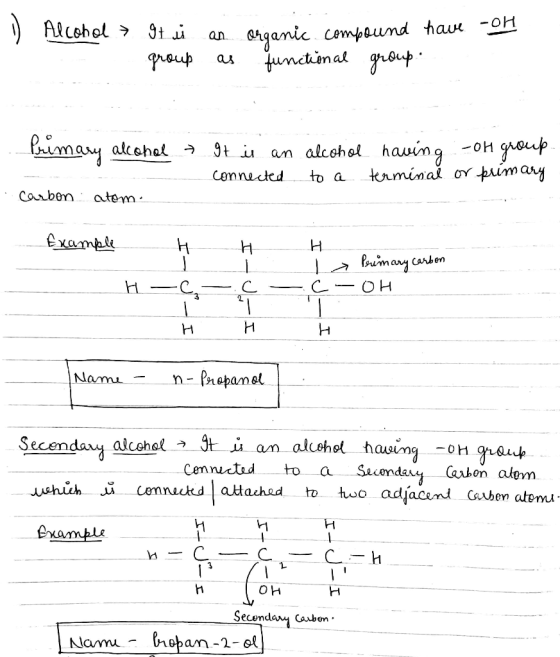
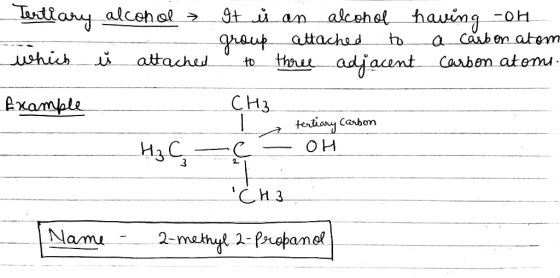
1. Draw structures of one primary alcohol, one secondary alcohol and one tertiary alcohol and give...
pounds, giving Section Name Describe what is meant by oxidation and reduction in relation to organic...
 pounds, giving Section Name Describe what is meant by oxidation and reduction in relation to organic compound example of oxidation of an organic compound and one example of reduction of an compound. The compound you use for the example may be the same or different for oxidation and the reduction reactions. Be sure to indicate what oxidizing agent is us reducing agent is used for each example. on of an organic fferent for the ent is used and when
0H 2. Describe the difference between alcohols and phenols. The Describe the difference between an aldehyde...
 0H 2. Describe the difference between alcohols and phenols. The Describe the difference between an aldehyde and a ketone, and indicate how each differs from an alcohol. 109
Draw structures with names of Primary, Secondary, Tertiary alcohols. Also draw the reaction with product as...
Draw structures with names of Primary, Secondary, Tertiary alcohols. Also draw the reaction with product as each kind of alcohol undergoes oxidation reaction. Draw the condensed structural formula.
ChemActivity 10: Oxidation and Reduction 145 Model 7: Primary (1°), Secondary (2°), and Tertiary (3°) Carbons...
 ChemActivity 10: Oxidation and Reduction 145 Model 7: Primary (1°), Secondary (2°), and Tertiary (3°) Carbons The words methyl (0'), primary (1), secondary (2"), and tertiary (3) were used to describe the number of (nonhydrogen) R groups attached to a carbocation carbon (see CA 8). This same naming strategy is used to describe any carbon with one attached "heteroatom," Z (hetero other). H R Z any atom other than C or H (hetroatom) R- -z -Z н- alkyl (not H)...
ChemActivity 10: Oxidation and Reduction 145 Model 7: Primary (1°), Secondary (2°), and Tertiary (3°) Carbons...
 ChemActivity 10: Oxidation and Reduction 145 Model 7: Primary (1°), Secondary (2°), and Tertiary (3°) Carbons The words methyl (0'), primary (1), secondary (2"), and tertiary (3) were used to describe the number of (nonhydrogen) R groups attached to a carbocation carbon (see CA 8). This same naming strategy is used to describe any carbon with one attached "heteroatom," Z (hetero other). H R Z any atom other than C or H (hetroatom) R- -z -Z н- alkyl (not H)...
21-Ketones are easily reduced to secondary alcohols. b- Primary CH, CCH, a-Secondary alcohol alcohol C- to...
 21-Ketones are easily reduced to secondary alcohols. b- Primary CH, CCH, a-Secondary alcohol alcohol C- to acetaldehyde acid d-to carboxylic 22-Ozonolysis of alkenes yields aa-ketones if one of the unsaturated carbon atoms is disubstituted b-alcohol C-carboxylic acid d-alkane 23-Aldehyde C=0 is more polarized than ketone C-0 because a-As in carbocations, more alkyl groups stabilize + character b-Ketone has more alkyl groups, stabilizing the C=0 carbon inductively cc- due to a and b d- none of the above 24-Aldehydes and unhindered...
3. Classify each of the following alcohols as primary, secondary, or tertiary. a. 3-pentanol SELECT ONE...
 3. Classify each of the following alcohols as primary, secondary, or tertiary. a. 3-pentanol SELECT ONE SELECT ONE b. 2-methyl-2-butanol c. 1-propanol SELECT ONE 4. If you add chromate, an oxidizing agent, to each of the following would a green Cr solution be formed? SELECT ONE a. 3-pentanol b. 2-methyl-2-butanol SELECT ONE c. 1-propanol SELECT ONE
(Hint, draw it out....) 1-Methylcyclopentanol is classified as A) a primary alcohol B) a secondary alcohol...
 (Hint, draw it out....) 1-Methylcyclopentanol is classified as A) a primary alcohol B) a secondary alcohol C) a tertiary alcohol D) a phenol E) an enol 2. (1 pt) Provide the IUPAC name for the following compound. OH 3. (1 pt) Provide the major organic product of the reaction below. 1, NaH HCM,CH 2 CHỊCH CHI
All questions please! Classify as primary, secondary, or tertiary alcohol the compounds below: 4. b. Chassify as pri...
 All questions please!
Classify as primary, secondary, or tertiary alcohol the compounds below: 4. b. Chassify as primary, a. Xoh b. ET CHOH c. cycle and 5. (4 points) Write Lewis Acid or Lewis Base beside each of the following: a. CH CH OH b. CHỊCHANH, c. FeBrz d. NH. 6.. (4 points) Consider the reaction of alcohols with hydrogen halides as written below: R-OH + H-X → R-X + H2O The reaction with tertiary alcohols only takes few minutes,...
All questions please!
Classify as primary, secondary, or tertiary alcohol the compounds below: 4. b. Chassify as primary, a. Xoh b. ET CHOH c. cycle and 5. (4 points) Write Lewis Acid or Lewis Base beside each of the following: a. CH CH OH b. CHỊCHANH, c. FeBrz d. NH. 6.. (4 points) Consider the reaction of alcohols with hydrogen halides as written below: R-OH + H-X → R-X + H2O The reaction with tertiary alcohols only takes few minutes,...
True or False: 1. Lucas reagent (Zinc chloride + HCl) differentiates between primary, secondary, and tertiary...
True or False: 1. Lucas reagent (Zinc chloride + HCl) differentiates between primary, secondary, and tertiary alcohols. True…………………..False 2. Diazonium ion can be produced by reacting an aromatic amine with a mixture of sodium nitrite and sulfuric acid or hydrochloric acid (which produces nitrous acid). True…………………..False 3. Secondary alcohols give yellow oil on reaction of with nitrous acid. True…………………..False 4. Beilstein test is used to detect aromaticity in an organic compound. True…………………..False 5. Organic compounds containing bromine give a yellow...
 pounds, giving Section Name Describe what is meant by oxidation and reduction in relation to organic compound example of oxidation of an organic compound and one example of reduction of an compound. The compound you use for the example may be the same or different for oxidation and the reduction reactions. Be sure to indicate what oxidizing agent is us reducing agent is used for each example. on of an organic fferent for the ent is used and when
 0H 2. Describe the difference between alcohols and phenols. The Describe the difference between an aldehyde and a ketone, and indicate how each differs from an alcohol. 109
 ChemActivity 10: Oxidation and Reduction 145 Model 7: Primary (1°), Secondary (2°), and Tertiary (3°) Carbons The words methyl (0'), primary (1), secondary (2"), and tertiary (3) were used to describe the number of (nonhydrogen) R groups attached to a carbocation carbon (see CA 8). This same naming strategy is used to describe any carbon with one attached "heteroatom," Z (hetero other). H R Z any atom other than C or H (hetroatom) R- -z -Z н- alkyl (not H)...
 ChemActivity 10: Oxidation and Reduction 145 Model 7: Primary (1°), Secondary (2°), and Tertiary (3°) Carbons The words methyl (0'), primary (1), secondary (2"), and tertiary (3) were used to describe the number of (nonhydrogen) R groups attached to a carbocation carbon (see CA 8). This same naming strategy is used to describe any carbon with one attached "heteroatom," Z (hetero other). H R Z any atom other than C or H (hetroatom) R- -z -Z н- alkyl (not H)...
 21-Ketones are easily reduced to secondary alcohols. b- Primary CH, CCH, a-Secondary alcohol alcohol C- to acetaldehyde acid d-to carboxylic 22-Ozonolysis of alkenes yields aa-ketones if one of the unsaturated carbon atoms is disubstituted b-alcohol C-carboxylic acid d-alkane 23-Aldehyde C=0 is more polarized than ketone C-0 because a-As in carbocations, more alkyl groups stabilize + character b-Ketone has more alkyl groups, stabilizing the C=0 carbon inductively cc- due to a and b d- none of the above 24-Aldehydes and unhindered...
 3. Classify each of the following alcohols as primary, secondary, or tertiary. a. 3-pentanol SELECT ONE SELECT ONE b. 2-methyl-2-butanol c. 1-propanol SELECT ONE 4. If you add chromate, an oxidizing agent, to each of the following would a green Cr solution be formed? SELECT ONE a. 3-pentanol b. 2-methyl-2-butanol SELECT ONE c. 1-propanol SELECT ONE
 (Hint, draw it out....) 1-Methylcyclopentanol is classified as A) a primary alcohol B) a secondary alcohol C) a tertiary alcohol D) a phenol E) an enol 2. (1 pt) Provide the IUPAC name for the following compound. OH 3. (1 pt) Provide the major organic product of the reaction below. 1, NaH HCM,CH 2 CHỊCH CHI
 All questions please!
Classify as primary, secondary, or tertiary alcohol the compounds below: 4. b. Chassify as primary, a. Xoh b. ET CHOH c. cycle and 5. (4 points) Write Lewis Acid or Lewis Base beside each of the following: a. CH CH OH b. CHỊCHANH, c. FeBrz d. NH. 6.. (4 points) Consider the reaction of alcohols with hydrogen halides as written below: R-OH + H-X → R-X + H2O The reaction with tertiary alcohols only takes few minutes,...
All questions please!
Classify as primary, secondary, or tertiary alcohol the compounds below: 4. b. Chassify as primary, a. Xoh b. ET CHOH c. cycle and 5. (4 points) Write Lewis Acid or Lewis Base beside each of the following: a. CH CH OH b. CHỊCHANH, c. FeBrz d. NH. 6.. (4 points) Consider the reaction of alcohols with hydrogen halides as written below: R-OH + H-X → R-X + H2O The reaction with tertiary alcohols only takes few minutes,...
Most questions answered within 3 hours.
-
Where is the error in this code sequence?
String s1 = "Hello";
String s2 = "ello";...
asked 10 months ago -
Financial data for Joel de Paris, Inc., for last year
follow:
Joel de Paris, Inc.
Balance...
asked 10 months ago -
Consider this reaction:
Al2(SO4)3 (aq)+ BaCl3
(aq) Al2Cl6 (aq)- +
3BaSO4(s) . What is the...
asked 10 months ago -
Suppose that Savneet is considering increasing her
recent random sample from 20 car rentals to 40...
asked 10 months ago -
Trucks arrive at an unloading terminal at an average rate of 120
per hour.
Trucks arrive...
asked 10 months ago -
Why are methanol and ethanol completely soluble in water while
octanol is not very little soluble....
asked 10 months ago -
A facilities manager at a university reads in a research report
that the mean amount of...
asked 10 months ago -
When the CuSO4 is rehydrated by adding water to the anhydrous
compound, is this an endothermic...
asked 10 months ago -
A ray of sunlight is passing from diamond into crown glass; the
angle of incidence is...
asked 10 months ago -
A block of mass 0.249 kg is placed on top of a light, vertical
spring of...
asked 10 months ago -
how do the kidneys compensate in the presences of acidosis
a) trigger hyperventilate
b) reserve acid...
asked 10 months ago -
Question 501 pts
The rental rate of capital to the firm increases. Which of the
following...
asked 10 months ago