CPP Create an algorithm for an unbounded producer Create an algorithm for an unbounded consumer
CPP
Create an algorithm for an unbounded producer
Create an algorithm for an unbounded consumer
Homework Answers
Some procedures are same for both producer and consumer unbounded buffer:-
Initializtion :
semaphores: mutex = 1 , Full = 0;
integers : in = 0 , out = 0;
append
buffer[in] = indata;
in = in+1;
end append;
take
outdata = buffer[out];
out = out+1;
end take;
Further Algorithm for producer:-
Repeat
produce indata;
wait(mutex);
append;
signal(mutex);
signal(Full);
Further Algorithm for Consumer:-
Reapeat
wait(Full);
wait(mutex);
take;
signal(mutex);
consume outdata;
Add Answer to:
CPP
Create an algorithm for an unbounded producer
Create an algorithm for an unbounded consumer
The producer-consumer problem can be solved in different ways. If we use the buffering technique, which...
The producer-consumer problem can be solved in different ways. If we use the buffering technique, which of the following sizes would be the most reliable. a) A zero capacity as the chances of the producer and consumer access the buffer at the same time is non-existent. b) A bounded capacity that is sized by the max of the incoming rate. c) An unbounded capacity. Then you never have any synchronization issues. d) A dynamic capacity that automatically grows as needed.
Create a Lagrange multiplier example with constraints that is unbounded and has a max and a...
Create a Lagrange multiplier example with constraints that is unbounded and has a max and a min
1) Producer/Consumer again Consider the bounded buffer Producer/Consumer problem we discussed in class. Assume the buffer...
1) Producer/Consumer again Consider the bounded buffer Producer/Consumer problem we discussed in class. Assume the buffer size is now 10. Assume the Producer process enters 3 items at a time into the buffer. It will only do this if there are at least 3 empty spots in the buffer. Assume the Consumer process will remove items two at a time, and will only do so if there are at least two items in the buffer. In addition to the Producer...
consumer and producer surplus Take Home 3 Math 1520 1. Consumer and Producer Surplus. Round answers...
 consumer and producer surplus
Take Home 3 Math 1520 1. Consumer and Producer Surplus. Round answers to the nearest whole number. a) Find the consumer and producer surpluses at the equilibrium (X.P). P. (*) - 6/78 - Demand price p.(x) = 3 102+x Supply price b) Find the new equilibrium and surpluses for the outward shift in demand P. (x)=683-X Demand price Ps(x) = 3/102 + x Supply price
consumer and producer surplus
Take Home 3 Math 1520 1. Consumer and Producer Surplus. Round answers to the nearest whole number. a) Find the consumer and producer surpluses at the equilibrium (X.P). P. (*) - 6/78 - Demand price p.(x) = 3 102+x Supply price b) Find the new equilibrium and surpluses for the outward shift in demand P. (x)=683-X Demand price Ps(x) = 3/102 + x Supply price
9. Here are the codes for producer and consumer problems Producer: while (true) { /*...
9. Here are the codes for producer and consumer problems Producer: while (true) { /* produce an item in next produced */ while (counter == BUFFER_SIZE) ; /* do nothing */ buffer[in] = next_produced; in = (in + 1) % BUFFER_SIZE; counter++; } Consumer: while (true) { while (counter == 0) ; /* do nothing */ next_consumed = buffer[out]; out = (out + 1) % BUFFER_SIZE; counter--; /*...
I need to creatre a C++ program that can modify the producer and consumer. My main...
I need to creatre a C++ program that can modify the producer and consumer. My main programmig language is C++. Modify "Producer and Consumer Problem" from lecture note so that it can use all buffer space, not "buffersize – 1" as in the lecture note. This program should work as follows: 1. The user will run the program and will enter two numbers on the command line. Those numbers will be used for buffersize and counter limit. 2. The main...
When prices rise above equilibrium: producer surplus falls and consumer surplus falls. consumer surplus falls and...
When prices rise above equilibrium: producer surplus falls and consumer surplus falls. consumer surplus falls and it is uncertain what happens to producer surplus. producer surplus falls and consumer surplus rises. producer surplus falls and it is uncertain what happens to consumer surplus.
Question 5 Welfare for a country is equal to consumer surplus consumer surplus minus producer surplus...
 Question 5 Welfare for a country is equal to consumer surplus consumer surplus minus producer surplus consumer surplus plus producer Surplus plus tariffrevenues consumer surplus plus producer Surplus minus tariff revenues Question 6 Use the graph below to answer this question: In autarky (before trade) consumer surplus is the area represented by the letter(s) (For this question and the following ones that use the same graph. Sis domestic supply. Dis domestic demand Pw is the world price is the tarif)
7. A recommendation is in the best interest of the consumer when: a. the producer considers...
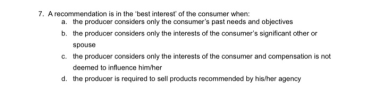 7. A recommendation is in the best interest of the consumer when: a. the producer considers only the consumer's past needs and objectives b. the producer considers only the interests of the consumer's significant other or spouse c. the producer considers only the interests of the consumer and compensation is not deemed to influence him/her d. the producer is required to sell products recommended by his/her agency
When the efficient quantity is produced O A. producer surplus exceeds consumer surplus by the greatest...
 When the efficient quantity is produced O A. producer surplus exceeds consumer surplus by the greatest possible amount O B. consumer surplus exceeds producer surplus by the greatest possible amount O C. total producer surplus is zero . O D. total consumer surplus is zero. O E. the sum of consumer surplus and producer surplus is maximized
 consumer and producer surplus
Take Home 3 Math 1520 1. Consumer and Producer Surplus. Round answers to the nearest whole number. a) Find the consumer and producer surpluses at the equilibrium (X.P). P. (*) - 6/78 - Demand price p.(x) = 3 102+x Supply price b) Find the new equilibrium and surpluses for the outward shift in demand P. (x)=683-X Demand price Ps(x) = 3/102 + x Supply price
consumer and producer surplus
Take Home 3 Math 1520 1. Consumer and Producer Surplus. Round answers to the nearest whole number. a) Find the consumer and producer surpluses at the equilibrium (X.P). P. (*) - 6/78 - Demand price p.(x) = 3 102+x Supply price b) Find the new equilibrium and surpluses for the outward shift in demand P. (x)=683-X Demand price Ps(x) = 3/102 + x Supply price
 Question 5 Welfare for a country is equal to consumer surplus consumer surplus minus producer surplus consumer surplus plus producer Surplus plus tariffrevenues consumer surplus plus producer Surplus minus tariff revenues Question 6 Use the graph below to answer this question: In autarky (before trade) consumer surplus is the area represented by the letter(s) (For this question and the following ones that use the same graph. Sis domestic supply. Dis domestic demand Pw is the world price is the tarif)
 7. A recommendation is in the best interest of the consumer when: a. the producer considers only the consumer's past needs and objectives b. the producer considers only the interests of the consumer's significant other or spouse c. the producer considers only the interests of the consumer and compensation is not deemed to influence him/her d. the producer is required to sell products recommended by his/her agency
 When the efficient quantity is produced O A. producer surplus exceeds consumer surplus by the greatest possible amount O B. consumer surplus exceeds producer surplus by the greatest possible amount O C. total producer surplus is zero . O D. total consumer surplus is zero. O E. the sum of consumer surplus and producer surplus is maximized
Most questions answered within 3 hours.
-
Where is the error in this code sequence?
String s1 = "Hello";
String s2 = "ello";...
asked 10 months ago -
Financial data for Joel de Paris, Inc., for last year
follow:
Joel de Paris, Inc.
Balance...
asked 10 months ago -
Consider this reaction:
Al2(SO4)3 (aq)+ BaCl3
(aq) Al2Cl6 (aq)- +
3BaSO4(s) . What is the...
asked 10 months ago -
Suppose that Savneet is considering increasing her
recent random sample from 20 car rentals to 40...
asked 10 months ago -
Trucks arrive at an unloading terminal at an average rate of 120
per hour.
Trucks arrive...
asked 10 months ago -
Why are methanol and ethanol completely soluble in water while
octanol is not very little soluble....
asked 10 months ago -
A facilities manager at a university reads in a research report
that the mean amount of...
asked 10 months ago -
When the CuSO4 is rehydrated by adding water to the anhydrous
compound, is this an endothermic...
asked 10 months ago -
A ray of sunlight is passing from diamond into crown glass; the
angle of incidence is...
asked 10 months ago -
A block of mass 0.249 kg is placed on top of a light, vertical
spring of...
asked 10 months ago -
how do the kidneys compensate in the presences of acidosis
a) trigger hyperventilate
b) reserve acid...
asked 10 months ago -
Question 501 pts
The rental rate of capital to the firm increases. Which of the
following...
asked 10 months ago