Use the kinetic molecular theory to explain why: -Gases can be compressed much more than liquids...
Homework Answers
Ans (a) The kinetic molecular theory tells us that particles if gases are so small that maximum distance between them is free space and these particles are negligible in comparison to the spaces between them. Hence as the gases particles have free space so they can come more and more close to each other without any resistance and which results high compresibility of gases which is less in liquid and more less in solid as compared to gases.
Ans(b) A blood sample to be analyzed for ammonia gas must be cool immediately after the blood is drawn from the patient because ammonia is not present in healthy person it is only present in an unhealthy person hence ammonia doesn't have a binding property with blood so according to kinetic molecular theory which tells that kinetic energy of gases is proportional to temperature. Hence when blood is drawn from patient if it gets the outer atmosphere contact it's temperature increase so the ammonia which is being tested will get removed before the testing. Hence immediate cooling is necessary
Add Answer to:
Use the kinetic molecular theory to explain why:
-Gases can be compressed much more than liquids...
1. Which of the following statements is not consistent with the kinetic-molecular theory of gas? a....
1. Which of the following statements is not consistent with the kinetic-molecular theory of gas? a. The volume occupied by the gas molecules only becomes significant at very low pressures b. A given volume of gas is mostly empty space except near the condensing point c. Except near condensing point, the attractive forces between gas molecules are very small d. The attractive forces between the molecules only becomes significant at very low temperatures 2. Which of the following statements does...
Use kinetic molecular theory to explain why for a given amount of gas, at constant volume,...
Use kinetic molecular theory to explain why for a given amount of gas, at constant volume, the pressure of the gas increases when its temperature increases?
6. Use the kinetic molecular theory of gases to predict what would happen to a closed...
 6. Use the kinetic molecular theory of gases to predict what would happen to a closed sample of a gas whose temperature increased while its volume decreased. A) Its pressure would decrease. B) Its pressure would increase. C) Its pressure would hold constant. D) The number of moles of the gas would decrease. E) The average kinetic energy of the molecules of the gas would decrease.
The kinetic molecular theory of gases predicts pressure to increase as the temperature of a gas...
The kinetic molecular theory of gases predicts pressure to increase as the temperature of a gas increases because: I. the average kinetic energy of the gas molecules increases. II. gas molecules collide more frequently with the container walls. III. there are more molecules per unit volume after raising the temperature. IV. the elasticity of the molecules increases. V. there are less molecules per unit volume after raising the temperature. a. I and II b. I and III c. II and...
Kinetic Molecular Theory (KMT) a. The KMT is a model we use to explain gas behavior....
 Kinetic Molecular Theory (KMT) a. The KMT is a model we use to explain gas behavior. According to the KMT, what causes the pressure when a gas is held in a sealed container? b. Increasing the temperature will increase the pressure of a gas in a sealed container, assuming the volume remains constant. Explain why this is the case, according to the KMT?
1a. How does kinetic molecular theory explain why pressure is directly propirtional to temperature at a fixed volume? 1b. Explain Boyle’s Law using the Kinetic Molecular Theory. 1c. A hot air balloo...
1a. How does kinetic molecular theory explain why pressure is directly propirtional to temperature at a fixed volume? 1b. Explain Boyle’s Law using the Kinetic Molecular Theory. 1c. A hot air balloonist is rising too fast for her liking. should she increase or decrease the temperature of the gas in the balloon? 1d. Could the pilot of the balloonist from (1c) reduce her rate of ascent by allowing some gas to leak out of the balloon?
2) Use the kinetic molecular theory to describe why when heat is added to a substance...
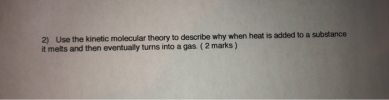 2) Use the kinetic molecular theory to describe why when heat is added to a substance it melts and then eventually turns into a gas. (2 marks )
Use kinetic molecular theory to explain the relationship between: 1. Pressure and volume of a confined...
 Use kinetic molecular theory to explain the relationship between: 1. Pressure and volume of a confined gas 2. Volume and temperature of a confined gas 3. Pressure and temperature of a confined gas 4. Moles and volume of a gas
Which statement best describes how the kinetic molecular view of gases can be used to explain...
 Which statement best describes how the kinetic molecular view of gases can be used to explain the effect of gas temperature on gas pressure? As temperature increases, the particles are damaged, slowing them down and decreasing the number of collisions against the beaker; therefore the pressure decreases. The effect of temperature on pressure depends upon the gas. Gas pressure and gas temperature are unrelated As temperature increases, the particles are split apart so that there are more collisions against the...
Based on Kinetic Molecular theory, explain/answer the following: a. Why would inhaling helium make your voice become much higher than normal? b. Why would inhaling sulfur hexafluoride make your voice...
Based on Kinetic Molecular theory, explain/answer the following: a. Why would inhaling helium make your voice become much higher than normal? b. Why would inhaling sulfur hexafluoride make your voice much lower than normal? c. Would your voice be higher or lower than average if you’re in the hospital and placed in an oxygen-rich environment?
 6. Use the kinetic molecular theory of gases to predict what would happen to a closed sample of a gas whose temperature increased while its volume decreased. A) Its pressure would decrease. B) Its pressure would increase. C) Its pressure would hold constant. D) The number of moles of the gas would decrease. E) The average kinetic energy of the molecules of the gas would decrease.
 Kinetic Molecular Theory (KMT) a. The KMT is a model we use to explain gas behavior. According to the KMT, what causes the pressure when a gas is held in a sealed container? b. Increasing the temperature will increase the pressure of a gas in a sealed container, assuming the volume remains constant. Explain why this is the case, according to the KMT?
 2) Use the kinetic molecular theory to describe why when heat is added to a substance it melts and then eventually turns into a gas. (2 marks )
 Use kinetic molecular theory to explain the relationship between: 1. Pressure and volume of a confined gas 2. Volume and temperature of a confined gas 3. Pressure and temperature of a confined gas 4. Moles and volume of a gas
 Which statement best describes how the kinetic molecular view of gases can be used to explain the effect of gas temperature on gas pressure? As temperature increases, the particles are damaged, slowing them down and decreasing the number of collisions against the beaker; therefore the pressure decreases. The effect of temperature on pressure depends upon the gas. Gas pressure and gas temperature are unrelated As temperature increases, the particles are split apart so that there are more collisions against the...
Most questions answered within 3 hours.
-
Where is the error in this code sequence?
String s1 = "Hello";
String s2 = "ello";...
asked 10 months ago -
Financial data for Joel de Paris, Inc., for last year
follow:
Joel de Paris, Inc.
Balance...
asked 10 months ago -
Consider this reaction:
Al2(SO4)3 (aq)+ BaCl3
(aq) Al2Cl6 (aq)- +
3BaSO4(s) . What is the...
asked 10 months ago -
Suppose that Savneet is considering increasing her
recent random sample from 20 car rentals to 40...
asked 10 months ago -
Trucks arrive at an unloading terminal at an average rate of 120
per hour.
Trucks arrive...
asked 10 months ago -
Why are methanol and ethanol completely soluble in water while
octanol is not very little soluble....
asked 10 months ago -
A facilities manager at a university reads in a research report
that the mean amount of...
asked 10 months ago -
When the CuSO4 is rehydrated by adding water to the anhydrous
compound, is this an endothermic...
asked 10 months ago -
A ray of sunlight is passing from diamond into crown glass; the
angle of incidence is...
asked 10 months ago -
A block of mass 0.249 kg is placed on top of a light, vertical
spring of...
asked 10 months ago -
how do the kidneys compensate in the presences of acidosis
a) trigger hyperventilate
b) reserve acid...
asked 10 months ago -
Question 501 pts
The rental rate of capital to the firm increases. Which of the
following...
asked 10 months ago