

Homework Answers

Add Answer to:
5. Joint formed by union of tooth root in bony socket Part B Assessments Identify the...
Laboratory Assessment 19 oint Structure and Movements Part A Assessments Match the terms in column in...
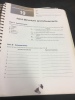 Laboratory Assessment 19 oint Structure and Movements Part A Assessments Match the terms in column in coluemn A with the descripeions ncolumn B Place the leter of B ehnice inthe spuce provided Gompboshs I. Immovable joint between fut bones of the skull united by a thim 2 Fiocanilage fifls the lighily mevablc join Suture layer of dense connective t Temporary join in which bones are uised boy bands of hoyaline 4 Slightly movable joint in which bones are unined bry...
Exercise 10.4: Classification of Synovial Joints 9. Match the description of the synovial joint listed in...
 Exercise 10.4: Classification of Synovial Joints 9. Match the description of the synovial joint listed in column with the corresponding classification listed in column B. Colume A Calum 1. biaxial oval convex and concave a bal-and-socket 2. multiaxial head it into a socket to condylar 3. multiaxiatresembles the shape of a saddle c. hinge 4 uniaxial convex and concave surfaces d. pivot 5. uniaxial: round surface in ring e plane 6. uniaxial, two flat surfaces 1 saddle 10. Which of...
5-8 5. What happens to synovial fluid when there is immobility? How is this remedied? 6....
 5-8
5. What happens to synovial fluid when there is immobility? How is this remedied? 6. What is an articular dise? Labrum? What are the functions of these structures? 7. Be able to describe the nerve and blood supply of the typical joint. 8. What are bursae? Describe the anatomy of these, their function. What is bursitis? 9. Describe the structure and function of tendon sheaths. 10. Know the different types of movements at synovial joints. (Usually a matching question...
5-8
5. What happens to synovial fluid when there is immobility? How is this remedied? 6. What is an articular dise? Labrum? What are the functions of these structures? 7. Be able to describe the nerve and blood supply of the typical joint. 8. What are bursae? Describe the anatomy of these, their function. What is bursitis? 9. Describe the structure and function of tendon sheaths. 10. Know the different types of movements at synovial joints. (Usually a matching question...
10. Use the key to identity each tooth area described below. Review Sheet 38 87 Key:...
 10. Use the key to identity each tooth area described below. Review Sheet 38 87 Key: a cement 1. visible portion of the tooth in situ 2. material covering the tooth root b. crown c. dentin 3. hardest substance in the body d enamel 4. attaches the tooth to the tooth socket e. gingival sulcus 5. portion of the tooth embedded in bone £ odontoblast 6. forms the major portion of tooth structure similar to bone g. periodontal ligament 7....
LABORATORY ASSESSMENT 30 Brain and Cranial Nerves PART A: Assessments Match the terms in Column A...
 LABORATORY ASSESSMENT 30 Brain and Cranial Nerves PART A: Assessments Match the terms in Column A with the descriptions in column B. Place the letter of your choice in the price provided. Column A Columns a. Central sulcus b. Cerebral cortex 1. Structure formed by the crossing over of the optic nerves c. Corpus callosum 2. Part of diencephalon that forms lower walls and floor of third ventricle d. Gyrus 3. Core-shaped gland in the upper posterior portion of diencephalon...
PART A: Assessments match the terms in column A with the definitions in column B. Place...
 PART A: Assessments match the terms in column A with the definitions in column B. Place the letter of your choice in the space provided.12 Column A Column B a. Endomysium 1. Protein that comprises part of the thin filament with actin b. Epimysium 2. Cytoplasm of a muscle fiber c. Fascia d. Fascicle 3. Connective tissue located between adjacent muscles e. Myosin 4. Layer of connective tissue that separates a muscle into small bundles called f. Perimysium fascicles g....
CIRCULATION: ANATOMY AND PHYSIOLOGY 1) Describe the composition (cells and/or proteins) of formed elements in the...
CIRCULATION: ANATOMY AND PHYSIOLOGY 1) Describe the composition (cells and/or proteins) of formed elements in the blood versus the plasma elements in blood. 2) Describe the features of an erythrocyte and how it helps promote the function of circulating gas through the body. 3) What is meant by cooperative binding? B) Hemoglobin shows cooperative binding. How does this help promote its function of gas delivery to tissues? 4) Identify at least two environmental conditions that can shift the affinity hemoglobin...
PART B: Assessments Match the tissues in column A with the characteristics in column B. Place...
 PART B: Assessments Match the tissues in column A with the characteristics in column B. Place the letter of your choice in the space provided. (Some answers may be used more than once.) A2 A3 Column A Column B a. Simple columnar epithelium 1. Consists of several layers of cube-shaped, elongated, and irregular b. Simple cuboidal epithelium cells, allowing an expandable lining c. Simple squamous epithelium 2. Commonly possesses cilia that move dust and mucus out of the d. Pseudostratified...
Answer part b only, answer for part a given Question 5 [4 marks] Finally, the researchers...
 Answer part b only, answer for part a given
Question 5 [4 marks] Finally, the researchers are interested to test whether average engine size varies with type of car Conduct an ANOVA analysis to assess what evidence there is that the average engine size of car models available in Australia in 1993 varies between different types of car You may use a computer to perform this test but please remember to interpret the p-value for this test in the context...
Answer part b only, answer for part a given
Question 5 [4 marks] Finally, the researchers are interested to test whether average engine size varies with type of car Conduct an ANOVA analysis to assess what evidence there is that the average engine size of car models available in Australia in 1993 varies between different types of car You may use a computer to perform this test but please remember to interpret the p-value for this test in the context...
480 Review Sheet 32 Major Systemic Arteries and Veins of the Body 5. Use the key on the right to identify the arter...
 480 Review Sheet 32 Major Systemic Arteries and Veins of the Body 5. Use the key on the right to identify the arteries or veins described on the left Key: a anterior tibial 1. vessel that is paired in the venous system, but only a singles vessel is present in the arterial system b basilic brachial 2. these arteries supply the myocardium d brachiocephalic 3. two paired arteries serving the brain celiac trunk e. 4. vein that runs between the...
 Laboratory Assessment 19 oint Structure and Movements Part A Assessments Match the terms in column in coluemn A with the descripeions ncolumn B Place the leter of B ehnice inthe spuce provided Gompboshs I. Immovable joint between fut bones of the skull united by a thim 2 Fiocanilage fifls the lighily mevablc join Suture layer of dense connective t Temporary join in which bones are uised boy bands of hoyaline 4 Slightly movable joint in which bones are unined bry...
 Exercise 10.4: Classification of Synovial Joints 9. Match the description of the synovial joint listed in column with the corresponding classification listed in column B. Colume A Calum 1. biaxial oval convex and concave a bal-and-socket 2. multiaxial head it into a socket to condylar 3. multiaxiatresembles the shape of a saddle c. hinge 4 uniaxial convex and concave surfaces d. pivot 5. uniaxial: round surface in ring e plane 6. uniaxial, two flat surfaces 1 saddle 10. Which of...
 5-8
5. What happens to synovial fluid when there is immobility? How is this remedied? 6. What is an articular dise? Labrum? What are the functions of these structures? 7. Be able to describe the nerve and blood supply of the typical joint. 8. What are bursae? Describe the anatomy of these, their function. What is bursitis? 9. Describe the structure and function of tendon sheaths. 10. Know the different types of movements at synovial joints. (Usually a matching question...
5-8
5. What happens to synovial fluid when there is immobility? How is this remedied? 6. What is an articular dise? Labrum? What are the functions of these structures? 7. Be able to describe the nerve and blood supply of the typical joint. 8. What are bursae? Describe the anatomy of these, their function. What is bursitis? 9. Describe the structure and function of tendon sheaths. 10. Know the different types of movements at synovial joints. (Usually a matching question...
 10. Use the key to identity each tooth area described below. Review Sheet 38 87 Key: a cement 1. visible portion of the tooth in situ 2. material covering the tooth root b. crown c. dentin 3. hardest substance in the body d enamel 4. attaches the tooth to the tooth socket e. gingival sulcus 5. portion of the tooth embedded in bone £ odontoblast 6. forms the major portion of tooth structure similar to bone g. periodontal ligament 7....
 LABORATORY ASSESSMENT 30 Brain and Cranial Nerves PART A: Assessments Match the terms in Column A with the descriptions in column B. Place the letter of your choice in the price provided. Column A Columns a. Central sulcus b. Cerebral cortex 1. Structure formed by the crossing over of the optic nerves c. Corpus callosum 2. Part of diencephalon that forms lower walls and floor of third ventricle d. Gyrus 3. Core-shaped gland in the upper posterior portion of diencephalon...
 PART A: Assessments match the terms in column A with the definitions in column B. Place the letter of your choice in the space provided.12 Column A Column B a. Endomysium 1. Protein that comprises part of the thin filament with actin b. Epimysium 2. Cytoplasm of a muscle fiber c. Fascia d. Fascicle 3. Connective tissue located between adjacent muscles e. Myosin 4. Layer of connective tissue that separates a muscle into small bundles called f. Perimysium fascicles g....
 PART B: Assessments Match the tissues in column A with the characteristics in column B. Place the letter of your choice in the space provided. (Some answers may be used more than once.) A2 A3 Column A Column B a. Simple columnar epithelium 1. Consists of several layers of cube-shaped, elongated, and irregular b. Simple cuboidal epithelium cells, allowing an expandable lining c. Simple squamous epithelium 2. Commonly possesses cilia that move dust and mucus out of the d. Pseudostratified...
 Answer part b only, answer for part a given
Question 5 [4 marks] Finally, the researchers are interested to test whether average engine size varies with type of car Conduct an ANOVA analysis to assess what evidence there is that the average engine size of car models available in Australia in 1993 varies between different types of car You may use a computer to perform this test but please remember to interpret the p-value for this test in the context...
Answer part b only, answer for part a given
Question 5 [4 marks] Finally, the researchers are interested to test whether average engine size varies with type of car Conduct an ANOVA analysis to assess what evidence there is that the average engine size of car models available in Australia in 1993 varies between different types of car You may use a computer to perform this test but please remember to interpret the p-value for this test in the context...
 480 Review Sheet 32 Major Systemic Arteries and Veins of the Body 5. Use the key on the right to identify the arteries or veins described on the left Key: a anterior tibial 1. vessel that is paired in the venous system, but only a singles vessel is present in the arterial system b basilic brachial 2. these arteries supply the myocardium d brachiocephalic 3. two paired arteries serving the brain celiac trunk e. 4. vein that runs between the...
Most questions answered within 3 hours.
-
Where is the error in this code sequence?
String s1 = "Hello";
String s2 = "ello";...
asked 11 months ago -
Financial data for Joel de Paris, Inc., for last year
follow:
Joel de Paris, Inc.
Balance...
asked 11 months ago -
Consider this reaction:
Al2(SO4)3 (aq)+ BaCl3
(aq) Al2Cl6 (aq)- +
3BaSO4(s) . What is the...
asked 11 months ago -
Suppose that Savneet is considering increasing her
recent random sample from 20 car rentals to 40...
asked 11 months ago -
Trucks arrive at an unloading terminal at an average rate of 120
per hour.
Trucks arrive...
asked 11 months ago -
Why are methanol and ethanol completely soluble in water while
octanol is not very little soluble....
asked 11 months ago -
A facilities manager at a university reads in a research report
that the mean amount of...
asked 11 months ago -
When the CuSO4 is rehydrated by adding water to the anhydrous
compound, is this an endothermic...
asked 11 months ago -
A ray of sunlight is passing from diamond into crown glass; the
angle of incidence is...
asked 11 months ago -
A block of mass 0.249 kg is placed on top of a light, vertical
spring of...
asked 11 months ago -
how do the kidneys compensate in the presences of acidosis
a) trigger hyperventilate
b) reserve acid...
asked 11 months ago -
Question 501 pts
The rental rate of capital to the firm increases. Which of the
following...
asked 11 months ago