An unstable atomic nucleus with with a mass of 1.7x10^-26kg is at rest at the origin...
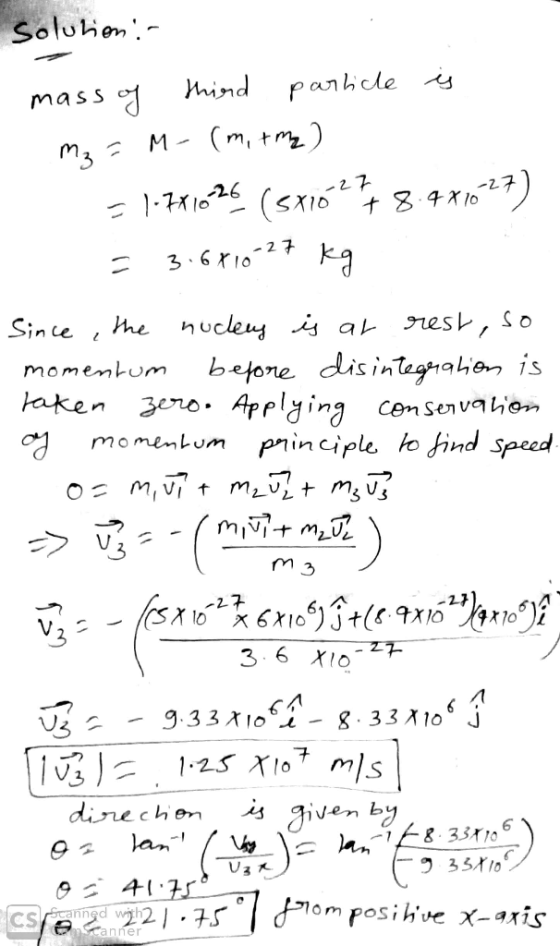
An unstable atomic nucleus with with a mass of 1.7x10^-26kg is at rest at the origin of a coordinate system. It spontaneously disintegrates into three particles: one moving in the positive y-direction with a mass of 5x10^-27 kg and a speed of 6x10^6 m/s, the second moves in the positive x-direction with a mass of 8.4x10^-27kg and a speed of 4x10^6m/s. Find the magnitude and direction of the velocity of the third particle.
Homework Answers
Add Answer to:
An unstable atomic nucleus with with a mass of 1.7x10^-26kg is
at rest at the origin...
An unstable nucleus of mass 1.7 ✕ 10−26 kg, initially at rest at the origin of...
An unstable nucleus of mass 1.7 ✕ 10−26 kg, initially at rest at the origin of a coordinate system, disintegrates into three particles. One particle, having a mass of m1 = 1.0 ✕ 10−27 kg, moves in the positive y-direction with speed v1 = 5.0 ✕ 106 m/s. Another particle, of mass m2 = 8.0 ✕ 10−27 kg, moves in the positive x-direction with speed v2 = 3.8 ✕ 106 m/s. Find the magnitude and direction of the velocity of...
An unstable atomic nucleus of mass 1.50 10-26 kg initially at rest disintegrates into three particles....
An unstable atomic nucleus of mass 1.50 10-26 kg initially at rest disintegrates into three particles. One of the particles, of mass 5.12 10-27 kg, moves in the y direction with a speed of 6.00 106 m/s. Another particle, of mass 8.44 10-27 kg, moves in the x direction with a speed of 4.00 106 m/s. (a) Find the velocity of the third particle. (b) Find the total kinetic energy increase in the process.
An unstable atomic nucleus of mass 1.78*10^-26 kg initially at rest disintegrates into three particles. One...
An unstable atomic nucleus of mass 1.78*10^-26 kg initially at rest disintegrates into three particles. One of the particles, of mass 5.12*10^-27 kg, moves in the y direction with a speed of 6.00*10^6 m/s. Another particle, of mass 8.44*10^-27 kg, moves in the x direction with a speed of 4.00*10^6 m/s. a) Find the velocity of the third particle. ___________î + _____________ ĵm/s (b) Find the total kinetic energy increase in the process. ___________J
An unstable atomic nucleus of mass 1.58 10-26 kg initially at rest disintegrates into three particles. One of the parti...
An unstable atomic nucleus of mass 1.58 10-26 kg initially at rest disintegrates into three particles. One of the particles, of mass 5.20 10-27 kg, moves in the y direction with a speed of 6.00 106 m/s. Another particle, of mass 8.44 10-27 kg, moves in the x direction with a speed of 4.00 106 m/s. (a) Find the velocity of the third particle. i + j m/s (b) Find the total kinetic energy increase in the process. J Please...
An unstable atomic nucleus of mass 1.82 x 10⁻²⁶ kg initially at rest disintegrates into three...
 An unstable atomic nucleus of mass 1.82 x 10⁻²⁶ kg initially at rest disintegrates into three particles. One of the particles, of mass 5.16 x 10⁻²⁷ kg, moves in the y direction with a speed of 6.00 x 10⁶ m/s. Another particle, of mass 8.42 x 10⁻²⁷ kg, moves in the x direction with a speed of 4.00 x 10⁶ m/s. (a) Find the velocity of the third particle. Your response is within 10% of the correct value. This may...
(a) An unstable atomic nucleus of mass 1.61 x 10kg initially at rest disintegrates into three...
 (a) An unstable atomic nucleus of mass 1.61 x 10kg initially at rest disintegrates into three particles (basically a perfectly inelastic collision in reverse). Particle 1. of mass 5.01 x 1027 kg, moves in the y direction with a speed of 6.00 x 10^m's. Particle 2, of mass 8.49 x 10 kg, moves in the x direction with a speed of 4.00 x 10^m's. Find the components of the velocity of particle 3. (b) A car accelerates uniformly from rest...
The spontaneous decay of a heavy atomic nucleus of mass M = 16.5 ? 10?27 kg...
The spontaneous decay of a heavy atomic nucleus of mass M = 16.5 ? 10?27 kg that is initially at rest produces three particles. The first particle, with mass m1 = 6.64 ? 10?27 kg, is ejected in the positive x direction with a speed of 1.70 ? 107 m/s. The second particle, with mass m2 = 3.40 ? 10?27 kg, is ejected in the negative y direction with a speed of 2.00 ? 107 m/s. (a) What is the...
Beryllium-8 is an unstable isotope and decays into two α particles, which are helium nuclei with...
Beryllium-8 is an unstable isotope and decays into two α particles, which are helium nuclei with mass 6.68×10⁻²⁷kg. This decay process releases 1.5×10⁻¹⁴J of energy. For this problem, let's assume that the mass of the Beryllium-8 nucleus is just twice the mass of an α particle and that all the energy released in the decay becomes kinetic energy of the α particles. If the Beryllium-8 nucleus is moving in the positive x-direction with a speed of 1.0×10⁶ m/s when it...
An atomic nucleus initially moving at 360 m/s emits an alpha particle in the direction of...
An atomic nucleus initially moving at 360 m/s emits an alpha particle in the direction of its velocity, and the remaining nucleus slows to 260 m/s If the alpha particle has a mass of 4.0 u and the original nucleus has a mass of 222 u, what speed does the alpha particle have when it is emitted?
An atomic nucleus at rest decays radioactively into an alpha particle and a smaller nucleus. What...
An atomic nucleus at rest decays radioactively into an alpha particle and a smaller nucleus. What will be the speed of this recoiling nucleus if the speed of the alpha particle is 2.6 x10⁵ m/s. Assume the recoiling nucleus has a mass 57 times greater than that of the alpha particle.
 An unstable atomic nucleus of mass 1.82 x 10⁻²⁶ kg initially at rest disintegrates into three particles. One of the particles, of mass 5.16 x 10⁻²⁷ kg, moves in the y direction with a speed of 6.00 x 10⁶ m/s. Another particle, of mass 8.42 x 10⁻²⁷ kg, moves in the x direction with a speed of 4.00 x 10⁶ m/s. (a) Find the velocity of the third particle. Your response is within 10% of the correct value. This may...
 (a) An unstable atomic nucleus of mass 1.61 x 10kg initially at rest disintegrates into three particles (basically a perfectly inelastic collision in reverse). Particle 1. of mass 5.01 x 1027 kg, moves in the y direction with a speed of 6.00 x 10^m's. Particle 2, of mass 8.49 x 10 kg, moves in the x direction with a speed of 4.00 x 10^m's. Find the components of the velocity of particle 3. (b) A car accelerates uniformly from rest...
Most questions answered within 3 hours.
-
Where is the error in this code sequence?
String s1 = "Hello";
String s2 = "ello";...
asked 10 months ago -
Financial data for Joel de Paris, Inc., for last year
follow:
Joel de Paris, Inc.
Balance...
asked 10 months ago -
Consider this reaction:
Al2(SO4)3 (aq)+ BaCl3
(aq) Al2Cl6 (aq)- +
3BaSO4(s) . What is the...
asked 10 months ago -
Suppose that Savneet is considering increasing her
recent random sample from 20 car rentals to 40...
asked 10 months ago -
Trucks arrive at an unloading terminal at an average rate of 120
per hour.
Trucks arrive...
asked 10 months ago -
Why are methanol and ethanol completely soluble in water while
octanol is not very little soluble....
asked 10 months ago -
A facilities manager at a university reads in a research report
that the mean amount of...
asked 10 months ago -
When the CuSO4 is rehydrated by adding water to the anhydrous
compound, is this an endothermic...
asked 10 months ago -
A ray of sunlight is passing from diamond into crown glass; the
angle of incidence is...
asked 10 months ago -
A block of mass 0.249 kg is placed on top of a light, vertical
spring of...
asked 10 months ago -
how do the kidneys compensate in the presences of acidosis
a) trigger hyperventilate
b) reserve acid...
asked 10 months ago -
Question 501 pts
The rental rate of capital to the firm increases. Which of the
following...
asked 10 months ago