Telluride Tours is currently evaluating two mutually exclusive investments. After doing a scenario analysis and applying...
Telluride Tours is currently evaluating two mutually exclusive investments. After doing a scenario analysis and applying probabilities to each scenario, it has determined that the investments have the following distributions around the expected NPVs.
| probability | NPV a | NPV b |
| 0.1 | -39,780 | -14,918 |
| 0.2 | -9945 | 2486 |
| 0.4 | 19890 | 19890 |
| 0.2 | 49725 | 37294 |
| 0.1 | 79560 |
54698 |
a). calculate the expected NPV for both projects. Can the question be resolved with this information alone?
b). calculate the variance and standard deviation of the NPVs for both projects. Which project appears to be riskier?
c). calculate the coefficient of variation for both projects. Does this change your opinion from part b?
d). calculate the probability of a negative NPV for both projects.
e). Which project should be accepted and why?
Homework Answers
a) Expected NPV of a = (0.1*-39780) + (0.2*-9945) + (0.4*19890) + (0.2*49725) + (0.1*79560) = -3978 -1989 + 7956 + 9945 + 7956 = 19,890
Expected NPV of b = (0.1*-14,918) + (0.2*2486) + (0.4*19890) + (0.2*37294) + (0.1*54698) = -1491.8 +497.2 + 7956 + 7458.8 + 5469.8 = 19,890
The question cannot be resolved with this information alone because the expected NPV is the same for both
b)
p1 = 0.1
p2 = 0.2
p3 = 0.4
p4 = 0.2
p5 = 0.1
S1 = NPV1 for a = -39,780
S2 = NPV2 for a = -9945
S3 = NPV3 for a = 19890
S4 = NPV4 for a = 49725
S5 = NPV5 for a = 79560
ES = Expected NPV of a
Variance for a = p1*(S1-ES)2
+ p2*(S2-ES)2
+ p3*(S3-ES)2
+ p4*(S4-ES)2 + p5*(S5-ES)2
Variance for a = 0.1*(-39,780 - 19890)2
+ 0.2*(-9945 - 19890)2
+ 0.4*(19890 - 19890)2
+ 0.2*(49725- 19890)2 + 0.1*(79560
- 19890)2 = 1068152670
Standard deviation of a = (variance of a)(1/2) = (1068152670)(1/2) = 32682.60501
similarly for b
Variance of b =
0.1*(-14918 - 19890)2 + 0.2*(2486 - 19890)2 + 0.4*(19890 - 19890)2 + 0.2*(37294- 19890)2 + 0.1*(54698 - 19890)2 = 363479059.2000
Standard deviation of b = (variance of b)(1/2) = (363479059.2000)(1/2) = 19065.12678
Comparing the standard deviations and variance , project a seems to be riskier
c) Coefficient of variation for a = standard deviation of a / ES = 32682.60501/19890 = 1.643167
Coefficient of variation for b = standard deviation of b / ES = 19065.12678/19890 = 0.958528
Coefficient of variation is greater for a , which means that project a is riskier which is the same result we got from part b)
d)
probability of negative NPV for project a = no. of negative NPVs / total no. of NPVs = 2/5 = 0.4 = 40%
probability of negative NPV for project b = no. of negative NPVs / total no. of NPVs = 1/5 = 0.2 = 20%
e) from the above calculations since project b is less riskier , we should select project b
Add Answer to:
Telluride Tours is currently evaluating two mutually exclusive
investments. After doing a scenario analysis and applying...
Basic scenario analysis Prime Paints is in the process of evaluating two mutually exclusive additions to...
 Basic scenario analysis Prime Paints is in the process of evaluating two mutually exclusive additions to its processing capacity. The firm's financial analysts have developed pessimistic, most likely, and optimistic estimates of the annual cash inflows associated with each project. These estimates are shown in the following table. Project A $12,200 Project B $12,200 Initial investment (CF) Outcome Pessimistic Most likely Optimistic Annual cash inflows (CF) $880 $1,510 1,680 1,680 2,480 1,730 a. Determine the range of annual cash inflows...
Basic scenario analysis - Prime Paints is in the process of evaluating two mutually exclusive additions...
Basic scenario analysis - Prime Paints is in the process of evaluating two mutually exclusive additions to its processing capacity. The firm's financial analysts have developed pessimistic, most likely, and optimistic estimates of the annual cash inflows associated with each project. These estimates are shown in the following table: Project A Project B Initial Investment (CF0) $12,500 $12,500 Outcome Annual cash inflows (CF) Pessimistic $900 $1,580 Most Likely $2,650 $1,650 Optimistic $2,490 $1,760 a. determine the range of annual cash...
Basic scenario analysis Prime Paints is in the process of evaluating two mutually exclusive additions to...
Basic scenario analysis Prime Paints is in the process of evaluating two mutually exclusive additions to its processing capacity. The firm's financial analysts have developed pessimistic, most likely, and optimistic estimates of the annual cash inflows associated with each project. These estimates are shown in the following table. Project A Project B Initial investment (CF 0CF0) $12 comma 50012,500 $12 comma 50012,500 Outcome Annual cash inflows (CFCF ) Pessimistic $820820 $1 comma 5101,510 Most likely 1 comma 6201,620 1 comma...
Basic scenario analysis Prime Paints is in the process of evaluating two mutually exclusive additions to...
 Basic scenario analysis Prime Paints is in the process of evaluating two mutually exclusive additions to its processing capacity. The firm's financial analysts have developed pessimistic, most likely, and optimistic estimates of the annual cash inflows associated with each project. These estimates are shown in the following table Project A Project B Initial investment (CF) $12.700 $12,700 Outcome Annual cash inflows (CF) Pessimistic $830 $1 Most likely 1,630 1,630 Optimistic 2 450 1.770 a. Determine the range of annual cash...
Consider the case of another company. Turnkey Printing is evaluating two mutually exclusive projects. They both...
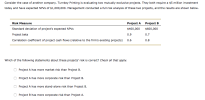 Consider the case of another company. Turnkey Printing is evaluating two mutually exclusive projects. They both require a $5 million investment today and have expected NPVs of $1,000,000. Management conducted a full risk analysis of these two projects, and the results are shown below. Risk Measure Project A $400,000 Standard deviation of project's expected NPVS Project beta Correlation coefficient of project cash flows (relative to the firm's existing projects) Project B $600,000 0.7 0.8 0.6 Which of the following statements...
We have two mutually exclusive investments with the following cash flows: &n
We have two mutually exclusive investments with the following cash flows: (13 marks total) Year Investment A Investment B 0 –$100 –$100 1 10 50 2 30 40 3 50 30 4 70 20 a. Using a financial calculator, calculate the IRR for each of the investments. State your answers in percentages rounded to two decimal places. (2 marks) b. Calculate the NPV profile for each investment, using the discount rates of 0%, 5%, 10%, 15%, 20%, and 25%. Perform this task in an...
Question :1 (40%, 8% per sub question) A firm is evaluating two mutually exclusive projects that...
Question :1 (40%, 8% per sub question) A firm is evaluating two mutually exclusive projects that have unequal lives. The firm must evaluate the projects using the annualized net present value approach and recommend which project they should select. The firm's cost of capital has been determined to be 14 percent, and the projects have the following initial investments and cash flows: The NPVs of Projects R and S are The annualized NPV of Project R is The annualized NPV...
A FBO is evaluating two projects that are mutually exclusive with initial investments and cash flows...
A FBO is evaluating two projects that are mutually exclusive with initial investments and cash flows as follows: Year Cash Flows (A) Cash Flows (B) 0 1 2 3 4 5 -$11,000 3,000 3,000 3,000 3,000 3,000 -$8,000 2,500 2,500 2,500 2,500 2,500 Discount rate = 3.52% What is the NPV of project (A)? 2,539 2,739 3,449 4,000
The Bartram-Pulley Company (BPC) must decide between two mutually exclusive investment projects. Each project costs $7,500...
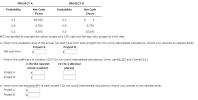 The Bartram-Pulley Company (BPC) must decide between two
mutually exclusive investment projects. Each project costs $7,500
and has an expected life of 3 years. Annual net cash flows from
each project begin 1 year after the initial investment is made and
have the following probability distributions:
PROJECT A PROJECT B Probability Net Cash Probability Net Cash Flows Flows $5,000 0.2 0.2 0.6 6,750 0.6 6,750 8,000 0.2 0.2 20,000 BPC has decided to evaluate the riskier project at a 12%...
The Bartram-Pulley Company (BPC) must decide between two
mutually exclusive investment projects. Each project costs $7,500
and has an expected life of 3 years. Annual net cash flows from
each project begin 1 year after the initial investment is made and
have the following probability distributions:
PROJECT A PROJECT B Probability Net Cash Probability Net Cash Flows Flows $5,000 0.2 0.2 0.6 6,750 0.6 6,750 8,000 0.2 0.2 20,000 BPC has decided to evaluate the riskier project at a 12%...
Problem 11-15 Risky Cash Flows The Bartram-Pulley Company (BPC) must decide between two mutually exclusive investment...
Problem 11-15 Risky Cash Flows The Bartram-Pulley Company (BPC) must decide between two mutually exclusive investment projects. Each project costs $5,750 and has an expected life of 3 years. Annual net cash flows from each project begin 1 year after the initial investment is made and have the following probability distributions: PROJECT A PROJECT B Probability Net Cash Flows Probability Net Cash Flows 0.2 $6,000 0.2 $ 0 0.6 6,750 0.6 6,750 0.2 7,500 0.2 17,000 BPC has decided to evaluate...
 Basic scenario analysis Prime Paints is in the process of evaluating two mutually exclusive additions to its processing capacity. The firm's financial analysts have developed pessimistic, most likely, and optimistic estimates of the annual cash inflows associated with each project. These estimates are shown in the following table. Project A $12,200 Project B $12,200 Initial investment (CF) Outcome Pessimistic Most likely Optimistic Annual cash inflows (CF) $880 $1,510 1,680 1,680 2,480 1,730 a. Determine the range of annual cash inflows...
 Basic scenario analysis Prime Paints is in the process of evaluating two mutually exclusive additions to its processing capacity. The firm's financial analysts have developed pessimistic, most likely, and optimistic estimates of the annual cash inflows associated with each project. These estimates are shown in the following table Project A Project B Initial investment (CF) $12.700 $12,700 Outcome Annual cash inflows (CF) Pessimistic $830 $1 Most likely 1,630 1,630 Optimistic 2 450 1.770 a. Determine the range of annual cash...
 Consider the case of another company. Turnkey Printing is evaluating two mutually exclusive projects. They both require a $5 million investment today and have expected NPVs of $1,000,000. Management conducted a full risk analysis of these two projects, and the results are shown below. Risk Measure Project A $400,000 Standard deviation of project's expected NPVS Project beta Correlation coefficient of project cash flows (relative to the firm's existing projects) Project B $600,000 0.7 0.8 0.6 Which of the following statements...
 The Bartram-Pulley Company (BPC) must decide between two
mutually exclusive investment projects. Each project costs $7,500
and has an expected life of 3 years. Annual net cash flows from
each project begin 1 year after the initial investment is made and
have the following probability distributions:
PROJECT A PROJECT B Probability Net Cash Probability Net Cash Flows Flows $5,000 0.2 0.2 0.6 6,750 0.6 6,750 8,000 0.2 0.2 20,000 BPC has decided to evaluate the riskier project at a 12%...
The Bartram-Pulley Company (BPC) must decide between two
mutually exclusive investment projects. Each project costs $7,500
and has an expected life of 3 years. Annual net cash flows from
each project begin 1 year after the initial investment is made and
have the following probability distributions:
PROJECT A PROJECT B Probability Net Cash Probability Net Cash Flows Flows $5,000 0.2 0.2 0.6 6,750 0.6 6,750 8,000 0.2 0.2 20,000 BPC has decided to evaluate the riskier project at a 12%...
Most questions answered within 3 hours.
-
Where is the error in this code sequence?
String s1 = "Hello";
String s2 = "ello";...
asked 10 months ago -
Financial data for Joel de Paris, Inc., for last year
follow:
Joel de Paris, Inc.
Balance...
asked 10 months ago -
Consider this reaction:
Al2(SO4)3 (aq)+ BaCl3
(aq) Al2Cl6 (aq)- +
3BaSO4(s) . What is the...
asked 10 months ago -
Suppose that Savneet is considering increasing her
recent random sample from 20 car rentals to 40...
asked 10 months ago -
Trucks arrive at an unloading terminal at an average rate of 120
per hour.
Trucks arrive...
asked 10 months ago -
Why are methanol and ethanol completely soluble in water while
octanol is not very little soluble....
asked 10 months ago -
A facilities manager at a university reads in a research report
that the mean amount of...
asked 10 months ago -
When the CuSO4 is rehydrated by adding water to the anhydrous
compound, is this an endothermic...
asked 10 months ago -
A ray of sunlight is passing from diamond into crown glass; the
angle of incidence is...
asked 10 months ago -
A block of mass 0.249 kg is placed on top of a light, vertical
spring of...
asked 10 months ago -
how do the kidneys compensate in the presences of acidosis
a) trigger hyperventilate
b) reserve acid...
asked 10 months ago -
Question 501 pts
The rental rate of capital to the firm increases. Which of the
following...
asked 10 months ago