The same constant force, F, is applied to two blocks. The first block has a mass...
The same constant force, F, is applied to two blocks. The first block has a mass of M and the second block has a mass of 2M. Both blocks are initially at rest and the force acts on each of them for the same period of time, t.
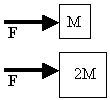
15) After time, t, which block has more momentum?
a)The block of mass M
b)The block of mass 2M
c)They will have the same momentum
16) After time, t, which block has more kinetic energy?
a)The block of mass M
b)The block of mass 2M
c)They will have the same kinetic energy
17) After time, t, which block is moving the fastest?
a)The block of mass M
b)The block of mass 2M
c)They will have the same speed
Homework Answers
1. From Impulse momentum theorem we can say
Since force on two blocks are same for same interval of time
So both blocks will have same momentum (C)
2) Relation between KE and Momentum is given by
so here momentum of two objects are same
so we can say KE is iinversely proportional to mass "m"
so lesser mass more KE
a)The block of mass M will have more KE
3) Now since the two blocks will have same Force so lesser mass block will have more acceleration
So it will gain more speed in same time then the mass "2m"
a)The block of mass M will move faster
Add Answer to:
The same constant force, F, is applied to two blocks. The first
block has a mass...
help The same horizontal force, of magnitude F, is applied to two different blocks, of mass...
 help
The same horizontal force, of magnitude F, is applied to two different blocks, of mass m and 3m The blocks move on a frictionless surface and both blocks begin from rest. If each block moves the same distance as the force is applied, which one of the following sentences is true? O The heavier block acquires 3 times as much kinetic energy as the lighter block. The heavier block acquires 9 times as much kinetic energy as the lighter...
help
The same horizontal force, of magnitude F, is applied to two different blocks, of mass m and 3m The blocks move on a frictionless surface and both blocks begin from rest. If each block moves the same distance as the force is applied, which one of the following sentences is true? O The heavier block acquires 3 times as much kinetic energy as the lighter block. The heavier block acquires 9 times as much kinetic energy as the lighter...
A 10 kg block is dragged by an applied force of 20N, which makes an angle...
A 10 kg block is dragged by an applied force of 20N, which makes an angle of 600 with the horizontal. The coefficient of friction of the surface is. The block starts from rest and is pulled a distance of 7m. Calculate the work done by the applied force? Calculate the work done by the force of friction? What is the resultant work done? What is the final velocity of the block? Recall: work done equals change in kinetic...
A horizontal force F is applied to a small block of mass m1 to make it...
 A horizontal force F is applied to a small block of mass
m1 to make it slide along the top of a larger block of
mass m2 and length L. The coefficient of kinetic
friction between the blocks is µ. The larger block slides without
friction along a horizontal surface. The blocks start from rest
with the smaller block at one end of the larger block.
a) Label all the forces acting on each block.
b) Find the acceleration of...
A horizontal force F is applied to a small block of mass
m1 to make it slide along the top of a larger block of
mass m2 and length L. The coefficient of kinetic
friction between the blocks is µ. The larger block slides without
friction along a horizontal surface. The blocks start from rest
with the smaller block at one end of the larger block.
a) Label all the forces acting on each block.
b) Find the acceleration of...
(a) A force F is applied to a block of mass m1 causing it to be...
(a) A force F is applied to a block of mass m1 causing it to be accelerated at 1.9 m/s2. The same force is also applied to another block, m2, which is accelerated at 3.4 m/s2. Find the ratio of m1/m2 (b) The two blocks from the previous problem are combined to make a block of mass m1 + m2. It is being pushed by the same force F from the previous problem. Find the acceleration of the block. __________...
The impulse of an object is 1 a. the product of (the peak force applied to...
 The impulse of an object is 1 a. the product of (the peak force applied to an object) x (time interval during which the force acts). 2 b. the product of (the average force applied to an object) x (time interval during which the force acts). 3 c. the average force applied to an object for a period of 1 sec. 4 d. the peak force applied to an object for a period of 1 sec. 5 e. the total...
6. Consider a horizontal spring with spring constant k. A block with mass m is pushed...
 6. Consider a horizontal spring with spring constant k. A block with mass m is pushed far to the left against the spring until the spring is compressed a distance r relative to its relaxed length. A second block, which is stationary and also has a mass m, is located to the right of the spring im rrm a) We release the first block from rest. Due to the force from the spring, it slides to the right and eventually...
In figure (a) a constant horizontal force Fa is applied to block A
 In figure (a) a constant horizontal forceFa is applied to block A,which pushes against block B with a 26.0 Nforce directed horizontally to the right.In figure (b), the same forceFa is applied to block B; nowblock Apushes on block B with a 13.0 N force directed horizontally to the left.The blocks have a combined mass of 21.0 kg.(a) What is the magnitude of the accelerationof the blocks in figure (a)? m/s2(b) What is the magnitude of the forceFa? N
withinitial Q3-(25 pts) A block of mass m is attached to an ideal spring with rest...
 withinitial Q3-(25 pts) A block of mass m is attached to an ideal spring with rest (equilibrium) length L and spring constant k on the x axis. The other end of the spring is fixed to a wall. Initially, the spring is compressed by an amount L/2 and another block of mass 2m is placed in front of the first block (they are not attached). The system is released at t 0 from rest. Ignore friction and the sizes of...
Q3-(25 pts) A block of mass m is attached to an ideal spring with rest (equilibrium)...
 Q3-(25 pts) A block of mass m is attached to an ideal spring with rest (equilibrium) length L and spring constant k on the x axis. m other end of the spring is fixed to a wall Initially, the spring is compressed by an amount L/2 and another block of mass 2m is placed in front of the first block (they are not attached). The system is released at t 0 from rest. Ignore friction and the sizes of the...
1. A force F(t) is suddenly applied to a mass m, which is supported by a...
 1. A force F(t) is suddenly applied to a mass m, which is supported by a spring with a constant k After a short period of time r, the force is suddenly removed. During the time the force is active, it is a constant Determine the response of the system for t> τ. The spring and mass are initially at rest before the force F() is applied. (a) Use the convolution integral. (b) Use the Laplace Transform. (c) what values...
 help
The same horizontal force, of magnitude F, is applied to two different blocks, of mass m and 3m The blocks move on a frictionless surface and both blocks begin from rest. If each block moves the same distance as the force is applied, which one of the following sentences is true? O The heavier block acquires 3 times as much kinetic energy as the lighter block. The heavier block acquires 9 times as much kinetic energy as the lighter...
help
The same horizontal force, of magnitude F, is applied to two different blocks, of mass m and 3m The blocks move on a frictionless surface and both blocks begin from rest. If each block moves the same distance as the force is applied, which one of the following sentences is true? O The heavier block acquires 3 times as much kinetic energy as the lighter block. The heavier block acquires 9 times as much kinetic energy as the lighter...
 A horizontal force F is applied to a small block of mass
m1 to make it slide along the top of a larger block of
mass m2 and length L. The coefficient of kinetic
friction between the blocks is µ. The larger block slides without
friction along a horizontal surface. The blocks start from rest
with the smaller block at one end of the larger block.
a) Label all the forces acting on each block.
b) Find the acceleration of...
A horizontal force F is applied to a small block of mass
m1 to make it slide along the top of a larger block of
mass m2 and length L. The coefficient of kinetic
friction between the blocks is µ. The larger block slides without
friction along a horizontal surface. The blocks start from rest
with the smaller block at one end of the larger block.
a) Label all the forces acting on each block.
b) Find the acceleration of...
 The impulse of an object is 1 a. the product of (the peak force applied to an object) x (time interval during which the force acts). 2 b. the product of (the average force applied to an object) x (time interval during which the force acts). 3 c. the average force applied to an object for a period of 1 sec. 4 d. the peak force applied to an object for a period of 1 sec. 5 e. the total...
 6. Consider a horizontal spring with spring constant k. A block with mass m is pushed far to the left against the spring until the spring is compressed a distance r relative to its relaxed length. A second block, which is stationary and also has a mass m, is located to the right of the spring im rrm a) We release the first block from rest. Due to the force from the spring, it slides to the right and eventually...
 withinitial Q3-(25 pts) A block of mass m is attached to an ideal spring with rest (equilibrium) length L and spring constant k on the x axis. The other end of the spring is fixed to a wall. Initially, the spring is compressed by an amount L/2 and another block of mass 2m is placed in front of the first block (they are not attached). The system is released at t 0 from rest. Ignore friction and the sizes of...
 Q3-(25 pts) A block of mass m is attached to an ideal spring with rest (equilibrium) length L and spring constant k on the x axis. m other end of the spring is fixed to a wall Initially, the spring is compressed by an amount L/2 and another block of mass 2m is placed in front of the first block (they are not attached). The system is released at t 0 from rest. Ignore friction and the sizes of the...
 1. A force F(t) is suddenly applied to a mass m, which is supported by a spring with a constant k After a short period of time r, the force is suddenly removed. During the time the force is active, it is a constant Determine the response of the system for t> τ. The spring and mass are initially at rest before the force F() is applied. (a) Use the convolution integral. (b) Use the Laplace Transform. (c) what values...
Most questions answered within 3 hours.
-
Where is the error in this code sequence?
String s1 = "Hello";
String s2 = "ello";...
asked 10 months ago -
Financial data for Joel de Paris, Inc., for last year
follow:
Joel de Paris, Inc.
Balance...
asked 10 months ago -
Consider this reaction:
Al2(SO4)3 (aq)+ BaCl3
(aq) Al2Cl6 (aq)- +
3BaSO4(s) . What is the...
asked 10 months ago -
Suppose that Savneet is considering increasing her
recent random sample from 20 car rentals to 40...
asked 10 months ago -
Trucks arrive at an unloading terminal at an average rate of 120
per hour.
Trucks arrive...
asked 10 months ago -
Why are methanol and ethanol completely soluble in water while
octanol is not very little soluble....
asked 10 months ago -
A facilities manager at a university reads in a research report
that the mean amount of...
asked 10 months ago -
When the CuSO4 is rehydrated by adding water to the anhydrous
compound, is this an endothermic...
asked 10 months ago -
A ray of sunlight is passing from diamond into crown glass; the
angle of incidence is...
asked 10 months ago -
A block of mass 0.249 kg is placed on top of a light, vertical
spring of...
asked 10 months ago -
how do the kidneys compensate in the presences of acidosis
a) trigger hyperventilate
b) reserve acid...
asked 10 months ago -
Question 501 pts
The rental rate of capital to the firm increases. Which of the
following...
asked 10 months ago