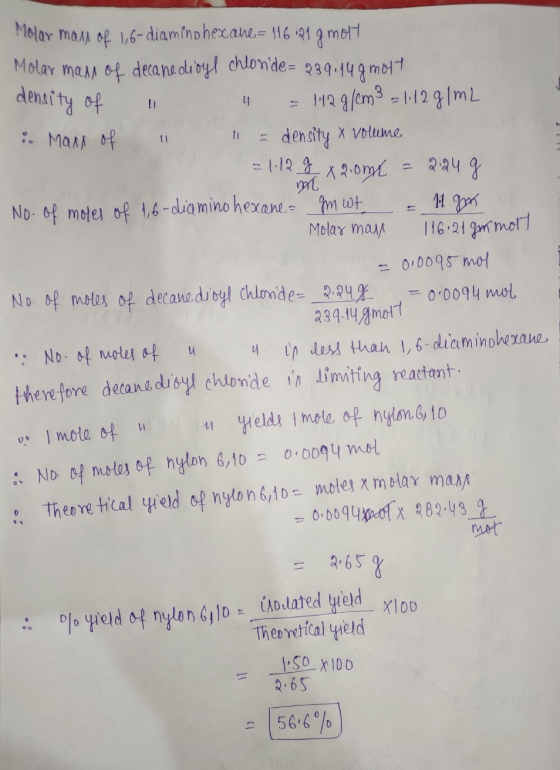
From the information below calculate the percent yield. What is the limiting reagent? for nylon 6,...
From the information below calculate the percent yield. What is the limiting reagent? for nylon 6, 10
H2N(CH2)6NH2 + ClCO(CH2)8COCl --> -[-NH(CH2)6NHCO(CH2)8CO-]- +2HCl
regents used :
1,6-diaminohexane (1.1 g) and NaOH (1.0 g)
distilled water (30 mL,).
decanedioyl chloride (2.0 mL,)
dichloromethane (25 mL,).
The isolated product (1.50 g)
Homework Answers
Your one thumbs up will help me lot. Thanks!
Add Answer to:
From the information below calculate the percent yield. What is
the limiting reagent? for nylon 6,...
10 mL of 0.59M 1,6-diaminohexane and 10 mL of 0.29M Sebacoyl chloride are used to make nylon 6.10. The final product weight was 1.36g. Calculate the percent yield? Use the MW of one repeating monomer...
10 mL of 0.59M 1,6-diaminohexane and 10 mL of 0.29M Sebacoyl chloride are used to make nylon 6.10. The final product weight was 1.36g. Calculate the percent yield? Use the MW of one repeating monomer for the weight of the product? Please show all work.
2. Calculate the limiting reagent, theoretical yield, and percent yield of the following reaction. (6 pts)...
 2. Calculate the limiting reagent, theoretical yield, and percent yield of the following reaction. (6 pts) o= NaOH/H20 5.2 g MW: 106.12 g/mol H3C CH3 1.3 g MW: 58.08 g/mol 3.0 g MW: 234 g/mol
2. Calculate the limiting reagent, theoretical yield, and percent yield of the following reaction. (6 pts)...
 2. Calculate the limiting reagent, theoretical yield, and percent yield of the following reaction. (6 pts) NAOH / H20 2 CHз Нас 3.0 g 1.3 g 5.2 g MW: 234 g/mol MW: 58.08 g/mol MW: 106.12 g/mol
Calculate the theoretical yield and percent yield. What is the limiting reagent? Reaction: Aniline to Acetanilide...
Calculate the theoretical yield and percent yield. What is the limiting reagent? Reaction: Aniline to Acetanilide in acetic anhydride, HCl, and NaOAc 5 g of aniline 4.5 mL HCl 5.32 g sodium acetate 6.60 g acetic anhydride 4.33 g of acetanilide (product)
calculate the theoretical and percent yield. what is the limiting reagent? Reaction: 4-bromoaniline from 4-bromoacetanilide in...
calculate the theoretical and percent yield. what is the limiting reagent? Reaction: 4-bromoaniline from 4-bromoacetanilide in HCl and EtOH 0.24 g 4-bromoacetanilide 0.38 mL of 95% ethanol 0.247 mL HCl 0.228 mL sodium hydroxide 0.19 g product (4-bromoaniline)
2. Calculate the limiting reagent, theoretical vield. and percent yield of the following reaction. (6 pts)...
 2. Calculate the limiting reagent, theoretical vield. and percent yield of the following reaction. (6 pts) NaOH / H20 H + 5.2 g MW: 106.12 g/mol H3C CH3 1.3 g MW: 58.08 g/mol 3.0 g MW: 234 g/mol
please show how to find each one 2. Calculate the limiting reagent, theoretical yield, and percent...
 please show how to find each one
2. Calculate the limiting reagent, theoretical yield, and percent yield of the following reaction. (6 pts) NaOH/ H20 2 CH3 Hас 3.0 g 1.3 g 5.2 g MW: 234 g/mol MW: 58.08 g/mol MW: 106.12 g/mol
please show how to find each one
2. Calculate the limiting reagent, theoretical yield, and percent yield of the following reaction. (6 pts) NaOH/ H20 2 CH3 Hас 3.0 g 1.3 g 5.2 g MW: 234 g/mol MW: 58.08 g/mol MW: 106.12 g/mol
6. (25 pts) (a) Calculate the theoretical yield, (b) limiting reagent, and (c) percent yield of the above reaction i...
 6. (25 pts) (a) Calculate the theoretical yield, (b) limiting reagent, and (c) percent yield of the above reaction if you were to react 48 mmol of 1-Butanol with 60 mmol of aqueous hydrobromic acid and you obtained 4.1g of 1-Bromobutane? SHOW ALL CALCULATIONS (a) Theoretical Yield: (b) Limiting Reagent: (c) Percent Yield:
help with limiting reagents and percent yield needed the reactions are the bromination of cis-stilbene and...
 help with limiting reagents and percent yield needed
the
reactions are the bromination of cis-stilbene and trans-stilbene.
The reagents and the moles of each reagent are in my data, as is
the moles of the products formed. The volume and mass of the
reagents are given as well. I need to know how to find the percent
yield and what the limiting reagents are for both the trans and cis
stilbene brominations. The information is there.
Name Physical Properties of...
help with limiting reagents and percent yield needed
the
reactions are the bromination of cis-stilbene and trans-stilbene.
The reagents and the moles of each reagent are in my data, as is
the moles of the products formed. The volume and mass of the
reagents are given as well. I need to know how to find the percent
yield and what the limiting reagents are for both the trans and cis
stilbene brominations. The information is there.
Name Physical Properties of...
Determining limiting reactant and percent yield Since this is our first synthesis experiment, this is a...
 Determining limiting reactant and percent yield Since this is our first synthesis experiment, this is a good place to review how to identify the imiting reactant and calculate the percent yield. I'll use some sample data to illustrate the process. CH CH2 HC OH HC H C CI CH CH t-butyl alcohol Density 0.7809 g/mL Conc. 0.42 g/mL MM-92.52 g/mol MM-79.2 g/mol Hydrochloric acid -butyl chloride MM-36 g/mol A student starts withmL of hydrochloric acid and-S mL t-butyl alcohol. She...
 2. Calculate the limiting reagent, theoretical yield, and percent yield of the following reaction. (6 pts) o= NaOH/H20 5.2 g MW: 106.12 g/mol H3C CH3 1.3 g MW: 58.08 g/mol 3.0 g MW: 234 g/mol
 2. Calculate the limiting reagent, theoretical yield, and percent yield of the following reaction. (6 pts) NAOH / H20 2 CHз Нас 3.0 g 1.3 g 5.2 g MW: 234 g/mol MW: 58.08 g/mol MW: 106.12 g/mol
 2. Calculate the limiting reagent, theoretical vield. and percent yield of the following reaction. (6 pts) NaOH / H20 H + 5.2 g MW: 106.12 g/mol H3C CH3 1.3 g MW: 58.08 g/mol 3.0 g MW: 234 g/mol
 please show how to find each one
2. Calculate the limiting reagent, theoretical yield, and percent yield of the following reaction. (6 pts) NaOH/ H20 2 CH3 Hас 3.0 g 1.3 g 5.2 g MW: 234 g/mol MW: 58.08 g/mol MW: 106.12 g/mol
please show how to find each one
2. Calculate the limiting reagent, theoretical yield, and percent yield of the following reaction. (6 pts) NaOH/ H20 2 CH3 Hас 3.0 g 1.3 g 5.2 g MW: 234 g/mol MW: 58.08 g/mol MW: 106.12 g/mol
 6. (25 pts) (a) Calculate the theoretical yield, (b) limiting reagent, and (c) percent yield of the above reaction if you were to react 48 mmol of 1-Butanol with 60 mmol of aqueous hydrobromic acid and you obtained 4.1g of 1-Bromobutane? SHOW ALL CALCULATIONS (a) Theoretical Yield: (b) Limiting Reagent: (c) Percent Yield:
 help with limiting reagents and percent yield needed
the
reactions are the bromination of cis-stilbene and trans-stilbene.
The reagents and the moles of each reagent are in my data, as is
the moles of the products formed. The volume and mass of the
reagents are given as well. I need to know how to find the percent
yield and what the limiting reagents are for both the trans and cis
stilbene brominations. The information is there.
Name Physical Properties of...
help with limiting reagents and percent yield needed
the
reactions are the bromination of cis-stilbene and trans-stilbene.
The reagents and the moles of each reagent are in my data, as is
the moles of the products formed. The volume and mass of the
reagents are given as well. I need to know how to find the percent
yield and what the limiting reagents are for both the trans and cis
stilbene brominations. The information is there.
Name Physical Properties of...
 Determining limiting reactant and percent yield Since this is our first synthesis experiment, this is a good place to review how to identify the imiting reactant and calculate the percent yield. I'll use some sample data to illustrate the process. CH CH2 HC OH HC H C CI CH CH t-butyl alcohol Density 0.7809 g/mL Conc. 0.42 g/mL MM-92.52 g/mol MM-79.2 g/mol Hydrochloric acid -butyl chloride MM-36 g/mol A student starts withmL of hydrochloric acid and-S mL t-butyl alcohol. She...
Most questions answered within 3 hours.
-
Where is the error in this code sequence?
String s1 = "Hello";
String s2 = "ello";...
asked 10 months ago -
Financial data for Joel de Paris, Inc., for last year
follow:
Joel de Paris, Inc.
Balance...
asked 10 months ago -
Consider this reaction:
Al2(SO4)3 (aq)+ BaCl3
(aq) Al2Cl6 (aq)- +
3BaSO4(s) . What is the...
asked 10 months ago -
Suppose that Savneet is considering increasing her
recent random sample from 20 car rentals to 40...
asked 10 months ago -
Trucks arrive at an unloading terminal at an average rate of 120
per hour.
Trucks arrive...
asked 10 months ago -
Why are methanol and ethanol completely soluble in water while
octanol is not very little soluble....
asked 10 months ago -
A facilities manager at a university reads in a research report
that the mean amount of...
asked 10 months ago -
When the CuSO4 is rehydrated by adding water to the anhydrous
compound, is this an endothermic...
asked 10 months ago -
A ray of sunlight is passing from diamond into crown glass; the
angle of incidence is...
asked 10 months ago -
A block of mass 0.249 kg is placed on top of a light, vertical
spring of...
asked 10 months ago -
how do the kidneys compensate in the presences of acidosis
a) trigger hyperventilate
b) reserve acid...
asked 10 months ago -
Question 501 pts
The rental rate of capital to the firm increases. Which of the
following...
asked 10 months ago