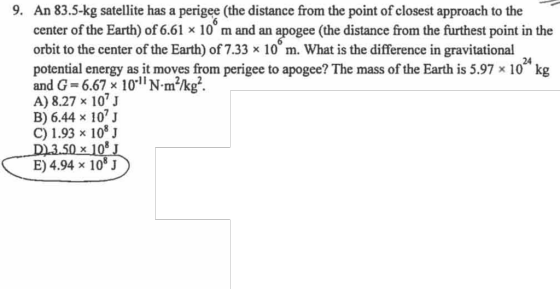
a 83.5 kg satellite has a perigee of 6.61 x 10^6m and a apogee of 7.33 x 10^6m. What is the difference in gravitational potential energy as it moves from perigee to apogee.
Homework Answers
In this case the gravitational PE is given by
U = -GMm/r
where r is the distance from the center of the earth
So
Ua = Uf = -GMm/Ra
Up = Ui = -GMm/Rp
so
Uf - Ui = -GMm(1/Ra - 1/Rp)
Rp,a must be in meteres
G = 6.67E-11
M = 5.98E24kg
m=83.5 kg
Uf - Ui = -GMm(1/Ra - 1/Rp) = -(6.67*10^-11*5.98*10^24*83.5)*[(1/7.33*10^6) - (1/6.61*10^6)]
= 494926326.43 J = 4.95*10^8 J
Add Answer to:
a 83.5 kg satellite has a perigee of 6.61 x 10^6m and a apogee
of 7.33...
The mass of Sputnik I was 83.5 kg, and its distances from the center of the Earth at apogee and perigee were 7330 km an...
The mass of Sputnik I was 83.5 kg, and its distances from the center of the Earth at apogee and perigee were 7330 km and 6610 km, respectively. Find the difference in gravitational potential energy for Sputnik I as it moved from apogee to perigee.
Sputnik the first artificial satellite to orbit the Earth was Sputnik I launched October 4,1957. The mass of Sputnik...
Sputnik the first artificial satellite to orbit the Earth was Sputnik I launched October 4,1957. The mass of Sputnik I was 83.5 kg and it’s distance from the center of the Earth at apogee and perigee were 7330km and 6610 km respectively.Find the difference in gravitational potential energy for Sputnik I as it moved from apogee to perigee
Sputnik The first artificial satellite to orbit the Earth was Sputnik I, launched October 4, 1957. The mass of Sputnik...
Sputnik The first artificial satellite to orbit the Earth was Sputnik I, launched October 4, 1957. The mass of Sputnik I was 83.5 kg, and its distances from the center of the Earth at apogee and perigee were 7330 km and 6610 km, respectively. Find the difference in gravitational potential energy for Sputnik I as it moved from apogee to perigee. (Joules)
A 7340-kg satellite has an elliptical orbit, as in the figure. The point on the orbit...
 A 7340-kg satellite has an elliptical orbit, as in the figure.
The point on the orbit that is farthest from the earth is called
the apogee and is at the far right side of the drawing. The point
on the orbit that is closest to the earth is called the perigee and
is at the far left side of the drawing. Suppose that the speed of
the satellite is 2700 m/s at the apogee and 8150 m/s at the
perigee....
A 7340-kg satellite has an elliptical orbit, as in the figure.
The point on the orbit that is farthest from the earth is called
the apogee and is at the far right side of the drawing. The point
on the orbit that is closest to the earth is called the perigee and
is at the far left side of the drawing. Suppose that the speed of
the satellite is 2700 m/s at the apogee and 8150 m/s at the
perigee....
A satellite is put into an elliptical orbit around the Earth. When the satellite is at its perigee, its nearest point t...
 A satellite is put into an elliptical orbit around the Earth. When the satellite is at its perigee, its nearest point to the Earth, its height above the ground is hp = 249.0 km, and it is moving with a speed of up = 7.950 km/s. The gravitational constant G equals 6.67 x 10⁻¹¹ mº.kg-1.5-2 and the mass of Earth equals 5.972 x 1024 kg. When the satellite reaches its apogee, at its farthest point from the Earth, what is...
A satellite is put into an elliptical orbit around the Earth. When the satellite is at...
 A satellite is put into an elliptical orbit around the Earth. When the satellite is at its perigee, its nearest point to the Earth, its height above the ground is ho = 207.0 km, and it is moving with a speed of v, = 8.050 kr/s. The gravitational constant G equals 6.67 x 10⁻¹¹ m² kg-15-2 and the mass of Earth equals 5.972 x 1024 kg. When the satellite reaches its apogee, at its farthest point from the Earth, what...
A satellite is put into an elliptical orbit around the Earth. When the satellite is at...
 A satellite is put into an elliptical orbit around the Earth. When the satellite is at its perigee, its nearest point to the Earth, its height above the ground is he = 227.0 km, and it is moving with a speed of up = 8.050 km/s. The gravitational constant G equals 6.67 x 10-'1 m² kg---5-2 and the mass of Earth equals 5.972 x 1024 kg. When the satellite reaches its apogee, at its farthest point from the Earth, what...
A satellite is put into an elliptical orbit around the Earth. When the satellite is at...
A satellite is put into an elliptical orbit around the Earth. When the satellite is at its perigee, its nearest point to the Earth, its height above the ground is hp=227.0 km, and it is moving with a speed of vp=8.950 km/s. The gravitational constant G equals 6.67×10⁻¹¹ m3·kg−1·s−2 and the mass of Earth equals 5.972×1024 kg. When the satellite reaches its apogee, at its farthest point from the Earth, what is its height ha above the ground? For this...
Question 2 of 10 > Attempt 2 A satellite is put into an elliptical orbit around...
 Question 2 of 10 > Attempt 2 A satellite is put into an elliptical orbit around the Earth. When the satellite is at its perigee, its nearest point to the Earth, its height above the ground is h = 237.0 km, and it is moving with a speed of uy = 9.550 km/s. The gravitational constant G equals 6.67 x 10-!mkgs and the mass of Earth equals 5.972 x 10⁴ kg. When the satellite reaches its apogee, at its farthest...
Attempt « Question 18 of 27 > A satellite is put into an elliptical orbit around...
 Attempt « Question 18 of 27 > A satellite is put into an elliptical orbit around the Earth. When the satellite is at its perigee, its nearest point to the Earth, its height above the ground is hp = 233.0 km, and it is moving with a speed of up = 9.850 km/s. The gravitational constant G equals 6.67 x 10 m.kg .s and the mass of Earth equals 5.972 x 10 kg. When the satellite reaches its apogee, at...
 A 7340-kg satellite has an elliptical orbit, as in the figure.
The point on the orbit that is farthest from the earth is called
the apogee and is at the far right side of the drawing. The point
on the orbit that is closest to the earth is called the perigee and
is at the far left side of the drawing. Suppose that the speed of
the satellite is 2700 m/s at the apogee and 8150 m/s at the
perigee....
A 7340-kg satellite has an elliptical orbit, as in the figure.
The point on the orbit that is farthest from the earth is called
the apogee and is at the far right side of the drawing. The point
on the orbit that is closest to the earth is called the perigee and
is at the far left side of the drawing. Suppose that the speed of
the satellite is 2700 m/s at the apogee and 8150 m/s at the
perigee....
 A satellite is put into an elliptical orbit around the Earth. When the satellite is at its perigee, its nearest point to the Earth, its height above the ground is hp = 249.0 km, and it is moving with a speed of up = 7.950 km/s. The gravitational constant G equals 6.67 x 10⁻¹¹ mº.kg-1.5-2 and the mass of Earth equals 5.972 x 1024 kg. When the satellite reaches its apogee, at its farthest point from the Earth, what is...
 A satellite is put into an elliptical orbit around the Earth. When the satellite is at its perigee, its nearest point to the Earth, its height above the ground is ho = 207.0 km, and it is moving with a speed of v, = 8.050 kr/s. The gravitational constant G equals 6.67 x 10⁻¹¹ m² kg-15-2 and the mass of Earth equals 5.972 x 1024 kg. When the satellite reaches its apogee, at its farthest point from the Earth, what...
 A satellite is put into an elliptical orbit around the Earth. When the satellite is at its perigee, its nearest point to the Earth, its height above the ground is he = 227.0 km, and it is moving with a speed of up = 8.050 km/s. The gravitational constant G equals 6.67 x 10-'1 m² kg---5-2 and the mass of Earth equals 5.972 x 1024 kg. When the satellite reaches its apogee, at its farthest point from the Earth, what...
 Question 2 of 10 > Attempt 2 A satellite is put into an elliptical orbit around the Earth. When the satellite is at its perigee, its nearest point to the Earth, its height above the ground is h = 237.0 km, and it is moving with a speed of uy = 9.550 km/s. The gravitational constant G equals 6.67 x 10-!mkgs and the mass of Earth equals 5.972 x 10⁴ kg. When the satellite reaches its apogee, at its farthest...
 Attempt « Question 18 of 27 > A satellite is put into an elliptical orbit around the Earth. When the satellite is at its perigee, its nearest point to the Earth, its height above the ground is hp = 233.0 km, and it is moving with a speed of up = 9.850 km/s. The gravitational constant G equals 6.67 x 10 m.kg .s and the mass of Earth equals 5.972 x 10 kg. When the satellite reaches its apogee, at...
Most questions answered within 3 hours.
-
Where is the error in this code sequence?
String s1 = "Hello";
String s2 = "ello";...
asked 11 months ago -
Financial data for Joel de Paris, Inc., for last year
follow:
Joel de Paris, Inc.
Balance...
asked 11 months ago -
Consider this reaction:
Al2(SO4)3 (aq)+ BaCl3
(aq) Al2Cl6 (aq)- +
3BaSO4(s) . What is the...
asked 11 months ago -
Suppose that Savneet is considering increasing her
recent random sample from 20 car rentals to 40...
asked 11 months ago -
Trucks arrive at an unloading terminal at an average rate of 120
per hour.
Trucks arrive...
asked 11 months ago -
Why are methanol and ethanol completely soluble in water while
octanol is not very little soluble....
asked 11 months ago -
A facilities manager at a university reads in a research report
that the mean amount of...
asked 11 months ago -
When the CuSO4 is rehydrated by adding water to the anhydrous
compound, is this an endothermic...
asked 11 months ago -
A ray of sunlight is passing from diamond into crown glass; the
angle of incidence is...
asked 11 months ago -
A block of mass 0.249 kg is placed on top of a light, vertical
spring of...
asked 11 months ago -
how do the kidneys compensate in the presences of acidosis
a) trigger hyperventilate
b) reserve acid...
asked 11 months ago -
Question 501 pts
The rental rate of capital to the firm increases. Which of the
following...
asked 11 months ago