
Homework Answers
Add Answer to:
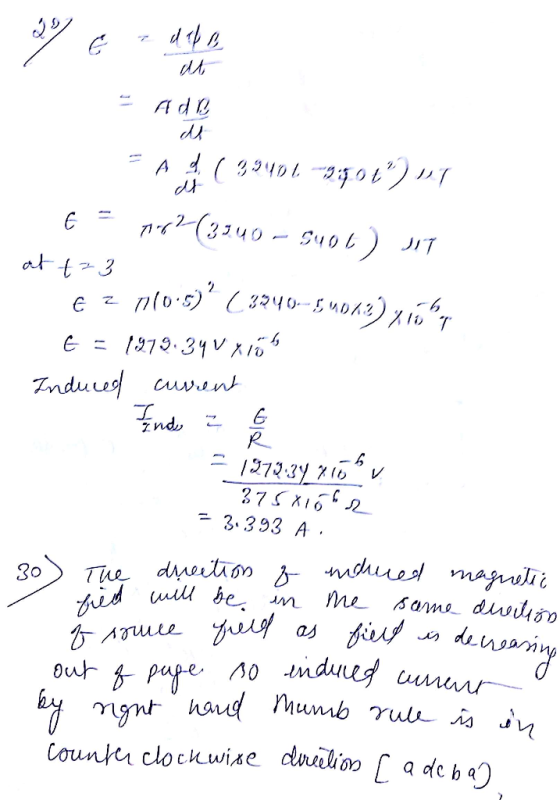
A circular conducting loop (radius -0.50 m) is immersed in a vertically upward (ie. perpen- dicular...
Parts A-E refer to the following figure of a circular loop of conducting wire
 1) Parts A-E refer to the following figure of a circular loop of conducting wire. In the figure, Region I has a uniform magnetic field in the direction shown and Region II has no magnetic field. a) If the loop moves to the right and starts to move into Region II, what is the direction of the induced current in the wire? Circle the correct response. a) Clockwise. b) Counterclockwise. c) There is no induced current. b) If the loop moves straight down and remains...
a. Consider a circular conducting loop that is moved at a constant speed from right to...
 a. Consider a circular conducting loop that is moved at a constant speed from right to left through a rectangular region with uniform magnetic field B, as shown in the figure. As the loop moves from position 3 to position 4, a clockwise current is induced in the loop. b. a counterclockwise current is x x induced in the loop. an into the page current is 5 1 induced in the loop. d. an out of the page current is...
Consider a circular conducting loop that is moved at a constant speed from right to left...
 Consider a circular conducting loop that is moved at a constant speed from right to left through a rectangular region with uniform magnetic field B, as shown in the figure. As the loop moves from position 1 to position 2, a. a clockwise current is induced in the loop. b. a counterclockwise current is induced in the loop. * * * * * c. an into the page current is 5 3 1 induced in the loop. d. an out...
A conducting loop is formed by running a wire completely around the edge of this page....
 A conducting loop is formed by running a wire completely around the edge of this page. A uniform magnetic field directed into the page is increasing at the rate of 2.5 T/s. What is the direction of the current induced in the loop? A) The induced current will move counterclockwise around the edge of the page. B) The induced current will alternate between clockwise and counterclockwise. C) The induced current will move clockwise around the edge of the page. D)...
The radius of the conducting loop is increasing with time. Which of the following describes the direction of induced current flow?
 Monday Homework Problem 9.7 The figure to the right shows a magnetic field directed out of the page. The radius of the conducting loop is increasing with time. Which of the following describes the direction of induced current flow? Select One of the Following (a) clockwise (b) counterclockwise (c) There is no induced current.
A circuit consists of a circular loop of wire with a radius a = 35.5 x...
 A circuit consists of a circular loop of wire with a radius a = 35.5 x 10² m. The circuit has a resistor with a resistance R = 1.8 as shown below. The circuit is entirely immersed a uniform magnetic field whose magnitude changes over time. If the rate of change of the magnetic field is either decreasing (-) or increasing (+) with a AB = -9.6 T/s, Ri X At Buto la page X X X X X X...
Consider a conducting loop placed on a horizontal plane in a region of uniform magnetic field...
Consider a conducting loop placed on a horizontal plane in a region of uniform magnetic field directed downward. If the magnitude of the magnetic field begins to decrease, what will the direction of the induced current in the loop be? Select one: a. Clockwise, so that the magnetic field of the loop is upward b. Clockwise, so that the magnetic field of the loop is downward c. Counterclockwise, so that the magnetic field of the loop is upward d. Counterclockwise,...
4. Consider a circular loop of wire with a mass m and a radius R. The...
 4. Consider a circular loop of wire with a mass m and a radius R. The circular loop is vertical such that gravitational force on the loop points straight down. You may assume this is near the surface of the earth such that the force of gravity has a magnitude FGl mg. The upper half of the circular wire is immersed in a uniform magnetic field B pointing into the page. In the figure below this corresponds to the region...
2. A magnetic field B Bêz in a certain space. A circular conducting loop of radius...
 2. A magnetic field B Bêz in a certain space. A circular conducting loop of radius 5 cm and total resistance 1.512 originally lies on the sy-plane with its center at the origin. (a) If a counterclockwise current I = 0.045 A is induced on the loop, find dB. (10%) (b) Forget about part (a). Now set B = 0.05T, and at time t = 0 the loop starts to rotate about the 3-axis at a angular rate w=0.057 rad/sec....
The magnetic field in the center of a horizontal circular loop with a radius of 3...
The magnetic field in the center of a horizontal circular loop with a radius of 3 mm is 2.0˛10-5 T and is directed vertically up. What is the magnitude of current in the loop and its direction, when viewed from above? A) 300 mA, counterclockwise B) 300 mA, clockwise C) 95 mA, counterclockwise D) 95 mA, clockwise E) 48 mA, clockwise
 a. Consider a circular conducting loop that is moved at a constant speed from right to left through a rectangular region with uniform magnetic field B, as shown in the figure. As the loop moves from position 3 to position 4, a clockwise current is induced in the loop. b. a counterclockwise current is x x induced in the loop. an into the page current is 5 1 induced in the loop. d. an out of the page current is...
 Consider a circular conducting loop that is moved at a constant speed from right to left through a rectangular region with uniform magnetic field B, as shown in the figure. As the loop moves from position 1 to position 2, a. a clockwise current is induced in the loop. b. a counterclockwise current is induced in the loop. * * * * * c. an into the page current is 5 3 1 induced in the loop. d. an out...
 A conducting loop is formed by running a wire completely around the edge of this page. A uniform magnetic field directed into the page is increasing at the rate of 2.5 T/s. What is the direction of the current induced in the loop? A) The induced current will move counterclockwise around the edge of the page. B) The induced current will alternate between clockwise and counterclockwise. C) The induced current will move clockwise around the edge of the page. D)...
 A circuit consists of a circular loop of wire with a radius a = 35.5 x 10² m. The circuit has a resistor with a resistance R = 1.8 as shown below. The circuit is entirely immersed a uniform magnetic field whose magnitude changes over time. If the rate of change of the magnetic field is either decreasing (-) or increasing (+) with a AB = -9.6 T/s, Ri X At Buto la page X X X X X X...
 4. Consider a circular loop of wire with a mass m and a radius R. The circular loop is vertical such that gravitational force on the loop points straight down. You may assume this is near the surface of the earth such that the force of gravity has a magnitude FGl mg. The upper half of the circular wire is immersed in a uniform magnetic field B pointing into the page. In the figure below this corresponds to the region...
 2. A magnetic field B Bêz in a certain space. A circular conducting loop of radius 5 cm and total resistance 1.512 originally lies on the sy-plane with its center at the origin. (a) If a counterclockwise current I = 0.045 A is induced on the loop, find dB. (10%) (b) Forget about part (a). Now set B = 0.05T, and at time t = 0 the loop starts to rotate about the 3-axis at a angular rate w=0.057 rad/sec....
Most questions answered within 3 hours.
-
Where is the error in this code sequence?
String s1 = "Hello";
String s2 = "ello";...
asked 10 months ago -
Financial data for Joel de Paris, Inc., for last year
follow:
Joel de Paris, Inc.
Balance...
asked 10 months ago -
Consider this reaction:
Al2(SO4)3 (aq)+ BaCl3
(aq) Al2Cl6 (aq)- +
3BaSO4(s) . What is the...
asked 10 months ago -
Suppose that Savneet is considering increasing her
recent random sample from 20 car rentals to 40...
asked 10 months ago -
Trucks arrive at an unloading terminal at an average rate of 120
per hour.
Trucks arrive...
asked 10 months ago -
Why are methanol and ethanol completely soluble in water while
octanol is not very little soluble....
asked 10 months ago -
A facilities manager at a university reads in a research report
that the mean amount of...
asked 10 months ago -
When the CuSO4 is rehydrated by adding water to the anhydrous
compound, is this an endothermic...
asked 10 months ago -
A ray of sunlight is passing from diamond into crown glass; the
angle of incidence is...
asked 10 months ago -
A block of mass 0.249 kg is placed on top of a light, vertical
spring of...
asked 10 months ago -
how do the kidneys compensate in the presences of acidosis
a) trigger hyperventilate
b) reserve acid...
asked 10 months ago -
Question 501 pts
The rental rate of capital to the firm increases. Which of the
following...
asked 10 months ago