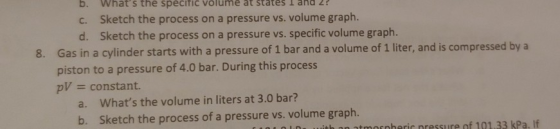
I need help with number 8 please. thermodynamics.
Homework Answers
a)
given
p x V= constant
so it is a isothermal process
at initial state pressure (p1) =1 bar
volume (V1) = 1 liter
we need to find volume at pressure (p2) = 3 bar
since pV=constant during process
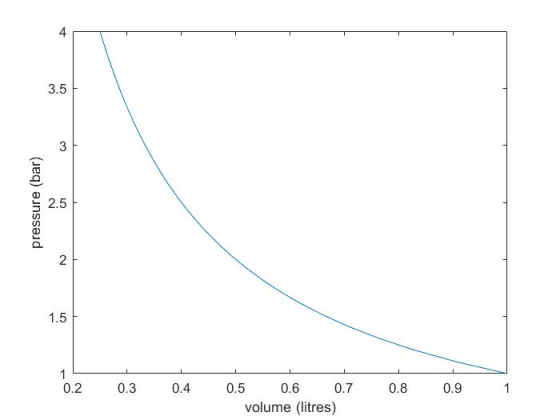
b)
we can plot the graph using relation
p x V =constant
in the given problem
constant =1
graph is obtained from equation
p x V =1
Add Answer to:
I need help with number 8 please. thermodynamics.
b. What's the specific volume at states Tand...
Air contained in an insulated piston-cylinder assembly, initially at 8 bar, 377 °C and a volume...
 Air contained in an insulated piston-cylinder assembly, initially at 8 bar, 377 °C and a volume of 0.60 m3, expands to a pressure of 2 bar. Model the air as an ideal gas with constant specific heats. a. Sketch process on a p-v and T-s diagram. Clearly indicate accessible states allowed by 2nd Law. T V b. Determine the maximum work of the expanding air (both magnitude and direction). Justify using the laws of thermodynamics. c. If the actual work...
(Thermodynamics) Need help answering this question, many thanks in advance. VI (10 pts.) A gas contained...
 (Thermodynamics) Need help answering this question, many
thanks in advance.
VI (10 pts.) A gas contained in a piston cylinder assembly undergoes a process from state 1 to state 2 defined by the following relationship and given properties. Determine the final pressure (P2) of the gas and the work(kJ) for the process. kPa 10 m3 P 100 kPa -10 Ovtonstant dv P (V) Constant VI 2.5 m3 V2 1.2 m3 pV-1ov /0 100-3.2,5 92.5=P,-10. 1035 P2= kPa kJ WI-2
(Thermodynamics) Need help answering this question, many
thanks in advance.
VI (10 pts.) A gas contained in a piston cylinder assembly undergoes a process from state 1 to state 2 defined by the following relationship and given properties. Determine the final pressure (P2) of the gas and the work(kJ) for the process. kPa 10 m3 P 100 kPa -10 Ovtonstant dv P (V) Constant VI 2.5 m3 V2 1.2 m3 pV-1ov /0 100-3.2,5 92.5=P,-10. 1035 P2= kPa kJ WI-2
I need help please! A piston–cylinder assembly contains air, initially at 2.6 bar, 149 K, and...
I need help please! A piston–cylinder assembly contains air, initially at 2.6 bar, 149 K, and a volume of 2.3 m3. The air undergoes a process to a state where the pressure is 0.6 bar, during which the pressure–volume relationship is pV = constant. Assuming ideal gas behavior for the air, determine the mass in kg.
Please solve ONLY question (2) with providing explanations of how you solve it. You will see...
 Please solve ONLY question (2) with providing explanations of
how you solve it.
You will see an example of what I’m asking for in Q4. A
Problem 2 (10 points) 15 kg of an ideal gas is contained in a piston-cylinder device at an initial pressure of 500 kPa and specific volume of 0.4 m3/kg. The gas is subsequently expanded to a specific volume of 1.3 m/kg During the expansion process, the pressure drops to 125 kPa and it is...
Please solve ONLY question (2) with providing explanations of
how you solve it.
You will see an example of what I’m asking for in Q4. A
Problem 2 (10 points) 15 kg of an ideal gas is contained in a piston-cylinder device at an initial pressure of 500 kPa and specific volume of 0.4 m3/kg. The gas is subsequently expanded to a specific volume of 1.3 m/kg During the expansion process, the pressure drops to 125 kPa and it is...
Imagine some helium in a cylinder with an initial volume of 1 liter and an initial...
Imagine some helium in a cylinder with an initial volume of 1 liter and an initial pressure of 1 atm. Somehow the helium is made to expand to a final volume of 3 liters, in such a wat that its pressure rises in direct proportion to its volume. Sketch a graph of pressure vs. volume for this process Calculate the work done on the gas during this process, assuming there are no “other” types of work being done. Calculate the...
CAN YALL PLEASE HELP ME I HAVE 4 HOURS TO DO THESE!! THANK YOU!! Question 1...
CAN YALL PLEASE HELP ME I HAVE 4 HOURS TO DO THESE!! THANK YOU!! Question 1 A mass of 4 kilograms of air in a piston-cylinder assembly undergoes two processes in series from an initial state where p1 = 0.3 MPa, T1 = 211°C: Process 1–2: Constant-temperature expansion until the volume is twice the initial volume. Process 2–3: Constant-volume heating until the pressure is again 0.3 MPa. Assuming ideal gas behavior, determine the temperature at state 3, in kelvin. _________________________________________________...
2 Thermodynamics Equations (Cycles) • Solve the following problems from the textbook (Thermodynamics: An Engineering Approach,...
 2
Thermodynamics Equations (Cycles)
• Solve the following problems from the textbook (Thermodynamics: An Engineering Approach, by Yunus A. Cengel and Michael A. Boles, 8th Edition, SI Version, 2015): Gas Power Cycles: Obtain problem statements from the textbook Air-Standard Cycles (Otto Cycles) Problems No.: 9-32 An ideal Otto cyele has a compression ratio of 8. At the beginning of the compression process, air at 95 kPa and 27°C, and 750 kJ/kg of heat is transferred to air during the constant-...
2
Thermodynamics Equations (Cycles)
• Solve the following problems from the textbook (Thermodynamics: An Engineering Approach, by Yunus A. Cengel and Michael A. Boles, 8th Edition, SI Version, 2015): Gas Power Cycles: Obtain problem statements from the textbook Air-Standard Cycles (Otto Cycles) Problems No.: 9-32 An ideal Otto cyele has a compression ratio of 8. At the beginning of the compression process, air at 95 kPa and 27°C, and 750 kJ/kg of heat is transferred to air during the constant-...
Number 16 please 15. Air of a mass of .6kg and temperature 110°F is contained within...
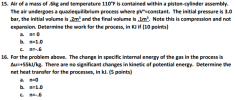 Number 16 please
15. Air of a mass of .6kg and temperature 110°F is contained within a piston-cylinder assembly. The air undergoes a quaziequilibrium process where pV=constant. The initial pressure is 3.0 bar, the initial volume is .2m and the final volume is .1m'. Note this is compression and not expansion. Determine the work for the process, in KJ if (10 points) a. n= 0 b. n=1.0 c. n=-.6 16. For the problem above. The change in specific internal energy...
Number 16 please
15. Air of a mass of .6kg and temperature 110°F is contained within a piston-cylinder assembly. The air undergoes a quaziequilibrium process where pV=constant. The initial pressure is 3.0 bar, the initial volume is .2m and the final volume is .1m'. Note this is compression and not expansion. Determine the work for the process, in KJ if (10 points) a. n= 0 b. n=1.0 c. n=-.6 16. For the problem above. The change in specific internal energy...
Need help with Thermodynamics Homework. WILL RATE HIGH! Thank you! Please answer them all for high...
Need help with Thermodynamics Homework. WILL RATE HIGH! Thank you! Please answer them all for high rate 1. Carbon Oxide (CO) initially occupying 2.9 m3 at 7.4 bar, 246.85°C undergoes an internally reversible expansion during which pV1.4 = constant to a final state where the temperature is 36.85°C. Assuming the ideal gas model, determine the entropy change, in Joules/K. 2. Water at 10 bar, 240°C enters a turbine operating at steady state and exits at 4 bar. Stray heat transfer...
Tutorial 1: Working Fluids and Vapour Tables Question 1: Calculate the specific volume, specific enthalpy and...
 Tutorial 1: Working Fluids and Vapour Tables Question 1: Calculate the specific volume, specific enthalpy and specific internal energy of wet steam at 18 bar and a dryness fraction of 0.9 Question 2: Calculate the dryness fraction, specific volume and specific internal energy of steam at 7 bar and with a specific enthalpy of 2600kJ/kg Question 3: Steam at 110 bar was found to have a specific volume of 0.0196 m²/kg. Calculate the temperature, specific enthalpy and specific internal energy...
 Air contained in an insulated piston-cylinder assembly, initially at 8 bar, 377 °C and a volume of 0.60 m3, expands to a pressure of 2 bar. Model the air as an ideal gas with constant specific heats. a. Sketch process on a p-v and T-s diagram. Clearly indicate accessible states allowed by 2nd Law. T V b. Determine the maximum work of the expanding air (both magnitude and direction). Justify using the laws of thermodynamics. c. If the actual work...
 (Thermodynamics) Need help answering this question, many
thanks in advance.
VI (10 pts.) A gas contained in a piston cylinder assembly undergoes a process from state 1 to state 2 defined by the following relationship and given properties. Determine the final pressure (P2) of the gas and the work(kJ) for the process. kPa 10 m3 P 100 kPa -10 Ovtonstant dv P (V) Constant VI 2.5 m3 V2 1.2 m3 pV-1ov /0 100-3.2,5 92.5=P,-10. 1035 P2= kPa kJ WI-2
(Thermodynamics) Need help answering this question, many
thanks in advance.
VI (10 pts.) A gas contained in a piston cylinder assembly undergoes a process from state 1 to state 2 defined by the following relationship and given properties. Determine the final pressure (P2) of the gas and the work(kJ) for the process. kPa 10 m3 P 100 kPa -10 Ovtonstant dv P (V) Constant VI 2.5 m3 V2 1.2 m3 pV-1ov /0 100-3.2,5 92.5=P,-10. 1035 P2= kPa kJ WI-2
 Please solve ONLY question (2) with providing explanations of
how you solve it.
You will see an example of what I’m asking for in Q4. A
Problem 2 (10 points) 15 kg of an ideal gas is contained in a piston-cylinder device at an initial pressure of 500 kPa and specific volume of 0.4 m3/kg. The gas is subsequently expanded to a specific volume of 1.3 m/kg During the expansion process, the pressure drops to 125 kPa and it is...
Please solve ONLY question (2) with providing explanations of
how you solve it.
You will see an example of what I’m asking for in Q4. A
Problem 2 (10 points) 15 kg of an ideal gas is contained in a piston-cylinder device at an initial pressure of 500 kPa and specific volume of 0.4 m3/kg. The gas is subsequently expanded to a specific volume of 1.3 m/kg During the expansion process, the pressure drops to 125 kPa and it is...
 2
Thermodynamics Equations (Cycles)
• Solve the following problems from the textbook (Thermodynamics: An Engineering Approach, by Yunus A. Cengel and Michael A. Boles, 8th Edition, SI Version, 2015): Gas Power Cycles: Obtain problem statements from the textbook Air-Standard Cycles (Otto Cycles) Problems No.: 9-32 An ideal Otto cyele has a compression ratio of 8. At the beginning of the compression process, air at 95 kPa and 27°C, and 750 kJ/kg of heat is transferred to air during the constant-...
2
Thermodynamics Equations (Cycles)
• Solve the following problems from the textbook (Thermodynamics: An Engineering Approach, by Yunus A. Cengel and Michael A. Boles, 8th Edition, SI Version, 2015): Gas Power Cycles: Obtain problem statements from the textbook Air-Standard Cycles (Otto Cycles) Problems No.: 9-32 An ideal Otto cyele has a compression ratio of 8. At the beginning of the compression process, air at 95 kPa and 27°C, and 750 kJ/kg of heat is transferred to air during the constant-...
 Number 16 please
15. Air of a mass of .6kg and temperature 110°F is contained within a piston-cylinder assembly. The air undergoes a quaziequilibrium process where pV=constant. The initial pressure is 3.0 bar, the initial volume is .2m and the final volume is .1m'. Note this is compression and not expansion. Determine the work for the process, in KJ if (10 points) a. n= 0 b. n=1.0 c. n=-.6 16. For the problem above. The change in specific internal energy...
Number 16 please
15. Air of a mass of .6kg and temperature 110°F is contained within a piston-cylinder assembly. The air undergoes a quaziequilibrium process where pV=constant. The initial pressure is 3.0 bar, the initial volume is .2m and the final volume is .1m'. Note this is compression and not expansion. Determine the work for the process, in KJ if (10 points) a. n= 0 b. n=1.0 c. n=-.6 16. For the problem above. The change in specific internal energy...
 Tutorial 1: Working Fluids and Vapour Tables Question 1: Calculate the specific volume, specific enthalpy and specific internal energy of wet steam at 18 bar and a dryness fraction of 0.9 Question 2: Calculate the dryness fraction, specific volume and specific internal energy of steam at 7 bar and with a specific enthalpy of 2600kJ/kg Question 3: Steam at 110 bar was found to have a specific volume of 0.0196 m²/kg. Calculate the temperature, specific enthalpy and specific internal energy...
Most questions answered within 3 hours.
-
Where is the error in this code sequence?
String s1 = "Hello";
String s2 = "ello";...
asked 10 months ago -
Financial data for Joel de Paris, Inc., for last year
follow:
Joel de Paris, Inc.
Balance...
asked 10 months ago -
Consider this reaction:
Al2(SO4)3 (aq)+ BaCl3
(aq) Al2Cl6 (aq)- +
3BaSO4(s) . What is the...
asked 10 months ago -
Suppose that Savneet is considering increasing her
recent random sample from 20 car rentals to 40...
asked 10 months ago -
Trucks arrive at an unloading terminal at an average rate of 120
per hour.
Trucks arrive...
asked 10 months ago -
Why are methanol and ethanol completely soluble in water while
octanol is not very little soluble....
asked 10 months ago -
A facilities manager at a university reads in a research report
that the mean amount of...
asked 10 months ago -
When the CuSO4 is rehydrated by adding water to the anhydrous
compound, is this an endothermic...
asked 10 months ago -
A ray of sunlight is passing from diamond into crown glass; the
angle of incidence is...
asked 10 months ago -
A block of mass 0.249 kg is placed on top of a light, vertical
spring of...
asked 10 months ago -
how do the kidneys compensate in the presences of acidosis
a) trigger hyperventilate
b) reserve acid...
asked 10 months ago -
Question 501 pts
The rental rate of capital to the firm increases. Which of the
following...
asked 10 months ago