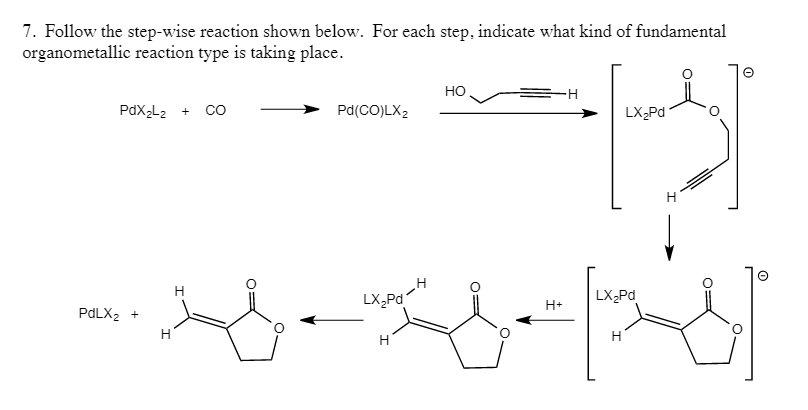
Follow the stepwise reaction shown below. For each step, indicate what kind of fundamental organometallic reaction type is taking place.
Homework Answers
Request Answer!
We need at least 10 more requests to produce the answer.
0 / 10 have requested this problem solution
The more requests, the faster the answer.
Add Answer to:
Follow the stepwise reaction shown below. For each step, indicate what kind of fundamental organometallic reaction type is taking place.
3. Indicate the type e the type of fundamental mechanistic step displayed in each of the...
 3. Indicate the type e the type of fundamental mechanistic step displayed in each of the following transformations. Use on transfer. NA for nucleille attack LG for loss of leaving group, and R for rearrangement NA 4. Rank the following carbocations in order of stability (1 MOST-3 - LEAST). For the second set, one of the three is more stable the others due to resonance Circle the one that exhibit this property Dowarows showing the mechanism nowotections of the following...
D Question 12 6 pts What type of mechanism is taking place in the reaction shown?...
 D Question 12 6 pts What type of mechanism is taking place in the reaction shown? OH D Question 13 6 pts What is the correct absolute configuration for the stereocenter, marked with an asterisk (*), in the molecule below? trans Question 15 6 pts What is an appropriate name for the compound shown? OH m-bromophenol m-bromobenzyl alcohol m-hydroxybenzenebromide p-bromoanisole Question 16 6 pts What reagents would be required to make the following transformation? с HCl H2/Pd Na/NH3(0) H.Br 2...
What type of transport is being shown in the diagram? Explain what is taking place. A...
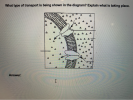 What type of transport is being shown in the diagram? Explain what is taking place. A A A A A A A A D AAAA A A A A4 A A A AA Answer: I
1. For the following reaction, assume a stepwise process is taking place and draw the mechanism...
 1. For the following reaction, assume a stepwise process is taking place and draw the mechanism (first loss of the LG and then proton transfer): MeOH 2. For the following reaction, assume a concerted process is taking place and draw the mechanism (the base abstracts the proton and the LG leaves simultaneously) OTS
1. Your reaction forms methyl m-nitrobenzoate. What kind of reaction is taking place in your round...
 1. Your reaction forms methyl m-nitrobenzoate. What kind of reaction is taking place in your round bottom flask? 2. Why do you use a minimum quantity of methanol to recrystallize the product? 3. Why is the reaction mixture cooled as the sulfuric/nitric acid mixture is added? 4. What is the reason that you wash the recovered solids with several small portions of ice cold water? 5. How might placing the recrystallized product under vacuum help to remove excess solvent?
5. Identify the fundamental organometallic or organic step involved in each transformation. [Cu]an NHC-ligated Cu center...
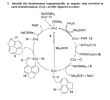 5. Identify the fundamental organometallic or organic step involved in each transformation. [Cu]an NHC-ligated Cu center NaOSiMe3 [Cu]-CI OSiMes PH2R - [Cu] NaBr Me3SiOH NaOSiMe 6 [Cu-PHR 12 ArCH2CI (1) Me3SiOH PHR(CH2Ar) (6) 2 [Cul-CI NaOSiMe3 +6 14 MegSiOH NaCl P-R Br 13
8. Write a complete, stepwise reaction mechanism for the reaction shown. Indicate a electron flow with...
 8. Write a complete, stepwise reaction mechanism for the reaction shown. Indicate a electron flow with arrows and draw all intermediato structures (12 points) CH3OH (excess) HCI, heat OCH OCHa
Question 9 What type of reaction would take place for the two reactants shown below? acid-base...
 Question 9 What type of reaction would take place for the two reactants shown below? acid-base • S2 substitution Si substitution O E2 elimination Question 10 Identify the reaction that would best give the molecule shown below. yay OH 1. Nah T 2. W OH 1. Nah 2. HO OH 1. PBrg 2.0 HO 1.H2SO4 2. 0
Identify the type of interactions involved in each of the following processes taking place during the...
 Identify the type of interactions involved in each of the
following processes taking place during the dissolution of sodium
chloride (NaCl) in water.
Part AIdentify the type of interactions involved in each of the following processes taking place during the dissolution of sodium chloride (NaCl) in water.
Identify the type of interactions involved in each of the
following processes taking place during the dissolution of sodium
chloride (NaCl) in water.
Part AIdentify the type of interactions involved in each of the following processes taking place during the dissolution of sodium chloride (NaCl) in water.
Using the letters shown by each problem type, indicate what type of problem the question describes....
 Using the letters shown by each problem type, indicate what type of problem the question describes. A. Capital Gains/Loss between two consecutive periods B. Current Yield between Two Consecutive Periods C. Finding period 1's price of a stock with super-normal growth D. Finding today's price of a stock with super-normal growth E. Lump sum funds a delayed level annuity F. Lump Sum funds Future Lump Sum G. Lump Sum Funds Ordinary Level Annuity H. Ordinary Level Annuity Funds a Future...
 3. Indicate the type e the type of fundamental mechanistic step displayed in each of the following transformations. Use on transfer. NA for nucleille attack LG for loss of leaving group, and R for rearrangement NA 4. Rank the following carbocations in order of stability (1 MOST-3 - LEAST). For the second set, one of the three is more stable the others due to resonance Circle the one that exhibit this property Dowarows showing the mechanism nowotections of the following...
 D Question 12 6 pts What type of mechanism is taking place in the reaction shown? OH D Question 13 6 pts What is the correct absolute configuration for the stereocenter, marked with an asterisk (*), in the molecule below? trans Question 15 6 pts What is an appropriate name for the compound shown? OH m-bromophenol m-bromobenzyl alcohol m-hydroxybenzenebromide p-bromoanisole Question 16 6 pts What reagents would be required to make the following transformation? с HCl H2/Pd Na/NH3(0) H.Br 2...
 What type of transport is being shown in the diagram? Explain what is taking place. A A A A A A A A D AAAA A A A A4 A A A AA Answer: I
 1. For the following reaction, assume a stepwise process is taking place and draw the mechanism (first loss of the LG and then proton transfer): MeOH 2. For the following reaction, assume a concerted process is taking place and draw the mechanism (the base abstracts the proton and the LG leaves simultaneously) OTS
 1. Your reaction forms methyl m-nitrobenzoate. What kind of reaction is taking place in your round bottom flask? 2. Why do you use a minimum quantity of methanol to recrystallize the product? 3. Why is the reaction mixture cooled as the sulfuric/nitric acid mixture is added? 4. What is the reason that you wash the recovered solids with several small portions of ice cold water? 5. How might placing the recrystallized product under vacuum help to remove excess solvent?
 5. Identify the fundamental organometallic or organic step involved in each transformation. [Cu]an NHC-ligated Cu center NaOSiMe3 [Cu]-CI OSiMes PH2R - [Cu] NaBr Me3SiOH NaOSiMe 6 [Cu-PHR 12 ArCH2CI (1) Me3SiOH PHR(CH2Ar) (6) 2 [Cul-CI NaOSiMe3 +6 14 MegSiOH NaCl P-R Br 13
 8. Write a complete, stepwise reaction mechanism for the reaction shown. Indicate a electron flow with arrows and draw all intermediato structures (12 points) CH3OH (excess) HCI, heat OCH OCHa
 Question 9 What type of reaction would take place for the two reactants shown below? acid-base • S2 substitution Si substitution O E2 elimination Question 10 Identify the reaction that would best give the molecule shown below. yay OH 1. Nah T 2. W OH 1. Nah 2. HO OH 1. PBrg 2.0 HO 1.H2SO4 2. 0
 Identify the type of interactions involved in each of the
following processes taking place during the dissolution of sodium
chloride (NaCl) in water.
Part AIdentify the type of interactions involved in each of the following processes taking place during the dissolution of sodium chloride (NaCl) in water.
Identify the type of interactions involved in each of the
following processes taking place during the dissolution of sodium
chloride (NaCl) in water.
Part AIdentify the type of interactions involved in each of the following processes taking place during the dissolution of sodium chloride (NaCl) in water.
 Using the letters shown by each problem type, indicate what type of problem the question describes. A. Capital Gains/Loss between two consecutive periods B. Current Yield between Two Consecutive Periods C. Finding period 1's price of a stock with super-normal growth D. Finding today's price of a stock with super-normal growth E. Lump sum funds a delayed level annuity F. Lump Sum funds Future Lump Sum G. Lump Sum Funds Ordinary Level Annuity H. Ordinary Level Annuity Funds a Future...
Most questions answered within 3 hours.
-
Where is the error in this code sequence?
String s1 = "Hello";
String s2 = "ello";...
asked 10 months ago -
Financial data for Joel de Paris, Inc., for last year
follow:
Joel de Paris, Inc.
Balance...
asked 10 months ago -
Consider this reaction:
Al2(SO4)3 (aq)+ BaCl3
(aq) Al2Cl6 (aq)- +
3BaSO4(s) . What is the...
asked 10 months ago -
Suppose that Savneet is considering increasing her
recent random sample from 20 car rentals to 40...
asked 10 months ago -
Trucks arrive at an unloading terminal at an average rate of 120
per hour.
Trucks arrive...
asked 10 months ago -
Why are methanol and ethanol completely soluble in water while
octanol is not very little soluble....
asked 10 months ago -
A facilities manager at a university reads in a research report
that the mean amount of...
asked 10 months ago -
When the CuSO4 is rehydrated by adding water to the anhydrous
compound, is this an endothermic...
asked 10 months ago -
A ray of sunlight is passing from diamond into crown glass; the
angle of incidence is...
asked 10 months ago -
A block of mass 0.249 kg is placed on top of a light, vertical
spring of...
asked 10 months ago -
how do the kidneys compensate in the presences of acidosis
a) trigger hyperventilate
b) reserve acid...
asked 10 months ago -
Question 501 pts
The rental rate of capital to the firm increases. Which of the
following...
asked 10 months ago