
Homework Answers
Add Answer to:
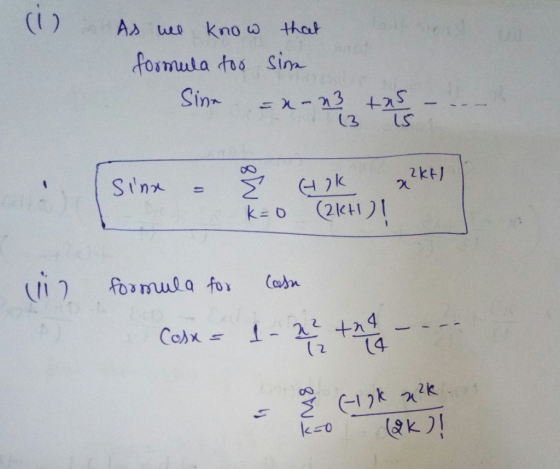
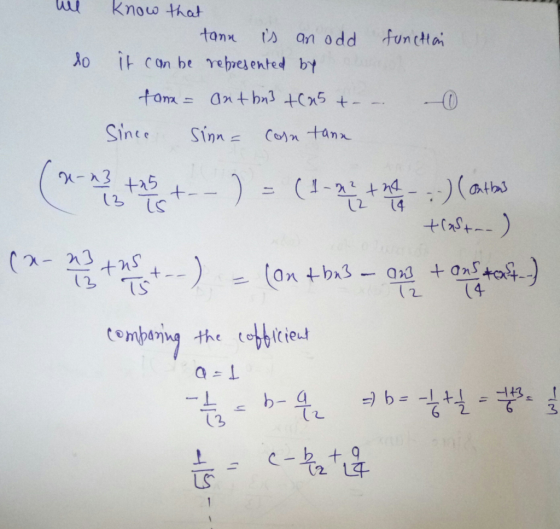
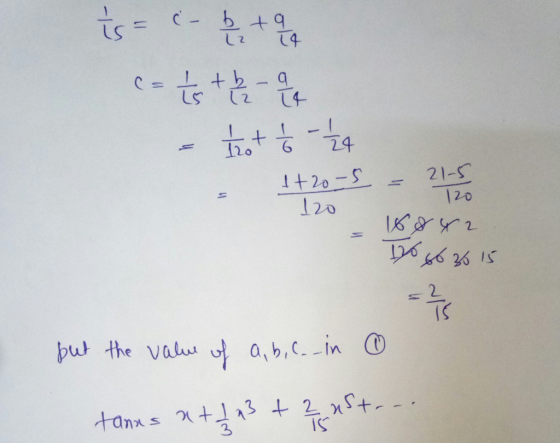
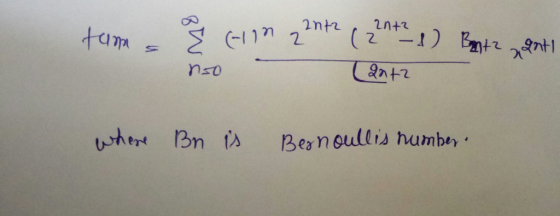
Express the following in terms of a series expansion. sin(x) cos(x) tan(x); use only (i) and...
Question 9: The first four non-zero terms in the expansion, in ascending powers of x, of In(1+ sin x) are 2 6 12 () 0) Write down the expansion of in(I - sin x) in ascending powers of x up to and...
 Question 9: The first four non-zero terms in the expansion, in ascending powers of x, of In(1+ sin x) are 2 6 12 () 0) Write down the expansion of in(I - sin x) in ascending powers of x up to and including the term in (i) Henee show that the first two non-zero terms in the expansion, in ascending powers of x, of 2 12 are (ii) Hence, or otherwise, find the first two non-zero terms in the expansion,...
7. (a) Use the well known Maclaurin series expansion for the cosine function: f (x )...
 7. (a) Use the well known Maclaurin series expansion for the cosine function: f (x ) = cos x = 1 x? 2! + 4! х 6! + (-1)" (2n)! . * 8! 0 and a substitution to obtain the Maclaurin series expansion for g(x) = cos (x²). Express your formula using sigma notation. (b) Use the Term-by-Term Integration Theorem to obtain an infinite series which converges to: cos(x) dx . y = cos(x²) (c) Use the remainder theorem associated...
a.) Write a C++ program that calculates the value of the series sin x and cos...
 a.) Write a C++ program that calculates the value of the series
sin x and cos x, sin 2x or cos 2x where the user enters the value
of x (in degrees) and n the number of terms in the series. For
example, if n= 5, the program should calculate the sum of 5 terms
in the series for a given values of x. The program should use
switch statements to determine the choice sin x AND cos x, sin...
a.) Write a C++ program that calculates the value of the series
sin x and cos x, sin 2x or cos 2x where the user enters the value
of x (in degrees) and n the number of terms in the series. For
example, if n= 5, the program should calculate the sum of 5 terms
in the series for a given values of x. The program should use
switch statements to determine the choice sin x AND cos x, sin...
(1 point) Fill in the blanks: 1. If tan r 3.5 then tan(-z) - I 2. If sin a 0.7 then sin(=x) = 3. If cos r 0.2 then...
 (1 point) Fill in the blanks: 1. If tan r 3.5 then tan(-z) - I 2. If sin a 0.7 then sin(=x) = 3. If cos r 0.2 then cos(-r)=| 4. If tan r 1.5 then tan(T+ x)=|
(1 point) Fill in the blanks: 1. If tan r 3.5 then tan(-z) - I 2. If sin a 0.7 then sin(=x) = 3. If cos r 0.2 then cos(-r)=| 4. If tan r 1.5 then tan(T+ x)=|
(1 point) Fill in the blanks: 1. If tan r 3.5 then tan(-z) - I 2. If sin a 0.7 then sin(=x) = 3. If cos r 0.2 then cos(-r)=| 4. If tan r 1.5 then tan(T+ x)=|
(1 point) Find the Fourier series expansion, i.e., f(x) [an cos(170) + by sin(t, x)] n1...
 (1 point) Find the Fourier series expansion, i.e., f(x) [an cos(170) + by sin(t, x)] n1 J1 0< for the function f(1) = 30 < <3 <0 on - SIST ao = 1 an = cos npix bn = Thus the Fourier series can be written as f() = 1/2
3. Use a labeled reference triangle to evaluate tan (cos-1 (cos** (33)) in terms of x....
 3. Use a labeled reference triangle to evaluate tan (cos-1 (cos** (33)) in terms of x. Show triangle for credit.
*Using Python* Write an example for each of the following functions sqrt(), sin(), tan(), cos(), ceil(),...
*Using Python* Write an example for each of the following functions sqrt(), sin(), tan(), cos(), ceil(), floor(), hypot(), exp(), degrees(), log(), log10()
Find sin(2x), cos(2x), and tan(2x) from the given information. tan(x) = ) = - cos(x) >...
 Find sin(2x), cos(2x), and tan(2x) from the given information. tan(x) = ) = - cos(x) > 0 sin(2x) = cos(2x) = tan(2x) =
-1-1 arctan n n" n!5* (c) Find the interval of convergence and radius of convergence for )0301 i )e-3r) (d) Use the geometric series to write the power series expansion for i. f(1)- 2-4r, cen...
 -1-1 arctan n n" n!5* (c) Find the interval of convergence and radius of convergence for )0301 i )e-3r) (d) Use the geometric series to write the power series expansion for i. f(1)- 2-4r, centered at a = 0. i.)4 centered at a-6. (e) Write the first 4 nonzero terms of the Maclaurin expansion for i, f(z) = z2 (e4-1) ii. /(x) = cos(3r)-2 sin(2x). (0) Use the Taylor Series definition to write the expansion for f(a)entered at (8) Use...
On the back, prove the identity: tan^3(x)csc^2(x)cot^2(x)cos(x)sin(x)=1 Use only the left side and try changing everything...
 On the back, prove the identity:
tan^3(x)csc^2(x)cot^2(x)cos(x)sin(x)=1
Use only the left side and try changing everything to sine and
cosine.
Original Question Image:
On the back, prove the identity: tan'(r)csc(r)cot'(x)cos(x)sin(r)-1 Use only the left side and try changing everything to sine and cosine.
On the back, prove the identity:
tan^3(x)csc^2(x)cot^2(x)cos(x)sin(x)=1
Use only the left side and try changing everything to sine and
cosine.
Original Question Image:
On the back, prove the identity: tan'(r)csc(r)cot'(x)cos(x)sin(r)-1 Use only the left side and try changing everything to sine and cosine.
 Question 9: The first four non-zero terms in the expansion, in ascending powers of x, of In(1+ sin x) are 2 6 12 () 0) Write down the expansion of in(I - sin x) in ascending powers of x up to and including the term in (i) Henee show that the first two non-zero terms in the expansion, in ascending powers of x, of 2 12 are (ii) Hence, or otherwise, find the first two non-zero terms in the expansion,...
 7. (a) Use the well known Maclaurin series expansion for the cosine function: f (x ) = cos x = 1 x? 2! + 4! х 6! + (-1)" (2n)! . * 8! 0 and a substitution to obtain the Maclaurin series expansion for g(x) = cos (x²). Express your formula using sigma notation. (b) Use the Term-by-Term Integration Theorem to obtain an infinite series which converges to: cos(x) dx . y = cos(x²) (c) Use the remainder theorem associated...
 a.) Write a C++ program that calculates the value of the series
sin x and cos x, sin 2x or cos 2x where the user enters the value
of x (in degrees) and n the number of terms in the series. For
example, if n= 5, the program should calculate the sum of 5 terms
in the series for a given values of x. The program should use
switch statements to determine the choice sin x AND cos x, sin...
a.) Write a C++ program that calculates the value of the series
sin x and cos x, sin 2x or cos 2x where the user enters the value
of x (in degrees) and n the number of terms in the series. For
example, if n= 5, the program should calculate the sum of 5 terms
in the series for a given values of x. The program should use
switch statements to determine the choice sin x AND cos x, sin...
 (1 point) Fill in the blanks: 1. If tan r 3.5 then tan(-z) - I 2. If sin a 0.7 then sin(=x) = 3. If cos r 0.2 then cos(-r)=| 4. If tan r 1.5 then tan(T+ x)=|
(1 point) Fill in the blanks: 1. If tan r 3.5 then tan(-z) - I 2. If sin a 0.7 then sin(=x) = 3. If cos r 0.2 then cos(-r)=| 4. If tan r 1.5 then tan(T+ x)=|
(1 point) Fill in the blanks: 1. If tan r 3.5 then tan(-z) - I 2. If sin a 0.7 then sin(=x) = 3. If cos r 0.2 then cos(-r)=| 4. If tan r 1.5 then tan(T+ x)=|
 (1 point) Find the Fourier series expansion, i.e., f(x) [an cos(170) + by sin(t, x)] n1 J1 0< for the function f(1) = 30 < <3 <0 on - SIST ao = 1 an = cos npix bn = Thus the Fourier series can be written as f() = 1/2
 3. Use a labeled reference triangle to evaluate tan (cos-1 (cos** (33)) in terms of x. Show triangle for credit.
 Find sin(2x), cos(2x), and tan(2x) from the given information. tan(x) = ) = - cos(x) > 0 sin(2x) = cos(2x) = tan(2x) =
 -1-1 arctan n n" n!5* (c) Find the interval of convergence and radius of convergence for )0301 i )e-3r) (d) Use the geometric series to write the power series expansion for i. f(1)- 2-4r, centered at a = 0. i.)4 centered at a-6. (e) Write the first 4 nonzero terms of the Maclaurin expansion for i, f(z) = z2 (e4-1) ii. /(x) = cos(3r)-2 sin(2x). (0) Use the Taylor Series definition to write the expansion for f(a)entered at (8) Use...
 On the back, prove the identity:
tan^3(x)csc^2(x)cot^2(x)cos(x)sin(x)=1
Use only the left side and try changing everything to sine and
cosine.
Original Question Image:
On the back, prove the identity: tan'(r)csc(r)cot'(x)cos(x)sin(r)-1 Use only the left side and try changing everything to sine and cosine.
On the back, prove the identity:
tan^3(x)csc^2(x)cot^2(x)cos(x)sin(x)=1
Use only the left side and try changing everything to sine and
cosine.
Original Question Image:
On the back, prove the identity: tan'(r)csc(r)cot'(x)cos(x)sin(r)-1 Use only the left side and try changing everything to sine and cosine.
Most questions answered within 3 hours.
-
Where is the error in this code sequence?
String s1 = "Hello";
String s2 = "ello";...
asked 11 months ago -
Financial data for Joel de Paris, Inc., for last year
follow:
Joel de Paris, Inc.
Balance...
asked 11 months ago -
Consider this reaction:
Al2(SO4)3 (aq)+ BaCl3
(aq) Al2Cl6 (aq)- +
3BaSO4(s) . What is the...
asked 11 months ago -
Suppose that Savneet is considering increasing her
recent random sample from 20 car rentals to 40...
asked 11 months ago -
Trucks arrive at an unloading terminal at an average rate of 120
per hour.
Trucks arrive...
asked 11 months ago -
Why are methanol and ethanol completely soluble in water while
octanol is not very little soluble....
asked 11 months ago -
A facilities manager at a university reads in a research report
that the mean amount of...
asked 11 months ago -
When the CuSO4 is rehydrated by adding water to the anhydrous
compound, is this an endothermic...
asked 11 months ago -
A ray of sunlight is passing from diamond into crown glass; the
angle of incidence is...
asked 11 months ago -
A block of mass 0.249 kg is placed on top of a light, vertical
spring of...
asked 11 months ago -
how do the kidneys compensate in the presences of acidosis
a) trigger hyperventilate
b) reserve acid...
asked 11 months ago -
Question 501 pts
The rental rate of capital to the firm increases. Which of the
following...
asked 11 months ago