Cesium flouride is a highly ionic compound. Calculate the strength of the Cs+ - F- bond....
Cesium flouride is a highly ionic compound. Calculate the strength of the Cs+ - F- bond. Assume repulsive energy is 10% of attractive energy at the equilibrium seperation.
Homework Answers

Add Answer to:
Cesium flouride is a highly ionic compound. Calculate the
strength of the Cs+ - F- bond....
5. Consider the phase change of cesium: Cs(l)Cs(g) Calculate the temperature (in °C) at which the...
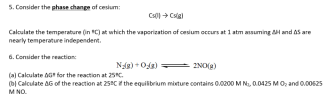 5. Consider the phase change of cesium: Cs(l)Cs(g) Calculate the temperature (in °C) at which the vaporization of cesium occurs at 1 atm assuming ΔΗ and AS are nearly temperature independent. 6. Consider the reaction N2(g) + 02(g) 2NO(g) (a) Calculate ΔG° for the reaction at 25°C. (b) Calculate AG of the reaction at 259C if the equilibrium mixture contains 0.0200 M N2, 0.0425 M O2 and 0.00625 M NO.
The charges and sizes of the ions in an ionic compound affect the strength of the...
 The charges and sizes of the ions in an ionic compound affect the strength of the electrostatic interaction between the ions and thus the strength of the lattice energy of the ionic compound. Arrange the compounds according to the magnitudes of their lattice energies based on the relative ion charges and sizes. Highest lattice energy MgO MgF, NaF КСІ Lowest lattice energy
The charges and sizes of the ions in an ionic compound affect the strength of the...
 The charges and sizes of the ions in an ionic compound affect the strength of the electrostatic interaction between the ions and thus the strength of the lattice energy of the ionic compound. Arrange the compounds according to the magnitudes of their lattice energies based on the relative ion charges and sizes. Highest lattice energy RbF Csi SrF2 Sro Lowest lattice energy
IN Calculate the ionic strength of 0.0092 M NaOH. М Calculate the ionic strength of 0.00034...
 IN Calculate the ionic strength of 0.0092 M NaOH. М Calculate the ionic strength of 0.00034 M La(I0). Assume complete dissociation at this low concentration and no hydrolysis reaction to form LaOH2+
estion 22 of 32 > Calculate the ionic strength of 0.0080 M NaOH. HE Calculate the...
 estion 22 of 32 > Calculate the ionic strength of 0.0080 M NaOH. HE Calculate the ionic strength of 0.00049 M La(10),. Assume complete dissociation at this low concentration and no hydrolysis reaction to form LaOH+.
Calculate the ionic strength of 0.0078 M NaOH Calculate the ionic strength of 0.00049 M La(IO,),....
 Calculate the ionic strength of 0.0078 M NaOH Calculate the ionic strength of 0.00049 M La(IO,),. Assume complete dissociation at this low concentration and no hydrolysis reaction to form LaOH2+. М
material science
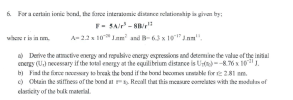 for certain ionic bond , the force interatomic distance relationship is given by F= 2A÷r^3-10B÷r^11 where r is in nm, A= 7.2*10^-20J and B=9.4*10^-25J. determine: a) the attractive energy, repulsive energy and the initial energy(U), necessary to from seperate ions if the total energy at the equilibrium distance is -8.5*10^-19J. b) find the force necessary to break the bond if the bond becomes unstable for r 0.31 nm c) find the modulus of Elasticity
When aluminum reacts with phosphorus to form an ionic compound, each metal atom loses electron(s) and...
When aluminum reacts with phosphorus to form an ionic compound, each metal atom loses electron(s) and each nonmetal atom gains electron(s). There must be aluminum atom(s) for every phosphorus atom(s) in the reaction. Enter the smallest integers possible. When cesium reacts with bromine to form an ionic compound, each metal atom loses electron(s) and each nonmetal atom gains electron(s). There must be cesium atom(s) for every bromine atom(s) in the reaction. Enter the smallest integers possible. Calculate the lattice energy...
1. For each compound given here, write what type of compound it is (molecular or ionic...
1. For each compound given here, write what type of compound it is (molecular or ionic or acid). (a) NH4Cl (b) AlH3 (c) O2 (d) CH4 (e) NH3 (f) H2O (g) PCl5 (h) SF4 (I) ClF3 (j) XeF2 (k) SF6 (l) BrF5 (m) XeF4 (o) CS2 (p) CH2Cl2 2. Write a chemical equation that goes with Lattice energy of CaCl2(s). 3. Draw the Lewis Dot structure of .. (a) Na (b) Cl (c) O-2 (d) Mg+2 4. What is the...
Calculate the quotient [HCO2-]/[HCO2H] at pH 3.744 if the ionic strength is 0.1M by using the...
Calculate the quotient [HCO2-]/[HCO2H] at pH 3.744 if the ionic strength is 0.1M by using the effective equilibrium constant listed for ionic strength = 0.1 Please show all work and explain. Thanks!
 5. Consider the phase change of cesium: Cs(l)Cs(g) Calculate the temperature (in °C) at which the vaporization of cesium occurs at 1 atm assuming ΔΗ and AS are nearly temperature independent. 6. Consider the reaction N2(g) + 02(g) 2NO(g) (a) Calculate ΔG° for the reaction at 25°C. (b) Calculate AG of the reaction at 259C if the equilibrium mixture contains 0.0200 M N2, 0.0425 M O2 and 0.00625 M NO.
 The charges and sizes of the ions in an ionic compound affect the strength of the electrostatic interaction between the ions and thus the strength of the lattice energy of the ionic compound. Arrange the compounds according to the magnitudes of their lattice energies based on the relative ion charges and sizes. Highest lattice energy MgO MgF, NaF КСІ Lowest lattice energy
 The charges and sizes of the ions in an ionic compound affect the strength of the electrostatic interaction between the ions and thus the strength of the lattice energy of the ionic compound. Arrange the compounds according to the magnitudes of their lattice energies based on the relative ion charges and sizes. Highest lattice energy RbF Csi SrF2 Sro Lowest lattice energy
 IN Calculate the ionic strength of 0.0092 M NaOH. М Calculate the ionic strength of 0.00034 M La(I0). Assume complete dissociation at this low concentration and no hydrolysis reaction to form LaOH2+
 estion 22 of 32 > Calculate the ionic strength of 0.0080 M NaOH. HE Calculate the ionic strength of 0.00049 M La(10),. Assume complete dissociation at this low concentration and no hydrolysis reaction to form LaOH+.
 Calculate the ionic strength of 0.0078 M NaOH Calculate the ionic strength of 0.00049 M La(IO,),. Assume complete dissociation at this low concentration and no hydrolysis reaction to form LaOH2+. М
Most questions answered within 3 hours.
-
Where is the error in this code sequence?
String s1 = "Hello";
String s2 = "ello";...
asked 10 months ago -
Financial data for Joel de Paris, Inc., for last year
follow:
Joel de Paris, Inc.
Balance...
asked 10 months ago -
Consider this reaction:
Al2(SO4)3 (aq)+ BaCl3
(aq) Al2Cl6 (aq)- +
3BaSO4(s) . What is the...
asked 10 months ago -
Suppose that Savneet is considering increasing her
recent random sample from 20 car rentals to 40...
asked 10 months ago -
Trucks arrive at an unloading terminal at an average rate of 120
per hour.
Trucks arrive...
asked 10 months ago -
Why are methanol and ethanol completely soluble in water while
octanol is not very little soluble....
asked 10 months ago -
A facilities manager at a university reads in a research report
that the mean amount of...
asked 10 months ago -
When the CuSO4 is rehydrated by adding water to the anhydrous
compound, is this an endothermic...
asked 10 months ago -
A ray of sunlight is passing from diamond into crown glass; the
angle of incidence is...
asked 10 months ago -
A block of mass 0.249 kg is placed on top of a light, vertical
spring of...
asked 10 months ago -
how do the kidneys compensate in the presences of acidosis
a) trigger hyperventilate
b) reserve acid...
asked 10 months ago -
Question 501 pts
The rental rate of capital to the firm increases. Which of the
following...
asked 10 months ago