
Homework Answers
For a valid probability distribution sum of probabilities must be equal to 1. Following table shows the calculations:
| X | Y | |Y-X| | c|Y-X| |
| -3 | -2 | 1 | 1c |
| -3 | -1 | 2 | 2c |
| -3 | 0 | 3 | 3c |
| -3 | 1 | 4 | 4c |
| -1 | -2 | 1 | 1c |
| -1 | -1 | 0 | 0 |
| -1 | 0 | 1 | 1c |
| -1 | 1 | 2 | 2c |
| 1 | -2 | 3 | 3c |
| 1 | -1 | 2 | 2c |
| 1 | 0 | 1 | 1c |
| 1 | 1 | 0 | 0 |
| 2 | -2 | 4 | 4c |
| 2 | -1 | 3 | 3c |
| 2 | 0 | 2 | 2c |
| 2 | 1 | 1 | 1c |
| Total | 30c |
For a valid probability distribution 30c must be equal to 1 so
30c = 1
c = 1/30
------------------------------------------
Following are the set of values for which X <= Y :
| X | Y | |Y-X| | c|Y-X| |
| -3 | -2 | 1 | 1c |
| -3 | -1 | 2 | 2c |
| -3 | 0 | 3 | 3c |
| -3 | 1 | 4 | 4c |
| -1 | -1 | 0 | 0 |
| -1 | 0 | 1 | 1c |
| -1 | 1 | 2 | 2c |
| 1 | 1 | 0 | 0 |
| Total | 13c |
Therefore,
Add Answer to:
2. Suppose that X and Y have a discrete joint distribution for which the joint p.f....
1. Let X and Y have a discrete joint distribution with ( P(X = x, Y = y) = {1, 10, if (x, y) = (-1,1) if x = y = 0 else...
 1. Let X and Y have a discrete joint distribution with ( P(X = x, Y = y) = {1, 10, if (x, y) = (-1,1) if x = y = 0 elsewhere Show that X and Y are uncorrelated but not independent. [5 points] 2. Let X and Y have a discrete joint distribution with f(-1,0) = 0, f(-1,1) = 1/4, f(0,0) = 1/6, f(0, 1) = 0, $(1,0) = 1/12, f(1,1) = 1/2. Show that (a) the two...
10. Let X and Y have a discrete joint distribution with if (x,y) = (-1,1) P(X...
 10. Let X and Y have a discrete joint distribution with if (x,y) = (-1,1) P(X = 2, Y = y) = { = ; if x=y=0 = 0, elsewhere Find (a) the conditional distribution of Y given X = -1. (b) show that X and Y are uncorrelated but not independent. (C) Find the marginal distributions of X and Y.
20. (8 points) Suppose X, Y, and Z are discrete random variables with joint probability mass...
 20. (8 points) Suppose X, Y, and Z are discrete random variables with joint probability mass function P(x, y, z) given below. Be sure to full justify your answers and show ALL work. P(0,0,0) = 2,3 P(0,0,1) 33 P(0,1,0) = P(1,0,0) = 32 P(1,0,1) = P(1,1,0) = 32 a. Find the marginal probability mass function for 2, pz(2). b. What is E[X | Y = 0]? P(0,1,1) = 4 P(1,1, 1) = 32
3. Let X and Y have a discrete joint distribution with Table 1: Joint discrete distribution...
 3. Let X and Y have a discrete joint distribution with Table 1: Joint discrete distribution of X and Y Values of Y -1 0 1 Values of X -1 1 į 0 1 1 0 -600-100 Then, find the following: • the marginal distribution of X; [2 points) • the marginal distribution of Y; [2 points] the conditional distribution of X given Y = -1; [2 points] Are X and Y are independent? Discuss with proper justification. (3 points)...
5. Suppose we have two random variables X and Y. They are discrete and have the...
 5. Suppose we have two random variables X and Y. They are discrete and have the exact same distribution and also independent. You see below the distribution of X which of course also the distribution of Y as well, that is what we called independent and identically distributed) P(X =- X. Remem- a./ (-) Find and draw the cumulative distribution function F() function of ber that F(x) -P(X S) HINT: For the next 3 parts you might want to make...
3. Suppose X, Y are discrete random variables taking values in -1,0,1) and their joint probability...
 3. Suppose X, Y are discrete random variables taking values in -1,0,1) and their joint probability mass function is 0 0 0 where a, b are two positive real numbers. (i) Find the values of a and b such that X and Y are uncorrelated (ii) Show that X and Y cannot be independent
3. Suppose X, Y are discrete random variables taking values in {-1,0,1) and their joint probability...
 3. Suppose X, Y are discrete random variables taking values in {-1,0,1) and their joint probability mass function is 0 X=1 where a, b are two positive real numbers. (i) Find the values of a and b such that X and Y are uncorrelated. (ii) Show that X and Y cannot be independent 0
Problem 47.18 Let X and Y be discrete random variables with joint distribution defined by the...
 Problem 47.18 Let X and Y be discrete random variables with joint distribution defined by the following table Y X 2 345 Py(y) 0.05 0.05 0.15 0.05 0.30 0.40 0 0.05 0.15 0.10 0 0.40 0.30 2 px(x 0.50 0.20 0.25 0.05 1 For this joint distribution, E(X) = 285, E(Y) = 1 . Calculate Coy(X,Y)
1) Suppose that three random variables, X, Y, and Z have a continuous joint probability density...
 1) Suppose that three random variables, X, Y, and Z have a continuous joint probability density function f(x, y. z) elsewhere a) Determine the value of the constant b) Find the marginal joint p. d. fof X and Y, namely f(x, y) (3 Points) c) Using part b), compute the conditional probability of Z given X and Y. That is, find f (Z I x y) d) Using the result from part c), compute P(Z<0.5 x - 3 Points) 2...
(50 points) Suppose that the joint p.d.f. of X and Y is as follows: for x...
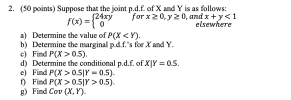 (50 points) Suppose that the joint p.d.f. of X and Y is as follows: for x 2 0, y 2 0, and x + y <1 elsewhere 2. 24xy f(x)0 a) Determine the value of P(X < Y). b) Determine the marginal p.d.f.'s for Xand Y c) Find P(X> 0.5) d) Determine the conditional p.d.f. of X|Y = 0.5 e) Find P(X> 0.5|Y 0.5) f) Find P(X> 0.5|Y> 0.5) g) Find Cov (X, Y)
 1. Let X and Y have a discrete joint distribution with ( P(X = x, Y = y) = {1, 10, if (x, y) = (-1,1) if x = y = 0 elsewhere Show that X and Y are uncorrelated but not independent. [5 points] 2. Let X and Y have a discrete joint distribution with f(-1,0) = 0, f(-1,1) = 1/4, f(0,0) = 1/6, f(0, 1) = 0, $(1,0) = 1/12, f(1,1) = 1/2. Show that (a) the two...
 10. Let X and Y have a discrete joint distribution with if (x,y) = (-1,1) P(X = 2, Y = y) = { = ; if x=y=0 = 0, elsewhere Find (a) the conditional distribution of Y given X = -1. (b) show that X and Y are uncorrelated but not independent. (C) Find the marginal distributions of X and Y.
 20. (8 points) Suppose X, Y, and Z are discrete random variables with joint probability mass function P(x, y, z) given below. Be sure to full justify your answers and show ALL work. P(0,0,0) = 2,3 P(0,0,1) 33 P(0,1,0) = P(1,0,0) = 32 P(1,0,1) = P(1,1,0) = 32 a. Find the marginal probability mass function for 2, pz(2). b. What is E[X | Y = 0]? P(0,1,1) = 4 P(1,1, 1) = 32
 3. Let X and Y have a discrete joint distribution with Table 1: Joint discrete distribution of X and Y Values of Y -1 0 1 Values of X -1 1 į 0 1 1 0 -600-100 Then, find the following: • the marginal distribution of X; [2 points) • the marginal distribution of Y; [2 points] the conditional distribution of X given Y = -1; [2 points] Are X and Y are independent? Discuss with proper justification. (3 points)...
 5. Suppose we have two random variables X and Y. They are discrete and have the exact same distribution and also independent. You see below the distribution of X which of course also the distribution of Y as well, that is what we called independent and identically distributed) P(X =- X. Remem- a./ (-) Find and draw the cumulative distribution function F() function of ber that F(x) -P(X S) HINT: For the next 3 parts you might want to make...
 3. Suppose X, Y are discrete random variables taking values in -1,0,1) and their joint probability mass function is 0 0 0 where a, b are two positive real numbers. (i) Find the values of a and b such that X and Y are uncorrelated (ii) Show that X and Y cannot be independent
 3. Suppose X, Y are discrete random variables taking values in {-1,0,1) and their joint probability mass function is 0 X=1 where a, b are two positive real numbers. (i) Find the values of a and b such that X and Y are uncorrelated. (ii) Show that X and Y cannot be independent 0
 Problem 47.18 Let X and Y be discrete random variables with joint distribution defined by the following table Y X 2 345 Py(y) 0.05 0.05 0.15 0.05 0.30 0.40 0 0.05 0.15 0.10 0 0.40 0.30 2 px(x 0.50 0.20 0.25 0.05 1 For this joint distribution, E(X) = 285, E(Y) = 1 . Calculate Coy(X,Y)
 1) Suppose that three random variables, X, Y, and Z have a continuous joint probability density function f(x, y. z) elsewhere a) Determine the value of the constant b) Find the marginal joint p. d. fof X and Y, namely f(x, y) (3 Points) c) Using part b), compute the conditional probability of Z given X and Y. That is, find f (Z I x y) d) Using the result from part c), compute P(Z<0.5 x - 3 Points) 2...
 (50 points) Suppose that the joint p.d.f. of X and Y is as follows: for x 2 0, y 2 0, and x + y <1 elsewhere 2. 24xy f(x)0 a) Determine the value of P(X < Y). b) Determine the marginal p.d.f.'s for Xand Y c) Find P(X> 0.5) d) Determine the conditional p.d.f. of X|Y = 0.5 e) Find P(X> 0.5|Y 0.5) f) Find P(X> 0.5|Y> 0.5) g) Find Cov (X, Y)
Most questions answered within 3 hours.
-
Where is the error in this code sequence?
String s1 = "Hello";
String s2 = "ello";...
asked 10 months ago -
Financial data for Joel de Paris, Inc., for last year
follow:
Joel de Paris, Inc.
Balance...
asked 10 months ago -
Consider this reaction:
Al2(SO4)3 (aq)+ BaCl3
(aq) Al2Cl6 (aq)- +
3BaSO4(s) . What is the...
asked 10 months ago -
Suppose that Savneet is considering increasing her
recent random sample from 20 car rentals to 40...
asked 10 months ago -
Trucks arrive at an unloading terminal at an average rate of 120
per hour.
Trucks arrive...
asked 10 months ago -
Why are methanol and ethanol completely soluble in water while
octanol is not very little soluble....
asked 10 months ago -
A facilities manager at a university reads in a research report
that the mean amount of...
asked 10 months ago -
When the CuSO4 is rehydrated by adding water to the anhydrous
compound, is this an endothermic...
asked 10 months ago -
A ray of sunlight is passing from diamond into crown glass; the
angle of incidence is...
asked 10 months ago -
A block of mass 0.249 kg is placed on top of a light, vertical
spring of...
asked 10 months ago -
how do the kidneys compensate in the presences of acidosis
a) trigger hyperventilate
b) reserve acid...
asked 10 months ago -
Question 501 pts
The rental rate of capital to the firm increases. Which of the
following...
asked 10 months ago