
Homework Answers
1) a. The reaction of nitric acid with Cu gives toxic NO2 gas. Therefore we must carry out oxidation in fume hood to avoid inhaling of this gas.
b.) 3 M H2SO4 is a powerful toxic oxidant. In order to prevent eye, skin and clothing contact, it should be handled with care.
2) a. Decant: it is a laboratory process to separate mixtures.decanting is just allowing solid - liquid mixture to settle and separate by gravity.
b.) Filtrate: The product of filtration; a gas or liquid that has been passed through filter is known as filtrate.
c.) Supernatant liquid: The clear liquid that lies above the solid residue after centrifugation, precipitation, crystallization or settling known as supernatant liquid.
Add Answer to:
name 1. Briefly doscribe Pre-Laboratory Assignment 3. Write the chemical equation(s) for each part the experimet,...
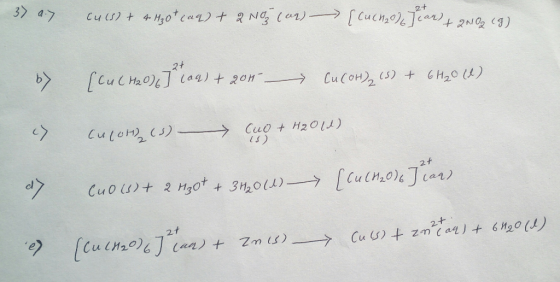
3. Write the chemical equation(s) for each part of the experiment, as outlined in Equation 1....
 3. Write the chemical equation(s) for each part of the experiment, as outlined in Equation 1. Cu(s) a) Part 1, Cu(H20).]2+ (aq) (b) Part 1 Cu(OH),(s) () Part 1, CuO(s) [Cu(H20)]2+ (aq) () Part Y Cu(s) (d) Part IV (Eq. 1)
Balance the equation for the reaction observed: _ Cu(s) + HNO3(aq) → Cu(NO3)2(aq) +_ NO2(g) + H2O(1) 3. Add 40 mL...
 Balance the equation for the reaction observed: _ Cu(s) + HNO3(aq) → Cu(NO3)2(aq) +_ NO2(g) + H2O(1) 3. Add 40 mL of 3.0 M NaOH (sodium hydroxide) to the solution in your beaker. Write the balanced equation for the reaction observed: 4. Add 2-3 boiling chips to your beaker and carefully heat the solution, while stirring with a stirring rod, just to the boiling point. (Do NOT boil. Have a low flame and keep the beaker well above the flame.)...
PRE-LABORATORY QUESTIONS NAME: 1. According to the experimental procedure written above which cation in your sample...
 PRE-LABORATORY QUESTIONS NAME: 1. According to the experimental procedure written above which cation in your sample should be identified first if it is indeed in the sample? 2. In what phase is the first cation supposed to be identified, in solid or liquid phase? And in what color? 3. According to the experimental procedure written above which cation in your sample should be identified second if it is indeed in the sample? 4. In what phase is the second cation...
Reactions and Neutralization in the Copper Cycle A Cycle of Chemical Reactions of Copper PRE-LABORATORY ASSIGNMENT...
 Reactions and Neutralization in the Copper Cycle
A Cycle of Chemical Reactions of Copper PRE-LABORATORY ASSIGNMENT Finish the pre-laboratory assignments before the laboratory experiment. Read the manual of this experiment and complete the following questions. 1. a. Identify oxidation-reduction reactions in the copper cycle experiment. For each oxidation-reduction reaction, write half reactions to show what is oxidized and what is reduced. Identify acid-base reactions and precipitation reactions in the copper cycle experi- ment. Write equations for the corresponding reactions. b....
Reactions and Neutralization in the Copper Cycle
A Cycle of Chemical Reactions of Copper PRE-LABORATORY ASSIGNMENT Finish the pre-laboratory assignments before the laboratory experiment. Read the manual of this experiment and complete the following questions. 1. a. Identify oxidation-reduction reactions in the copper cycle experiment. For each oxidation-reduction reaction, write half reactions to show what is oxidized and what is reduced. Identify acid-base reactions and precipitation reactions in the copper cycle experi- ment. Write equations for the corresponding reactions. b....
Lab 14 Studying Boyle's Low Rashara Derden Oll W 19 Pre-Laboratory Assignment 1. Briefly answer the...
 Lab 14 Studying Boyle's Low Rashara Derden Oll W 19 Pre-Laboratory Assignment 1. Briefly answer the following questions: (a) Describe what you will do with the acetone rinses you collect while drying your flask after measuring its volume. (b) Describe why you must wash your hands with soap or detergent before leaving the laboratory after you complete this experiment. 2. In this experiment, you will study Boyle's law. (a) Briefly state, in words, Boyle's law. (b) Identify the gas you...
PRE- LAB QUESTIONS NAME: 1. Write a balanced chemical equation for the reaction of aluminum metal...
 PRE- LAB QUESTIONS NAME: 1. Write a balanced chemical equation for the reaction of aluminum metal with hydrochloric acid. UAL TI3 3H2 ZAltaHCI od bw 2. Use the equation above to calculate the mass of aluminum that is needed to prepare between mL of hydrogen gas. The laboratory temperature is 22.0°C and the barometric pressure is 760.0 tor. 966 04m570 =0.0227 Pu K AT D.032 24S K 3. Calculate the minimum volume of 6.0 M HCI that you will need...
CATION ANALYSIS PRE-LABORATORY QUESTIONS Name Date Drawer No. 1. What are the cation symbols and names...
 CATION ANALYSIS PRE-LABORATORY QUESTIONS Name Date Drawer No. 1. What are the cation symbols and names by group of the cations you will be studying? Group 2: copper (cu) Group 3: Icon Ife nicke (N) Batium(Ba3) Calciun (ca Group 4: 2. Study the chemistry used to precipitate Cu2" and Ni?". Notice the similarity. What is the chief difference in the procedures to separate each of these cations from the original mixture? Cu adding ste of the solution tower Shift left...
Show work as well Your T. A.'s Name Lab meeting time Your Name Pre-Laboratory Assignment (Part...
 Show work as well
Your T. A.'s Name Lab meeting time Your Name Pre-Laboratory Assignment (Part 3) 1. A student determined percent of Br in a sample of an unknown bromide gravimetrically by dissolving 1.691 of solid unknown in water, adding excess of AgNO, and precipitating AgBr. He obtained 3.450 g of AgBr. Using these data, calculate % bromide in the unknown. (Give set-up and numerical answer. If you use more than one step in your calculations, show all work.)...
Show work as well
Your T. A.'s Name Lab meeting time Your Name Pre-Laboratory Assignment (Part 3) 1. A student determined percent of Br in a sample of an unknown bromide gravimetrically by dissolving 1.691 of solid unknown in water, adding excess of AgNO, and precipitating AgBr. He obtained 3.450 g of AgBr. Using these data, calculate % bromide in the unknown. (Give set-up and numerical answer. If you use more than one step in your calculations, show all work.)...
Experiment 6 PRE-LABORATORY PROBLEMS NAME 1. Write a purpose statement and a summary of the procedure...
 Experiment 6 PRE-LABORATORY PROBLEMS NAME 1. Write a purpose statement and a summary of the procedure to include special technique equipment, chemicals, and chemical reactions to be performed, an understanding of any calculations that are important to understanding the procedure. 2. Calculate the molar mass of copper (II) Sulfate pentahydrate, Cuso,5H.O. 3. Calculate the mass percent of water present in Copper(II) sulfate pentahydrate. 4. Define the term hydrate and anhydrous. S. A 2.000 gram sample of hydrated barium carbonate was...
Pre-Laboratory Assignment 1. Briefly describe the hazards associated with us ing the following (1) concentrated NH,...
 Pre-Laboratory Assignment 1. Briefly describe the hazards associated with us ing the following (1) concentrated NH, solution 3. We can prepare the yellow coordination compound potassium tris(oxalato rhodate(lll), KIRh(,0)), by reacting potassiumn hexachlororhodatelli), KIRCI. and potassium oxalate, K 0,04 (1) Balance the chemical equation for this reac- tion, shown below. K(RhCi (aq) + K C20 (aq) → K[Rh(C2O4)3 (s. yellow) + KCl(aq) (2) If we combine 1 mol of KIRhClel with 1 mol of K C204, which compound is the...
 3. Write the chemical equation(s) for each part of the experiment, as outlined in Equation 1. Cu(s) a) Part 1, Cu(H20).]2+ (aq) (b) Part 1 Cu(OH),(s) () Part 1, CuO(s) [Cu(H20)]2+ (aq) () Part Y Cu(s) (d) Part IV (Eq. 1)
 Balance the equation for the reaction observed: _ Cu(s) + HNO3(aq) → Cu(NO3)2(aq) +_ NO2(g) + H2O(1) 3. Add 40 mL of 3.0 M NaOH (sodium hydroxide) to the solution in your beaker. Write the balanced equation for the reaction observed: 4. Add 2-3 boiling chips to your beaker and carefully heat the solution, while stirring with a stirring rod, just to the boiling point. (Do NOT boil. Have a low flame and keep the beaker well above the flame.)...
 PRE-LABORATORY QUESTIONS NAME: 1. According to the experimental procedure written above which cation in your sample should be identified first if it is indeed in the sample? 2. In what phase is the first cation supposed to be identified, in solid or liquid phase? And in what color? 3. According to the experimental procedure written above which cation in your sample should be identified second if it is indeed in the sample? 4. In what phase is the second cation...
 Reactions and Neutralization in the Copper Cycle
A Cycle of Chemical Reactions of Copper PRE-LABORATORY ASSIGNMENT Finish the pre-laboratory assignments before the laboratory experiment. Read the manual of this experiment and complete the following questions. 1. a. Identify oxidation-reduction reactions in the copper cycle experiment. For each oxidation-reduction reaction, write half reactions to show what is oxidized and what is reduced. Identify acid-base reactions and precipitation reactions in the copper cycle experi- ment. Write equations for the corresponding reactions. b....
Reactions and Neutralization in the Copper Cycle
A Cycle of Chemical Reactions of Copper PRE-LABORATORY ASSIGNMENT Finish the pre-laboratory assignments before the laboratory experiment. Read the manual of this experiment and complete the following questions. 1. a. Identify oxidation-reduction reactions in the copper cycle experiment. For each oxidation-reduction reaction, write half reactions to show what is oxidized and what is reduced. Identify acid-base reactions and precipitation reactions in the copper cycle experi- ment. Write equations for the corresponding reactions. b....
 Lab 14 Studying Boyle's Low Rashara Derden Oll W 19 Pre-Laboratory Assignment 1. Briefly answer the following questions: (a) Describe what you will do with the acetone rinses you collect while drying your flask after measuring its volume. (b) Describe why you must wash your hands with soap or detergent before leaving the laboratory after you complete this experiment. 2. In this experiment, you will study Boyle's law. (a) Briefly state, in words, Boyle's law. (b) Identify the gas you...
 PRE- LAB QUESTIONS NAME: 1. Write a balanced chemical equation for the reaction of aluminum metal with hydrochloric acid. UAL TI3 3H2 ZAltaHCI od bw 2. Use the equation above to calculate the mass of aluminum that is needed to prepare between mL of hydrogen gas. The laboratory temperature is 22.0°C and the barometric pressure is 760.0 tor. 966 04m570 =0.0227 Pu K AT D.032 24S K 3. Calculate the minimum volume of 6.0 M HCI that you will need...
 CATION ANALYSIS PRE-LABORATORY QUESTIONS Name Date Drawer No. 1. What are the cation symbols and names by group of the cations you will be studying? Group 2: copper (cu) Group 3: Icon Ife nicke (N) Batium(Ba3) Calciun (ca Group 4: 2. Study the chemistry used to precipitate Cu2" and Ni?". Notice the similarity. What is the chief difference in the procedures to separate each of these cations from the original mixture? Cu adding ste of the solution tower Shift left...
 Show work as well
Your T. A.'s Name Lab meeting time Your Name Pre-Laboratory Assignment (Part 3) 1. A student determined percent of Br in a sample of an unknown bromide gravimetrically by dissolving 1.691 of solid unknown in water, adding excess of AgNO, and precipitating AgBr. He obtained 3.450 g of AgBr. Using these data, calculate % bromide in the unknown. (Give set-up and numerical answer. If you use more than one step in your calculations, show all work.)...
Show work as well
Your T. A.'s Name Lab meeting time Your Name Pre-Laboratory Assignment (Part 3) 1. A student determined percent of Br in a sample of an unknown bromide gravimetrically by dissolving 1.691 of solid unknown in water, adding excess of AgNO, and precipitating AgBr. He obtained 3.450 g of AgBr. Using these data, calculate % bromide in the unknown. (Give set-up and numerical answer. If you use more than one step in your calculations, show all work.)...
 Experiment 6 PRE-LABORATORY PROBLEMS NAME 1. Write a purpose statement and a summary of the procedure to include special technique equipment, chemicals, and chemical reactions to be performed, an understanding of any calculations that are important to understanding the procedure. 2. Calculate the molar mass of copper (II) Sulfate pentahydrate, Cuso,5H.O. 3. Calculate the mass percent of water present in Copper(II) sulfate pentahydrate. 4. Define the term hydrate and anhydrous. S. A 2.000 gram sample of hydrated barium carbonate was...
 Pre-Laboratory Assignment 1. Briefly describe the hazards associated with us ing the following (1) concentrated NH, solution 3. We can prepare the yellow coordination compound potassium tris(oxalato rhodate(lll), KIRh(,0)), by reacting potassiumn hexachlororhodatelli), KIRCI. and potassium oxalate, K 0,04 (1) Balance the chemical equation for this reac- tion, shown below. K(RhCi (aq) + K C20 (aq) → K[Rh(C2O4)3 (s. yellow) + KCl(aq) (2) If we combine 1 mol of KIRhClel with 1 mol of K C204, which compound is the...
Most questions answered within 3 hours.
-
Where is the error in this code sequence?
String s1 = "Hello";
String s2 = "ello";...
asked 10 months ago -
Financial data for Joel de Paris, Inc., for last year
follow:
Joel de Paris, Inc.
Balance...
asked 10 months ago -
Consider this reaction:
Al2(SO4)3 (aq)+ BaCl3
(aq) Al2Cl6 (aq)- +
3BaSO4(s) . What is the...
asked 10 months ago -
Suppose that Savneet is considering increasing her
recent random sample from 20 car rentals to 40...
asked 10 months ago -
Trucks arrive at an unloading terminal at an average rate of 120
per hour.
Trucks arrive...
asked 10 months ago -
Why are methanol and ethanol completely soluble in water while
octanol is not very little soluble....
asked 10 months ago -
A facilities manager at a university reads in a research report
that the mean amount of...
asked 10 months ago -
When the CuSO4 is rehydrated by adding water to the anhydrous
compound, is this an endothermic...
asked 10 months ago -
A ray of sunlight is passing from diamond into crown glass; the
angle of incidence is...
asked 10 months ago -
A block of mass 0.249 kg is placed on top of a light, vertical
spring of...
asked 10 months ago -
how do the kidneys compensate in the presences of acidosis
a) trigger hyperventilate
b) reserve acid...
asked 10 months ago -
Question 501 pts
The rental rate of capital to the firm increases. Which of the
following...
asked 10 months ago