3. A pendulum is released from an initial height 83.0 cm (a) above its lowest point....
3. A pendulum is released from an initial height 83.0 cm (a) above its lowest point. It then swings down to its lowest point (b), where it contacts a horizontal rod that interrupts its motion and causes it to swing upward with a new radius, as shown below. The highest point it can swing to is 78.2 cm (c). What will be its speed at tha point?
Homework Answers
Here ,
for the speed at the lowest point
before the collision ,
u = sqrt(2 * g * h)
u = sqrt(2 * 9.8 * 0.83)
u = 4.03 m/s
after the collision
speed , v = sqrt(2 g * h2)
v = sqrt(2 * 9.8 * 0.782)
v = 3.915 m/s
the velocity at that point after collision is 3.915 m/s
Add Answer to:
3. A pendulum is released from an initial height 83.0 cm (a)
above its lowest point....
Alice launches a pendulum from a point that is a height h above the lowest point...
Alice launches a pendulum from a point that is a height h above the lowest point by giving the bob an initial velocity directed upward along the trajectory. Bob decides to launch the pendulum from the same position at the same speed but directed downward along the trajectory. Whose launch will cause the pendulum to reach a higher highest point? Briefly explain your answer.
This question refers to the Post Pendulum exercise we did in Laboratory(see Figure below). Suppos...
 This question refers to the Post Pendulum exercise we did in Laboratory(see Figure below). Suppose the pendulum is 108 cm long, and it swings from a hook that is 110 cm above the table. A thin horizontal rod is placed 18.0 cm above the table so that it will cause the pendulum string to hit it and wrap around it when the pendulum reaches it lowest point. The pendulum ball has a mass of 120 g. Assume the rod is...
the height above the ground of a child on a swing varies from 0.5m at the lowest point to 2.0m at the highest point
the height above the ground of a child on a swing varies from 0.5m at the lowest point to 2.0m at the highest point. what is the maximum speed of the child?
A bullet of mass 8 g is fired into a 1.2 kg ballistic pendulum (a block...
 A bullet of mass 8 g is fired into a 1.2 kg ballistic pendulum (a block of wood acting as the pendulum bob of a thin metal arm attached to a low friction pivot point) that is initially at rest. The bullet exits the block of wood with a speed of 180 m/s and the wooden block swings from its lowest point to a maximum height of 9.2 cm above that location. Determine the velocity of the bullet before it...
Introduction: In this activity a ball is suspended by a piece of string above the floor....
 Introduction: In this activity a ball is suspended by a piece of string above the floor. The ball swings back and forth as if it were a pendulum. You wll find a mathematical model which represents the position of the ball with respect to time. We are going to ignore resistance, which would have an impact on the maximum height of the ball over time. I. Collecting the data: One student started the ball swinging back and forth as if...
1)The string in the figure is L = 100.0 cm long, and the distance d to...
1)The string in the figure is L = 100.0 cm long, and the distance d to the fixed peg at point P is 62.5 cm. When the initially stationary ball is released with the string horizontal as shown, it will swing along the dashed arc. What is its speed when it reaches its lowest point 2)What is its speed when it reaches its highest point after the string catches on the peg 3) A constant force of 45.5 N, directed...
mg mg sin Here it is assumed that the mass is released with zero velocity at an initial angle, 0 < α < π. We would like to determine the equation of motion for the pendulum and its period of os...
 mg mg sin Here it is assumed that the mass is released with zero velocity at an initial angle, 0 < α < π. We would like to determine the equation of motion for the pendulum and its period of oscillation. Do the following. The period P of the pendulum is defined to be the time required for it to swing from one extreme to the other and back-that is, from α to-α and back to α. Show that the...
PART II: PE and KE At the lower center, turn the speed to “Slow”. At the left, drag the ruler to the KE/PE bar graph. Swing the pendulum so the total Energy Shows. Place ruler so that 5 cm is above the total energy bar. At this point the total should be 5
 PART II: PE and KEAt the lower center, turn the speed to “Slow”. At the left, drag the ruler to the KE/PE bar graph. Swing the pendulum so the total Energy Shows. Place ruler so that 5 cm is above the total energy bar. At this point the total should be 55 cm - 5 cm = 50 cm. Remember to subtract that 5 cm each time you take a reading. (Note: this needs to be altered depending upon the...
A block (can be treated as point particle) of mass m is released from a vertical...
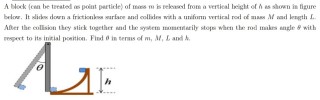 A block (can be treated as point particle) of mass m is released from a vertical height of h as shown in figure below. It slides down a frictionless surface and collides with a uniform vertical rod of mass M and length L After the collision they stick together and the system momentarily stops when the rod makes angle with respect to its initial position. Find ? in terms of m, M, L and h
An ideal spring dangles from the ceiling at its relaxed length of 5 cm. A 3-kg...
An ideal spring dangles from the ceiling at its relaxed length of 5 cm. A 3-kg mass is carefully hung from the end of the spring while the spring is relaxed, and then the mass is released from rest at time t = 0, which begins to stretch the spring. The spring stretches to its maximum length at time t = 130 ms when the mass reaches its lowest point. Then the mass returns upward, shortening the spring. The oscillation...
 This question refers to the Post Pendulum exercise we did in Laboratory(see Figure below). Suppose the pendulum is 108 cm long, and it swings from a hook that is 110 cm above the table. A thin horizontal rod is placed 18.0 cm above the table so that it will cause the pendulum string to hit it and wrap around it when the pendulum reaches it lowest point. The pendulum ball has a mass of 120 g. Assume the rod is...
 A bullet of mass 8 g is fired into a 1.2 kg ballistic pendulum (a block of wood acting as the pendulum bob of a thin metal arm attached to a low friction pivot point) that is initially at rest. The bullet exits the block of wood with a speed of 180 m/s and the wooden block swings from its lowest point to a maximum height of 9.2 cm above that location. Determine the velocity of the bullet before it...
 Introduction: In this activity a ball is suspended by a piece of string above the floor. The ball swings back and forth as if it were a pendulum. You wll find a mathematical model which represents the position of the ball with respect to time. We are going to ignore resistance, which would have an impact on the maximum height of the ball over time. I. Collecting the data: One student started the ball swinging back and forth as if...
 mg mg sin Here it is assumed that the mass is released with zero velocity at an initial angle, 0 < α < π. We would like to determine the equation of motion for the pendulum and its period of oscillation. Do the following. The period P of the pendulum is defined to be the time required for it to swing from one extreme to the other and back-that is, from α to-α and back to α. Show that the...
 A block (can be treated as point particle) of mass m is released from a vertical height of h as shown in figure below. It slides down a frictionless surface and collides with a uniform vertical rod of mass M and length L After the collision they stick together and the system momentarily stops when the rod makes angle with respect to its initial position. Find ? in terms of m, M, L and h
Most questions answered within 3 hours.
-
Where is the error in this code sequence?
String s1 = "Hello";
String s2 = "ello";...
asked 11 months ago -
Financial data for Joel de Paris, Inc., for last year
follow:
Joel de Paris, Inc.
Balance...
asked 11 months ago -
Consider this reaction:
Al2(SO4)3 (aq)+ BaCl3
(aq) Al2Cl6 (aq)- +
3BaSO4(s) . What is the...
asked 11 months ago -
Suppose that Savneet is considering increasing her
recent random sample from 20 car rentals to 40...
asked 11 months ago -
Trucks arrive at an unloading terminal at an average rate of 120
per hour.
Trucks arrive...
asked 11 months ago -
Why are methanol and ethanol completely soluble in water while
octanol is not very little soluble....
asked 11 months ago -
A facilities manager at a university reads in a research report
that the mean amount of...
asked 11 months ago -
When the CuSO4 is rehydrated by adding water to the anhydrous
compound, is this an endothermic...
asked 11 months ago -
A ray of sunlight is passing from diamond into crown glass; the
angle of incidence is...
asked 11 months ago -
A block of mass 0.249 kg is placed on top of a light, vertical
spring of...
asked 11 months ago -
how do the kidneys compensate in the presences of acidosis
a) trigger hyperventilate
b) reserve acid...
asked 11 months ago -
Question 501 pts
The rental rate of capital to the firm increases. Which of the
following...
asked 11 months ago