
Homework Answers
![oc DFs starting vert ex=1 [discovery 0 [002] final] Time 0 0,7) G4] Depth first seakan 0-~ ~ -0-0-](http://img.homeworklib.com/questions/cdbca110-26bb-11eb-9588-a5bdc383d385.png?x-oss-process=image/resize,w_560)
Add Answer to:
Perform a DFS on the following Graph. Tell the discovery time and the final time for...
Q2. Show the execution trace of DFS on the following directed graph. You must show discovery...
 Q2. Show the execution trace of DFS on the following directed graph. You must show discovery time v.d, finish time v.f, and the v.color for each node as the algorithm progresses. Indicate all tree edges, back edges, forward edges, and cross edges when the final DFS forest is constructed. Assume that the edges going out from a vertex are processed in alphabetical order and that each adjacency list is ordered alphabetically.
1 Graph Search Consider the following graph G. 1.1 Draw the DFS tree for G when...
 1 Graph Search Consider the following graph G. 1.1 Draw the DFS tree for G when starting in node 0. Assume that the adjacency lists are sorted in increasing order. Write the discovery and finish times for each node in the area marked by"_/_" next to each node. Solution:
PI) Given undirected graph answer the following questions: (30 points) (a) Show how a Breath-First Search...
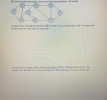 PI) Given undirected graph answer the following questions: (30 points) (a) Show how a Breath-First Search (BFS) works. Your starting node is B. You also need to show the discovery time for each node. (b) Given above graph, Apply Depth-First-Search (DFS), starting from node A. You should show the discovery time and return time (finishing time) on each of the node
b. (Weight: 15%) Perform DFS and BFS based on the following graph: - For BFS, provide...
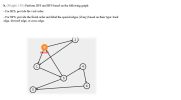 b. (Weight: 15%) Perform DFS and BFS based on the following graph: - For BFS, provide the visit order. - For DFS, provide the finish order and label the special edges (if any) based on their type: back edge, forward edge, or cross edge. Sduro
1. a. Using C++, represent the following graph using adjacency matrix, and implement DFS by using...
 1. a. Using C++, represent the following graph using adjacency matrix, and implement DFS by using stack (define it using class) to traverse the graph. b. Similarly, implement BFS (define queue using class) to traverse the graph c.When node 6 is printed, what numbers are in the stack (for DFS) and queue (for BFS) respectively? Draw pictures to show them.
1. a. Using C++, represent the following graph using adjacency matrix, and implement DFS by using stack (define it using...
1. a. Using C++, represent the following graph using adjacency matrix, and implement DFS by using stack (define it using class) to traverse the graph. b. Similarly, implement BFS (define queue using class) to traverse the graph c.When node 6 is printed, what numbers are in the stack (for DFS) and queue (for BFS) respectively? Draw pictures to show them.
1. a. Using C++, represent the following graph using adjacency matrix, and implement DFS by using stack (define it using...
Problem 2 [10 points] Depth-First Search Write inside each vertex in the following graph the discovery...
 Problem 2 [10 points] Depth-First Search Write inside each vertex in the following graph the discovery and finishing times in the format discovery/finish. Assume DFS considers the vertices in alphabetical order (A,B,C,....X,Y,Z), and assume that each adjacency list is ordered alphabetically W 1/ х у
ignore red marks. Thanks 10. (16) You will compute the strongly connected components of this graph...
 ignore red marks. Thanks
10. (16) You will compute the strongly connected components of this graph in three steps. a. STRONGLY-CONNECTED-COMPONENTS (G) (7) Perform a depth-first search on call DFS(G) to compute finishing times w/ for each vertex the following graph. (To make 2 compute GT this easier to grade, everyone call DFS(GT), but in the main loop of DFS, consider the vertices in order of decreasing wf (as computed in line 1) please start with vertex "a" and 4...
ignore red marks. Thanks
10. (16) You will compute the strongly connected components of this graph in three steps. a. STRONGLY-CONNECTED-COMPONENTS (G) (7) Perform a depth-first search on call DFS(G) to compute finishing times w/ for each vertex the following graph. (To make 2 compute GT this easier to grade, everyone call DFS(GT), but in the main loop of DFS, consider the vertices in order of decreasing wf (as computed in line 1) please start with vertex "a" and 4...
The DFSGraph uses a time attribute to note when a vertex is first encountered (discovery attribute)...
 The DFSGraph uses a time attribute to note when a vertex is first encountered (discovery attribute) in the depth-first search (dfs) and when a vertex is backtracked thro (finish attribute). Consider the prerequisite graph for the courses in Bob's Computer Science minor. CS 1410 CS 3470 CS 4400) CS 1510 CS 1510) CS 1520 C$ 1520) CS 2530 S 2530 from graph import Graph class DFSGraph(Graph): definit__(self): super() . _init_0 self. time = 0 def dfs (self): for aVertex in...
3. (8 points-7+1) Figure 4 shows an undirected graph G. Assume that the adjacency list lists the ...
 3. (8 points-7+1) Figure 4 shows an undirected graph G. Assume that the adjacency list lists the edges in alphabetical order. Figure 3: Graph for P3 (a) Apply depth first search (DFS) to graph G, and show the discovery and finish times of each vertex. In the main-loop of DFS, check the vertices in alphabetical the form dsc/fin, where dsc is the discovery time and fin is the finish time. (b) Draw the DFS tree obtained.
3. (8 points-7+1) Figure...
3. (8 points-7+1) Figure 4 shows an undirected graph G. Assume that the adjacency list lists the edges in alphabetical order. Figure 3: Graph for P3 (a) Apply depth first search (DFS) to graph G, and show the discovery and finish times of each vertex. In the main-loop of DFS, check the vertices in alphabetical the form dsc/fin, where dsc is the discovery time and fin is the finish time. (b) Draw the DFS tree obtained.
3. (8 points-7+1) Figure...
3. Given a directed graph G < V E >, we define its transpose Gr < V.E1 > to be the graph such tha...
 3. Given a directed graph G < V E >, we define its transpose Gr < V.E1 > to be the graph such that ET-{ < v, u >:< u, v >EE). In other words, GT has the same number of edges as in G, but the directions of the edges are reversed. Draw the transpose of the following graph: ta Perform DFS on the original graph G, and write down the start and finish times for each vertex in...
 Q2. Show the execution trace of DFS on the following directed graph. You must show discovery time v.d, finish time v.f, and the v.color for each node as the algorithm progresses. Indicate all tree edges, back edges, forward edges, and cross edges when the final DFS forest is constructed. Assume that the edges going out from a vertex are processed in alphabetical order and that each adjacency list is ordered alphabetically.
 1 Graph Search Consider the following graph G. 1.1 Draw the DFS tree for G when starting in node 0. Assume that the adjacency lists are sorted in increasing order. Write the discovery and finish times for each node in the area marked by"_/_" next to each node. Solution:
 PI) Given undirected graph answer the following questions: (30 points) (a) Show how a Breath-First Search (BFS) works. Your starting node is B. You also need to show the discovery time for each node. (b) Given above graph, Apply Depth-First-Search (DFS), starting from node A. You should show the discovery time and return time (finishing time) on each of the node
 b. (Weight: 15%) Perform DFS and BFS based on the following graph: - For BFS, provide the visit order. - For DFS, provide the finish order and label the special edges (if any) based on their type: back edge, forward edge, or cross edge. Sduro
 1. a. Using C++, represent the following graph using adjacency matrix, and implement DFS by using stack (define it using class) to traverse the graph. b. Similarly, implement BFS (define queue using class) to traverse the graph c.When node 6 is printed, what numbers are in the stack (for DFS) and queue (for BFS) respectively? Draw pictures to show them.
1. a. Using C++, represent the following graph using adjacency matrix, and implement DFS by using stack (define it using...
1. a. Using C++, represent the following graph using adjacency matrix, and implement DFS by using stack (define it using class) to traverse the graph. b. Similarly, implement BFS (define queue using class) to traverse the graph c.When node 6 is printed, what numbers are in the stack (for DFS) and queue (for BFS) respectively? Draw pictures to show them.
1. a. Using C++, represent the following graph using adjacency matrix, and implement DFS by using stack (define it using...
 Problem 2 [10 points] Depth-First Search Write inside each vertex in the following graph the discovery and finishing times in the format discovery/finish. Assume DFS considers the vertices in alphabetical order (A,B,C,....X,Y,Z), and assume that each adjacency list is ordered alphabetically W 1/ х у
 ignore red marks. Thanks
10. (16) You will compute the strongly connected components of this graph in three steps. a. STRONGLY-CONNECTED-COMPONENTS (G) (7) Perform a depth-first search on call DFS(G) to compute finishing times w/ for each vertex the following graph. (To make 2 compute GT this easier to grade, everyone call DFS(GT), but in the main loop of DFS, consider the vertices in order of decreasing wf (as computed in line 1) please start with vertex "a" and 4...
ignore red marks. Thanks
10. (16) You will compute the strongly connected components of this graph in three steps. a. STRONGLY-CONNECTED-COMPONENTS (G) (7) Perform a depth-first search on call DFS(G) to compute finishing times w/ for each vertex the following graph. (To make 2 compute GT this easier to grade, everyone call DFS(GT), but in the main loop of DFS, consider the vertices in order of decreasing wf (as computed in line 1) please start with vertex "a" and 4...
 The DFSGraph uses a time attribute to note when a vertex is first encountered (discovery attribute) in the depth-first search (dfs) and when a vertex is backtracked thro (finish attribute). Consider the prerequisite graph for the courses in Bob's Computer Science minor. CS 1410 CS 3470 CS 4400) CS 1510 CS 1510) CS 1520 C$ 1520) CS 2530 S 2530 from graph import Graph class DFSGraph(Graph): definit__(self): super() . _init_0 self. time = 0 def dfs (self): for aVertex in...
 3. (8 points-7+1) Figure 4 shows an undirected graph G. Assume that the adjacency list lists the edges in alphabetical order. Figure 3: Graph for P3 (a) Apply depth first search (DFS) to graph G, and show the discovery and finish times of each vertex. In the main-loop of DFS, check the vertices in alphabetical the form dsc/fin, where dsc is the discovery time and fin is the finish time. (b) Draw the DFS tree obtained.
3. (8 points-7+1) Figure...
3. (8 points-7+1) Figure 4 shows an undirected graph G. Assume that the adjacency list lists the edges in alphabetical order. Figure 3: Graph for P3 (a) Apply depth first search (DFS) to graph G, and show the discovery and finish times of each vertex. In the main-loop of DFS, check the vertices in alphabetical the form dsc/fin, where dsc is the discovery time and fin is the finish time. (b) Draw the DFS tree obtained.
3. (8 points-7+1) Figure...
 3. Given a directed graph G < V E >, we define its transpose Gr < V.E1 > to be the graph such that ET-{ < v, u >:< u, v >EE). In other words, GT has the same number of edges as in G, but the directions of the edges are reversed. Draw the transpose of the following graph: ta Perform DFS on the original graph G, and write down the start and finish times for each vertex in...
Most questions answered within 3 hours.
-
Where is the error in this code sequence?
String s1 = "Hello";
String s2 = "ello";...
asked 10 months ago -
Financial data for Joel de Paris, Inc., for last year
follow:
Joel de Paris, Inc.
Balance...
asked 10 months ago -
Consider this reaction:
Al2(SO4)3 (aq)+ BaCl3
(aq) Al2Cl6 (aq)- +
3BaSO4(s) . What is the...
asked 10 months ago -
Suppose that Savneet is considering increasing her
recent random sample from 20 car rentals to 40...
asked 10 months ago -
Trucks arrive at an unloading terminal at an average rate of 120
per hour.
Trucks arrive...
asked 10 months ago -
Why are methanol and ethanol completely soluble in water while
octanol is not very little soluble....
asked 10 months ago -
A facilities manager at a university reads in a research report
that the mean amount of...
asked 10 months ago -
When the CuSO4 is rehydrated by adding water to the anhydrous
compound, is this an endothermic...
asked 10 months ago -
A ray of sunlight is passing from diamond into crown glass; the
angle of incidence is...
asked 10 months ago -
A block of mass 0.249 kg is placed on top of a light, vertical
spring of...
asked 10 months ago -
how do the kidneys compensate in the presences of acidosis
a) trigger hyperventilate
b) reserve acid...
asked 10 months ago -
Question 501 pts
The rental rate of capital to the firm increases. Which of the
following...
asked 10 months ago