
Homework Answers

Add Answer to:
Problem 2. Show that for a step input, f(t) = 18(t), that the system is unstable.
2. (Chapter 2). A linear, time-invariant, continuous-time (LTIC) system with input f(t) and output y(t) is specified by the differential equation D2(D +1)y(t) (D - 3)f(t) Find the characteristic poly...
 2. (Chapter 2). A linear, time-invariant, continuous-time (LTIC) system with input f(t) and output y(t) is specified by the differential equation D2(D +1)y(t) (D - 3)f(t) Find the characteristic polynomial, characteristic equation, characteristic root(s), and characteristic mode(s) of this system. a. b. Is this system asymptotically stable, marginally stable, or unstable? Justify your answer.
2. (Chapter 2). A linear, time-invariant, continuous-time (LTIC) system with input f(t) and output y(t) is specified by the differential equation D2(D +1)y(t) (D - 3)f(t)...
2. (Chapter 2). A linear, time-invariant, continuous-time (LTIC) system with input f(t) and output y(t) is specified by the differential equation D2(D +1)y(t) (D - 3)f(t) Find the characteristic polynomial, characteristic equation, characteristic root(s), and characteristic mode(s) of this system. a. b. Is this system asymptotically stable, marginally stable, or unstable? Justify your answer.
2. (Chapter 2). A linear, time-invariant, continuous-time (LTIC) system with input f(t) and output y(t) is specified by the differential equation D2(D +1)y(t) (D - 3)f(t)...
Problem 24: (18 points) 1. (6 points) Figure 2 shows an RC circuit with input f(t)...
 Problem 24: (18 points) 1. (6 points) Figure 2 shows an RC circuit with input f(t) and output y(t) Function Generator R, v, (r) y1) Figure 2: RC circuit. (a) (1 point) Sketch the circuit in the phasor domain by replacing the capacitor with its impedance represen- (b) (3 points) Using circuit analysis techniques, show that the frequency response function is Specify the DC gain, K, and the time constant, T, in terms of the parameters R, R, and C...
Problem 4: Evaluation of the convolution integral too y(t) = (f * h)(t) = f(t)h(t –...
 Problem 4: Evaluation of the convolution integral too y(t) = (f * h)(t) = f(t)h(t – 7)dt is greatly simplified when either the input f(t) or impulse response h(t) is the sum of weighted impulse functions. This fact will be used later in the semester when we study the operation of communication systems using Fourier analysis methods. a) Use the convolution integral to prove that f(t) *8(t – T) = f(t – T) and 8(t – T) *h(t) = h(t...
Show ALL work. Include all units at every step. 2. For the system shown in the...
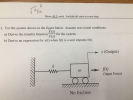 Show ALL work. Include all units at every step. 2. For the system shown in the figure below. Assume zero initial conditions. X(s) for the system. a) Derive the transfer function F(s) b) Derive an expression for x(t) when f(t) is a unit impulse 8(t). x(Output) f(t) (Input Force) ww No friction
Use Simulink to show the time responses of the following system from t-0 to 5 with a step function input: . 1 x12x1-2x2 +x2 + f ä2--x1 + 2x2-3x2 + 2x3 i3-3 +2x2-3x3 (a) Show the time responses gr...
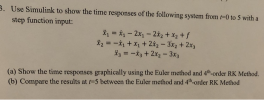 Use Simulink to show the time responses of the following system from t-0 to 5 with a step function input: . 1 x12x1-2x2 +x2 + f ä2--x1 + 2x2-3x2 + 2x3 i3-3 +2x2-3x3 (a) Show the time responses graphically using the Euler method and 4th-order RK Method. (b) Compare the results at t-5 between the Euler method and 4th-order RK Method
Use Simulink to show the time responses of the following system from t-0 to 5 with a step function...
Use Simulink to show the time responses of the following system from t-0 to 5 with a step function input: . 1 x12x1-2x2 +x2 + f ä2--x1 + 2x2-3x2 + 2x3 i3-3 +2x2-3x3 (a) Show the time responses graphically using the Euler method and 4th-order RK Method. (b) Compare the results at t-5 between the Euler method and 4th-order RK Method
Use Simulink to show the time responses of the following system from t-0 to 5 with a step function...
control system Q4) Figure (a) and Figure (b) below show a system with a unit-step input,...
 control system
Q4) Figure (a) and Figure (b) below show a system with a unit-step input, and the output time response respectively. From the response curve, determine the values of K and T shown in Figure (a)
control system
Q4) Figure (a) and Figure (b) below show a system with a unit-step input, and the output time response respectively. From the response curve, determine the values of K and T shown in Figure (a)
Problem 2 - System Representation: Input/Output (20pts) (2 For the following set of coupled differential equations: or...
 Problem 2 - System Representation: Input/Output (20pts) (2 For the following set of coupled differential equations: or the following set dx dt + F(t dt Find the input/output equation describing x, given the input force F(t).
Problem 2 - System Representation: Input/Output (20pts) (2 For the following set of coupled differential equations: or the following set dx dt + F(t dt Find the input/output equation describing x, given the input force F(t).
Problem 2 - System Representation: Input/Output (20pts) (2 For the following set of coupled differential equations: or the following set dx dt + F(t dt Find the input/output equation describing x, given the input force F(t).
If the input voltage, ein(t), of the following system is a unit step,
 If the input voltage, ein(t), of the following system is a unit step,
Problem 3. Consider an LTIC system S. whose response to the unit-step function u(t) is as...
 Problem 3. Consider an LTIC system S. whose response to the unit-step function u(t) is as follows Slu(t)] Moreover, let the following input signal (t) go through the same LTIC system: r(t) 3 -2 1 Can you sketch/compute the output y(t) of the LTIC system S] to the input r(t) without using the impulse-response function h(t) of the system? Justify your answer!
Consider an undamped system where the vector-matrix form of the system model is: [F(t) [18 07ž...
 Consider an undamped system where the vector-matrix form of the system model is: [F(t) [18 07ž Mx + Kx = 083, + [18000 -72007x -7200 8000X, E]-[] The input to the system is F(t) = 6300 sin (30t). Use modal decomposition to find the system's frequency response. Note that the frequency response is the particular solution, and also called the steady-state response.
 2. (Chapter 2). A linear, time-invariant, continuous-time (LTIC) system with input f(t) and output y(t) is specified by the differential equation D2(D +1)y(t) (D - 3)f(t) Find the characteristic polynomial, characteristic equation, characteristic root(s), and characteristic mode(s) of this system. a. b. Is this system asymptotically stable, marginally stable, or unstable? Justify your answer.
2. (Chapter 2). A linear, time-invariant, continuous-time (LTIC) system with input f(t) and output y(t) is specified by the differential equation D2(D +1)y(t) (D - 3)f(t)...
2. (Chapter 2). A linear, time-invariant, continuous-time (LTIC) system with input f(t) and output y(t) is specified by the differential equation D2(D +1)y(t) (D - 3)f(t) Find the characteristic polynomial, characteristic equation, characteristic root(s), and characteristic mode(s) of this system. a. b. Is this system asymptotically stable, marginally stable, or unstable? Justify your answer.
2. (Chapter 2). A linear, time-invariant, continuous-time (LTIC) system with input f(t) and output y(t) is specified by the differential equation D2(D +1)y(t) (D - 3)f(t)...
 Problem 24: (18 points) 1. (6 points) Figure 2 shows an RC circuit with input f(t) and output y(t) Function Generator R, v, (r) y1) Figure 2: RC circuit. (a) (1 point) Sketch the circuit in the phasor domain by replacing the capacitor with its impedance represen- (b) (3 points) Using circuit analysis techniques, show that the frequency response function is Specify the DC gain, K, and the time constant, T, in terms of the parameters R, R, and C...
 Problem 4: Evaluation of the convolution integral too y(t) = (f * h)(t) = f(t)h(t – 7)dt is greatly simplified when either the input f(t) or impulse response h(t) is the sum of weighted impulse functions. This fact will be used later in the semester when we study the operation of communication systems using Fourier analysis methods. a) Use the convolution integral to prove that f(t) *8(t – T) = f(t – T) and 8(t – T) *h(t) = h(t...
 Show ALL work. Include all units at every step. 2. For the system shown in the figure below. Assume zero initial conditions. X(s) for the system. a) Derive the transfer function F(s) b) Derive an expression for x(t) when f(t) is a unit impulse 8(t). x(Output) f(t) (Input Force) ww No friction
 Use Simulink to show the time responses of the following system from t-0 to 5 with a step function input: . 1 x12x1-2x2 +x2 + f ä2--x1 + 2x2-3x2 + 2x3 i3-3 +2x2-3x3 (a) Show the time responses graphically using the Euler method and 4th-order RK Method. (b) Compare the results at t-5 between the Euler method and 4th-order RK Method
Use Simulink to show the time responses of the following system from t-0 to 5 with a step function...
Use Simulink to show the time responses of the following system from t-0 to 5 with a step function input: . 1 x12x1-2x2 +x2 + f ä2--x1 + 2x2-3x2 + 2x3 i3-3 +2x2-3x3 (a) Show the time responses graphically using the Euler method and 4th-order RK Method. (b) Compare the results at t-5 between the Euler method and 4th-order RK Method
Use Simulink to show the time responses of the following system from t-0 to 5 with a step function...
 control system
Q4) Figure (a) and Figure (b) below show a system with a unit-step input, and the output time response respectively. From the response curve, determine the values of K and T shown in Figure (a)
control system
Q4) Figure (a) and Figure (b) below show a system with a unit-step input, and the output time response respectively. From the response curve, determine the values of K and T shown in Figure (a)
 Problem 2 - System Representation: Input/Output (20pts) (2 For the following set of coupled differential equations: or the following set dx dt + F(t dt Find the input/output equation describing x, given the input force F(t).
Problem 2 - System Representation: Input/Output (20pts) (2 For the following set of coupled differential equations: or the following set dx dt + F(t dt Find the input/output equation describing x, given the input force F(t).
Problem 2 - System Representation: Input/Output (20pts) (2 For the following set of coupled differential equations: or the following set dx dt + F(t dt Find the input/output equation describing x, given the input force F(t).
 If the input voltage, ein(t), of the following system is a unit step,
 Problem 3. Consider an LTIC system S. whose response to the unit-step function u(t) is as follows Slu(t)] Moreover, let the following input signal (t) go through the same LTIC system: r(t) 3 -2 1 Can you sketch/compute the output y(t) of the LTIC system S] to the input r(t) without using the impulse-response function h(t) of the system? Justify your answer!
 Consider an undamped system where the vector-matrix form of the system model is: [F(t) [18 07ž Mx + Kx = 083, + [18000 -72007x -7200 8000X, E]-[] The input to the system is F(t) = 6300 sin (30t). Use modal decomposition to find the system's frequency response. Note that the frequency response is the particular solution, and also called the steady-state response.
Most questions answered within 3 hours.
-
Where is the error in this code sequence?
String s1 = "Hello";
String s2 = "ello";...
asked 10 months ago -
Financial data for Joel de Paris, Inc., for last year
follow:
Joel de Paris, Inc.
Balance...
asked 10 months ago -
Consider this reaction:
Al2(SO4)3 (aq)+ BaCl3
(aq) Al2Cl6 (aq)- +
3BaSO4(s) . What is the...
asked 10 months ago -
Suppose that Savneet is considering increasing her
recent random sample from 20 car rentals to 40...
asked 10 months ago -
Trucks arrive at an unloading terminal at an average rate of 120
per hour.
Trucks arrive...
asked 10 months ago -
Why are methanol and ethanol completely soluble in water while
octanol is not very little soluble....
asked 10 months ago -
A facilities manager at a university reads in a research report
that the mean amount of...
asked 10 months ago -
When the CuSO4 is rehydrated by adding water to the anhydrous
compound, is this an endothermic...
asked 10 months ago -
A ray of sunlight is passing from diamond into crown glass; the
angle of incidence is...
asked 10 months ago -
A block of mass 0.249 kg is placed on top of a light, vertical
spring of...
asked 10 months ago -
how do the kidneys compensate in the presences of acidosis
a) trigger hyperventilate
b) reserve acid...
asked 10 months ago -
Question 501 pts
The rental rate of capital to the firm increases. Which of the
following...
asked 10 months ago