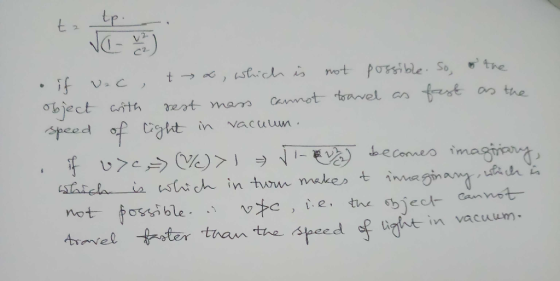
Using the equation: t = tp/(1 – v2/c2)1/2 show that an object with rest mass cannot...
Using the equation: t = tp/(1 – v2/c2)1/2 show that an object with rest mass cannot travel as fast as the speed of light in vacuum and cannot travel faster than the speed of light in vacuum. Show your work.
Homework Answers
Add Answer to:
Using the equation: t = tp/(1 – v2/c2)1/2 show
that an object with rest mass cannot...
Using the equation: t = tp/(1 – v2/c2)1/2 show that an object with rest mass cannot travel as fas...
Using the equation: t = tp/(1 – v2/c2)1/2 show that an object with rest mass cannot travel as fast as the speed of light in vacuum and cannot travel faster than the speed of light in vacuum. Show your work.
Question 3. With regard to the equation: t = tp/(1 – v2/c2)1/2 what does the result...
Question 3. With regard to the equation: t = tp/(1 – v2/c2)1/2 what does the result if v = c or v > c mean? a. nothing b. the speed of light in vacuum is a cosmic speed limit c. time travel to the distant future is possible d. undefined
An object with mass m is initially at rest at the origin z0. At time t-...
 An object with mass m is initially at rest at the origin z0. At time t- 0 it starts to accelerate with a changing accelerstion along the +z direction. At timet=Tit is at the point z-rr and its speed is measured ase(T)-vr. 3. How much work in done by the force to acelerate the object during the time interval 77
3. If the velocity function of an object is u(t)-C2-1) + (21+2) js , what is...
 3. If the velocity function of an object is u(t)-C2-1) + (21+2) js , what is the instantaneous speed of the object at t 2 4. If the position function of an object is ()(5t2) i+(-t+3t+1) js , what is the velocity of the object at t 4s in rectangular coordinates.
An object moves by an observer at 0.500 c (1/2 the speed of light).The relativistic mass...
An object moves by an observer at 0.500 c (1/2 the speed of light).The relativistic mass of the object will be what factor times that of the rest mass? a. 0.6 b. 0.97 c. 1.15 d. 1.67
Q22 v2. The path of an object is given by x = (t +4) and y=5t...
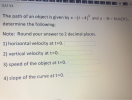 Q22 v2. The path of an object is given by x = (t +4) and y=5t + 6sin(2t), determine the following: Note: Round your answer to 2 decimal places. 1) horizontal velocity at t=0. 2) vertical velocity at t=0. 3) speed of the object at t=0. 4) slope of the curve at t=0.
2. The pion has an average lifetime of 26.0ns when at rest. For it to travel...
 2. The pion has an average lifetime of 26.0ns when at rest. For it to travel 10.0m, how fast must it move? Throughout this homework assignment, you may use e to denote the speed of light in both your work and final answers without using its numerical value. (This is actually preferred unless the problem requires the numerical value of e.)
Question 1 (2 points) Select all that are true. Using Maxwell's equations it is possible to show ...
 Special Relativity help
Question 1 (2 points) Select all that are true. Using Maxwell's equations it is possible to show that electromagnetic waves must travel at a constant speed (c 3x10 8 m/s) The only assumption needed for special relativity to work is for nothing in the universe to go faster than the speed of light. The only assumption needed for special relativity to work is for the speed of light to be a constant in the universe. Assuming the...
Special Relativity help
Question 1 (2 points) Select all that are true. Using Maxwell's equations it is possible to show that electromagnetic waves must travel at a constant speed (c 3x10 8 m/s) The only assumption needed for special relativity to work is for nothing in the universe to go faster than the speed of light. The only assumption needed for special relativity to work is for the speed of light to be a constant in the universe. Assuming the...
An object of mass m is connected to a light spring with a force constant of...
An object of mass m is connected to a light spring with a force constant of kH N/meter which oscillates on a frictionless horizontal surface with Simple Harmonic Motion. At t = 0 the spring was at rest but is compressed x = A meter maximum during oscillation. Write the equation of motion from Newton's 2nd law FH = m·a and Hook's Law FH = -kH·x. Because of the starting position assume a solution is x = A sin(ωt) a...
2. The theory of relativity is stated as the equation E = mc2 where: E energy m =mass speed of light A scientist has da...
 2. The theory of relativity is stated as the equation E = mc2 where: E energy m =mass speed of light A scientist has data for the speed of light and energy variables. What form of the equation should the scientist use to determine the mass of an object? O Words B IU T,
2. The theory of relativity is stated as the equation E = mc2 where: E energy m =mass speed of light A scientist has data for...
2. The theory of relativity is stated as the equation E = mc2 where: E energy m =mass speed of light A scientist has data for the speed of light and energy variables. What form of the equation should the scientist use to determine the mass of an object? O Words B IU T,
2. The theory of relativity is stated as the equation E = mc2 where: E energy m =mass speed of light A scientist has data for...
 An object with mass m is initially at rest at the origin z0. At time t- 0 it starts to accelerate with a changing accelerstion along the +z direction. At timet=Tit is at the point z-rr and its speed is measured ase(T)-vr. 3. How much work in done by the force to acelerate the object during the time interval 77
 3. If the velocity function of an object is u(t)-C2-1) + (21+2) js , what is the instantaneous speed of the object at t 2 4. If the position function of an object is ()(5t2) i+(-t+3t+1) js , what is the velocity of the object at t 4s in rectangular coordinates.
 Q22 v2. The path of an object is given by x = (t +4) and y=5t + 6sin(2t), determine the following: Note: Round your answer to 2 decimal places. 1) horizontal velocity at t=0. 2) vertical velocity at t=0. 3) speed of the object at t=0. 4) slope of the curve at t=0.
 2. The pion has an average lifetime of 26.0ns when at rest. For it to travel 10.0m, how fast must it move? Throughout this homework assignment, you may use e to denote the speed of light in both your work and final answers without using its numerical value. (This is actually preferred unless the problem requires the numerical value of e.)
 Special Relativity help
Question 1 (2 points) Select all that are true. Using Maxwell's equations it is possible to show that electromagnetic waves must travel at a constant speed (c 3x10 8 m/s) The only assumption needed for special relativity to work is for nothing in the universe to go faster than the speed of light. The only assumption needed for special relativity to work is for the speed of light to be a constant in the universe. Assuming the...
Special Relativity help
Question 1 (2 points) Select all that are true. Using Maxwell's equations it is possible to show that electromagnetic waves must travel at a constant speed (c 3x10 8 m/s) The only assumption needed for special relativity to work is for nothing in the universe to go faster than the speed of light. The only assumption needed for special relativity to work is for the speed of light to be a constant in the universe. Assuming the...
 2. The theory of relativity is stated as the equation E = mc2 where: E energy m =mass speed of light A scientist has data for the speed of light and energy variables. What form of the equation should the scientist use to determine the mass of an object? O Words B IU T,
2. The theory of relativity is stated as the equation E = mc2 where: E energy m =mass speed of light A scientist has data for...
2. The theory of relativity is stated as the equation E = mc2 where: E energy m =mass speed of light A scientist has data for the speed of light and energy variables. What form of the equation should the scientist use to determine the mass of an object? O Words B IU T,
2. The theory of relativity is stated as the equation E = mc2 where: E energy m =mass speed of light A scientist has data for...
Most questions answered within 3 hours.
-
Where is the error in this code sequence?
String s1 = "Hello";
String s2 = "ello";...
asked 10 months ago -
Financial data for Joel de Paris, Inc., for last year
follow:
Joel de Paris, Inc.
Balance...
asked 10 months ago -
Consider this reaction:
Al2(SO4)3 (aq)+ BaCl3
(aq) Al2Cl6 (aq)- +
3BaSO4(s) . What is the...
asked 10 months ago -
Suppose that Savneet is considering increasing her
recent random sample from 20 car rentals to 40...
asked 10 months ago -
Trucks arrive at an unloading terminal at an average rate of 120
per hour.
Trucks arrive...
asked 10 months ago -
Why are methanol and ethanol completely soluble in water while
octanol is not very little soluble....
asked 10 months ago -
A facilities manager at a university reads in a research report
that the mean amount of...
asked 10 months ago -
When the CuSO4 is rehydrated by adding water to the anhydrous
compound, is this an endothermic...
asked 10 months ago -
A ray of sunlight is passing from diamond into crown glass; the
angle of incidence is...
asked 10 months ago -
A block of mass 0.249 kg is placed on top of a light, vertical
spring of...
asked 10 months ago -
how do the kidneys compensate in the presences of acidosis
a) trigger hyperventilate
b) reserve acid...
asked 10 months ago -
Question 501 pts
The rental rate of capital to the firm increases. Which of the
following...
asked 10 months ago