n the figure two large, thin metal plates are parallel and close to each other. On...
n the figure two large, thin metal plates are parallel and close to each other. On their inner faces, the plates have excess surface charge densities of opposite signs and magnitude 7.52
Homework Answers
Wow! 7.52*10^-22 C/m^2 is an extremely small charge! Taking into account that the charge of an electron is approximately 1.6*10^(-19) C, the charge density you list would mean that on average there is only one excess electron per 320 m^2 on the negatively charged plate! This hardly warrants using the continuum approximation below (one would need to assume the electron charge is quantum mechanically delocalized uniformly over the plate ), but I will approach the problem along that classical line anyway...
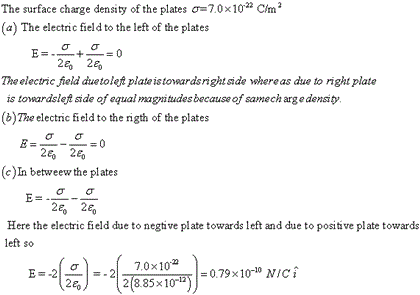
Hence in betweeen the plates,
E = -?/2e0 - ?/2e0 = -?/e0
= 7.5*10^-22 / 8.85*10^-12 = 0.85*10^-10
The electric field of an infinite plane charge density is
independent from the distance (E = sigma/eps0).
Because the charge densities on the plates are equal in magnitude
but of opposite charge, there is no net field outside the plates.
Between the plates the field lines point from the positive charge
density to the negative charge density, hence horizontally to the
left (c. 4)
Note that because there is no E field outside the plates, there is
no determined direction (what would be the direction of a vector of
zero length...?) Hence outside the plates the most appropriate
answer listed in (a) and (b) would be 6. Undetermined.
Add Answer to:
n the figure two large, thin metal plates are parallel and close
to each other. On...
In the figure two large, thin metal plates are parallel and close to each other. On...
 In the figure two large, thin metal plates are parallel and
close to each other. On their inner faces, the plates have excess
surface charge densities of opposite signs and magnitude 6.73 ×
10-22 C/m2. What is the magnitude of the electric field at points
(a) to the left of the plates, (b) to the right of them, and (c)
between them?
+ + + + + + + + TTTTTTTTTT
In the figure two large, thin metal plates are parallel and
close to each other. On their inner faces, the plates have excess
surface charge densities of opposite signs and magnitude 6.73 ×
10-22 C/m2. What is the magnitude of the electric field at points
(a) to the left of the plates, (b) to the right of them, and (c)
between them?
+ + + + + + + + TTTTTTTTTT
In the figure below, two large thin metal plates are parallel and close to each other....
 In the figure below, two large thin metal plates are parallel and close to each other. On their inner faces, the plates have excess surface charge densities of opposite signs and of magnitude 6.90 x 10⁻²² C/m2. (Express your answer in vector form.) (a) What is the electric field at points to the left of the plates? (b) What is the electric field at points to the right of the plates? (c) What is the electric field at points between...
Question 5 In the figure two large, thin metal plates are parallel and close to each...
 Question 5 In the figure two large, thin metal plates are parallel and close to each other. On their inner faces, the plates have excess surface charge densities of opposite signs and magnitude 8.22 × 10⁻²² C/m2. what is the magnitude of the electric field at points (a) to the left of the plates, (b) to the right of them, and (c) between them? (a) Number (b) Number (c) Number Units Units Units
12. In the figure two large, thin insulate plates are parallel and close to each other....
 12. In the figure two large, thin insulate plates are parallel and close to each other. They have surface charge densities of opposite signs and magnitude 8.40 x 10 C/m2. Find the magnitude of the electric field at points between them
-3 points HRW1d 23P o33 My Note 10 22 cm2 In the figure below, two large...
 -3 points HRW1d 23P o33 My Note 10 22 cm2 In the figure below, two large thin metal plates are parallel and close to each other on their inner faces, the plates have excess surface charge densities (Express your answer in vector form.) opposite signs and of magnitude 8 60 (a) What is the electric field at points to the left of the plates? N/C (b) What is the electric field at points to the right of the plates? N/C...
Two large metal plates of area 0.7m2 face each other. They are 5.2 cm apart and...
Two large metal plates of area 0.7m2 face each other. They are 5.2 cm apart and have equal but opposite chargeson their inner surfaces. If the magnitude E of theelectric field between the plates is 53 N/C, what is the magnitude of the charge oneach plate? Neglect edge effects.
Two square metal plates are placed parallel to each other, separated by a distance d= 2.28...
Two square metal plates are placed parallel to each other, separated by a distance d= 2.28 cm. The plates have sides of length L = 0.690 m. One of the plates has charge Q= + 2.34×10⁻⁶ C, while the other plate has charge -Q. Calculate the magnitude of the electric field between the plates, not close to the edge, i.e., assume a uniform surface charge distribution.
Two large metal plates of area 1.3 m2 face each other, 3.9 cm apart, with equal...
Two large metal plates of area 1.3 m2 face each other, 3.9 cm apart, with equal charge magnitudes but opposite signs. The field magnitude E between them (neglect fringing) is 66 N/C. Find |q|.
Two very large thin conducting plates with the same magnitude charge, but opposite sign, are held...
 Two very large thin conducting plates with the same magnitude charge, but opposite sign, are held near each other. The plates are large enough and close enough together that fringing effects near the edges can be ignored (that is results of the Gauss' law for "infinite" plate apply) The two plates are a distance D apart. The surface area of the face of each plate is A, the total charge on each plate is and -o, and the resulting uniform...
2. Two large metal sheets each having an area of 1 m2 face one another, are...
 2. Two large metal sheets each having an area of 1 m2 face one another, are separated by a distance of 1.0 cm, and carry equal and opposite charge densities on their inner surfaces. If the electric field between the plates is 50 N/C what is the charge on each plate?
 In the figure two large, thin metal plates are parallel and
close to each other. On their inner faces, the plates have excess
surface charge densities of opposite signs and magnitude 6.73 ×
10-22 C/m2. What is the magnitude of the electric field at points
(a) to the left of the plates, (b) to the right of them, and (c)
between them?
+ + + + + + + + TTTTTTTTTT
In the figure two large, thin metal plates are parallel and
close to each other. On their inner faces, the plates have excess
surface charge densities of opposite signs and magnitude 6.73 ×
10-22 C/m2. What is the magnitude of the electric field at points
(a) to the left of the plates, (b) to the right of them, and (c)
between them?
+ + + + + + + + TTTTTTTTTT
 In the figure below, two large thin metal plates are parallel and close to each other. On their inner faces, the plates have excess surface charge densities of opposite signs and of magnitude 6.90 x 10⁻²² C/m2. (Express your answer in vector form.) (a) What is the electric field at points to the left of the plates? (b) What is the electric field at points to the right of the plates? (c) What is the electric field at points between...
 Question 5 In the figure two large, thin metal plates are parallel and close to each other. On their inner faces, the plates have excess surface charge densities of opposite signs and magnitude 8.22 × 10⁻²² C/m2. what is the magnitude of the electric field at points (a) to the left of the plates, (b) to the right of them, and (c) between them? (a) Number (b) Number (c) Number Units Units Units
 12. In the figure two large, thin insulate plates are parallel and close to each other. They have surface charge densities of opposite signs and magnitude 8.40 x 10 C/m2. Find the magnitude of the electric field at points between them
 -3 points HRW1d 23P o33 My Note 10 22 cm2 In the figure below, two large thin metal plates are parallel and close to each other on their inner faces, the plates have excess surface charge densities (Express your answer in vector form.) opposite signs and of magnitude 8 60 (a) What is the electric field at points to the left of the plates? N/C (b) What is the electric field at points to the right of the plates? N/C...
 Two very large thin conducting plates with the same magnitude charge, but opposite sign, are held near each other. The plates are large enough and close enough together that fringing effects near the edges can be ignored (that is results of the Gauss' law for "infinite" plate apply) The two plates are a distance D apart. The surface area of the face of each plate is A, the total charge on each plate is and -o, and the resulting uniform...
 2. Two large metal sheets each having an area of 1 m2 face one another, are separated by a distance of 1.0 cm, and carry equal and opposite charge densities on their inner surfaces. If the electric field between the plates is 50 N/C what is the charge on each plate?
Most questions answered within 3 hours.
-
Where is the error in this code sequence?
String s1 = "Hello";
String s2 = "ello";...
asked 10 months ago -
Financial data for Joel de Paris, Inc., for last year
follow:
Joel de Paris, Inc.
Balance...
asked 10 months ago -
Consider this reaction:
Al2(SO4)3 (aq)+ BaCl3
(aq) Al2Cl6 (aq)- +
3BaSO4(s) . What is the...
asked 10 months ago -
Suppose that Savneet is considering increasing her
recent random sample from 20 car rentals to 40...
asked 10 months ago -
Trucks arrive at an unloading terminal at an average rate of 120
per hour.
Trucks arrive...
asked 10 months ago -
Why are methanol and ethanol completely soluble in water while
octanol is not very little soluble....
asked 10 months ago -
A facilities manager at a university reads in a research report
that the mean amount of...
asked 10 months ago -
When the CuSO4 is rehydrated by adding water to the anhydrous
compound, is this an endothermic...
asked 10 months ago -
A ray of sunlight is passing from diamond into crown glass; the
angle of incidence is...
asked 10 months ago -
A block of mass 0.249 kg is placed on top of a light, vertical
spring of...
asked 10 months ago -
how do the kidneys compensate in the presences of acidosis
a) trigger hyperventilate
b) reserve acid...
asked 10 months ago -
Question 501 pts
The rental rate of capital to the firm increases. Which of the
following...
asked 10 months ago